
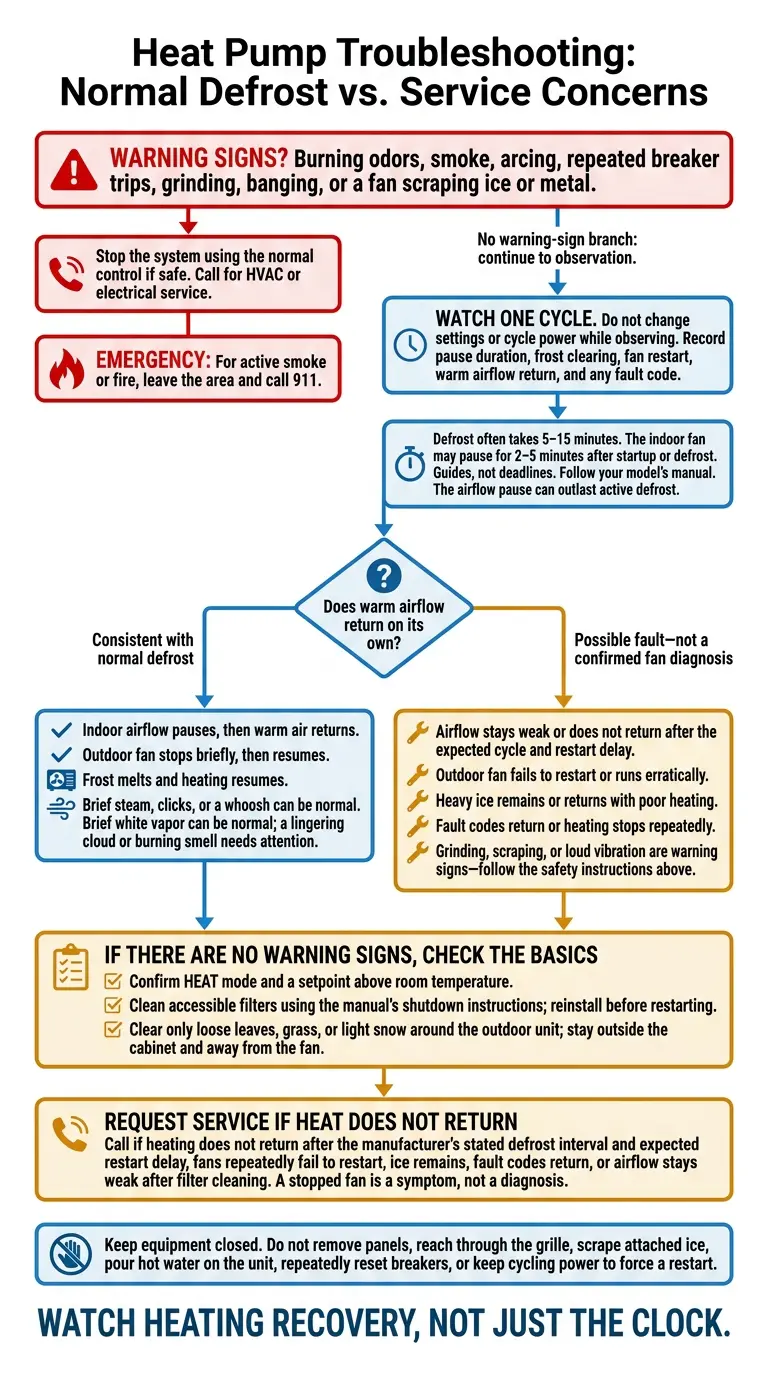
A heating pause doesn’t always mean a broken fan. I’d watch one cycle first: defrost often takes 5–15 minutes, but your model’s manual sets the expected timing. The best clue is whether warm airflow returns on its own.
Here’s what I’d check:
- Normal defrost: Airflow pauses, the outdoor fan stops, frost melts, and heat returns. Brief steam, clicks, or a whoosh can be normal.
- Possible fault: Airflow stays weak, fans fail to restart, heavy ice remains, or fault codes return. These signs need professional mini split repair – not a guess about which part failed.
- Safe next steps: Confirm Heat mode and a setpoint above room temperature. Clean accessible filters using the manual’s shutdown steps. Don’t open panels, scrape ice, or keep cycling power.
- Stop signs: Burning smells, grinding, arcing, or repeated breaker trips mean stop the system if safe and call for help. For active smoke or fire, leave and call 911.
Quick Comparison
| Clue | Normal defrost | Possible fan problem |
|---|---|---|
| Indoor airflow | Pauses, then warm air returns | Stays weak or doesn’t return |
| Outdoor fan | Stops briefly, then resumes | Fails to restart or runs erratically |
| Ice | Melts during the cycle | Remains or returns with poor heating |
| Sounds | Brief clicks or whooshing | Grinding, scraping, or loud vibration |
| Heating | Returns automatically | Stays weak or stops repeatedly |
My rule: <u>watch heating recovery, not just the clock</u>. In Chicagoland’s cold, damp weather, defrost is expected – but heat that doesn’t return after the manual’s stated interval calls for service.
Mini-Split Defrost or Fan Problem? Safe Heat-Mode Checks
Why Your Heat Pump Isn’t Defrosting
Normal Defrost Signs and Timing
In Heat mode, moisture can freeze on the outdoor coil during damp, near-freezing weather. Defrost briefly reverses refrigerant flow to melt the ice.
Airflow Pauses, Outdoor Steam, and Brief Clicks
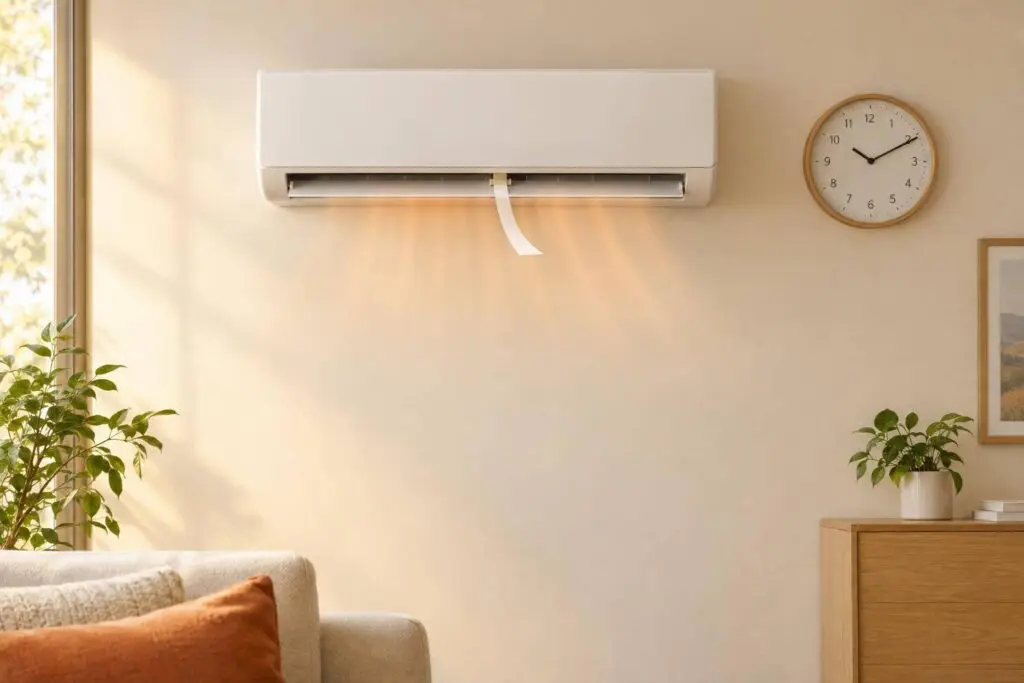
During defrost, the indoor fan may stop and its louvers may stay still. The outdoor fan also stops, but the compressor keeps running. You may see meltwater or hear a brief whoosh or click as the reversing valve switches.
A brief white cloud is usually water vapor from the warming coil. If the cloud lingers, you smell burning, or you hear grinding or repeated loud clicking, shut the system down if safe and call for service. Normal heating returns after defrost and any built-in indoor-fan restart delay. If heat returns on its own, the pause was normal defrost.
Why Defrost Often Takes About 5–15 Minutes
Five to 15 minutes is a guide, not a hard limit. The unit’s controls end active defrost based on a coil temperature target, a programmed time limit, or other control logic. Afterward, the indoor fan may wait for the indoor coil to warm up. That means the airflow pause can outlast active defrost. Check your manual for the defrost cycle timing and indoor-fan delay.
Weather, frost buildup, equipment design, sensors, and control settings all affect timing. Coil cleanliness, airflow, refrigerant charge, and installation also affect how fast the coil clears. Damp, near-freezing weather usually builds frost faster than very cold, dry air, so defrost may take longer.
If heat does not return after the expected delay, the pause is no longer normal defrost and calls for heat pump fan troubleshooting.
Signs of Persistent Fan Problems
A stopped fan is a symptom, not a diagnosis. Pay attention when airflow doesn’t return after the normal startup or defrost delay, or when the unit keeps stopping while the room is still below the set temperature. Check the restart delay first: indoor airflow should return after startup or defrost.
Indoor Fan: Weak Airflow or Failure to Restart
The indoor fan may pause for 2–5 minutes after startup or defrost. Check your unit’s manual for the expected timing. Once that delay passes, weak airflow, failure to restart, or running at only one speed points to a problem. Check whether warm air returns, too.
Start by checking the filter and intake path. If airflow remains weak or comes and goes after restart, note how long it lasts, whether the louvers move, and any fault code. Buzzing, grinding, rattling, or repeated failed starts call for service. Do not open the cabinet or reach into moving parts.
If the indoor fan restarts but heating remains poor, check the outdoor unit next.
Outdoor Fan: Ice Buildup or Poor Heating
Call for service if the outdoor fan stays stopped after heating should resume. Watch for repeated failed starts, shutdowns, fault codes, or ice that keeps building back up. Light frost alone isn’t the same warning sign.
These symptoms won’t tell you which part has failed. Leave diagnosis and repair to a technician. Before calling for service, check the basic settings and filters.
Defrost vs. Fan Failure: Heat-Mode Clues
Watch the full cycle, not just one clue. Warm airflow returning on its own points to defrost. If airflow stays weak or stops, suspect a fan problem.
Use these patterns to tell a normal defrost pause from a possible fan problem.
| Clue | Normal Defrost | Potential Fan Failure |
|---|---|---|
| Indoor airflow | Pauses or weakens, then warm airflow returns. | Stays weak or does not return after the cycle. |
| Outdoor fan | Stops during defrost, then resumes normal operation. | Does not restart normally or runs erratically. |
| Ice clearing | Frost melts and heating resumes. | Heavy ice remains or returns quickly, with poor heating. |
| Sounds | Brief clicks or whooshing. | Grinding, scraping, or loud vibration. |
| Heating recovery | Warm airflow returns automatically. | Heat stays weak, never returns, or stops repeatedly. |
Five to 15 minutes is a guide, not a deadline. Outdoor temperature, humidity, frost load, coil condition, and control logic all affect how long defrost lasts. Some models end defrost based on coil temperature rather than a fixed timer. If heat still does not return, move to basic checks. If you are unsure how to proceed, professional heat pump services in Crest Hill, IL can help diagnose the issue.
Before checking settings and filters, note when the pause began, how long it lasted, and whether warm airflow returned.
Safe Checks and When to Call for Service
Watch 1 Cycle, Then Check Settings and Filters
If the pause still seems like defrost, check the basics before assuming the fan has a fault. Unless warning signs appear, watch one cycle without changing settings or cycling power. Record the outdoor temperature and conditions, how long the pause lasts, whether the coil clears, whether the fan restarts, when heat returns, and any fault code.
Then confirm the unit is in HEAT mode with a higher setpoint. Clean the accessible filters, following the manual’s shutdown instructions first. Reinstall the filters before restarting the unit.
Clear only loose leaves, grass, or light snow from around the outdoor unit. Keep your hands outside the cabinet and away from the fan. Do not remove panels, reach through the grille, scrape ice, or pour hot water on the unit. Leave attached ice alone.
If heat still doesn’t return, use the service guidance below.
Request Service if Heating Does Not Return
Request service if heat doesn’t return after the manufacturer’s stated defrost interval. Also call if fans repeatedly fail to restart, ice remains, fault codes return, or airflow stays weak after you clean the filters. Do not keep cycling power to force a restart.
Eco Temp HVAC provides mini-split diagnosis and repair in Chicagoland.
Stop for Electrical or Mechanical Warning Signs
If you notice burning odors, smoke, arcing, repeated breaker trips, grinding, banging, or a fan scraping ice or metal, stop the system using the normal control if safe and call for HVAC or electrical service.
Keep the equipment closed. Do not repeatedly reset breakers, touch damaged wiring, or reach toward moving parts. For active smoke or fire, leave the area and call 911.
Conclusion: Judge the Pause by Heating Recovery
Judge the pause by whether heat returns, not how long it lasts. Pauses, steam, and brief clicks can be normal during defrost when heating resumes on its own. If heat doesn’t return, suspect a fan problem. Persistent ice, recurring fault codes, unusual noise, or failure to resume heating calls for professional mini split service.
Weather, frost buildup, and controls affect defrost timing, so 5–15 minutes is only a guide. Follow your model’s operating instructions and check that it returns to steady heating.
FAQs
How often should my mini-split defrost in damp weather?
In damp, freezing weather, mini-splits typically run a defrost cycle every 30–90 minutes, with each cycle lasting 5–15 minutes. The timing depends on the weather and equipment. During defrost, the indoor fan may stop or blow air that feels neither warm nor cool. That’s usually normal.
Defrost cycles that happen every 10 minutes or less or last 20 minutes or more aren’t normal. They often point to a faulty defrost sensor/thermistor, low refrigerant, or a control-board issue.
Can my mini-split have a fault if both fans run?
Yes. Running fans suggest the fan motors work, but your mini-split could still have a refrigerant leak, a faulty compressor or control board, or airflow blocked by dirty coils or clogged filters.
Have a technician inspect the system if you notice weak airflow, unusual grinding or clicking noises, or poor heating or cooling – even when the fans are running.
What if my manual doesn’t list a defrost time?
If your manual doesn’t list a defrost time, use this as a guide: in freezing weather, mini-splits typically pause airflow for 5–15 minutes during defrost. These cycles usually repeat every 30–90 minutes, though timing depends on the weather and equipment. Clicks, popping sounds, and steam can be normal.
Schedule a professional diagnosis if defrost cycles occur every 10 minutes or less, last 20 minutes or longer, or leave the outdoor coil coated in thick ice.