
Yes – sometimes. If I pay more for a high-SEER2 air conditioner, I may cut my summer power bill, but the total money saved depends on four things: the extra install cost, how many hours the AC runs, my electric rate, and how long I keep the property.
Here’s the short answer in plain English:
- A higher SEER2 rating means the system uses less electricity for the same cooling.
- In Chicagoland, the cooling season is shorter, so payback can take years.
- A jump from SEER2 14 to 18 may save about $82 per year for a 3-ton system running about 800 cooling hours at $0.18/kWh.
- If that upgrade costs $1,200 more, simple payback is about 14 to 15 years.
- If I move soon, already have a decent system, or don’t run the AC much, a moderate-efficiency unit may cost less overall.
- A bad install can cut performance hard. Even a high-rated unit can lose up to 20% of its cooling efficiency if refrigerant charge is off.
That’s the core idea: high-SEER2 can lower bills, but it does not always mean lower long-term cost.
| What I need to check | Why it matters |
|---|---|
| Extra upfront cost | This is the amount the energy savings must pay back |
| Cooling hours | More runtime usually means more yearly savings |
| Electric rate | Higher power prices make efficiency matter more |
| Current system age/efficiency | Replacing an old 10–13 SEER unit often saves more |
| Time in the property | If I sell early, I may not recover the extra cost |
| Install quality | Poor sizing, airflow, ducts, or charge can wipe out savings |
Bottom line: I’d compare two full quotes – one moderate-efficiency option and one high-SEER2 option – then use the after-rebate price difference to check payback and total cost over time.
SEER vs. Cost: Is a High-Efficiency AC Worth It?
sbb-itb-b5c10b1
How to Calculate Long-Term Savings
High-SEER2 vs Moderate-SEER2 AC: Cost, Savings & Payback Comparison
SEER2 savings come down to three things: annual energy use, electricity cost, and the extra installed cost of the higher-efficiency system.
Basic Formula for Energy Cost and Payback
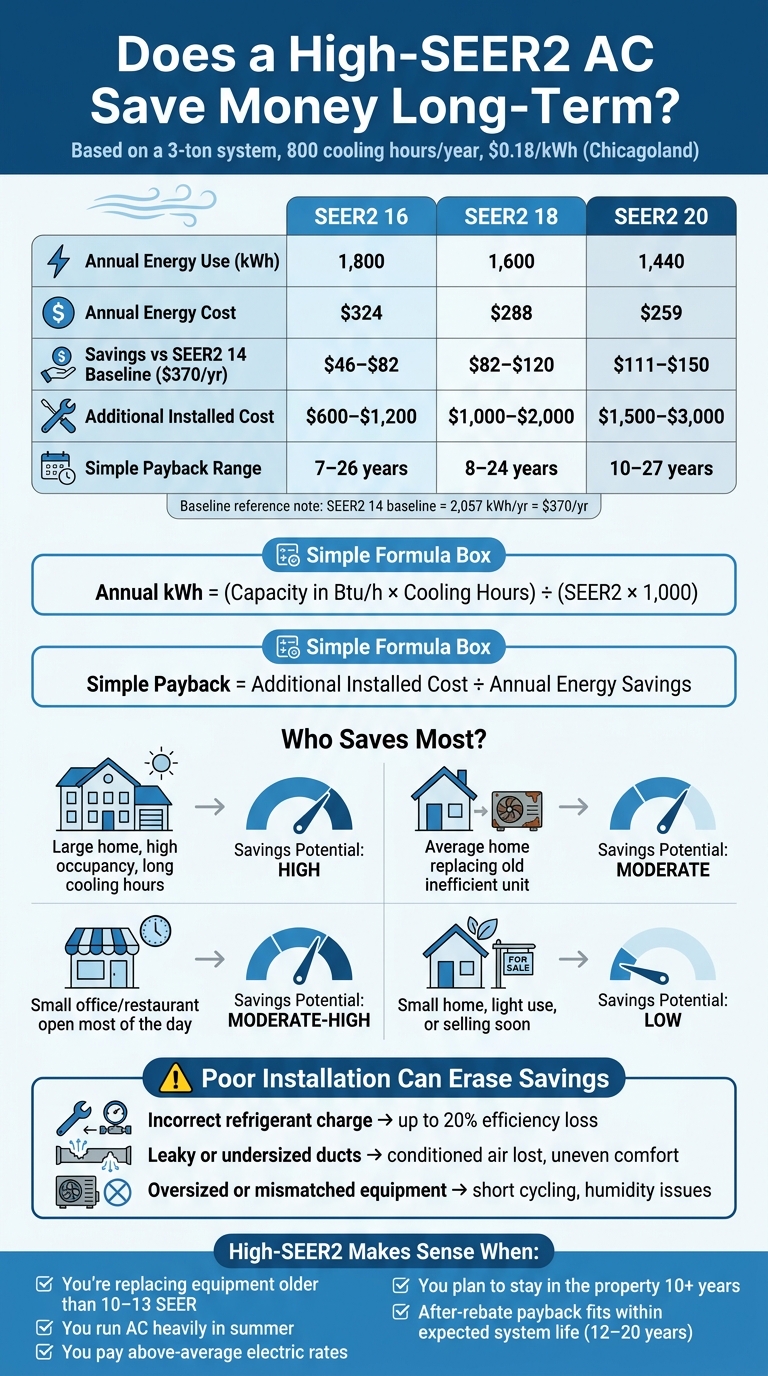
Start with annual cooling energy use. To estimate it, divide the system’s cooling capacity in Btu/h multiplied by estimated annual cooling hours by the SEER2 rating times 1,000:
Annual kWh = (Cooling capacity in Btu/h × Cooling hours) ÷ (SEER2 × 1,000)
Here’s what that looks like in practice. For a 3-ton system, or 36,000 Btu/h, running 800 equivalent full-load cooling hours, annual cost falls from about $370 at SEER2 14 to about $288 at SEER2 18. That’s roughly $82 per year in savings at Illinois’s average residential rate of $0.18 per kWh.
Simple payback shows how long it takes to earn back the efficiency premium. Use only the added installed cost.
Simple payback = Additional installed cost ÷ Annual energy savings
So if the higher-SEER2 system costs $1,200 more to install, and yearly savings are $82, the payback lands at about 14 to 15 years. That smaller yearly savings gap is common in Chicagoland, where cooling hours are limited.
Simple payback is a good starting point, but it doesn’t tell the whole story. Total ownership cost also includes installation, energy, maintenance, repairs, and rebates. Professional cooling services can help ensure these factors are optimized for your specific home. And the estimate only means anything if the comparison is apples to apples.
What a Fair Comparison Should Include
Looking at condenser sticker prices by themselves can throw the math off. A fair estimate compares complete, matched systems with the same cooling capacity and the same job scope, including:
- Outdoor unit
- Indoor coil
- Air handler or furnace
- Thermostat
- Permits and labor
Use the AHRI-rated matched combination, not just the outdoor unit’s label.
Comparison Table: Installed Cost, Annual Savings, and Payback
The table below shows how the numbers shift as efficiency goes up. These are estimates, not guarantees. Actual installed prices, savings, and service life can change based on equipment brand, local labor rates, duct conditions, and usage habits.
| Baseline SEER2 | Proposed SEER2 | Annual kWh: baseline / proposed | Annual cost: baseline / proposed | Additional installed cost | Est. yearly savings | Simple payback range | Expected service life |
|---|---|---|---|---|---|---|---|
| 14 | 16 | 2,057 / 1,800 | $370 / $324 | $600–$1,200 | $46–$82 | 7–26 years | ~12–20 years |
| 14 | 18 | 2,057 / 1,600 | $370 / $288 | $1,000–$2,000 | $82–$120 | 8–24 years | ~12–20 years |
| 14 | 20 | 2,057 / 1,440 | $370 / $259 | $1,500–$3,000 | $111–$150 | 10–27 years | ~12–20 years |
Use the table as a planning range, not a guarantee. It helps to run a low, middle, and high case for electricity prices and cooling hours so you can see the likely spread. Also, subtract rebates and tax credits from the added installed cost before you calculate payback.
Who Saves Most and How Climate Affects the Result
Those payback numbers get better or worse based on one simple thing: how much the system actually runs. The fastest payback usually shows up when cooling demand is high, the jump in efficiency is meaningful, and the owner stays put long enough to earn back the added upfront cost.
Homes and Small Businesses Most Likely to Save
The best fit is often a property replacing an older, lower-efficiency unit. Moving from a worn 10- to 13-SEER system to a properly matched 16- or 18-SEER2 system can cut electricity use for the same amount of cooling. That said, actual savings still come down to system size, ductwork, and runtime. A larger home with more people inside, heavy sun exposure, or weak attic insulation often saves more because the system runs longer. More runtime means each efficiency gain has more chances to pay off.
Small businesses with long daily hours can also make a strong case. Restaurants, salons, retail shops, and offices often run cooling for much of the day, so the math tends to look better.
Illinois residential electricity averaged about 17.7¢/kWh, and commercial electricity averaged about 13.7¢/kWh, based on the cited July 2025 EIA data. If you’re paying near the top of that range, every kilowatt-hour you don’t use matters more.
When Payback Takes Longer
The picture changes fast when the current system is already fairly efficient, the property does not need much cooling, or the owner plans to move before the payback window closes. A small home used mostly on evenings and weekends may run the air conditioner far fewer hours than a larger home or a space occupied all day. Fewer hours means fewer dollars saved each year.
Payback can also slip when the current unit still has useful life left. In that case, you’re paying the upgrade premium before the old equipment has given all the value it still had.
Comparison Table: Chicagoland Climate, Cooling Hours, and Savings Potential
Chicago’s cooling season is fairly short, so payback often takes longer than it would in hotter parts of the country. Climate shapes how often those savings show up in day-to-day use. Here’s how different property types usually compare.
| Property or operating profile | Cooling load | Moisture effect | Likely annual savings potential | Typical payback tendency |
|---|---|---|---|---|
| Small, lightly occupied home with an already efficient system | Low to moderate | Short cycles may limit dehumidification | Low | Long or uncertain |
| Average home replacing an older, inefficient unit | Moderate | Correct sizing improves moisture removal | Moderate | Moderate |
| Large home with high occupancy, sun exposure, or long cooling hours | Moderate to high | Longer, properly controlled cycles can improve comfort | Moderate to high | Often faster |
| Small office, shop, salon, or restaurant open most of the day | High | Occupancy and outdoor-air loads can increase humidity | Moderate to high | Often faster |
| Property with limited summer use or sale before payback | Low from the owner’s perspective | Comfort may improve, but energy savings are limited | Low for the current owner | Long or unrecovered |
In humid weather, efficiency alone doesn’t guarantee comfort. Chicago’s summer humidity makes proper sizing and airflow just as important as SEER2.
Repair Costs, Maintenance, and Installation Quality
After cooling costs, the next thing most people want to know is simple: what will this system cost to keep running?
Do High-SEER Systems Cost More to Repair?
No. SEER2 measures efficiency, not repair cost.
Repair bills usually depend more on the type of parts in the system, warranty coverage, and local labor rates than on the efficiency rating itself. That’s why total ownership cost matters more than the SEER2 number alone. A repair bill can eat into energy savings fast.
Routine maintenance still looks pretty standard:
- Filter changes
- Coil and drain checks
- Electrical testing
- Refrigerant checks
- Airflow verification
That said, more advanced systems can cost more to fix. Variable-speed and inverter-driven equipment often uses more complex control boards, electronic sensors, communicating thermostats, and power electronics. If one of those parts fails after the warranty ends, both parts and labor may cost more than they would on a simpler unit.
So the better question isn’t, “What SEER2 is this system?” It’s more like: what does the warranty cover, how complex is the equipment to service, are parts easy to get locally, and what’s the likely repair cost?
Before you commit to a high-SEER2 system, get the warranty terms in writing. Check what’s covered, including parts, the compressor, and whether labor is included. Also confirm whether registration is required to activate full coverage. That’s why warranty terms matter just as much as the equipment label.
Why Installation Quality Can Matter More Than SEER2
A published SEER2 rating assumes the system is matched correctly, charged correctly, and installed under the right conditions. In the field, that doesn’t always happen.
ENERGY STAR points to four core quality-installation requirements: correctly sized and matched equipment, sealed ductwork, correct refrigerant charge, and enough airflow. Each one shapes how the system works day after day. If the refrigerant charge is off, cooling efficiency can drop by up to 20%, and the risk of compressor damage goes up. If ducts are leaky or undersized, conditioned air gets lost, airflow drops, and some rooms end up uncomfortable no matter what the label says.
Poor installation can also lead to more service calls and a shorter equipment life. Before you sign off on any job, ask for documentation that shows:
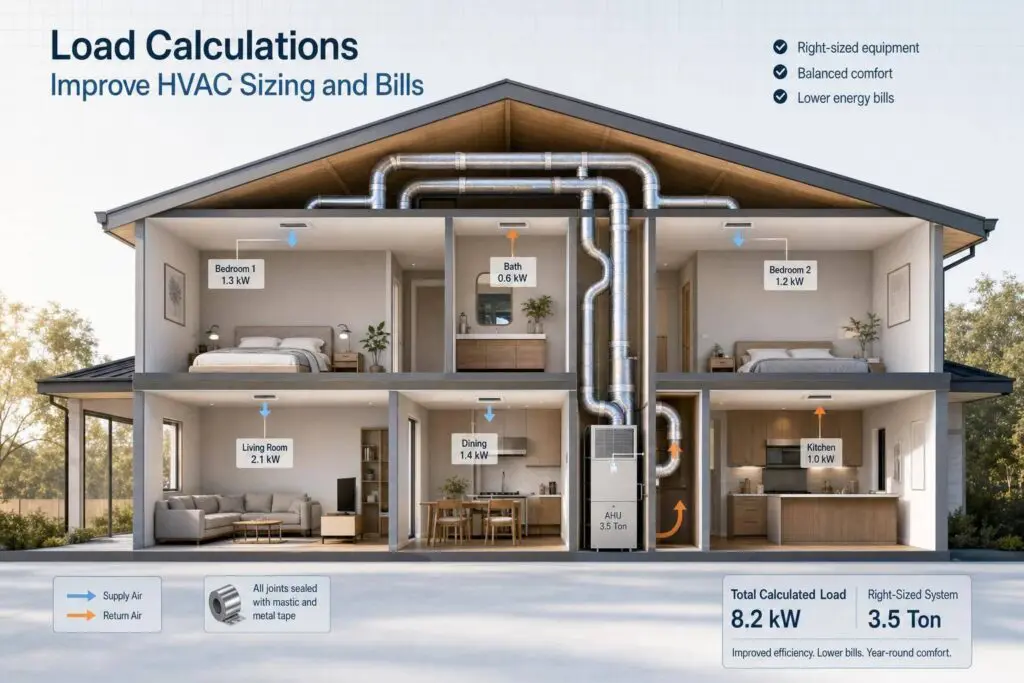
- A room-by-room load calculation using ACCA Manual J
- Confirmed indoor and outdoor equipment matching
- Measured airflow within 10% of design airflow
- Refrigerant charge verified with the manufacturer’s approved method
- A duct inspection
Those are the minimum checks needed for rated performance.
Local Service Considerations in Chicagoland
Since installation quality affects both repair risk and efficiency, a local evaluation should look at the full system, not just the outdoor unit. Chicagoland homes and small commercial buildings vary a lot in age, insulation, duct layout, and cooling demand. An older home, for example, may have leaky ducts or limited electrical capacity that a new condenser alone won’t fix.
A contractor should review the whole setup before suggesting a SEER2 level: ductwork, indoor coil, thermostat, drainage, and outdoor unit placement.
Local parts availability also matters. So does technician experience with variable-speed and communicating systems. Those two things can shape how fast a repair gets done and how much it ends up costing. Eco Temp HVAC serves Chicago, St. Charles, Bartlett, Lemont, Downers Grove, and Palatine.
How to Make the Final Decision
After you compare energy savings, repair risk, and install quality, the last call usually comes down to choosing the right HVAC system based on payback and how long you plan to keep the property.
When a Higher-SEER2 System Makes Financial Sense
A higher-SEER2 system tends to make sense when you’re replacing old equipment, running AC a lot during the summer, paying high electric rates, and planning to keep the system long enough to earn back the added cost.
Rebates and tax credits can shift the numbers, but only use confirmed amounts in your math. For the federal tax credit, qualifying split-system central air conditioners must meet at least SEER2 17.0 and EER2 12.0 beginning January 1, 2025.
That said, the install has to be done right. A strong rating on the label won’t help much if the system is oversized, mismatched, or put in poorly. On HVAC jobs, the paper specs can look great while the actual performance falls flat.
If the payback looks borderline, the next issue is simple: does a lower upfront price matter more to you than top-end efficiency?
When a Moderate-Efficiency System May Be the Better Buy
If the added installed cost is high and your cooling season is short, the payback often isn’t strong enough to justify the upgrade. When cooling demand is light or the price gap is wide, a higher rating doesn’t always lead to a faster return.
In that case, a moderate-efficiency system may be the better buy. That’s often true if:
- Your cooling demand is modest
- Local electric rates are average
- You may sell the property before the added cost pays back
The main thing is to look at total ownership cost, not just the label. Compare the full picture: installation, energy use, maintenance, repairs, and warranty.
Key Points to Remember Before You Choose
| Factor | What actually matters |
|---|---|
| Long-term savings | Possible, but not guaranteed – usage and climate drive results |
| Payback timeline | Depends on the efficiency gap, cooling hours, electric rates, and incentives |
| Repair costs | Tied to system design, parts availability, and warranty – not SEER2 alone |
| Installation quality | Can outweigh a rating difference; correct sizing and commissioning are critical |
| Best choice | Lowest total ownership cost for your usage pattern |
Ask for at least two written proposals: one moderate-efficiency quote and one higher-SEER2 quote. Make sure each one includes itemized pricing, confirmed incentives, and matched equipment specs.
Then calculate payback using the after-incentive premium, not the full replacement cost. If the numbers only work under best-case assumptions, go with the moderate-efficiency system.
FAQs
How do I calculate AC payback?
Compare the upfront price of a high-efficiency system with the price of a standard unit. Then divide that difference by your estimated yearly energy savings.
Your savings can vary a lot based on your local climate, utility rates, and how you use the system day to day. So before you run the numbers, estimate your yearly cooling hours with local cooling degree day data. Eco Temp HVAC can help you look at those factors and figure out a more realistic estimate.
Who benefits most from high-SEER2 AC?
Homeowners in hot, humid climates usually get the most from high-SEER2 air conditioners. These systems often run for 2,000 to 3,000 hours per season, so people who use them a lot tend to see payback sooner, often breaking even in 5 to 8 years.
In milder summer areas like Chicagoland, mid-tier systems can make more sense because they strike a better balance between upfront cost and long-term savings. In general, homes with high yearly cooling use see the biggest payoff.
Does installation quality affect savings?
Yes. Installation quality plays a big role in whether a high-SEER system delivers the energy savings you expect.
If the system is sized wrong, paired with mismatched parts, or connected to leaky ductwork, efficiency can drop by up to 30%. In some cases, those mistakes can even void the manufacturer warranty.
That’s why professional commissioning matters. It helps confirm that refrigerant levels, airflow, and static pressure are set the right way so the system runs as intended.