
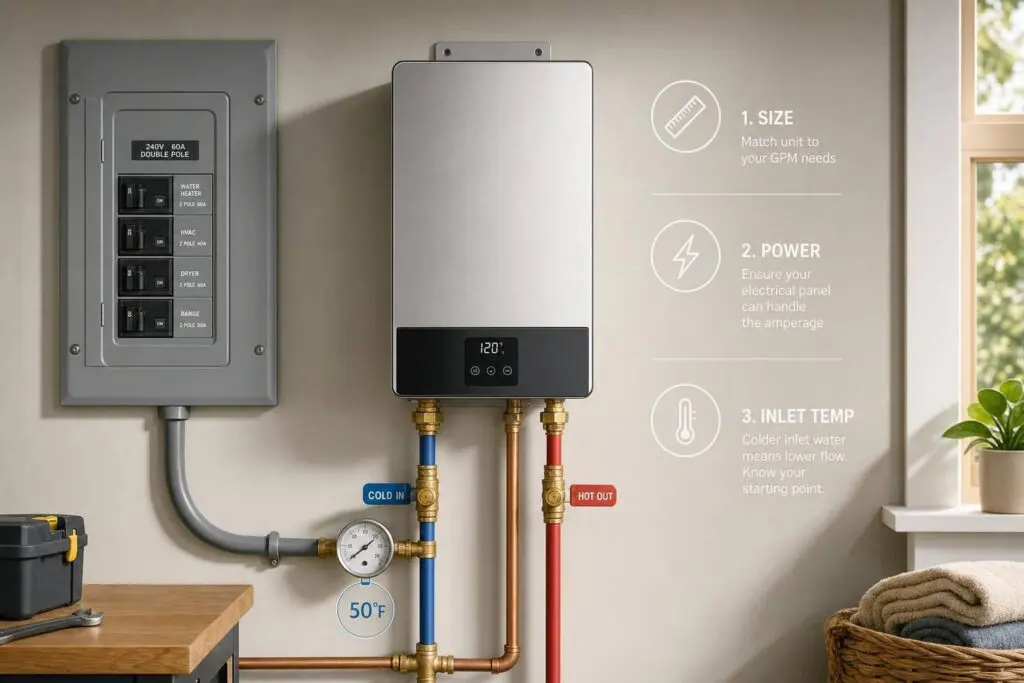
Most electric tankless water heater mistakes come down to two things: bad sizing and not enough panel capacity. A 36 kW unit can pull about 150 amps at 240V, which is 75% of a 200A panel, and in cold states that same unit may only supply one to two fixtures at once.
If I were narrowing these brands fast, here’s the short version:
- Stiebel Eltron: best if I want steadier outlet temperature and longer service life
- Rheem: best if I want easier parts access and lower unit cost
- EcoSmart: best if I want lower pricing with whole-home options
- Bosch: best for under-sink and single-fixture use
- Atmor: best for light-duty point-of-use jobs
- Marey: best for low-cost small-home or sink setups
- Camplux: best for budget single-sink and warm-climate small-home use
Before I buy, I’d check three things:
- Flow rate at my local inlet temperature, not just the box rating
- Electrical demand: breaker count, amperage draw, and panel size
- Maintenance needs: mainly descaling, especially with hard water
Prices in this group run from about $90 for small point-of-use units to about $950 for large whole-home models. Installed cost can climb to about $5,900 if an electrical upgrade is needed.
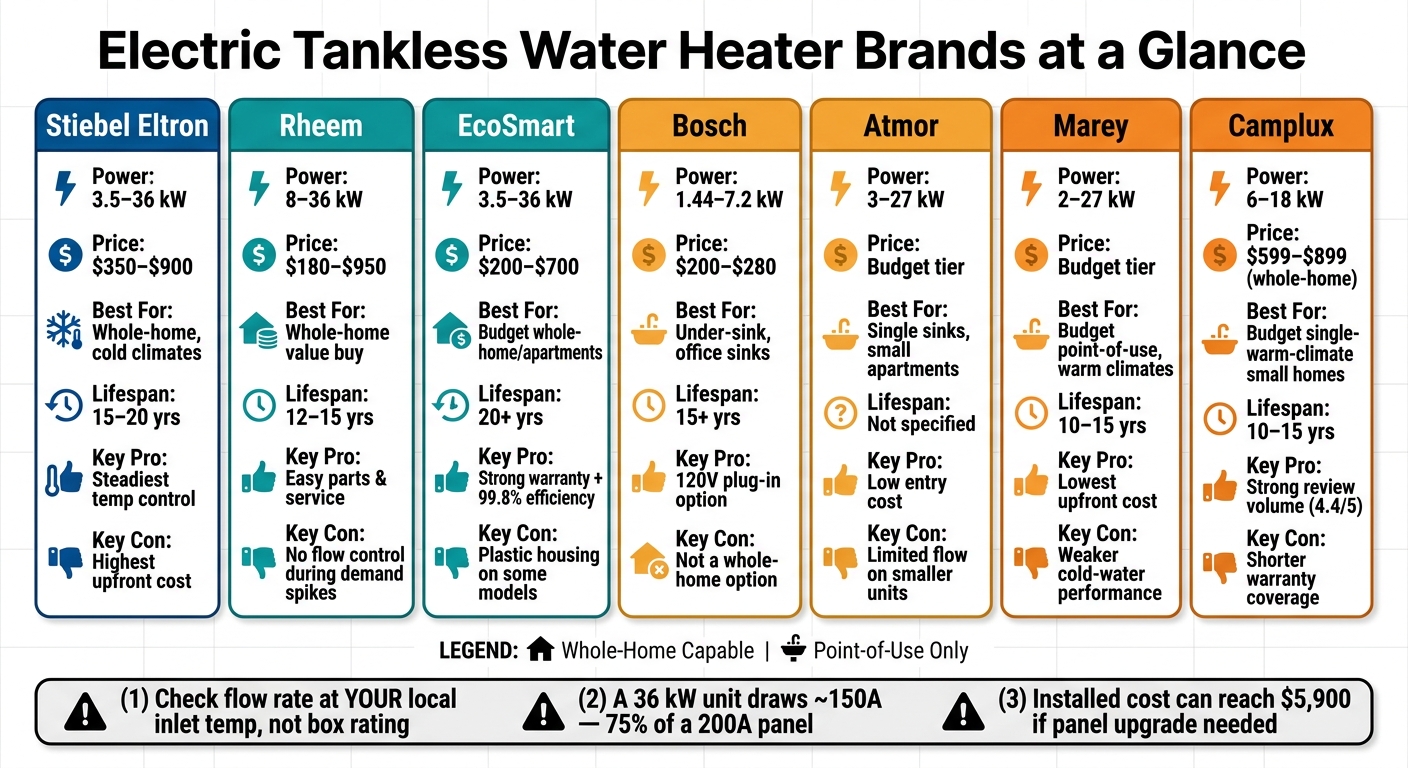
Electric Tankless Water Heater Brands Compared: Power, Price & Best Use
7 Best Electric On-Demand Water Heaters 2026! Top Picks Tested
sbb-itb-b5c10b1
Quick Comparison
| Brand | Best Use | Power Range | Main Upside | Main Downside |
|---|---|---|---|---|
| Stiebel Eltron | Whole-home, colder climates | 3.5–36 kW | Steadier temperature control | Higher upfront price |
| Rheem | Whole-home value buy | 8–36 kW | Easy parts and service | Output drops more when demand spikes |
| EcoSmart | Budget whole-home/small-home | 3.5–36 kW | Lower price and long warranty on some models | High-amp models can still force panel work |
| Bosch | Under-sink, office sinks | 1.44–7.2 kW | Good for single fixtures | Not a whole-home option |
| Atmor | Single sinks, small apartments | 3–27 kW | Low entry cost | Limited flow on smaller units |
| Marey | Budget point-of-use | 2–27 kW | Low upfront cost | Smaller use case in cold areas |
| Camplux | Budget small-home/POU | 6–18 kW | Low-cost options | Shorter warranty and lower top-end output |
Bottom line: if I need full-house hot water, I’d start with Stiebel Eltron, Rheem, or EcoSmart. If I only need hot water at one sink, I’d look first at Bosch, Atmor, Marey, or Camplux. From there, the right pick depends on my climate, fixture count, and electrical service.
1. Stiebel Eltron

Stiebel Eltron, founded in 1924, makes electric tankless water heaters that range from small point-of-use units to whole-home and commercial models.
Flow Capacity & kW Range
The lineup starts at 3.5 kW for point-of-use use and goes up to 36 kW for whole-house demand. In the Tempra Plus line, there are six whole-house sizes: 12, 15, 20, 24, 29, and 36 kW.
What sets this series apart is Advanced Flow Control (AFC). When hot-water demand goes past what the unit can handle, AFC lowers flow to keep the outlet temperature steady instead of letting the water swing cold. That matters in daily use. No one wants a shower that turns lukewarm the second another fixture kicks on.
| Model | Power | Max Flow @ 35°F Rise | Breaker Requirements |
|---|---|---|---|
| Tempra 12 Plus | 12 kW | 2.0 GPM | 1 x 50A |
| Tempra 20 Plus | 19.2 kW | 3.5 GPM | 2 x 40A |
| Tempra 24 Plus | 24 kW | 4.4 GPM | 2 x 50A or 3 x 40A |
| Tempra 29 Plus | 28.8 kW | 4.9 GPM | 3 x 40A |
| Tempra 36 Plus | 36 kW | 6.0 GPM | 3 x 50A or 4 x 40A |
The catch is the electrical load. Bigger units can be tough to install if the home has a smaller panel. Still, the output range makes sizing pretty simple for homes and small commercial spaces with steady, easy-to-predict demand.
Best-Fit Application
The Tempra 36 Plus is a strong match for 3+ bathroom homes, small offices, and light commercial spaces with low demand, especially in colder parts of the country. At a 42°F inlet water temperature, the 36 kW unit delivers about 3.9 GPM, which is enough for one to two fixtures.
The Tempra 24 Plus fits 1–2 bathroom homes in moderate climates well. One nice detail: it needs only two 50A breakers, while some similar 24 kW units need three 40A breakers. That can make planning a bit easier.
For small jobs, point-of-use options like the Mini-E Series make sense for single sinks or remote bathrooms where running a long hot-water line would be wasteful.
Maintenance & Lifespan
Stiebel Eltron units use copper heating chambers and brass fittings, and they are built for a 15–20 year service life. Upkeep is pretty simple: descale the unit every 1 to 2 years, especially if you have hard water, and install isolation valves during setup so the job is easier later.
If your water has a lot of minerals, adding a scale filter or water softener can help the unit last longer.
That lighter upkeep helps explain the higher sticker price.
Value & Reliability
Pricing runs from about $350 to $900, depending on the model, with the Tempra 36 Plus usually falling between $700 and $900. The tradeoff is simple: you pay more up front, and the larger models ask more from your electrical system.
The warranty helps balance that out, with 7 years for leakage and 3 years for parts. The Tempra 24 Plus gets a lot of praise for tight temperature control and quiet operation. If steady performance and long life are high on your list, the higher price can make sense.
On the main comparison points – output, electrical load, upkeep, and lifespan – Stiebel Eltron sits near the top for performance and durability. It makes the most sense when temperature stability and long service life matter more than a lower upfront price.
Next, compare how Rheem trades premium controls for broader availability and easier market access.
2. Rheem
Rheem’s RTEX series is built for buyers who want solid performance without spending top dollar. The lineup is simple to service, parts are easy to find, and it covers a broad range of setups, from a single sink to a whole-home install. That makes Rheem a strong pick when easy service matters more than premium flow management.
Flow Capacity & kW Range
The RTEX line runs from 8 kW to 36 kW. Every model in the series has an activation flow rate of 0.3 GPM, which means the unit can kick on even with a light trickle. That’s handy for low-flow fixtures and light commercial restrooms.
| Model | kW | Max Flow (Warm Climate) | Electrical Requirements | Best Fit |
|---|---|---|---|---|
| RTEX-08 | 8 | 1.95 GPM | 1 x 40A breaker | Point-of-use, single sinks |
| RTEX-13 | 13 | 2.68 GPM | 1 x 60A breaker | 1-bath home in warm climates |
| RTEX-18 | 18 | 4.4 GPM | 2 x 40A breakers | Small homes in warm climates |
| RTEX-24 | 24 | 5.9 GPM | 3 x 40A breakers | 1–2 bath homes |
| RTEX-36 | 36 | 8.8 GPM | 4 x 40A breakers | Whole-home, up to 3 baths |
Water temperature coming into the house changes everything. In warm-water areas, the RTEX-36 can hit 8.8 GPM. In cold-water areas, that same unit drops to 3.6 GPM, so homes in northern climates usually need to size up with extra care.
Best-Fit Application
Rheem fits best in 1–2 bath homes and light-use properties. The 8 kW model works well for single sinks and utility sinks. The 13 kW to 18 kW range makes sense for small homes in warm climates.
One thing to watch: Rheem does not include Advanced Flow Control. So when demand goes past the unit’s capacity, the water gets cooler instead of the flow slowing down. In plain English, if two showers start running at the same time, you may feel that drop.
Maintenance & Lifespan
Rheem uses replaceable copper heating elements, and that helps keep repair costs down. You can swap elements one at a time for about $30–$50 each instead of replacing the whole unit.
In hard water areas, plan to flush and descale the heater every 6–12 months to keep mineral buildup in check. With regular upkeep, a lifespan of 12–15 years is a fair expectation.
Value & Reliability
Pricing starts at about $180 for the RTEX-08 and runs to around $550–$950 for the RTEX-36. That keeps Rheem in the value camp, especially for homeowners who want a known brand with parts they can source without much hassle.
Customer feedback is solid, too. The RTEX-36 holds a 4.6/5 rating, and the RTEX-24 has a 4.3/5 rating from 833 reviews. Buyers often point to the compact size, simple digital temperature adjustment in 1°F increments, and the easy access to replacement parts.
The big catch is electrical capacity. The RTEX-36 needs 150 amps of available panel capacity, and the larger 24–36 kW models usually call for 200A to 300A service with multiple double-pole breakers. If a home only has 100A service, a panel upgrade can tack on $2,500–$4,500 to the job.
3. EcoSmart

EcoSmart is a budget-friendly pick in the electric tankless space. Its self-modulating tech changes power use in real time based on hot water demand, reaching efficiency near 99.8% and helping cut operating costs. That gives buyers a lower entry price without ruling out whole-home use.
Flow Capacity & kW Range
EcoSmart sells electric tankless units from 3.5 kW to 36 kW. The ECO 36 is a good example of how performance shifts with temperature rise: it can deliver 6.1 GPM at a 35°F rise, but that drops to 2.7 GPM at a 77°F rise.
| Model | kW | Max Flow (35°F Rise) | Electrical Requirement | Best Fit |
|---|---|---|---|---|
| ECO 36 | 36 kW | 6.1 GPM | 4x 40A breakers; 150A draw | Large households; cold-climate whole-home |
| ECO 27 | 27 kW | 4.6 GPM | 3x 40A breakers; 113A draw | 2-bath homes (warm); 1-bath (cold) |
| ECO 18 | 18 kW | 3.5 GPM | 2x 40A breakers; 75A draw | Small homes/apartments (Sun Belt) |
| ECO 11 (13 kW) | 13 kW | 2.2–3.1 GPM | 1x 60A breaker; 54A draw | Small apartments; offices |
| POU 6 | 6 kW | ~1.0 GPM | 1x 30A breaker; 25A draw | Single sink; wet bar; workshop |
Best-Fit Application
The ECO 11 and ECO 18 make the most sense for small apartments and homes in warmer parts of the country, where groundwater temperatures are less demanding. Step up to the ECO 27 or ECO 36, and you’re looking at units that fit bigger households or colder areas much better.
For offices or light commercial use, the POU 6 is built for a much narrower job. It works well as a point-of-use heater for one sink or a handwashing station.
Maintenance & Lifespan
EcoSmart uses stainless steel heat exchangers in some models, including the ECO 27. In hard-water areas, that can be a better choice than copper. Descaling is usually needed every 18 to 24 months, which is about half as often as many copper-exchanger units.
Replacement heating elements are made to be serviced in the field. They cost about $30 to $50 each and can usually be swapped in about 15 minutes. That’s a nice break for long-term ownership costs. With proper upkeep, a well-maintained EcoSmart unit can last 20 years or more.
Value & Reliability
Pricing starts at about $200 to $300 for the ECO 11 and goes up to around $550 to $700 for the ECO 36. EcoSmart also includes a limited lifetime residential warranty on the heat exchanger and, in some cases, the electronics for the original owner, though warranty coverage may depend on professional installation.
User feedback helps the value argument. The ECO 11 holds a 4.3/5 rating from 5,671 Amazon reviews, while the ECO 27 comes in at 4.5/5.
The main catch is electrical demand. The ECO 36 pulls 150 amps, which is 75% of the full capacity of a standard 200A panel. For some homes, that means a panel upgrade before the heater even goes in, adding about $1,500 to $3,000 to the project.
Bosch follows with a different mix of price, size, and serviceability.
4. Bosch
Bosch puts most of its attention on point-of-use and mini-tank units built for single-fixture hot water. So when you look at this brand, the big question isn’t whole-house output. It’s where the unit will go and how much hot water that one spot needs.
Flow Capacity & kW Range
Bosch electric units usually fall between 1.44 kW and 7.2 kW. That’s much lower than what you’d expect from whole-home brands. The main Tronic 3000T line comes in two versions:
- A 7.2 kW true tankless model that runs on 240V and needs a dedicated 30A circuit
- A 1.44- to 1.5 kW mini-tank model that plugs into a 120V standard outlet and stores 2.5 gallons of hot water
| Model | Type | kW / Voltage | Max Flow (35°F Rise) | Best Application |
|---|---|---|---|---|
| Tronic 3000T | Tankless POU | 7.2 kW / 240V | 1.2 GPM | Restroom sinks, commercial handwashing |
| Tronic 3000T (ES2.5) | Mini-Tank | 1.44–1.5 kW / 120V | N/A (2.5-gal storage) | Under-sink, remote bathroom vanities |
| Tronic Series | POU | 3.5–7 kW / Varies | 0.5–1.2 GPM | Single-fixture supplemental use |
The numbers tell the story pretty clearly. At a 35°F temperature rise, the 7.2 kW model can deliver 1.2 GPM. At a 77°F rise, that drops to 0.5 GPM. That’s well short of what most showers need.
Best-Fit Application
Bosch is not a whole-home play. It makes the most sense as a backup or add-on unit for a guest bath or kitchen sink that sits far from the main water heater. In that setup, it can cut the long wait for warm water and help reduce water waste.
This is a single-fixture brand, not a multi-fixture one.
The 120V mini-tank works well in rentals and apartments because it plugs into a standard outlet. For offices and light commercial use, the 7.2 kW tankless model is a good match for restroom handwashing stations.
That tight focus is what sets Bosch apart before the comparison moves into brands built for broader home coverage.
Maintenance & Lifespan
Upkeep is light, and Bosch POU units can last 15+ years with routine care. The mini-tank does have some standby heat loss since it stores water. The 7.2 kW tankless model has a 0.98 UEF.
Value & Reliability
Bosch keeps pricing simple. The 7.2 kW tankless model usually costs $200 to $280, while the ES2.5 mini-tank is about $225.99.
The ES2.5 has a 4.4/5 review rating, and users often point to easy installation and steady performance at remote sinks.
Bosch was also ranked the #1 most trusted tankless water heater brand in 2026 by Lifestory Research, with a Net Trust Quotient Score of 111.1. The tradeoff is a thinner U.S. service network, which can slow repairs and support. For a simple point-of-use setup, that usually matters less than it would with a whole-home system.
5. Atmor
Atmor covers both small point-of-use units and higher-capacity whole-home systems. In plain terms, it can work for a single sink or a small whole-home setup, as long as the model matches fixture demand and inlet water temperature.
Flow Capacity & kW Range
Atmor runs from 3 kW to 27 kW. Its point-of-use units are built for single sinks, while whole-home models go up to 5.1 GPM. That means the big limiter is often your electrical service, not just the unit size.
Best-Fit Application
Atmor is a good fit for:
- Single sinks
- Small apartments
- Small homes
- Small offices
- Light commercial handwashing stations
Larger whole-home models can support more fixtures, but many homes with 100A service will usually be limited to point-of-use units. Whole-home models in the 18 kW to 27 kW range often need 200A to 250A main service, which may mean an electrical upgrade before installation.
Once you’ve matched the unit to the job, maintenance mostly comes down to water quality.
Maintenance & Lifespan
Hard water means more frequent descaling. If scale builds up, efficiency drops and the unit may not last as long. So yes, routine maintenance matters here more than many buyers expect.
Value & Reliability
Atmor’s main selling point is lower install hassle because it doesn’t need venting. That’s a big plus. But there’s a tradeoff: colder inlet water reduces output, so buyers in colder parts of the U.S. should factor that into sizing.
Next, Marey narrows the comparison to smaller, lower-cost electric tankless models.
6. Marey
Marey lands in the budget to midrange group. It’s a sensible pick if you want a simple electric tankless unit and don’t want to spend a lot up front.
Flow Capacity & kW Range
Marey’s lineup runs from 2 kW point-of-use units to 27 kW whole-home models. The 2 kW to 3.5 kW units produce about 0.5 GPM, which is enough for a single handwashing sink. The 11 kW to 18 kW models fit small homes and light office use.
Best-Fit Application
Marey works best in point-of-use setups, small apartments, and whole-home use in warm climates with relatively high inlet water temperatures.
Maintenance & Lifespan
Plan on flushing the unit once a year. In hard water, copper exchangers usually need descaling every 9–12 months, while stainless steel units can often go 18–24 months. Skip that upkeep, and you can run into shutdowns or weaker performance. If you stay on top of maintenance, a Marey unit can last 10–15 years.
Those tradeoffs show up most clearly in performance and long-term ownership cost.
Value & Reliability
Marey’s biggest selling point is the low upfront price. That makes it a good fit for single-sink setups and small-apartment installs. The downside is lower output and a tighter use case than higher-capacity brands. That narrower fit stands out even more in the side-by-side comparison below.
7. Camplux
Camplux sits in the budget tier and makes the most sense for buyers who need basic point-of-use hot water or a small system for a warm-climate home.
Flow Capacity & kW Range
The TE06Pro is a 6 kW, 240V unit that delivers up to 1.5 GPM. That makes it a solid match for a single sink, an office breakroom faucet, or a wet bar. It also activates at just 0.4 GPM, so it can still deliver warm water during a light trickle.
Camplux also sells an 18 kW whole-home electric model rated at 99.8% energy efficiency. It’s aimed at 1–2 bathroom homes in warmer climates.
In plain terms, this lineup is better for lighter-demand setups than for homes trying to run many fixtures at once.
Best-Fit Application
The 6 kW models work best for single-sink and remote-fixture installs in small homes, offices, and light commercial handwashing stations. The 18 kW unit is a better match for a small home in a warm climate where inlet water temperatures are moderate.
Maintenance & Lifespan
Annual descaling is the main upkeep task, especially if you have hard water. Stay on top of that, and service life can stay in the 10–15 year range.
Value & Reliability
Camplux whole-home models usually cost $599–$899, which puts them below premium-brand pricing. The TE06Pro has a 4.4/5 Amazon rating from more than 1,500 reviews, with 72% five-star ratings. The 18 kW model holds a 4.3/5 rating.
The tradeoff is pretty clear: you get a lower upfront price, but you still need professional 240V hardwiring, and warranty coverage is a 5-year heat-exchanger warranty.
For buyers focused on a low initial cost, Camplux gives up some premium longevity and install flexibility in exchange for simpler, lower-cost use.
How These Brands Stack Up: Performance, Fit, and Ownership
After the brand-by-brand breakdown, the main gaps come down to three things: output in cold-water conditions, electrical demand, and service cost.
Flow Capacity and kW Range
kW matters. But cold inlet water is what shapes day-to-day output.
Stiebel Eltron’s Advanced Flow Control can help keep outlet temperature steadier during demand spikes. That said, actual output still comes back to the unit’s kW rating and the temperature of the incoming water.
Capacity still starts with kW. Bosch and smaller Atmor models work best as point-of-use options. Rheem, EcoSmart, Stiebel Eltron, Marey, and Camplux can cover larger loads. In northern states, even a 36 kW unit may only support one fixture at a time, and it pulls about 150 amps – around 75% of a standard 200A panel’s total capacity.
That changes where each heater makes sense: under a sink, in a small home, or as a whole-house setup.
Best Fit for Homes, Offices, and Light Commercial Use
| Brand | kW Range | Best For | Main Tradeoff |
|---|---|---|---|
| Stiebel Eltron | 3.5–36 kW | Best temperature control | Higher upfront unit price |
| Rheem | 8–36 kW | Serviceability and parts availability | Shorter heat exchanger warranty |
| EcoSmart | 3.5–36 kW | Strong warranty coverage | Plastic housing on some models |
| Bosch | 1.44–7.2 kW | Under-sink use and office sinks | Limited whole-home performance |
| Atmor | 3–27 kW | DIY single-sink installs | Limited flow |
| Marey | 2–27 kW | Budget point-of-use and small homes | Narrower use case |
| Camplux | 6–18 kW | Low-cost single-sink and small homes | Shorter warranty coverage |
For 1-bath homes and apartments, Rheem RTEX-13, EcoSmart ECO 11/13, and smaller Marey or Camplux units tend to fit best in warmer climates. Bosch and Atmor’s smallest point-of-use models make sense for offices and break rooms. For larger households with 2–3 bathrooms, it makes sense to start at 27–36 kW – models like Stiebel Eltron Tempra 36 Plus or EcoSmart ECO 36 – but only after a panel audit.
Once sizing is handled, upkeep and water quality start to matter just as much.
Maintenance Needs and Expected Lifespan
Descaling is the main maintenance job for every unit here, and how often you’ll need it depends on water hardness and heat exchanger material. Copper exchangers usually need descaling more often than stainless steel, so Rheem and Stiebel Eltron often need service more often than EcoSmart.
Hard water and exchanger material affect both service intervals and lifespan. Higher-end units like Stiebel Eltron are built for about 15–20 years, while budget-focused models usually land in the 10–15 year range when maintained well.
Price, Reliability, and Long-Term Ownership Cost
The price tag on the box is only part of the story. Installed cost matters more, since an electrical panel upgrade can cost more than the heater itself.
EcoSmart offers the strongest warranty. Stiebel Eltron and Rheem come with shorter, but still usable, coverage.
Those ownership-cost gaps are what the next pros-and-cons breakdown turns into quick buying signals.
Pros and Cons by Brand
Here’s the shortest buyer’s read on each brand. This quick view helps you line up each unit with your load, incoming water temperature, and how hard the install will be.
| Brand | Pros | Cons | Best Match |
|---|---|---|---|
| Stiebel Eltron | Tight temperature control; long service life | Higher upfront cost; AFC can restrict flow during peak demand | Large households; cold climates; premium whole-home installs |
| Rheem | Easy-to-source parts; replaceable elements | Needs more frequent descaling in hard water | Medium homes; value-focused whole-home use |
| EcoSmart | Strong warranty; high efficiency | Plastic housing on some models; mixed service feedback | Small homes; apartments; warmer climates |
| Bosch | 120V plug-in on smaller models; reduces wait at remote sinks | Not for whole-home demand | Office break rooms; remote bathroom sinks; under-sink installs |
| Atmor | Low entry price; simple single-sink install | Limited to light demand | Single sink; bar sinks; DIY point-of-use projects |
| Marey | Low upfront cost; fits small point-of-use jobs | Narrower use case; weaker cold-water performance | Budget sinks; small apartments; warm-climate homes |
| Camplux | Low-cost point-of-use and small-home options; strong review volume | Shorter warranty; limited high-demand capacity | Single sinks; break rooms; warm-climate small homes |
The main split is simple: some brands are built for full-home output, while others make more sense for point-of-use convenience.
Conclusion
When you stack up output, electrical demand, and upkeep, the best pick comes down to how and where you plan to use it.
Stiebel Eltron stands out for whole-home use in cold climates. Rheem gives you the best mix of price, coverage, and ease of service. EcoSmart is the budget option for residential installs. Bosch works well for single-fixture and point-of-use setups, while Atmor, Marey, and Camplux make the most sense for light-duty sinks and other small-use spots.
After you match the brand to the job, installation limits and water quality play a big role in how the unit holds up over time. Check your panel capacity before you buy. Size the heater for the coldest incoming water temperature, not summer averages. And if you live in a hard-water area, plan for annual descaling.
Match the heater to your load, panel, and climate, and the right model usually becomes pretty obvious.
FAQs
How do I size an electric tankless water heater for my home?
Add up the GPM for the fixtures you expect to use at the same time. Then figure out the needed temperature rise by subtracting your local winter groundwater temperature from your target water temperature, which is usually 120°F.
You’ll also want to check your home’s electrical capacity. Most whole-home units need 200-amp service, and 27 kW to 36 kW models often call for multiple dedicated 40-amp double-pole breakers.
This isn’t something to guess at. Have a licensed electrician perform a load calculation before installation.
Will my electrical panel support a whole-home electric tankless unit?
You’ll need a professional load calculation under NEC Article 220. Whole-home electric tankless units put a heavy, continuous load on your home’s electrical system.
Most 27–36 kW models need 150–200 amps of dedicated service and often three or more 40-amp double-pole breaker slots. A 100-amp panel usually won’t cut it without a major upgrade. And even a 200-amp panel still needs enough open capacity to handle the load.
How often does an electric tankless water heater need descaling?
How often you should descale the unit comes down to two things: the heat exchanger material and how hard your local water is.
In hard-water areas, copper heat exchangers often need descaling every 6 to 12 months. Stainless steel models can usually go 12 to 24 months between cleanings.
As a general rule, most units do best with professional descaling every 1 to 2 years. That helps the system keep running well and can reduce the risk of equipment failure.