
If your furnace stops heating in a Chicago winter, I’d check four things first: the air filter, thermostat, breaker, and vents. Those simple checks fix many no-heat calls before the problem gets into ignition parts, venting, or safety controls.
In this guide, I break the issue down into the 10 repairs I’d expect most often in Chicago homes during a long heating season that can last close to six months. The main trouble spots are usually:
- Airflow problems like dirty filters and blocked vents
- Startup problems like bad igniters and dirty flame sensors
- Power problems like a tripped breaker or shutoff switch
- Safety shutoffs tied to venting, pressure switches, and limit controls
Here’s the full list covered in the article:
- Dirty air filter
- Faulty thermostat
- Bad igniter
- Flame sensor problems
- Blower motor issues
- Tripped circuit breaker or power switch failure
- Blocked vents or airflow restrictions
- Pressure switch or venting problem
- Dirty burners or gas ignition components
- Limit switch or safety control failure
Good rule: if you’re dealing with a filter, batteries, vents, or one breaker reset, I’d start there. If gas, flame, vent pipes, or safety parts are involved, I’d stop and call a licensed technician. And if you smell gas, leave the house right away and call the gas company.
| Problem area | What you may notice | First step |
|---|---|---|
| Airflow | Weak air, short cycling, hot/cold rooms | Change filter, open vents |
| Thermostat/power | Furnace won’t start, blank screen, no sound | Check Heat mode, batteries, breaker, power switch |
| Ignition | Cold air, clicking, furnace lights then stops | Reset once, then service call |
| Safety/venting | Error code, lockout, burners shut off fast | Check outside vent for ice or snow, then call a pro |
That gives you the short version up front, so you can spot the likely problem fast and know when a DIY check is enough.
Solve Dozens of Furnace Problems With This Process
Common Furnace Repairs at a Glance
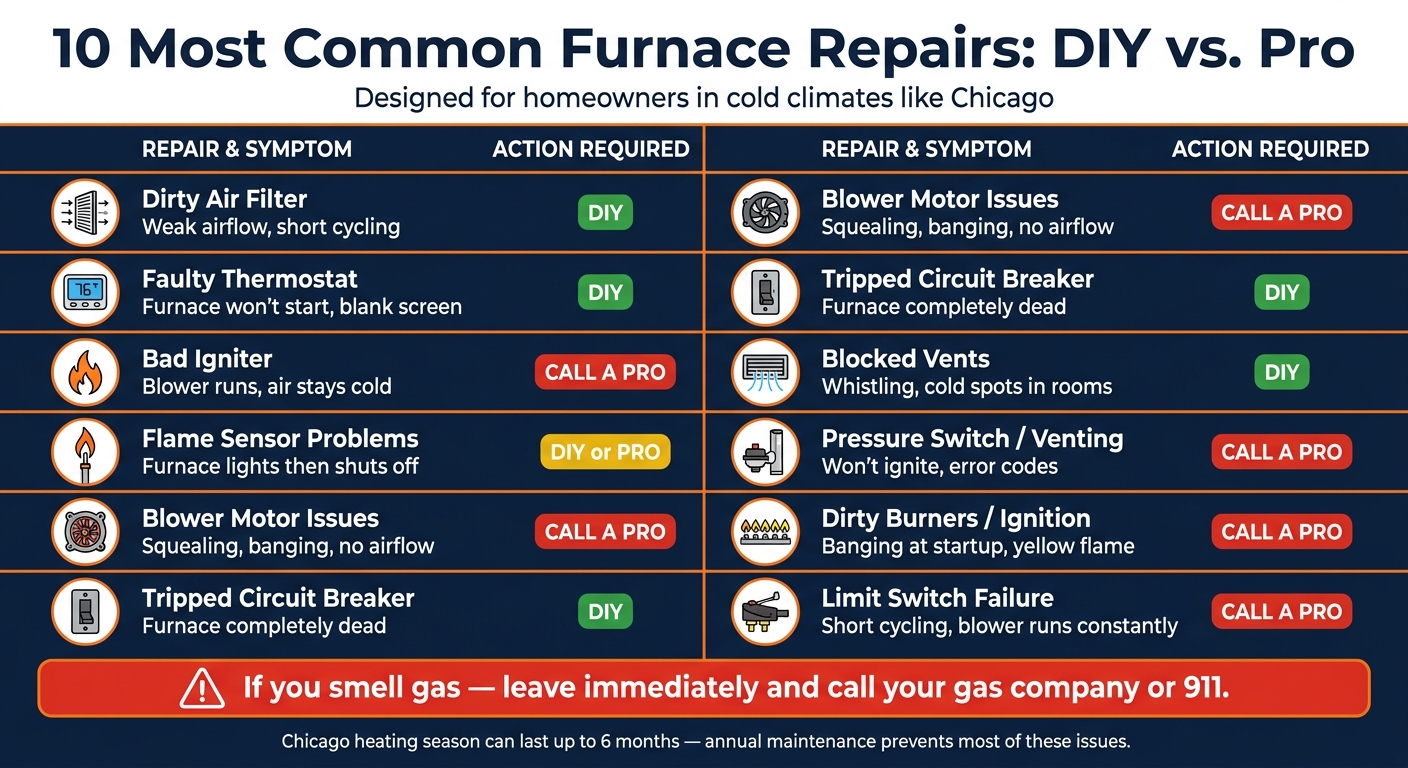
10 Most Common Furnace Repairs: DIY vs. Pro Guide
Here’s a quick look at the 10 furnace problems homeowners run into most often, along with the usual symptoms, likely cause, and the repair path that tends to make sense first. Think of this as a fast reference before getting into the step-by-step repair sections below.
| Repair | Main Symptom | Likely Cause | Typical Repair Path |
|---|---|---|---|
| Dirty Air Filter | Weak airflow; short cycling; high energy bills | Dust, pet hair, or debris buildup | DIY: Replace the filter |
| Faulty Thermostat | Furnace won’t start; inconsistent heat | Dead batteries; incorrect settings | DIY: Replace batteries; verify Heat mode |
| Bad Igniter | Blower runs but air stays cold; clicking or humming sounds | Igniter wear | Pro: Replace the hot-surface igniter |
| Flame Sensor Problems | Furnace lights briefly, then shuts off | Carbon buildup on the flame sensor | DIY or Pro: Clean the sensor; replace it if needed |
| Blower Motor Issues | Squealing, banging, or no air from vents | Worn bearings or electrical failure | Pro: Lubricate, repair, or replace the motor assembly |
| Tripped Circuit Breaker or Power Switch Failure | Furnace is completely dead; no power | Electrical overload; accidental shutoff | DIY: Reset the breaker once; check the furnace power switch |
| Blocked Vents or Airflow Restrictions | Whistling noises; cold spots in rooms | Blocked supply or return vents | DIY: Clear obstructions from supply and return vents |
| Pressure Switch or Venting Problem | Won’t ignite; error codes on the panel | Blocked exhaust; frozen exterior pipes | Pro: Clear vent blockages or replace the pressure switch |
| Dirty Burners or Gas Ignition Components | Banging on ignition; yellow flame | Dust, soot, or ignition buildup | Pro: Professional cleaning and burner alignment |
| Limit Switch or Safety Control Failure | Blower runs constantly; system overheats | Airflow restriction, often from a dirty filter | Pro: Restore airflow and replace the high-limit switch |
In most cases, homeowners can deal with the simple stuff first: filters, thermostat batteries, blocked vents, and a single breaker reset. But once you get into gas, ignition, or safety controls, it’s smart to bring in a licensed technician.
Next, each repair is broken down in this same order, starting with the easiest checks.
1. Dirty Air Filter
A dirty air filter is one of the most common furnace problems. When dust and debris pile up, airflow drops. Then the furnace has to work harder to move air through the system. That’s why this should be your first check before you move on to thermostat or ignition issues.
Common Symptoms
Watch for weak airflow, short cycling, or a furnace that shuts off on the limit switch.
Typical Repair Action
Replace the filter every 1–3 months during heating season, or sooner if it looks clogged. It’s a small job, but it can make a big difference. If a new filter doesn’t bring airflow back, the problem is probably deeper than the filter itself.
Simple Homeowner Check vs. Technician Repair
Changing the filter is safe DIY work. If the furnace still short cycles or blows cold air after you put in a fresh filter, it’s time to call a technician. At that point, they should check for airflow-related damage or a failing limit switch.
Chicago Winter Relevance
In Chicago’s long heating season, a clogged filter can shut a furnace down fast. During extreme cold, that can put your home at risk of frozen pipes and other freeze-related problems.
2. Faulty Thermostat
If the furnace still won’t start after you check the filter, the thermostat is the next place to look. A bad thermostat can stop the furnace from starting at all. It can also make heating feel uneven from room to room.
Common Symptoms
A few signs tend to show up fast. The furnace may not turn on when you bump up the temperature. It may also short cycle, which means it turns on and off too often. You might see a blank or dim screen. Or the rooms may feel colder than what the display says.
Simple Homeowner Check vs. Technician Repair
Start with the simple stuff first. Set the thermostat to "Heat" mode and make sure the target temperature is at least 5°F above the current room temperature.
If the screen looks blank or dim, swap in new batteries. Wipe off any dust on the thermostat too. It also helps to check that the furnace access panel is shut all the way, because a loose panel can trip a safety switch and keep the system from starting.
If the heat still doesn’t come on, it’s time for a technician to inspect the wiring, calibration, or the thermostat itself.
Chicago Winter Relevance
In Chicago, thermostat trouble can leave a home without heat fast when temperatures drop below freezing.
If the thermostat checks out, the next likely problem is ignition.
3. Bad Igniter
If the thermostat is working, the igniter is the next place to look. Most modern furnaces use a hot-surface igniter instead of a pilot light. When that part fails, the burner doesn’t light.
Common Symptoms
The blower runs, but the air coming out is cold. You might hear clicking when the system starts, or notice short cycling with no heat.
Simple Homeowner Check vs. Technician Repair
Check that the thermostat is still set to Heat one more time. Then try a basic reset: turn off the furnace power switch and thermostat for 30 seconds, then turn both back on.
If the furnace still blows cold air, it’s time to call a technician.
Don’t try to replace the igniter yourself. It’s fragile and easy to damage. A technician can test the igniter and swap it out if it has failed.
Chicago Winter Relevance
If you smell gas, leave right away and call your gas company or 911.
If the furnace lights but shuts off fast, the next likely issue is the flame sensor.
4. Flame Sensor Problems
If your furnace lights and then shuts right back off, the flame sensor is one of the first parts to look at. Its job is simple: confirm that the burners actually lit. If the sensor is coated with carbon or oxidation, the control board may read that as “no flame” and shut the furnace down as a safety step.
Common Symptoms
The most common pattern is this: the furnace lights for 3–5 seconds, then shuts off. After a few failed attempts, it may go into lockout mode and stop trying to restart.
A yellow or flickering flame can also point to incomplete combustion and a possible carbon monoxide risk.
Simple Homeowner Check vs. Technician Repair
You can inspect the flame sensor near the burner assembly. If it looks dark or sooty, shut off the power and gas first, then clean it gently with fine steel wool or an emery cloth.
Always shut off both the power and gas supply before touching anything inside the furnace.
If the porcelain housing around the rod is cracked, cleaning won’t help. The part needs to be replaced.
A technician can go a step further and test the sensor’s microamp signal with a multimeter. That helps confirm whether a light cleaning will do the job or if the sensor needs a full replacement.
Chicago Winter Relevance
In Chicago winters, this issue shows up a lot. Furnaces run for long stretches in midwinter, and dirty flame sensors often lead to short cycling. If the sensor is clean but the furnace still shuts off right after ignition, the next likely problem is the blower motor.
5. Blower Motor Issues
The blower motor is the part that moves heated air through your ductwork and out into your rooms. So if the furnace ignites but warm air never makes it to the vents, the blower is a likely problem.
Common Symptoms
Weak airflow, no airflow, or loud squealing and rattling sounds often point to blower trouble. Sometimes the furnace is still making heat, but that heat just isn’t getting into the living space.
Simple Homeowner Check vs. Technician Repair
Start with the simple stuff first. Replace a clogged air filter and make sure the fan is set to "Auto," not "On." A dirty filter can choke airflow, and a fan set to "On" can make the blower seem like it’s not cycling the way it should.
If the airflow is still weak after that, the fix may involve parts like the capacitor, motor, or belt. That’s usually a job for a technician.
Chicago Winter Relevance
During Chicago cold snaps, furnaces can run almost nonstop. That puts extra wear on blower bearings and electrical parts. And when temperatures drop below zero, a blower failure can turn serious fast because the house stops getting heat.
If the blower isn’t the issue and the furnace still won’t run, the next place to check is the breaker and power switch.
sbb-itb-b5c10b1
6. Tripped Circuit Breaker or Power Switch Failure
If your furnace is completely dead, power is one of the first things to check. A tripped breaker or a power switch that got flipped off can shut the whole system down. That means no blower, no ignition, no sound at all.
Common Symptoms
The clearest sign is total silence. The furnace doesn’t respond, and nothing starts when the thermostat calls for heat. If your thermostat gets power from the furnace, the screen may also go blank when the breaker trips.
Simple Homeowner Check vs. Technician Repair
Start with two fast checks:
- Look for the furnace power switch. It’s often mounted on the side of the unit or on a nearby wall, and it usually looks just like a light switch. During cleaning, it’s easy for someone to flip it off by mistake.
- Check your main electrical panel for a breaker that’s tripped or sitting fully in the OFF position.
If you find a tripped breaker, reset it once by turning it fully off and then back on. That’s it. If it trips again right away, stop there and call a technician. At that point, the issue may be a short in the furnace, the control board, or the wiring. A technician can track down the source, whether it’s a failing blower motor, a shorted control board, or damaged wiring.
Chicago Winter Relevance
In Chicago, furnaces can run hard for long stretches in winter. On older systems, that heavy use can strain aging electrical circuits. So if the unit loses power, it’s worth dealing with it fast. If the power checks out, the next place to look is airflow and venting.
7. Blocked Vents or Airflow Restrictions
If your furnace has power but still overheats or keeps turning on and off, airflow is the next place to look. When supply or return vents get blocked, the furnace can struggle to move air the way it should. That can lead to weak airflow, short cycling, or a full shutdown.
Common Symptoms
The usual signs are pretty easy to spot: weak airflow from the registers, uneven heating between rooms, whistling sounds at the vents, and a furnace that short cycles. When the airflow problem gets worse, it can trip the high-limit switch. That safety switch shuts off the gas to stop the heat exchanger from getting too hot.
Simple Homeowner Check vs. Technician Repair
Start with the simple checks first. Move furniture, curtains, rugs, or anything else blocking supply and return vents.
If the vents are open and the issue still doesn’t go away, it’s time to have a technician inspect the blower and the high-limit switch.
Chicago Winter Relevance
In a Chicago winter, furnaces work hard for long stretches. That means airflow problems can lead to shutdowns fast. With high-efficiency furnaces, there’s another cold-weather issue too: a frozen condensate line can shut the system down if the PVC drain runs through an unheated area.
8. Pressure Switch or Venting Problem
The pressure switch is a small safety part that tells the furnace whether venting is working the way it should. If the vents look clear but the furnace still won’t stay on, this is often the next thing to check. It works with the inducer to confirm exhaust is moving out of the system correctly. If it can’t confirm that draft, the furnace shuts itself down before ignition as a safety step.
Common Symptoms
Once basic airflow issues are ruled out, a pressure-switch problem moves much higher on the list. You might see the furnace start and then shut down before ignition finishes. In some cases, the control board flashes an error code. In others, the inducer keeps running, but the burners never light.
Simple Homeowner Check vs. Technician Repair
There is one simple check most homeowners can do: look at the exterior intake and exhaust pipes for snow, ice, or debris. A blocked pipe can stop the furnace in its tracks. If the issue involves frozen condensate, though, that’s a job for a technician.
After that, it’s best to step back and let a pro handle it. A technician can test the pressure switch with a multimeter and see whether it’s opening and closing as it should. If the inducer motor is starting to fail, that usually means repair or replacement by a professional.
If the furnace shuts off two or three times in a row, don’t keep resetting it. That can be risky when venting is the problem. Modern furnaces lock out for a reason: to cut the risk of carbon monoxide leaks or fire.
If the pressure switch and venting system both pass inspection, dirty burners or gas ignition parts are often the next place to look.
Chicago Winter Relevance
Chicago winters can make this problem show up fast. Exterior intake and exhaust pipes can freeze over in a short time during deep cold, and condensate lines that run through unheated spaces are more likely to freeze and trigger a shutdown.
9. Dirty Burners or Gas Ignition Components
If the venting looks fine, the next place to look is the burner and ignition system. Dirty burners, weak ignitors, and dirty flame sensors are common reasons a furnace stops making heat or starts short cycling.
Common Symptoms
A furnace that fires up, runs for a few seconds, and then shuts off after about 30 seconds often points to dirty burners, a weak ignitor, or both. Another warning sign is a loud bang at startup. That usually means gas is collecting before it lights, which can happen when dirty burners slow down combustion.
You may also notice cold air coming from the vents or see a yellow or flickering flame through the inspection port instead of a steady blue flame. If the flame looks yellow, lazy, or delayed, the burners probably need to be cleaned.
Simple Homeowner Check vs. Technician Repair
There is one simple thing you can do on your own: look through the viewing port. If the flame is yellow or uneven, cleaning is likely needed. It also helps to check the air filter. A clogged filter can make the furnace overheat and shut the burners down as a safety step.
Beyond that, it’s best to call a technician. A pro can clean the burners and flame sensor, test the ignitor, and make sure the furnace is lighting the way it should.
Chicago Winter Relevance
Chicago’s humid summers can speed up corrosion on burner assemblies, and sub-zero winter weather puts more strain on ignitors and other ignition parts. A preseason tune-up can catch buildup before the heating season starts.
10. Limit Switch or Safety Control Failure
If the burners and ignition parts are working, the next place to look is often the high-limit switch. This part shuts the furnace down when the heat exchanger gets too hot. When it trips over and over, or stops working the way it should, the furnace can short cycle or go into lockout.
Common Symptoms
The clearest sign is short cycling. The furnace starts, runs for a short time, and shuts off before your home reaches the set temperature. You might also notice the blower fan keeps running even after the burners shut off. In some cases, the furnace blows cold air for a moment and then turns off.
After several failed start-up attempts, many newer systems lock out and stop trying to restart. At that point, you may need a manual reset or a technician visit.
Simple Homeowner Check vs. Technician Repair
When a furnace short cycles, start with airflow. That’s because poor airflow often causes the limit switch to trip. Before you call for service, do two simple checks:
- Replace the air filter
- Open any blocked supply or return vents
Restricted airflow is the most common reason the limit switch trips.
If the furnace still shuts down after airflow is back to normal, it’s time for a technician. A pro can test the switch with a multimeter, check blower speed, and inspect the heat exchanger for cracks.
Chicago Winter Relevance
In Chicago, this issue tends to show up more often in the heart of winter. Furnaces may run almost nonstop when outdoor temperatures drop below 20°F, and sharp overnight temperature drops can wear out safety controls faster.
Conclusion
Most furnace failures in Chicago start with airflow or ignition. And when something goes wrong, the issue usually lands in one of four buckets: airflow, ignition, venting, or safety.
The good news is that the first things to check are often the simplest ones.
Homeowners can usually take care of a few basic fixes on their own:
- Change the filter
- Replace thermostat batteries
- Reset a tripped breaker one time
- Clear blocked vents
After those steps, the remaining repairs usually involve gas, ignition parts, or safety controls. That means parts like gas valves, igniters, blower motors, control boards, heat exchangers, and limit switches are best left to a licensed technician.
If the heat still doesn’t come back, write down any error codes before you call for service.
FAQs
How do I know if it’s a filter problem or a bad blower motor?
A clogged air filter can choke off airflow. When that happens, the system may overheat and shut itself down. Here’s a simple way to check: hold the filter up to the light. If you can’t see through it, it’s dirty.
A bad blower motor often leads to little or no airflow coming from the vents. It can also bring odd sounds, like banging or rattling. At that point, a professional diagnosis can confirm what’s going on.
Why does my furnace light and then shut off right away?
If your furnace starts, then shuts off almost right away, a dirty flame sensor is often the reason. When that sensor can’t detect the burner flame, the system may trigger a safety shutdown.
Other common causes include a clogged air filter or blocked vents, which can make the furnace run too hot. A failing thermocouple, a bad igniter, or thermostat trouble can also cause the same problem. If it keeps happening, contact Eco Temp HVAC for a professional diagnosis.
When should I stop troubleshooting and call a technician?
Call a professional if basic troubleshooting doesn’t solve the issue. Start with the simple stuff first:
- Check the power supply
- Look at the thermostat settings
- Inspect the air filter
If those don’t fix the problem, it’s time to bring in an HVAC pro.
Stop right away and call for help if you smell gas or think carbon monoxide may be present. You should also get help for persistent mechanical noises, repeat electrical issues like tripped breakers, or ignition and cycling problems that keep coming back.