
Looking for an efficient way to heat or cool your home? A ductless mini-split system could be the solution. Here’s why:
- No Ductwork Needed: Perfect for older homes or spaces without existing ducts.
- Energy Efficiency: SEER ratings of 18–33+ mean lower energy bills compared to traditional central HVAC systems.
- Zoned Comfort: Each room gets its own thermostat for precise temperature control.
- Quiet Operation: Indoor units run at 19–30 dB, much quieter than traditional systems.
- Cost-Effective Installation: Avoids the expense and disruption of adding ductwork.
Whether you’re retrofitting a historic home, adding a new room, or fixing uneven temperatures, ductless systems offer a practical and efficient solution. They’re also great for improving indoor air quality by eliminating dust and allergens often found in ducts. If you’re in a colder area, choose a cold-climate model for year-round comfort.
Are Mini Split Air Conditioners Worth It? – Top 5 Pros & Cons
sbb-itb-b5c10b1
Homes Without Existing Ductwork
Older homes and historic properties often lack ductwork because they were built before central air conditioning became common. For these homes, adding a traditional heating and cooling system presents a tough choice: either retrofit a duct network or go ductless. This highlights why retrofitting ductwork can be such a difficult task.
Why Installing Ductwork Is Difficult
Adding ductwork to homes that weren’t originally designed for it can be expensive, disruptive, and time-intensive. The process usually involves opening walls and ceilings to route large ducts through each room. In historic homes, preservation rules often restrict structural changes, and working around thick masonry walls or intricate architectural details can be nearly impossible. In condos or apartments, legal restrictions might prevent such extensive modifications altogether, and even if allowed, the costs can be overwhelming.
How Ductless Systems Avoid These Issues
Ductless systems offer a straightforward and efficient alternative to these challenges. Mini-split systems bypass the need for bulky ductwork by connecting an indoor air handler to an outdoor condenser through a small wall opening. This eliminates the need for major construction or demolition.
"They’re less expensive and simpler to install than central air conditioning because you don’t have to open up walls to put in ductwork." – Consumer Reports
Because of their minimal installation requirements, ductless systems are ideal for older homes, converted spaces like garages, or any area where extending a central HVAC system isn’t practical or affordable. Another bonus? They avoid the energy losses often associated with ductwork. The cost of a ductless unit ranges from $750 to over $2,200, excluding installation, which is far less than the expense of installing a complete duct system. This makes them a smart choice for room additions, new construction, or any situation requiring flexible climate control. Their adaptability makes them a go-to option for a variety of projects.
Room Additions and New Construction
If you’re planning to add a sunroom, convert a garage into a home office, or build a new bedroom, ensuring proper climate control for the new space is crucial. However, connecting these additions to your existing central HVAC system can come with a host of challenges.
Challenges with Expanding Central HVAC Systems
Extending a central HVAC system often pushes your current equipment beyond its intended capacity. Furnaces and air conditioners designed for a specific square footage may struggle to maintain consistent temperatures when extra space is added. This can lead to uneven heating and cooling, leaving some areas uncomfortable.
Retrofitting ductwork is another hurdle. Installing ducts through walls, ceilings, or crawl spaces can be both expensive and disruptive, especially in finished areas. It can also compromise insulation and lead to energy losses. In fact, duct losses in unconditioned spaces like attics can account for over 30% of energy consumption. These issues make ductless systems an appealing alternative.
A Flexible Solution for New Spaces
Room additions call for a heating and cooling option that avoids the downsides of traditional ductwork. Ductless mini-split systems are ideal for this purpose, requiring only minor wall modifications to connect the indoor air handler to the outdoor unit. The Department of Energy highlights their suitability:
"Minisplits are also an excellent choice for room additions and small apartments where extending or installing ductwork for a central air conditioner is impractical."
The outdoor compressor can be placed as far as 50 feet from the indoor unit, giving you flexibility in equipment placement. Inside, the air handler can be mounted on the wall, suspended from the ceiling, or installed flush in a drop ceiling, allowing it to blend seamlessly with your new space’s design. Additionally, some systems can support up to four indoor air handlers from a single outdoor unit, making it easy to expand as your needs grow.
For homeowners in the Chicagoland area, this flexibility means efficient and convenient climate control. Eco Temp HVAC specializes in installing ductless mini-split systems, offering tailored solutions for room additions and new construction projects.
Uneven Temperatures Throughout the Home
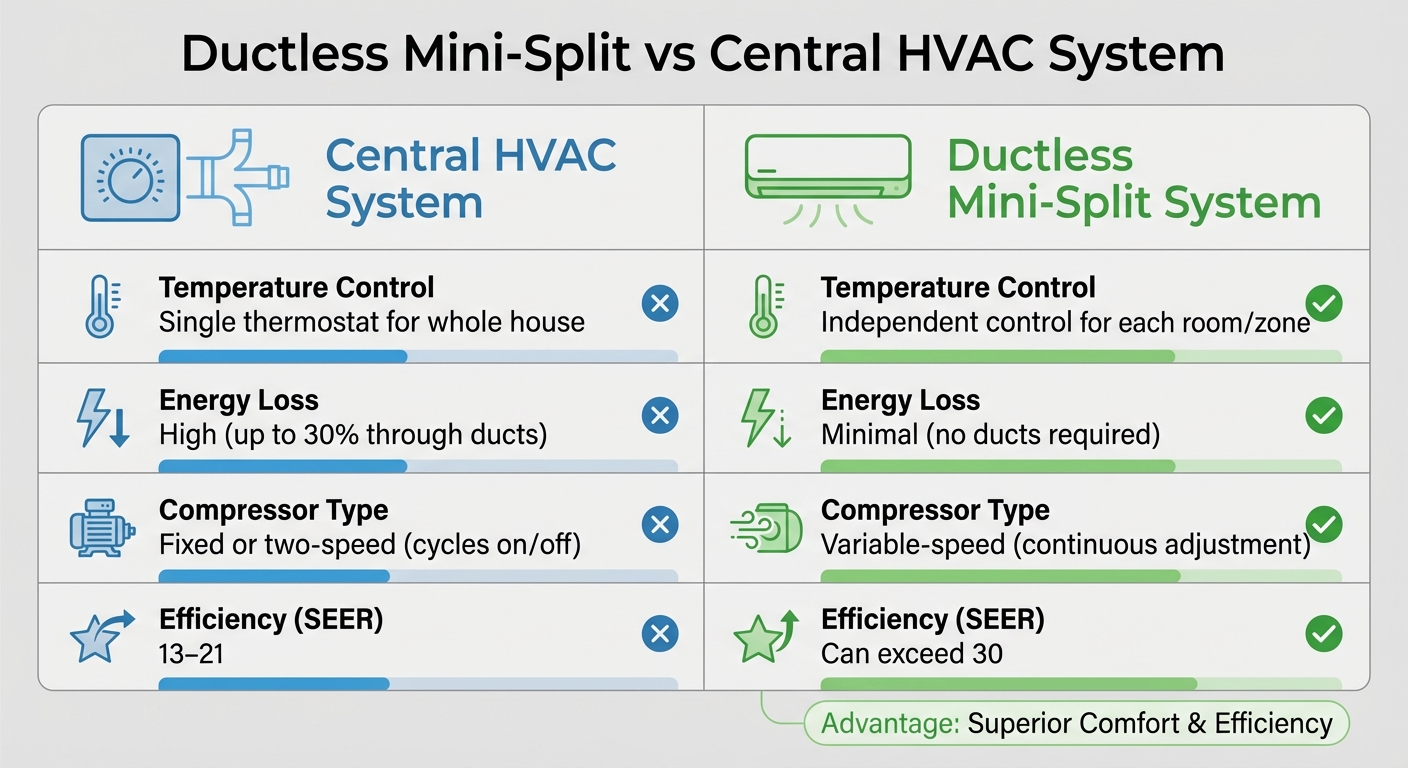
Ductless Mini-Split vs Central HVAC System Comparison
If you’ve ever noticed that some rooms in your house feel 10 degrees hotter or colder than others, you’re not alone. This issue is especially common in homes with central HVAC systems, particularly in multi-story or larger homes where maintaining consistent temperatures can be a challenge. These temperature differences highlight a key limitation of central systems and set the stage for how ductless mini-splits offer a better solution.
Why Central Systems Create Hot and Cold Spots
Central HVAC systems often struggle to provide consistent comfort because they rely on a single thermostat to control the temperature for the entire house. This approach doesn’t account for the unique heating or cooling needs of individual rooms. As a result, when one room reaches the set temperature, other areas may still feel too warm or too cold.
The problem is compounded by fixed-speed compressors, which cycle on and off, causing noticeable temperature swings. Additionally, rooms above garages or in finished attics can have different insulation levels, making it even harder for a central system to maintain uniform temperatures. And let’s not forget leaky ducts – these can reduce the efficiency of conditioned air by the time it reaches distant rooms, leaving them less comfortable.
Independent Temperature Control by Room
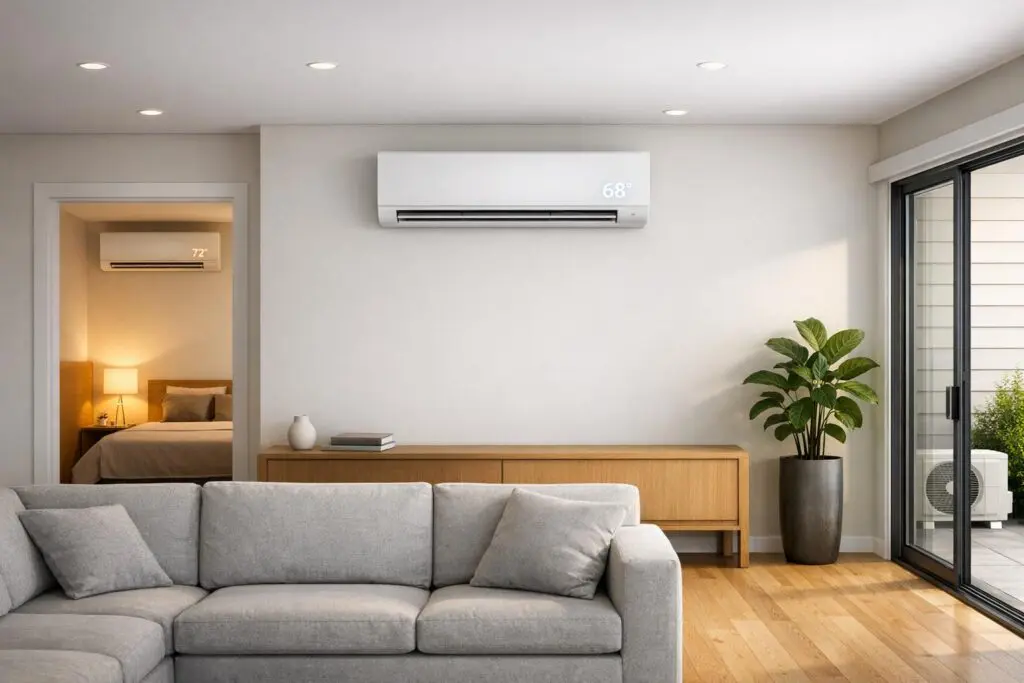
Ductless mini-split systems tackle these issues head-on by providing precise, room-by-room temperature control. A single outdoor unit can power multiple indoor air handlers – usually four to eight – each functioning as its own temperature zone. With individual thermostats controlled by remotes, smart devices, or mobile apps, you can set different temperatures for each room. This means you’re not wasting energy cooling or heating unoccupied spaces.
"With a ductless mini-split, you’re not running up your electric bill to try to cool your master bedroom. The rest of the house won’t be cold as well."
Unlike central systems, ductless mini-splits use variable-speed compressors that adjust continuously to maintain the desired temperature. This eliminates the on-and-off cycling that leads to temperature fluctuations, making them a great choice for homes where central systems fall short in providing consistent comfort.
| Feature | Central HVAC System | Ductless Mini-Split System |
|---|---|---|
| Temperature Control | Single thermostat for whole house | Independent control for each room/zone |
| Energy Loss | High (up to 30% through ducts) | Minimal (no ducts required) |
| Compressor Type | Fixed or two-speed (cycles on/off) | Variable-speed (continuous adjustment) |
| Efficiency (SEER) | 13–21 | Can exceed 30 |
Energy Efficiency and Lower Utility Bills
If you’re looking to save on heating and cooling costs while keeping your home comfortable, ductless mini-splits are a smart choice. These systems can significantly reduce your energy expenses. For example, if your annual heating and cooling costs are about $2,400, switching to a high-efficiency mini-split could save you between $720 and $1,200 each year. Over 15 years, those savings could add up to more than $10,000.
Avoiding Energy Loss Through Ducts
Traditional HVAC systems lose a surprising amount of energy through ductwork. In fact, up to 40% of conditioned air can escape due to leaks, gaps, crushed sections, or poor insulation. Essentially, you’re paying to heat or cool air that never reaches your living spaces.
"Because mini-splits pipe refrigerant – not air – directly to each indoor head, there are almost zero distribution losses." – Mark Callahan, Author
Ductless systems solve this issue by using small, sealed refrigerant lines to deliver heating or cooling directly to each indoor unit. This ensures that 100% of the energy you pay for is used to maintain your home’s temperature. This efficiency is a key factor in their superior performance.
Understanding Efficiency Ratings
Ductless mini-splits outperform traditional systems when it comes to efficiency. They boast SEER2 ratings between 18 and 30+, compared to the 13 to 18 SEER2 range typical of central air conditioners. For heating, an HSPF2 rating of 9 or higher signals excellent performance in colder weather.
The secret lies in inverter technology. These systems use variable-speed compressors that adjust output to match your home’s heating or cooling needs, cutting energy use by 30% to 50% compared to fixed-speed units.
"The secret is the inverter compressor: instead of cycling on/off at full blast, it modulates speed to match the exact load. That smooth operation avoids the energy spikes that plague fixed-speed units." – Mark Callahan, Author
When shopping for a mini-split, look for the ENERGY STAR® label. For non-ducted systems, this means a minimum of 15.2 SEER2 and 8.5 HSPF2. Plus, financial incentives make these systems even more appealing. The federal 25C tax credit offers up to $2,000 for qualifying heat pump mini-splits, and utility rebates can add another $300 to $1,500 in savings.
Better Indoor Air Quality
Ductless mini-split systems are a game-changer for anyone dealing with allergies, asthma, or other respiratory issues. Unlike traditional systems that push air through enclosed ductwork, these systems deliver purified air directly into each room. This approach not only ensures cleaner air but also reduces the spread of allergens, creating a healthier indoor environment.
Air Quality Problems with Ductwork
One major downside of conventional ducted systems is the ductwork itself. Over time, ducts can collect dust, pollen, pet dander, and even mold spores, turning them into a hidden reservoir of airborne contaminants. Every time the system operates, it recirculates these pollutants throughout your home. Even with regular filter changes, the ducts often remain untouched for years because they’re out of sight and difficult to clean.
"The ductwork in conventional HVAC systems can become a breeding ground for allergens, dust, and other airborne contaminants." – Alltemp Air
This hidden buildup makes it challenging to maintain healthy air quality, especially for those sensitive to allergens.
Multi-Stage Filtration in Ductless Systems
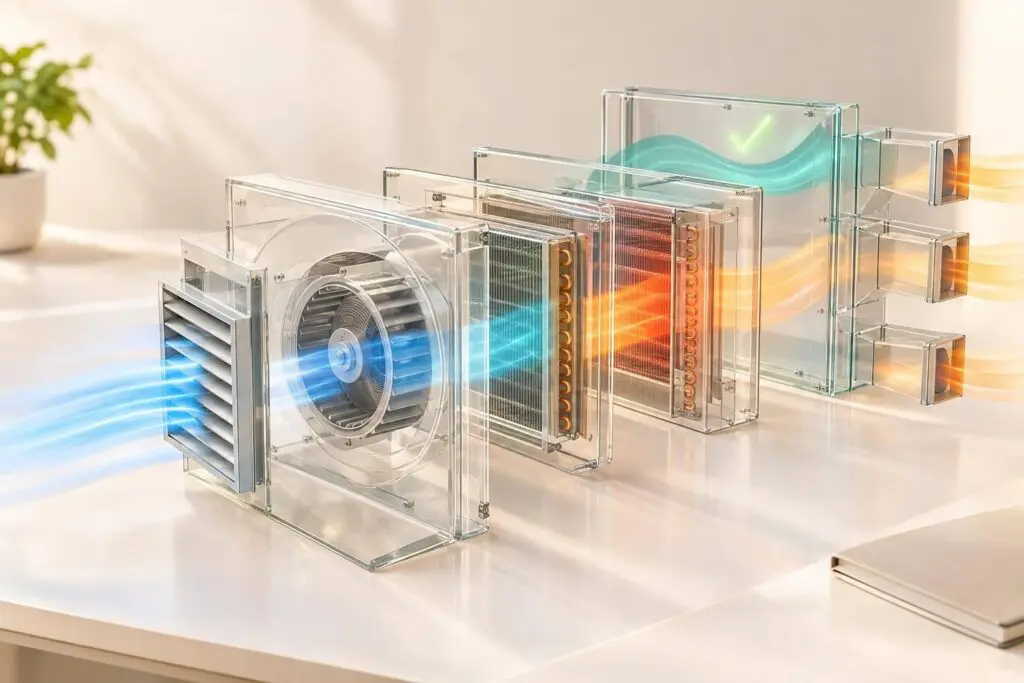
Ductless mini-split systems tackle this issue by eliminating ductwork entirely. In addition to being energy-efficient, they also enhance comfort by supplying cleaner air directly to each room. Each indoor unit is equipped with a multi-stage filtration system designed to trap bacteria, allergens, and mold spores. Without ductwork, there’s no hidden buildup of pollutants to worry about.
"The absence of ducts prevents allergens and contaminants from circulating throughout the space, contributing to improved indoor air quality." – Air & Heat Direct
To keep the system performing at its best, wash the filters monthly and schedule professional cleanings of internal components every two years. Many models even allow for filter upgrades, such as HEPA, antimicrobial, or activated-carbon filters, which target specific issues like odors or microscopic particles. Additionally, features like the built-in "dry mode" help reduce excess moisture, preventing mold, mildew, and dust mites from thriving.
Installation Options for Any Space
Ductless mini-split systems offer incredible flexibility, making them a great choice for almost any space. Whether you’re dealing with a compact basement, a spacious great room with high ceilings, or a garage-turned-living area, there’s an installation option that works. Plus, mini-splits require minimal wall modifications, making installation straightforward and adaptable to various layouts.
Indoor Unit Mounting Options
There are three main ways to install indoor units, tailored to different room types and layouts:
- Wall-mounted air handlers: These are typically installed 6 to 8 feet above the floor, making them ideal for bedrooms, offices, and other smaller spaces.
- Ceiling-mounted units: Options like flush cassettes and suspended units work well in larger rooms with high ceilings, blending seamlessly into the space.
- Floor-standing consoles: Perfect for areas like sunrooms, basements, or home additions where wall space is limited, these units sit near the floor.
"Each indoor air handler mounting type provides effective and efficient heating and cooling to its zone, so don’t worry about sacrificing performance when choosing yours."
- Mattioni Plumbing, Heating & Cooling
These options make it easy to create a comfortable, zone-specific climate without the hassle of ductwork.
Outdoor Unit Placement
The outdoor condenser adds another layer of flexibility to installation. It can be placed up to 50 feet away from the indoor unit, giving you several placement options:
- On a concrete pad for stability
- Mounted on a wall bracket to save ground space
- Positioned on a rooftop for a discreet look
To ensure optimal performance, maintain at least 3 feet of clearance around the unit to avoid hot-air recirculation and allow for easy maintenance. In snowy regions, elevate the unit at least 6 inches off the ground to prevent snow from blocking airflow.
"Keep the line-set length under 50 ft when possible; longer runs add refrigerant pressure losses and may lower capacity on the hottest days."
- Mark Callahan, The Furnace Outlet
With these thoughtful placement options, mini-split systems can be tailored to fit your space while maintaining efficiency and performance.
Is a Ductless Mini-Split Right for Your Home?
If you’re wondering whether a ductless mini-split is the right choice for your home, it often comes down to your specific heating and cooling needs. These systems are especially useful when traditional options aren’t practical. For example, older homes that rely on radiators, baseboard heating, or window AC units can benefit greatly since adding ductwork to such spaces is often expensive and complicated.
Room additions are another common scenario where mini-splits shine. Extending central ductwork into a new space may not always be possible or could violate building codes. Mini-splits also excel in addressing hot or cold spots in your home. Think of rooms like south-facing bedrooms or loft areas – spaces your central system struggles to regulate. The zonal control of a mini-split allows you to target these problem areas directly.
For those using hybrid systems, mini-splits can help reduce costs. If your home relies on oil, propane, or baseboard heating, you can switch to the efficient electric heat pump of a mini-split during milder seasons like spring and fall. However, keep in mind that standard mini-splits may not perform well in temperatures below 20°F. If you live in a colder area, such as Illinois, consider a cold-climate model and consult a professional for guidance.
Before deciding, consider practical factors like the placement of indoor units. While modern designs are sleek and low-profile, they are visible on walls. Installing them on exterior walls is generally best for performance, but interior wall placements may require extra components like condensate pumps. Consulting a professional ensures you choose a system that meets your comfort needs while blending into your space.
Eco Temp HVAC offers expert consultation and installation services throughout Chicagoland. They back their Mitsubishi products with a 12-year warranty and use precise ACCA Manual J load calculations to ensure your system is sized correctly. Their team also helps homeowners take advantage of federal tax credits – up to $2,000 for qualifying air-source heat pumps – and local utility rebates to offset upfront costs.
FAQs
How many indoor units do I need for my home?
The number of indoor units you’ll need depends on factors like your home’s layout, size, and how you use the space. Generally, you’ll need one mini-split unit per room, especially for enclosed spaces that require individual temperature control. In homes with open floor plans, fewer units might suffice if a single unit can cover multiple areas effectively. For instance, a home between 700 and 900 square feet might need 1-3 units, while larger homes could require 3-5 units or more, depending on the insulation and overall design.
Can a mini-split heat my home during a Chicago winter?
Yes, ductless mini-splits are up to the task of keeping your home warm during Chicago’s harsh winters. Thanks to advanced cold-climate heat pump technology, these systems can perform efficiently even when temperatures plunge below zero. This means you can count on consistent and reliable heating throughout the season, no matter how frigid it gets outside.
Where should the indoor and outdoor units be placed?
Proper placement of ductless mini-split units plays a big role in their efficiency. For the outdoor unit, choose a level surface like a concrete pad or a wall bracket. Make sure it has enough clearance and is placed in a shaded spot to shield it from harsh weather. For indoor units, mount them on an interior wall about 7–8 feet high. Avoid areas with direct sunlight or drafts to ensure even air distribution and make maintenance more convenient.