
- HRVs: Ideal for cold, dry climates. They recover heat from outgoing air, reducing heating costs.
- ERVs: Best for humid areas. They manage both heat and moisture, cutting cooling loads.
- Hybrid systems: Combine natural and mechanical airflow for up to 40-60% energy savings.
- Central Fan Integrated Supply Ventilation (CFIS): Leverages existing HVAC systems to improve air quality in Chicago and other urban settings.
Buildings consume over 38% of global energy, with ventilation accounting for 36% of space conditioning energy. Intelligent systems can cut energy use by up to 60% while maintaining healthy indoor air. With urban populations growing, these solutions are critical for balancing comfort, air quality, and energy efficiency.
How Does Energy Recovery Ventilation Work? | This Old House

Heat Recovery and Energy Recovery Ventilators
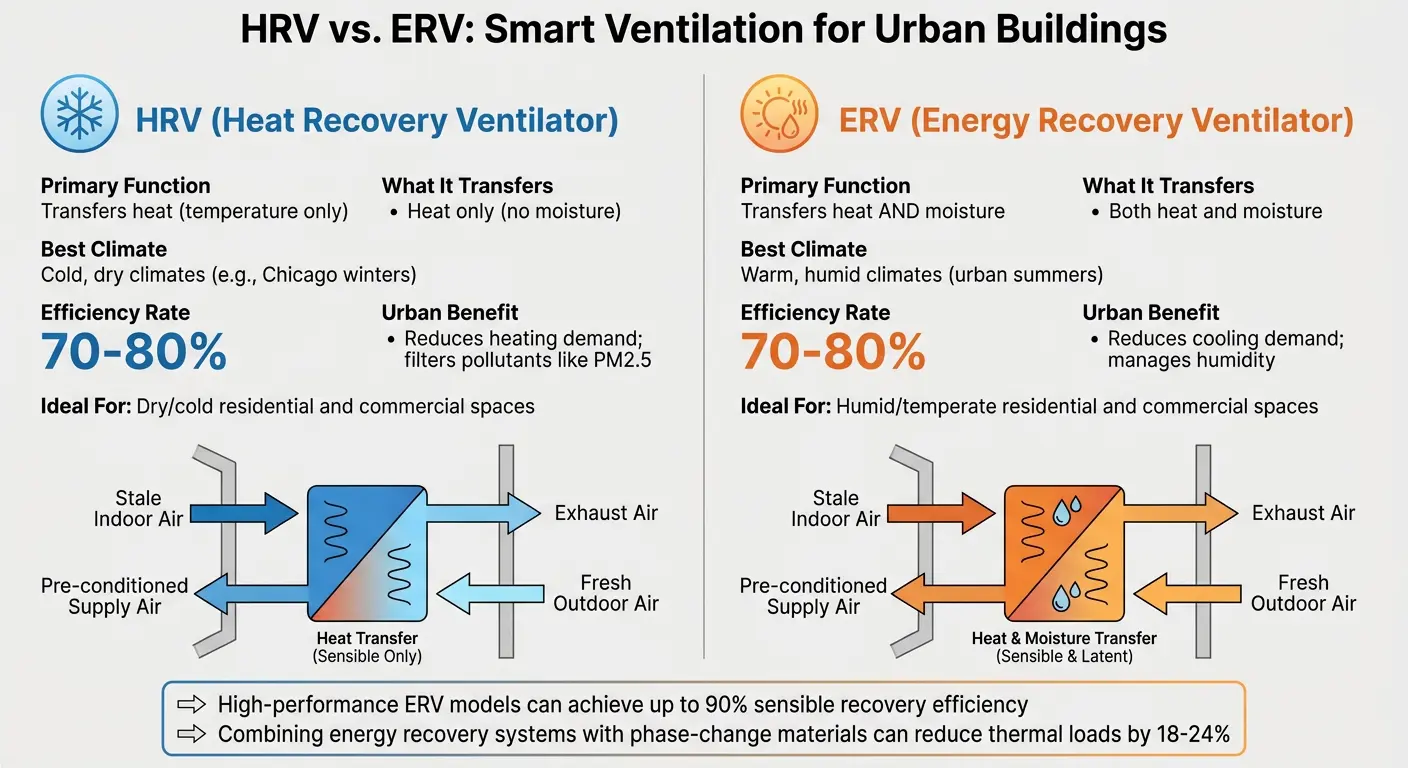
HRV vs ERV Ventilation Systems: Climate-Based Comparison
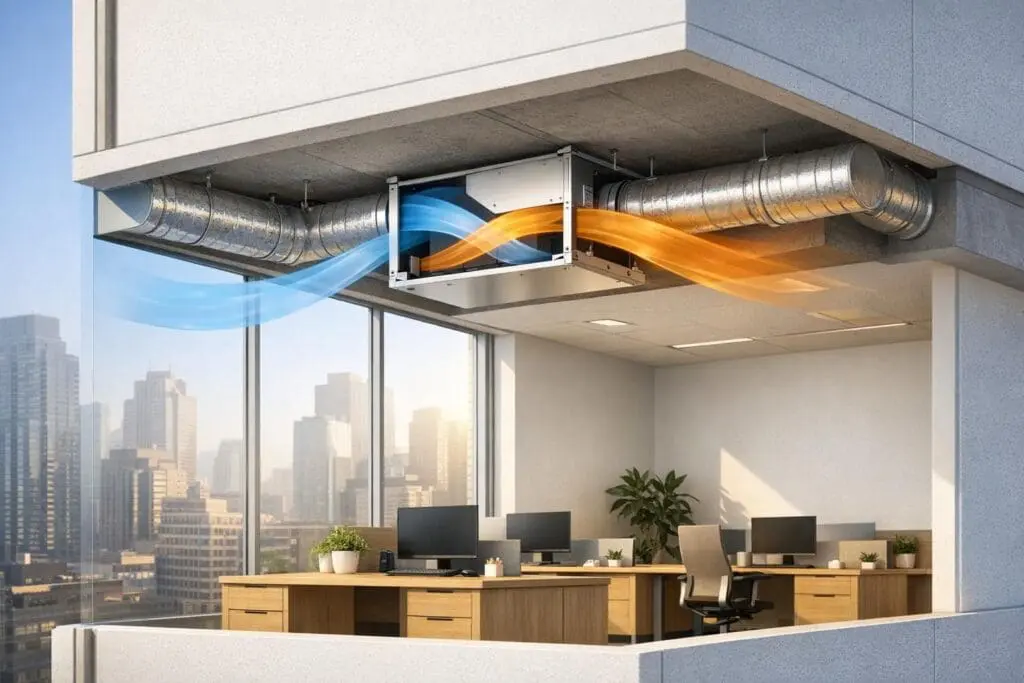
Heat Recovery Ventilators (HRVs) and Energy Recovery Ventilators (ERVs) are systems designed to exchange thermal energy between exhaust air and incoming fresh air through a heat exchanger. In airtight buildings, they help maintain indoor air quality while minimizing energy loss. This is especially important in urban environments where pollutants like PM2.5 and VOCs are common. The main difference? HRVs transfer only heat, while ERVs transfer both heat and moisture. This distinction makes each system better suited to specific climate challenges, particularly in cities.
Here’s how they operate based on climate needs:
Heat Recovery Ventilators (HRVs)
HRVs are ideal for colder climates. They recover heat from outgoing air and use it to preheat the incoming air, cutting down on heating costs without introducing extra moisture. This makes them especially useful in dry, cold conditions where retaining heat is critical.
For example, since 2019, the National Renewable Energy Laboratory (NREL) and Elevate have partnered with the City of Chicago and ComEd to implement energy retrofits. By tailoring the ResStock energy model to Chicago’s housing, they developed solutions – like advanced ventilation systems and heat pumps – that led to over 50% energy savings in Chicago’s single-family and small multi-unit homes.
Energy Recovery Ventilators (ERVs)
ERVs, on the other hand, are better suited for humid climates. They transfer both heat and moisture, which helps manage indoor humidity levels while reducing the cooling load during hot, humid summers. This dual capability makes them particularly effective in urban areas with high outdoor humidity.
In polluted cities, ERVs also provide filtered fresh air while controlling indoor humidity. For instance, high-performance models like Panasonic’s Intelli-Balance Elite series can achieve up to 90% sensible recovery efficiency. Research has also shown that combining energy recovery systems with phase-change materials can reduce thermal loads by 18% to 24%.
"Energy recovery ventilators (ERV) are used to retain the thermal conditions of a building while allowing fresh air exchange." – Sustainable Energy Research
Comparing HRVs and ERVs
| Feature | Heat Recovery Ventilator (HRV) | Energy Recovery Ventilator (ERV) |
|---|---|---|
| Primary Function | Transfers heat (temperature only) | Transfers heat and moisture |
| Best Climate | Cold, dry climates (e.g., Chicago winters) | Warm, humid climates (urban summers) |
| Efficiency Rate | 70–80% | 70–80% |
| Urban Benefit | Reduces heating demand; filters pollutants like PM2.5 | Reduces cooling demand; manages humidity |
| Suitability | Ideal for dry/cold residential and commercial spaces | Best for humid/temperate residential and commercial spaces |
Both systems work most efficiently at low flow velocities, ensuring maximum thermal recovery. However, ERVs are particularly sensitive to higher speeds, which can affect their performance. To maintain efficiency and ensure clean air, regular filter replacement is a must – especially in urban areas where pollutants can accumulate.
Balanced and Hybrid Ventilation Systems
When it comes to ensuring fresh air and energy efficiency, balanced and hybrid ventilation systems offer alternative solutions to traditional heat and energy recovery ventilators. These systems take different approaches to managing airflow and adjusting to outdoor conditions.
Balanced Ventilation Systems
Balanced ventilation relies on mechanical fans to handle both supply and exhaust air, maintaining equalized building pressure. These systems often include heat recovery ventilators (HRVs) or energy recovery ventilators (ERVs) to capture and reuse thermal energy during the air exchange process. One big advantage here is the ability to deliver consistent, filtered air year-round – especially important in cities where outdoor air quality can vary widely.
Unlike systems that depend on natural pressure differences, balanced ventilation ensures steady indoor air quality through continuous filtration. This predictability makes it easier to comply with standards like ASHRAE 62.1 (for commercial buildings) and 62.2 (for residential spaces), as airflow rates can be independently tested and verified. However, when outdoor conditions fluctuate significantly, hybrid systems provide a more flexible alternative.
Hybrid Ventilation Systems
Hybrid systems, often referred to as mixed-mode ventilation, combine natural airflow (via operable windows or automated dampers) with mechanical systems. They switch between these modes based on outdoor conditions – using natural ventilation when the weather is favorable and mechanical systems when the air outside is too hot, cold, or polluted.
A case study conducted in January 2025 at Oslo Metropolitan University demonstrated the potential of hybrid systems. In a 763 m² (about 8,200 ft²) office building, researchers installed automated windows (0.4 m, or roughly 1.3 ft, high) integrated with a variable air volume (VAV) system. Under future climate scenarios (RCP 8.5), the hybrid approach achieved a 40% reduction in energy use compared to fully mechanical ventilation. It also extended natural ventilation periods by about 6%, leading to better CO₂ dilution indoors.
"Hybrid ventilation, facilitated by automated window opening, presents a promising strategy for reducing energy consumption while maintaining comfortable indoor temperatures."
– Mehrdad Rabani, Department of Built Environment, Oslo Metropolitan University
To maximize efficiency, advanced controls like Model Predictive Control (MPC) or Deep Reinforcement Learning (DRL) can manage the switch between natural and mechanical modes. These systems also rely on multi-parameter sensors (monitoring CO₂, VOCs, and PM2.5) to prevent outdoor pollutants from entering during natural ventilation periods. With proper controls in place, hybrid systems can achieve energy savings of up to 60% without compromising indoor air quality.
| Feature | Balanced Ventilation (Mechanical) | Hybrid Ventilation (Mixed-Mode) |
|---|---|---|
| Energy Source | Continuous electrical power for fans | Natural airflow with occasional fan assistance |
| Energy Efficiency | High with HRV/ERV but limited by fan energy use | Very high; potential energy savings of 40–60% |
| Air Quality (IAQ) | Consistent, filtered, and reliable | Variable; excellent CO₂ control but some risk of outdoor pollutants |
| Weather Dependency | Independent of wind or temperature | Heavily dependent; performance varies by climate |
| Urban Code Compliance | Easier to meet airtightness and filtration standards | Requires advanced controls to meet exchange rate requirements during "closed" periods |
Central Fan Integrated Supply Ventilation
Central fan integrated supply ventilation, or CFIS, is a practical option for urban buildings looking to improve air quality without the need for entirely new infrastructure. By using the existing HVAC system’s fans and ductwork, CFIS systems bring filtered outdoor air into the building, addressing challenges like poor air quality in urban areas while keeping costs manageable. This approach is especially useful in airtight buildings where natural air infiltration isn’t sufficient for proper ventilation.
How it works: A 6-inch outdoor air intake duct connects to the return side of the air handler. A motorized damper and cycling control ensure the system runs the central fan for about 15% of its operation time to meet ventilation requirements. Once the ventilation targets are met, the damper closes automatically, preventing over-ventilation and minimizing the conditioning of outdoor air.
"Building enclosures must be ‘built tight and then ventilated right.’ Because before you can control air you must enclose it."
– buildingscience.com
One standout benefit of CFIS is its ability to distribute filtered air directly to living spaces. This is particularly important in urban settings where outdoor air quality can vary significantly.
A study from May 2024 by Joanna Ferdyn-Grygierek and Krzysztof Grygierek at the Silesian University of Technology highlighted the efficiency of mechanical ventilation systems. The research showed these systems achieved around 50% energy savings compared to natural ventilation while keeping CO₂ levels at approximately 930 ppm – well below the 2,500 ppm often seen with natural ventilation.
For compliance with ASHRAE 62.2 standards, systems like the Panasonic SelectCycler® offer automated fresh air management. These systems use programmable controllers and motorized dampers to ensure proper ventilation. However, successful implementation depends on careful commissioning. During installation, supply and exhaust airflow must be measured and adjusted to meet design specifications, avoiding issues like stagnant air or uneven distribution. When paired with an Electronically Commutated Motor (ECM) fan in the air handler, CFIS systems further improve energy efficiency, especially during ventilation-only cycles.
For expert assistance with CFIS integration in urban buildings, consider reaching out to Eco Temp HVAC, serving the Chicagoland area.
Chicago Ventilation Codes and Standards
In Chicago, mechanical ventilation is required when air infiltration falls below 5 ACH (air changes per hour), as determined by a blower door test at 50 Pascals.
"Where the air infiltration rate in a dwelling unit is less than 5 air changes per hour… the dwelling unit shall be ventilated by mechanical means." – Municipal Code of Chicago
These regulations guide the design of ventilation systems that meet strict airflow and energy standards, especially in modern urban homes. In properties built under the 2022 Energy Transformation Code, whole-house systems must deliver at least 0.35 ACH (or a minimum of 15 CFM per person) while maintaining balanced supply, return, and exhaust airflow.
Specific requirements for ventilation include:
- Bathrooms: 20 CFM for continuous exhaust or 50 CFM for intermittent exhaust.
- Enclosed kitchens: 50 CFM continuous exhaust.
- Open-concept kitchens: Either a 100 CFM vented range hood or 300 CFM intermittent exhaust.
Interestingly, designing kitchens as enclosed spaces can reduce exhaust requirements, which helps urban developers lower energy demands.
Chicago also allows demand-controlled ventilation (DCV) systems, which adjust outdoor air delivery based on CO₂ levels, provided they stay below 1,000 ppm. Additionally, the Residential High-Rise Mechanical Ventilation Pilot Program, extended through March 31, 2026, is testing mechanical-only systems as an alternative to natural ventilation in tall residential buildings.
For those navigating these complex codes while aiming to optimize energy performance, Eco Temp HVAC offers certified expertise in mechanical ventilation systems across the Chicagoland area.
Conclusion
Balancing indoor air quality with energy efficiency is no small feat, but energy-efficient ventilation systems in urban buildings are proving it’s possible. With intelligent designs, these systems can cut energy use by up to 60% while maintaining healthy indoor environments – showing that comfort and efficiency can coexist.
The strategies discussed – ranging from heat recovery ventilators to hybrid systems and central fan integrated supply ventilation – share a common goal: delivering fresh air precisely when and where it’s needed. Advanced sensors that monitor CO₂, volatile organic compounds (VOCs), and particulates ensure ventilation systems address a broad spectrum of indoor pollutants.
Take passive pipe systems as an example. When incorporated into building envelopes, they can improve ventilation rates by roughly 158%. Urban ventilation corridors, on the other hand, offer another way to enhance natural airflow in dense cityscapes.
For buildings in Chicago, where strict ventilation codes and rising energy costs are pressing concerns, these technologies offer practical solutions. Real-time adaptive systems like demand-controlled ventilation and Model Predictive Control blend passive and active strategies to reduce energy loads while maintaining comfort.
As cities grow and climate challenges intensify, buildings equipped with coordinated, efficient ventilation systems will stand out. Whether modernizing an older property or designing a new one, the evidence is clear: smarter ventilation leads to healthier spaces and lower costs. For expert guidance on implementing these advanced systems in Chicagoland, Eco Temp HVAC offers tailored solutions for both residential and commercial projects.
FAQs
Should I choose an HRV or an ERV for my building’s climate?
When deciding between an HRV (Heat Recovery Ventilator) and an ERV (Energy Recovery Ventilator), your local climate plays a big role.
- ERVs are a better fit for humid areas or situations where controlling indoor moisture levels is crucial. They transfer both heat and moisture, helping to maintain balanced humidity indoors.
- HRVs are more suitable for colder, drier climates. They focus on transferring heat without affecting moisture, which helps to minimize energy loss during ventilation.
The choice ultimately depends on your environment and specific needs to ensure better air quality and energy use.
Can hybrid ventilation work in a polluted city without harming indoor air quality?
Hybrid ventilation systems, which blend natural and mechanical methods, can function effectively in polluted urban areas when carefully managed. Research indicates these systems can maintain healthy indoor air by monitoring outdoor pollution levels and adjusting ventilation accordingly. Adding features like air purifiers and smart controls helps minimize pollutants while also saving energy. With thoughtful design, these systems can deliver clean indoor air without sacrificing energy efficiency, even in cities with significant outdoor pollution challenges.
Will a CFIS setup meet Chicago ventilation code without major ductwork changes?
A Continuous Fresh Air Supply (CFIS) system can meet the requirements of the Chicago ventilation code when it incorporates adequate relief openings and exhaust systems. That said, adjustments to the ductwork might still be necessary, depending on the building’s existing layout.