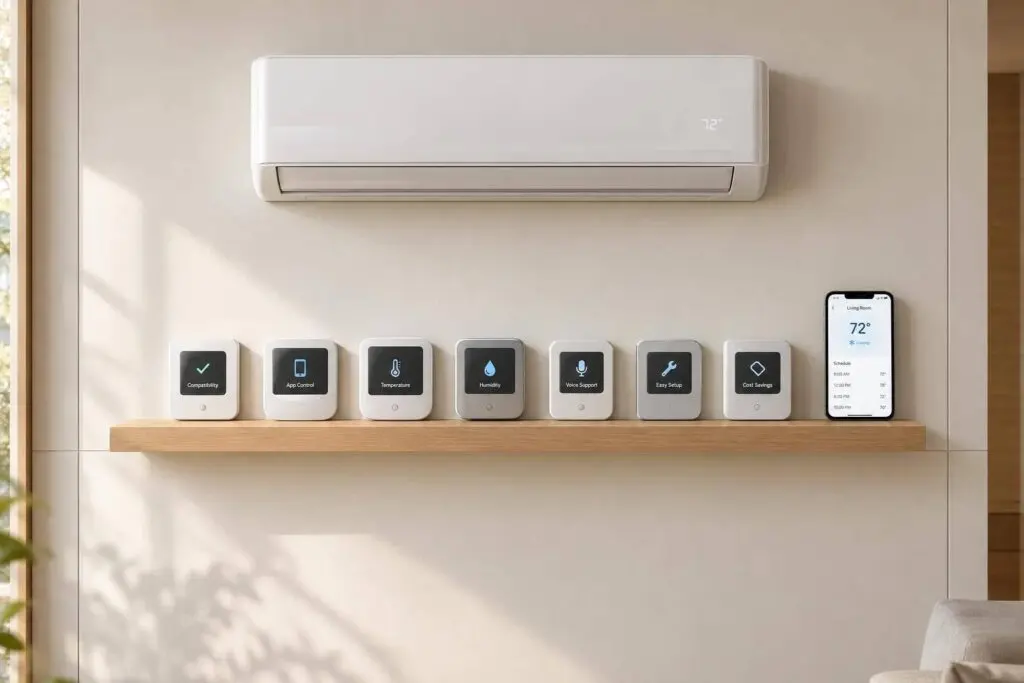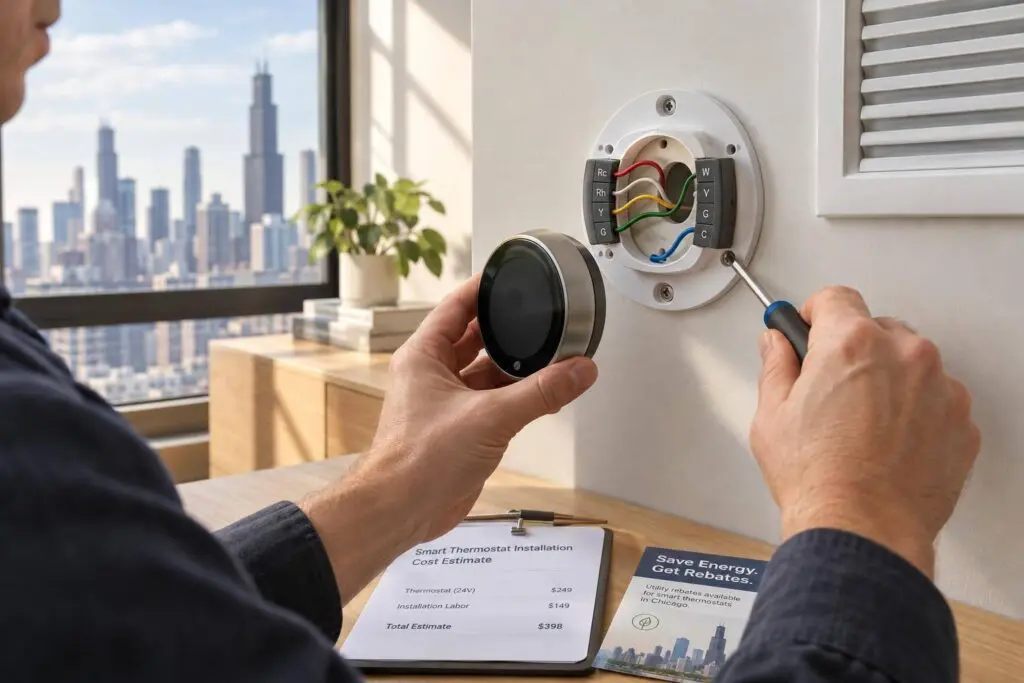

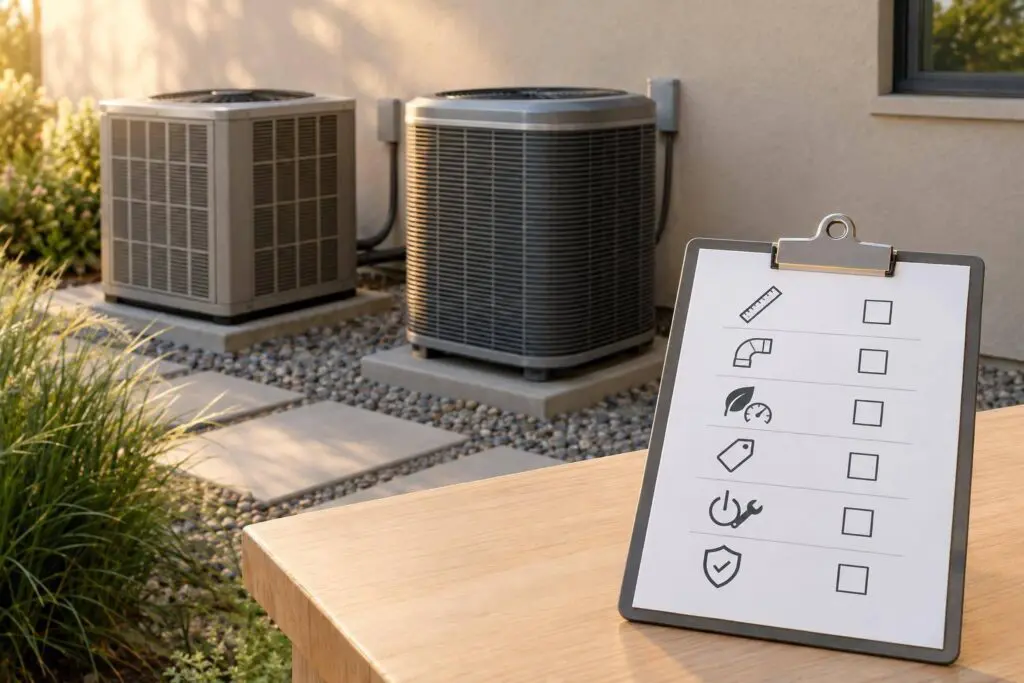
I’d choose inverter AC for steadier temperatures and single-stage AC for a lower upfront price – but only after checking the installation needs. An inverter adjusts cooling output; a single-stage system runs at 100% of its rated capacity whenever its compressor is on.
For a Chicagoland home or small business, I’d compare ductless mini split vs. traditional central HVAC systems before signing:
- Comfort and noise: Temperature swings, moisture removal, cycling, and published sound ratings.
- Property fit: A written load calculation, measured airflow and duct pressure, matched equipment, and enough electrical capacity.
- Total cost: Itemized installed prices, exact-system efficiency ratings, estimated electricity costs, maintenance, and repairs.
- Installation protection: Startup test results, permits, equipment records, and separate written parts and labor warranties.
Quick Comparison
| What I’d compare | Inverter AC | Single-stage AC |
|---|---|---|
| Cooling output | Varies within a capacity range | One fixed capacity |
| Temperature and humidity | May provide steadier control | Depends more on sizing and cycling |
| Noise | May be quieter at low output | Starts and stops may be more noticeable |
| Upfront price | Usually higher | Usually lower |
| Electricity use | May use less at partial load | Depends on efficiency and runtime |
| Controls and repairs | May need specific controls and electronics | Usually simpler; check parts availability |
My rule: <u>compare complete installed systems, not equipment prices alone</u>. Neither design fixes poor sizing or weak airflow, and lower electricity use does not guarantee that a higher purchase price will pay off.
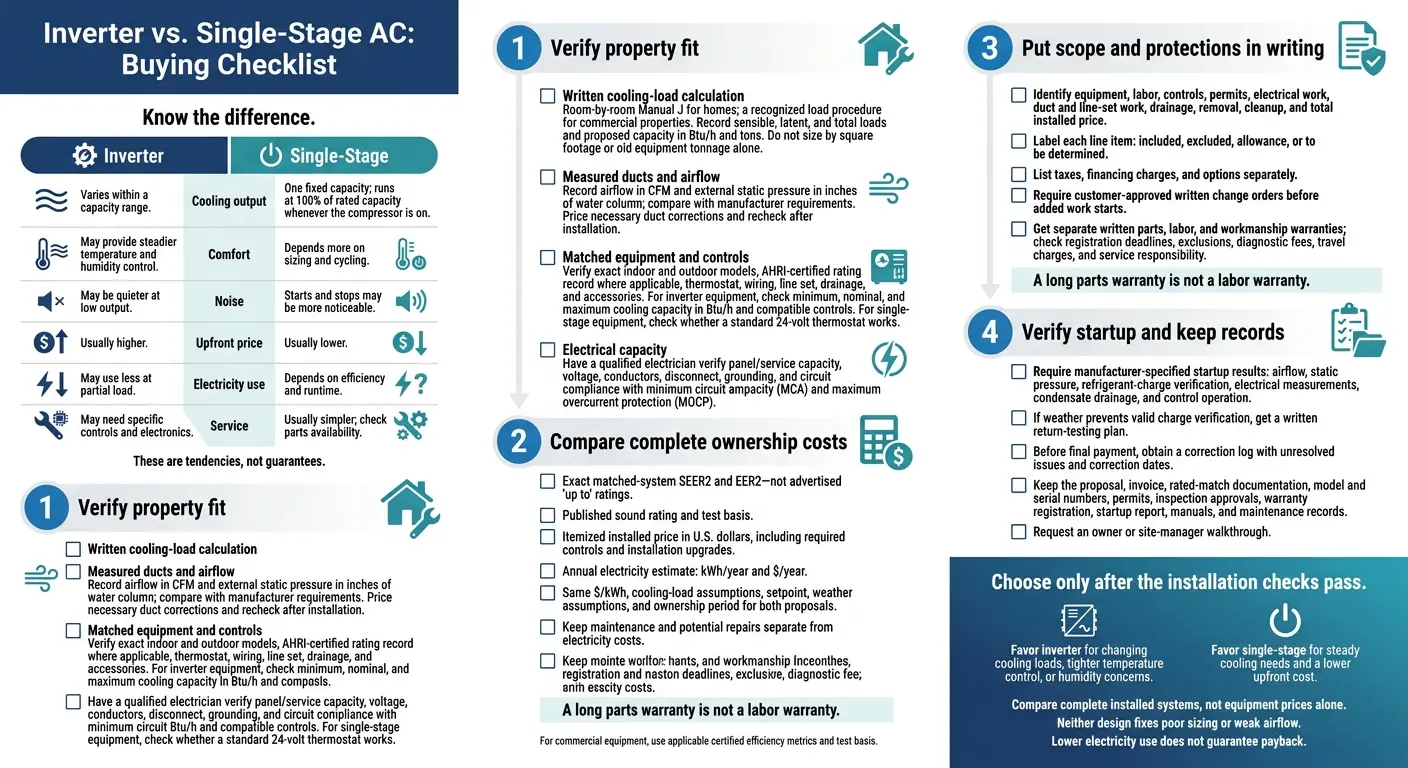
Inverter vs. Single-Stage AC: Buying Checklist
Don’t Buy A New AC Until You Watch This! Inverter vs Base Model Explained
Compare Inverter and Single-Stage AC
Before comparing quotes, look at how each system controls cooling output, comfort, and operating costs.
| Factor | Inverter AC | Single-stage AC |
|---|---|---|
| Compressor operation | Adjusts speed within a capacity range | Runs at one capacity and cycles on and off |
| Temperature control | Longer runs at lower output may reduce temperature swings | Temperature changes may be more noticeable between cycles |
| Humidity control | Longer cycles may remove more moisture when airflow and controls support it | Can control humidity adequately, but short cycling limits moisture removal |
| Noise | May be quieter at low output; check the published sound rating | Starts and stops may be more noticeable |
| Upfront cost | Often higher due to electronics and required controls | Often lower, unless ducts, electrical systems, or controls need upgrades |
| Operating costs | Part-load efficiency may lower electricity use | Depend on rated efficiency, runtime, and cycling |
| Repair complexity | Specialized electronics can make diagnosis and parts sourcing harder | Simpler controls may make repairs easier; check parts availability |
These are tendencies, not guarantees. Sizing, matched equipment, controls, ducts, and installation determine how either system performs at your property.
Inverter AC: Check Capacity Range and Controls
Check the minimum, nominal, and maximum cooling capacity in Btu/h, along with the outdoor temperatures at which the system can vary its output. During mild Chicagoland weather, an inverter still has to cycle if its minimum capacity exceeds the cooling load.
Confirm the approved coil, furnace or air handler, sensors, wiring, and thermostat. Ask whether a conventional thermostat would limit variable-output operation or humidity features. Verify the equipment combination through an AHRI-certified rating record that lists the outdoor model, indoor coil or air handler, rated capacity, SEER2, and EER2.
Before buying, ask about technician training and the availability of replacement electronics and other parts.
Single-Stage AC: Check Cycling and Comfort
Confirm that the system runs at a fixed capacity. Discuss expected cycling, startup noise, temperature swings, and moisture removal.
Check whether a standard 24-volt thermostat will work and whether any comfort features require a variable-speed indoor blower. Ask about diagnostic charges, capacitor and compressor replacement costs, and parts availability. Simpler equipment still needs correct sizing – oversizing can cause problems.
Compare Efficiency Ratings and Ownership Costs
Compare the exact equipment combinations in each proposal, not advertised “up to” ratings. SEER2 measures seasonal cooling efficiency, while EER2 measures efficiency at a specified test condition.
Use certified records, published specifications, and itemized quotes to fill in the comparison below.
| Required quote entry | Inverter proposal | Single-stage proposal |
|---|---|---|
| Equipment identification | Exact outdoor and indoor models, plus AHRI reference | Exact outdoor and indoor models, plus AHRI reference |
| Certified efficiency | Actual matched-system SEER2 and EER2 | Actual matched-system SEER2 and EER2 |
| Cooling capacity | Rated Btu/h plus minimum–maximum range | Rated Btu/h |
| Published sound rating and test basis | Sound rating and test basis | Sound rating and test basis |
| Installed price | Total in U.S. dollars, including required controls | Total in U.S. dollars, covering the same installation scope |
| Annual operating estimate | kWh/year and electricity cost in $/year | kWh/year and electricity cost in $/year |
| Assumptions used | Maintenance allowance, repair complexity, and assumed ownership period | Maintenance allowance, repair complexity, and assumed ownership period |
Use the same electricity rate in $/kWh, cooling-load profile or equivalent full-load hours, indoor setpoint, weather assumptions, and ownership period for both proposals. Keep annual maintenance and potential repair costs separate from electricity costs.
For commercial equipment, use the applicable certified efficiency metrics and test basis rather than residential ratings. Neither an efficiency rating nor a lower estimated electric bill guarantees payback.
Check Property and Equipment Requirements
Before choosing either AC type, check whether your property can support it. Variable-capacity operation won’t fix an incorrect load estimate, unsuitable ducts, or inadequate electrical infrastructure.
Get a Documented Cooling-Load Calculation
For either AC type, request a written cooling-load calculation – not a square-foot estimate or the old system’s tonnage. For homes, use room-by-room Manual J. For commercial properties, use a recognized load procedure.
The calculation should document local outdoor design conditions, indoor design temperature, window orientation, insulation, air leakage, occupancy, ventilation, lighting, and equipment. It should also show sensible, latent, and total loads, along with proposed capacity in Btu/h and tons.
Room-by-room calculations help spot hot or undercooled rooms that a whole-building total can hide. Confirm that equipment selection follows Manual S or an equivalent manufacturer-approved procedure.
Check Ducts, Airflow, and Static Pressure
Have the contractor inspect supply and return ducts, registers, grilles, dampers, insulation, accessible joints and connections, filters, transitions, and restricted or crushed sections. Include leakage testing where warranted.
Require measured airflow and static pressure – not assumptions. Record airflow in CFM and external static pressure in inches of water column. Compare those readings with the manufacturer’s required airflow and maximum allowable static pressure.
Ask for a written list that separates immediate corrections from optional improvements. Before buying, get prices for needed sealing, duct resizing, added returns, or compatible zoning. Require another airflow and pressure check after installation. If the proposal includes zoning, confirm that the duct layout, bypass strategy, dampers, controls, and minimum airflow are approved for the selected equipment.
Verify Matched Equipment
After checking sizing and airflow, confirm that the proposed equipment match can be installed correctly. Record every installed component and verify that the indoor and outdoor units are a matched set.
Include model numbers for the outdoor unit, indoor coil or air handler, furnace when applicable, thermostat, metering device, controls, filter assembly, and accessories. Confirm the required airflow, indoor fan settings, refrigerant, and compatible line set size and length.
The proposal should state whether the line set will be reused or replaced. It should document its diameter, length, vertical rise, insulation condition, cleanliness, and refrigerant compatibility.
Also check cabinet fit, condensate drainage, filter size, thermostat compatibility, and required communication wiring. Matched equipment doesn’t mean the existing installation components will work with it.
Check Electrical Capacity and Circuit Requirements
Have a qualified electrician check service and panel capacity, voltage, conductors, breaker or fuse size, disconnect, grounding, and local code requirements. The proposed circuit must meet the unit’s minimum circuit ampacity (MCA) and maximum overcurrent protection (MOCP) ratings.
Verify that the service can handle the new load alongside existing major loads. Before signing, make sure the written price includes required panel, wiring, disconnect, and permit work. Use these requirements to screen quotes before comparing prices and warranty terms.
Review Quotes, Startup Tests, and Warranties
Once you’ve matched the equipment to the job, get the final cost, startup test requirements, and warranty terms in writing.
Get Itemized Prices and Installation Details
Compare fully installed bids – not equipment-only prices. Ask for a written scope based on the verified load, ducts, electrical capacity, and matched equipment. Equipment, labor, and installation charges should appear separately. Label every line item as included, excluded, allowance, or to be determined.
| Proposal item | Required details in each proposal |
|---|---|
| Equipment | Manufacturer, model numbers, capacity, rated efficiency, controls, accessories, and inverter capacity range |
| Installation scope | Inverter: labor and controls setup; single-stage: labor and thermostat setup |
| Permits and electrical | Permits, inspections, and required electrical work |
| Duct and refrigerant work | Duct corrections, line-set work, refrigerant charge, and condensate drainage |
| Removal and cleanup | Equipment disposal, cleanup, and lift costs if needed |
| Total installed price | Total in U.S. dollars, with taxes, financing charges, and options listed separately |
| Exclusions and assumptions | Reused parts, concealed conditions, and structural repairs |
| Startup and records | Startup tests, AHRI match record, and owner or site-manager walkthrough |
| Warranty and service | Parts, labor, workmanship, registration, fees, and service responsibility |
The contract should name who gets permits, schedules inspections, and fixes issues that cause failed inspections. List any reused components and explain how hidden problems will be handled. Price additional work separately or mark it as excluded.
Require customer-approved written change orders before added work starts. Each should state the reason, material and labor costs, tax, and schedule impact. An excluded repair is not a discount.
With the scope settled, check that the installed system performs as promised.
Require Startup Tests and System Records
Require the manufacturer-specified startup report – not a generic “system tested” note. It should record airflow in CFM, external static pressure, the refrigerant-charge verification method and results, electrical measurements, condensate drainage, and control operation. If the weather prevents valid charge verification, get a written plan for return testing.
Before final payment, get a correction log listing unresolved deficiencies and correction dates. Put any agreed payment holdback in the contract. Also request an owner or site-manager walkthrough that explains normal inverter modulation or single-stage cycling.
Keep these documents in one file: the signed proposal, final invoice, AHRI matched-system certificate or equivalent rated-match documentation, model and serial numbers, permits, inspection approvals, warranty registration confirmation, startup report, manuals, and maintenance records.
Warranty coverage also needs to be spelled out in the contract.
Get Parts and Labor Warranties in Writing
A long parts warranty is not a labor warranty. Get separate written terms for covered components, labor, workmanship, refrigerant leak detection, repair and recharge, diagnostic fees, and travel charges. Those terms should also explain maintenance duties, exclusions, transferability, and how claims are handled.
Ask Eco Temp HVAC to identify the exact equipment and provide written proof of parts coverage, labor coverage, the registration deadline, and any property or owner requirements.
Complete the Checklist Before Buying
After comparing both system types, don’t sign until the proposal passes the full checklist and answers every sizing and installation question.
Once those checks are complete, favor inverter AC for changing cooling loads, tighter temperature control, or humidity concerns. Favor single-stage AC for steady cooling needs and a lower upfront cost. Compare actual proposals based on installed price, expected operating costs, comfort benefits, and service requirements.
Request a Local Evaluation from Eco Temp HVAC
Request an evaluation from Eco Temp HVAC for a local review of the full checklist. Ask for a documented load evaluation, duct and airflow assessment, electrical-capacity check, matched-equipment proposal, itemized installation scope, startup-testing plan, and written warranties covering parts, labor, and workmanship.
Before the visit, gather equipment model numbers, recent utility bills, and notes on room-by-room comfort issues. Clear access to the indoor unit, outdoor unit, and accessible duct runs so the evaluation reflects your property’s actual conditions.
FAQs
Is inverter AC worth the extra cost in Chicagoland?
An inverter-driven (variable-speed) AC costs more upfront than a standard unit, but it costs less to run, runs more quietly, and removes more humidity. These systems typically carry ratings of 18 SEER2 or higher and may qualify for the largest federal tax credits, plus local utility rebates, depending on eligibility and availability.
Whether the extra cost makes sense depends on how long you plan to stay in your home, your electricity bills, and how much you value comfort and energy efficiency compared with a lower purchase price.
Can I keep my existing furnace with an inverter AC?
You can often keep your existing furnace when upgrading to an inverter air conditioner. Whether it will work depends on your ductwork’s condition and design, your electrical capacity, and the furnace’s ability to meet the new system’s airflow needs.
Have an HVAC professional check your setup to confirm it can support the new unit safely and efficiently without performance problems.
Which warranty exclusions should I watch for?
Check registration deadlines and installation exclusions. Some manufacturers require you to register your system within a set time to receive the full parts warranty. Have a certified professional install it to help avoid coverage denials due to improper installation.
Eco Temp HVAC handles manufacturer registration for you and offers a straightforward labor warranty.