
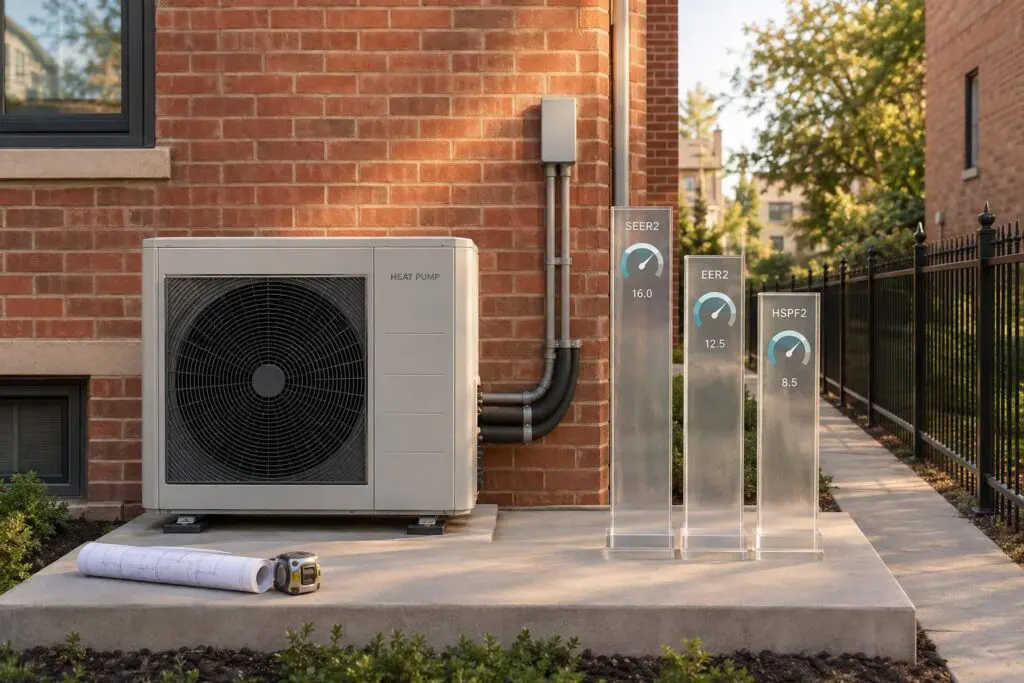
I compare SEER for seasonal cooling, EER for cooling at one test condition, and HSPF for seasonal heat-pump heating – not against each other. When shopping, check the current SEER2, EER2, and HSPF2 ratings, introduced under updated U.S. testing on January 1, 2023.
Quick Comparison
| Rating | What it measures | When I use it |
|---|---|---|
| SEER / SEER2 | Cooling efficiency over a season | Comparing seasonal AC or heat-pump cooling |
| EER / EER2 | Cooling efficiency at a fixed test condition | Comparing hot-weather cooling |
| HSPF / HSPF2 | Heat-pump heating efficiency over a season | Comparing winter heating |
For Chicagoland, I also check <u>heat pump heating efficiency, backup heat, proper sizing, and installation quality</u>. When hiring, ensure you find the best HVAC services to guarantee peak performance. ENERGY STAR cold-climate heat pumps must retain at least 70% of their 47°F heating capacity at 5°F, but that alone doesn’t confirm they can heat your building.
My bottom line: compare matched systems under the same test standard, then ask for installed prices and annual cost estimates. A higher rating isn’t a promise of a lower bill.
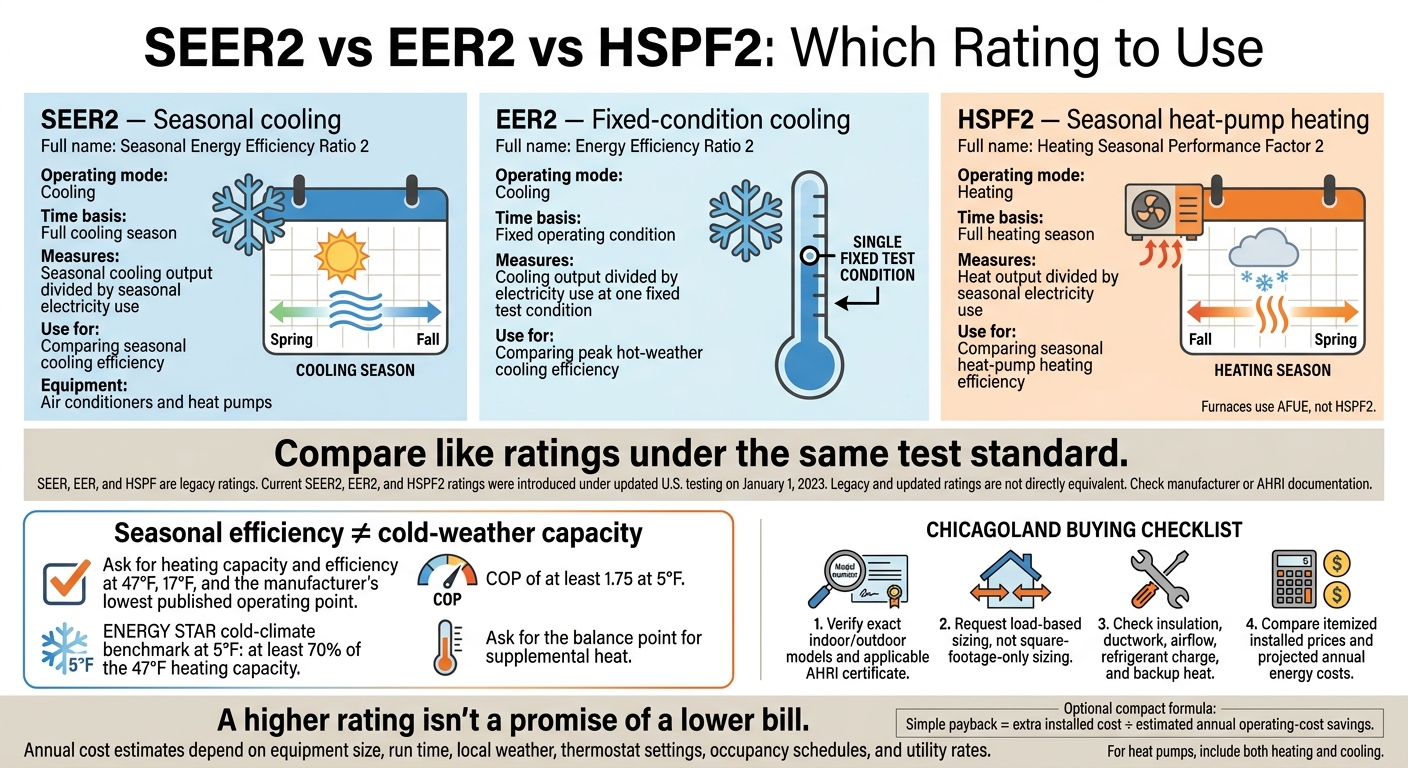
SEER2 vs EER2 vs HSPF2: Which Rating to Use
Energy efficiency EER SEER HSPF COP
sbb-itb-b5c10b1
What SEER, EER, and HSPF Measure
Residential central air conditioners and new heat pumps use SEER2, EER2, and HSPF2 under the current federal test procedure. These ratings let you compare models on the same scale. Each measures a different part of cooling or heating efficiency.
SEER: Cooling Efficiency Over a Season
SEER measures how efficiently an AC or heat pump cools over an entire season. Use SEER2 to compare cooling efficiency under current testing – not to predict operating costs. EER, by contrast, measures efficiency at a single operating point.
EER: Cooling Efficiency at a Set Condition
EER measures cooling efficiency at one fixed operating condition. Use EER2 for peak-summer comparisons under current testing, rather than comparisons of season-long efficiency. HSPF switches the focus from cooling to heating.
HSPF: Heat-Pump Heating Efficiency Over a Season
HSPF measures how efficiently a heat pump heats over a season. The test method accounts for colder-weather operation and backup heat. Use HSPF2 to compare heating efficiency under current testing; it does not measure cooling efficiency.
For Chicagoland systems, look at HSPF2 alongside low-temperature capacity data and the backup heat setup. A seasonal rating alone won’t tell you how a heat pump handles a Chicago cold snap. Furnaces use AFUE, not HSPF2.
SEER vs EER vs HSPF: Comparison Table
Compare like ratings – the numbers aren’t interchangeable. Use this table to choose the rating that answers your question.
For Chicagoland homes and small businesses, SEER2 and EER2 apply to summer cooling. HSPF2 applies to heat pumps used for winter heating. For those with traditional systems, furnace installation remains a common alternative for Chicago winters.
| Rating | Full name | Operating mode | Time basis | What it measures | Most useful for | Current U.S. rating |
|---|---|---|---|---|---|---|
| SEER2 | Seasonal Energy Efficiency Ratio 2 | Cooling | Full cooling season | Seasonal cooling output divided by seasonal electricity use | Comparing seasonal cooling efficiency | SEER2 |
| EER2 | Energy Efficiency Ratio 2 | Cooling | Fixed operating condition | Cooling output divided by electricity use at one fixed test condition | Comparing peak hot-weather cooling efficiency | EER2 |
| HSPF2 | Heating Seasonal Performance Factor 2 | Heating | Full heating season | Heat output divided by seasonal electricity use | Comparing seasonal heat-pump heating efficiency | HSPF2 |
These ratings don’t convert directly. If you’re comparing older and newer equipment, check manufacturer or AHRI documentation instead of treating legacy and updated ratings as equivalent.
None of these ratings predicts your bill. Ask for an annual cost estimate based on equipment size, run time, and local electricity rates. It’s an estimate, not a guarantee.
Next, compare equipment using these ratings and your actual cooling and heating load.
How to Use Efficiency Ratings in Chicagoland
Efficiency ratings help you compare equipment. But installation quality and operating conditions determine how that equipment performs in Chicagoland. Use ratings to narrow your options, then check how the system will work in your building.
Match Ratings to Equipment and Operating Hours
Use SEER2 to compare seasonal cooling, EER2 for peak hot-weather cooling, and HSPF2 for heat-pump heating. Give EER2 more weight if your cooling system runs through long, hot afternoons. For commercial equipment, check which metrics apply – residential ratings don’t cover every equipment category.
For Chicago winters, ask for heating capacity and efficiency at 47°F, 17°F, and the manufacturer’s lowest published operating point. Also ask for the balance point for supplemental heat. ENERGY STAR’s cold-climate criteria require at least 70% of the 47°F heating capacity at 5°F, along with a coefficient of performance (COP) of at least 1.75 at 5°F. These benchmarks help you screen equipment; they don’t prove it can handle the full winter.
If the winter performance data checks out, confirm the exact equipment pairing and installation plan.
Check System Ratings, Sizing, and Cost Estimates
Ask for the complete indoor and outdoor model numbers, plus the applicable AHRI certificate for that exact combination. Request a load-based sizing calculation – not a selection based only on square footage or the size of your current equipment. Have the contractor inspect insulation and ductwork, then verify airflow and refrigerant charge during installation. Poor airflow or leaking ducts can wipe out efficiency gains.
Next, compare total installed costs and expected operating costs. Ask for itemized pricing that covers equipment, labor, permits, electrical work, ductwork, controls, and any backup-heat changes.
Request projected annual electricity and fuel use based on local weather, thermostat settings, occupancy schedules, and utility rates. To estimate simple payback, divide the extra installed cost by the estimated annual operating-cost savings. When comparing heat pumps, include both heating and cooling.
Review Installation Needs With Eco Temp HVAC
Have Eco Temp HVAC explain the proposed SEER2, EER2, and HSPF2 values and check whether the installation suits your Chicagoland property. As part of that review, ask for written matched-system documentation and a clear plan for supplemental heat.
Conclusion: Choose the Right Rating for Your Equipment
Use each rating for what it measures: SEER2 measures seasonal cooling, EER2 measures cooling at a fixed test condition, and HSPF2 measures seasonal heat-pump heating.
Compare like ratings under the current test standard. Older SEER and HSPF numbers don’t line up directly with today’s “2” ratings.
For Chicagoland equipment, weigh heating and cooling performance together. Choose based on proper sizing, matched components, low-temperature capacity, installation quality, and annual cost estimates – not just the highest rating. The rating should match how your system will actually run.
FAQs
What SEER2 rating is worth paying extra for?
The right choice depends on your climate, AC usage, and budget. In hot, humid regions where AC runs more than 1,200 hours a year, systems rated 21 SEER2 or higher can cut cooling bills by 10%–20%. Those savings often cover the system’s cost within 5–8 years.
In milder climates like Chicagoland, 16–18 SEER2 often offers a better balance between upfront costs and long-term savings. Systems rated 17.0 SEER2 or higher may also qualify for specific tax credits.
Should I prioritize SEER2 or EER2 in Chicago?
In Chicago, put heating efficiency first. Look for higher HSPF2 ratings to help cut heating costs during harsh winters. SEER2 and EER2 measure cooling efficiency. These ratings matter most in hot, humid climates, where air conditioners run for thousands of hours.
For Chicago homes, a mid-tier system rated 16 to 18 SEER2 often offers a better balance of upfront cost and long-term savings than a costly, ultra-high-SEER2 unit.
How can I tell if a heat pump needs backup heat?
In colder areas like Chicagoland, a heat pump may need backup heat on the coldest days. Modern cold-climate air-source heat pumps can run efficiently at temperatures as low as -15°F to -25°F, but they may still need help from electric resistance heaters or a gas furnace to keep your home comfortable.
With a hybrid system, heating switches automatically to the furnace when temperatures drop below the heat pump’s effective range.