
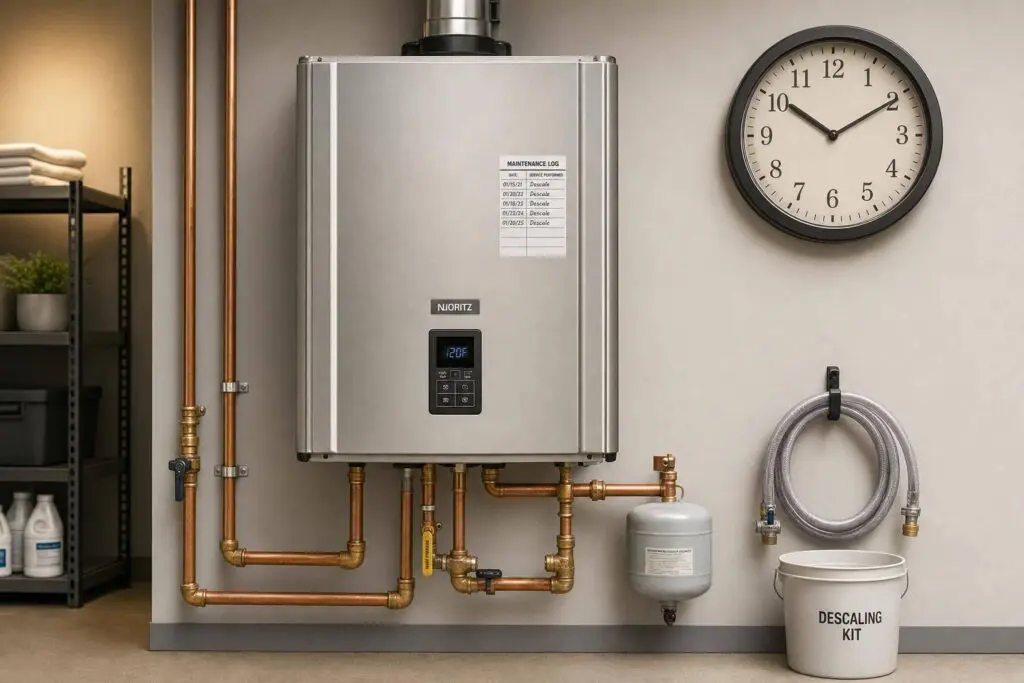
Most commercial tankless water heaters last about 15 to 20 years – but many businesses won’t see the full 20. In my view, the lifespan mostly comes down to daily demand, water hardness, install quality, and service frequency. If repair costs climb near 50% of a new unit’s price, or the system is past 15 years with heat exchanger trouble, replacement often makes more sense.
If I had to sum up the whole article fast, it would be this:
- Expected life: about 15–20 years
- Shorter life is common in restaurants, laundromats, gyms, salons, and multi-family buildings
- Hard water in Chicagoland can lead to scale buildup and lower heat transfer
- Yearly service is the floor, but every 6 months is often better for heavy-use buildings
- Common warning signs: temperature swings, cold bursts, low flow, repeat error codes
- Repair often fits when the unit is under 10 years old and the problem is limited
- Replacement often fits when the unit is over 15 years old, leaking, corroded, undersized, or facing a heat exchanger failure
Here’s the short version: a tankless unit can last a long time, but only if it is sized right, cleaned on schedule, and not pushed past its capacity. Water quality and maintenance history matter just as much as age.
How long does a Tankless Water Heater Last?
sbb-itb-b5c10b1
Typical Lifespan of a Commercial Tankless Water Heater
That lifespan range only holds up when the unit is properly sized for the building and serviced on schedule. In most cases, that gives a commercial tankless water heater a longer working life than a standard commercial tank-style unit.
That gap has a direct effect on operating costs and replacement planning.
The biggest drivers are pretty simple: daily run time, water hardness, and install quality. If the unit is undersized, or if the gas line and venting were set up poorly, service life can drop even with regular upkeep. And these issues don’t stay hidden for long – they tend to show up pretty fast in day-to-day use.
What 15–20 Years Looks Like in Practice
Hitting 20 years is realistic in buildings with lighter, steady demand and consistent preventive maintenance. But once demand goes up or water quality gets worse, lifespan can shrink fast.
Places like restaurants, gyms, salons, and multifamily buildings put a lot more stress on the system. In those buildings, a shorter lifespan is more common, especially when maintenance gets delayed or the unit wasn’t sized for peak demand in the first place. That’s why maintenance history matters just as much as the original install. Without regular service, even a well-installed unit can fail long before year 15.
What Shortens or Extends Service Life
Whether a unit makes it to the high end of its service life or quits early usually comes down to four things. And those lifespan ranges only mean much if the system runs within spec and gets proper care. If all four line up, the unit has a solid chance of lasting through its expected range. If one slips, service life can fall off fast.
| Factor | Shortens Lifespan | Extends Lifespan |
|---|---|---|
| Usage Level | Constant heavy peak draws; undersized for building demand | Steady, moderate demand; properly sized for peak loads |
| Water Hardness | Untreated hard water causing scale buildup | Water softening or regular descaling treatments |
| Maintenance | Skipped flushing; clogged inlet filters | Twice-yearly descaling; quarterly filter cleaning |
| Installation | Poor venting; undersized gas lines; restricted combustion air | Professional commissioning; correct gas and vent sizing |
Out of all of them, usage is often the fastest way a unit loses years off its life.
Usage Patterns and Daily Load
Frequent peak demand wears down the heat exchanger, fan, and igniter faster. A small office with occasional hot water use puts a lot less strain on the system than a restaurant pushing through lunch and dinner service every day. The same goes for laundromats and apartment buildings. These higher-use properties tend to put more wear on the unit, especially when demand surges happen several times a day.
Recirculation loops add more wear too. They’re handy because hot water shows up almost right away, but that convenience comes at a cost: the unit runs longer across the day, and that extra runtime adds stress to the heat exchanger and pump. If the system was sized for one level of demand and the building later adds fixtures or expands operations, that added load speeds up wear even more.
Water Hardness, Scale, and Chicagoland Conditions
Scale is sneaky. It builds up slowly, then starts cutting service life in a hurry. Hard water leaves calcium and magnesium inside the heat exchanger. Over time, that mineral layer acts like insulation, which blocks heat transfer and forces the unit to work harder to hold the set temperature. That means lower efficiency and more strain on the heat exchanger.
In Chicagoland, this matters a lot because hard water is common. Without treatment, scale can clog inlet valves, lead to uneven water temperatures, and push internal parts toward overheating and permanent damage.
Installation Quality and Service History
Good sizing, proper venting, and correct commissioning help limit early wear. Bad gas sizing, poor venting, or restricted combustion air put the unit under strain from the start, and that cuts into remaining service life right away. A history of repeat breakdowns is usually a bad sign too. It often points to several worn parts at once, which usually means the unit has less life left. Once repair calls start piling up, the remaining lifespan tends to drop fast.
How Often Commercial Tankless Water Heaters Should Be Serviced
The same issues that cut a unit’s lifespan also shape its service schedule. For most commercial buildings, once a year is the bare minimum. But in heavy-use properties, that usually isn’t enough.
A good way to start is with the building type. Then adjust the schedule if hot water demand stays high day after day.
| Property Type | Recommended Interval | Operating Stress |
|---|---|---|
| Restaurants | Every 6 months | High daily load and continuous peak use |
| Gyms & Spas | Every 6–12 months | Repeated peak use |
| Multi-Family Buildings | Every 6–12 months | Continuous demand across high fixture counts |
| Laundromats | Every 6 months | Concentrated demand bursts |
| Small Offices | Every 12–24 months | Low load and limited hours of operation |
Annual Service Tasks That Help Protect Lifespan
A proper annual service usually comes down to two things: descaling and a full inspection. That work should include:
- Descale the heat exchanger
- Clean inlet filter screens and air intake filters
- Inspect the burner assembly and flame sensor
- Check gas pressure at the manifold
- Run a combustion analysis
- Inspect venting for blockages or leaks
- Check condensate drains on high-efficiency units
- Review saved error codes
When to Shorten the Service Interval
Some setups need a tighter schedule. Recirculation systems should usually be serviced every six months. In Chicagoland, hard water often makes twice-yearly service the norm.
It also helps to watch for warning signs. Temperature swings, lower flow at fixtures, and scale or overheat error codes on the control panel can all point to a unit that needs more frequent attention. If those same issues keep coming back, it may be time to look past another repair bill and ask whether fixing the unit still makes financial sense.
When to Repair and When to Replace
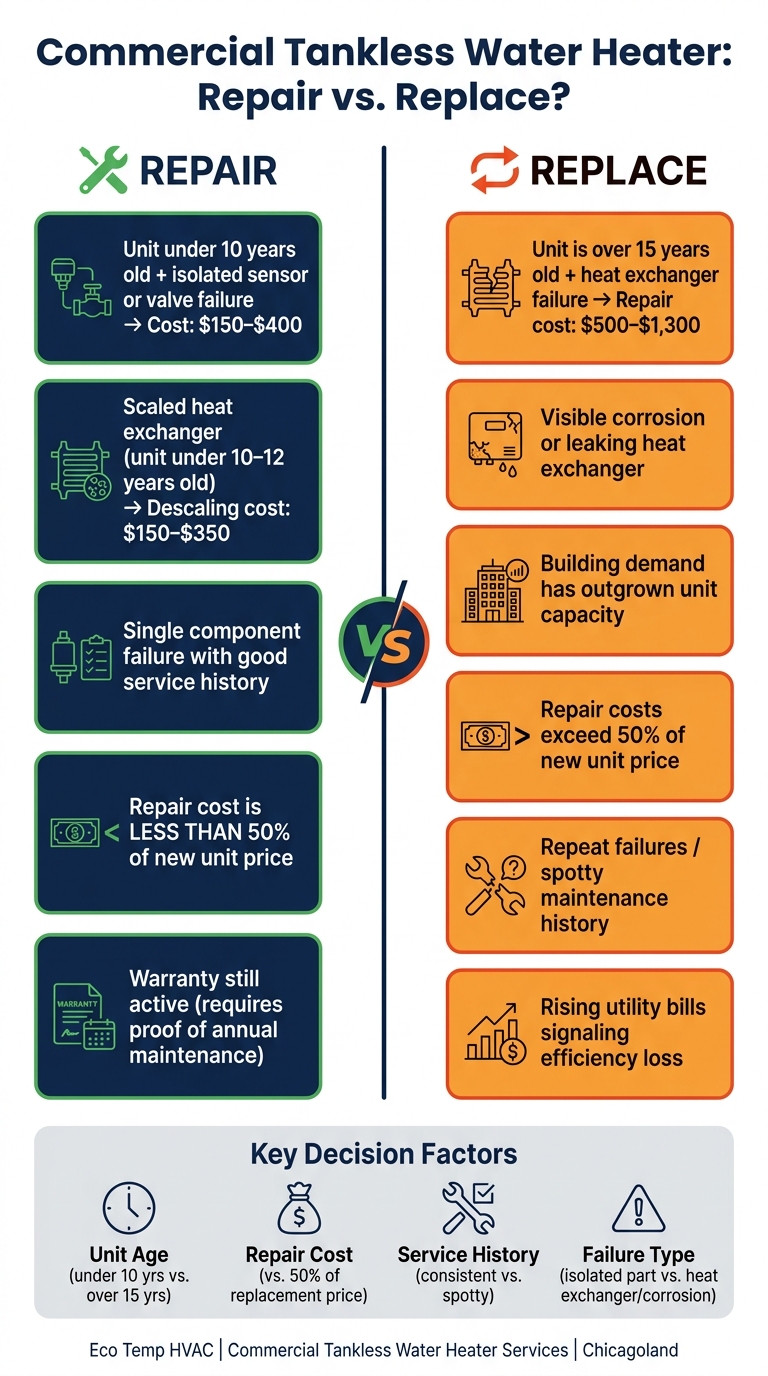
Commercial Tankless Water Heater: Repair vs. Replace Decision Guide
When repairs start to pile up, the bigger issue isn’t just can this unit be fixed? It’s whether the unit still has enough dependable life left to make that fix worth paying for.
At that point, age matters, but it’s not the only thing that matters. The better way to look at it is this: How old is the unit? What failed? How much will the repair cost? And is this the same problem showing up again and again?
When a Repair Is Still Worth Doing
A repair usually makes sense when the unit is under 10 years old, the problem is limited to one part, and the cost is less than half of what a new unit would cost.
For example, a failed flow sensor may cost about $150 to $400, while a scaled heat exchanger that can still be descaled may cost about $150 to $350 to address. On a younger unit with a good service record, those are often fair repairs to make.
Service history matters more than many owners think. A unit that has been maintained on schedule can often earn another repair. A unit with spotty upkeep and repeat failures usually points in the other direction.
Warranty coverage can shift the decision too. Most manufacturer warranties require proof of yearly maintenance, including descaling and flushing, to stay in force. In some cases, parts may still be covered even when labor is not.
When Replacement Is the Better Call
The same details that support a repair can also make replacement the smarter move once the unit gets older and repair costs start climbing.
In most cases, replacement makes more sense after 15 years, especially if the heat exchanger fails. Heat exchanger repair or replacement can cost $500 to $1,300, and that’s a tough bill to justify on a unit that’s already near the end of its service life.
Here’s a quick way to size up the situation:
| Scenario | Recommended Action | Reason |
|---|---|---|
| Unit under 10 years old; isolated sensor or valve failure | Repair | Minor, lower-cost fix on a younger unit |
| Scaled heat exchanger; unit under 10–12 years old | Repair (descaling) | Often reversible with professional descaling |
| Unit over 15 years old; heat exchanger failure | Replace | High repair cost on a unit near end of life |
| Visible corrosion or leaking heat exchanger | Replace | Structural damage cannot be repaired with confidence |
| Building demand has outgrown unit capacity | Replace | Fixing an undersized unit will not solve the main issue |
| Repair costs exceed 50% of new unit price | Replace | A new unit makes more financial sense over time |
Higher utility bills can be another sign that an older unit is losing efficiency as scale and internal wear build up. That extra operating cost adds weight to the case for replacement. For Chicagoland businesses, replacing a unit before peak season can help avoid expensive downtime.
Conclusion: Realistic Lifespan Expectations for Chicagoland Properties
Here’s the plain takeaway: a well-maintained commercial tankless water heater can realistically last 15 to 20 years. Whether it gets there comes down to a few simple things: how hard the unit works, how steady the service schedule is, and how fast problems get fixed.
In Chicagoland, hard water puts extra strain on these systems. That’s why annual descaling and sediment flushing matter so much if you want the unit to make it to the upper end of that lifespan.
Staying on top of maintenance also makes repair calls a lot easier to judge. Good service records help protect warranty coverage, and they give you a clearer picture when it’s time to decide between repair and replacement. If repair costs get close to half the price of a new unit, replacement usually makes more sense.
Eco Temp HVAC provides commercial tankless water heater installation, maintenance, and repair throughout Chicagoland.
FAQs
How can I tell if my unit is undersized?
An undersized tankless water heater often struggles to keep up with your building’s hot water demand. You’ll usually notice the problem in day-to-day use: water temperature swings, lukewarm water during busy periods, or a unit that can’t hold a steady hot water output.
If the system is running at full capacity on a regular basis, that’s a red flag. The same goes for units that can’t meet sanitation needs, such as 140°F water for dishwashers. In a commercial setting, those issues often point to a tankless water heater that’s simply too small for the job.
Does a water softener help tankless heater life?
Yes. A water softener can help a tankless water heater last longer, especially if you live in an area with hard water.
Here’s why: hard water leaves behind calcium and magnesium scale on the heat exchanger. Over time, that buildup makes the unit work harder, cuts into efficiency, and can lead to early failure.
A water softener helps reduce that scale, which keeps the heat exchanger cleaner and supports strong performance over time. That can help the unit stay closer to its expected 15 to 20-year lifespan.
Can regular maintenance prevent heat exchanger failure?
Yes. Regular maintenance can do a lot to lower the risk of heat exchanger failure.
One of the biggest troublemakers is hard water mineral buildup. When scale forms inside the system, it can restrict water flow and put more thermal stress on the heat exchanger. That added strain can wear parts down over time.
A professional flush and descaling service at least once a year can help clear out those deposits. In places with very hard water, every six months is often a better schedule.
That routine service helps:
- remove scale buildup
- keep the system running efficiently
- extend the heat exchanger’s lifespan
- help prevent warranty problems tied to neglected scale buildup
It’s a simple step, but it can save a lot of hassle later.