
High-SEER (Seasonal Energy Efficiency Ratio) air conditioners promise energy efficiency, but they’re often misunderstood. Here’s what you need to know:
- Higher SEER ≠ Better Cooling: SEER measures energy efficiency, not cooling power or speed. Cooling capacity depends on tonnage, not SEER.
- Cost Savings Take Time: While high-SEER units use less electricity, the upfront cost difference can take decades to break even, especially in mild climates.
- Efficiency Doesn’t Equal Quality: SEER ratings don’t guarantee better durability or reliability. Proper installation and maintenance matter more.
- More Maintenance, Not Less: High-SEER systems require regular upkeep due to their advanced, sensitive components.
- Full Efficiency Isn’t Guaranteed: Without proper installation, ductwork, and commissioning, a high-SEER system may never perform as advertised.
Quick Comparison
| Myth | Reality |
|---|---|
| Higher SEER = Better Cooling | SEER measures efficiency, not cooling power. Tonnage determines capacity. |
| Quick Cost Payback | Savings may take 19+ years, often beyond the unit’s lifespan. |
| Higher SEER = Better Quality | SEER doesn’t reflect build quality; installation and brand matter more. |
| Less Maintenance Needed | High-SEER systems require meticulous upkeep to function properly. |
| Full Efficiency Guaranteed | Poor installation and leaky ducts can undermine efficiency. |
High-SEER systems aren’t always the best choice. Evaluate your home’s cooling needs, climate, and budget carefully before investing.
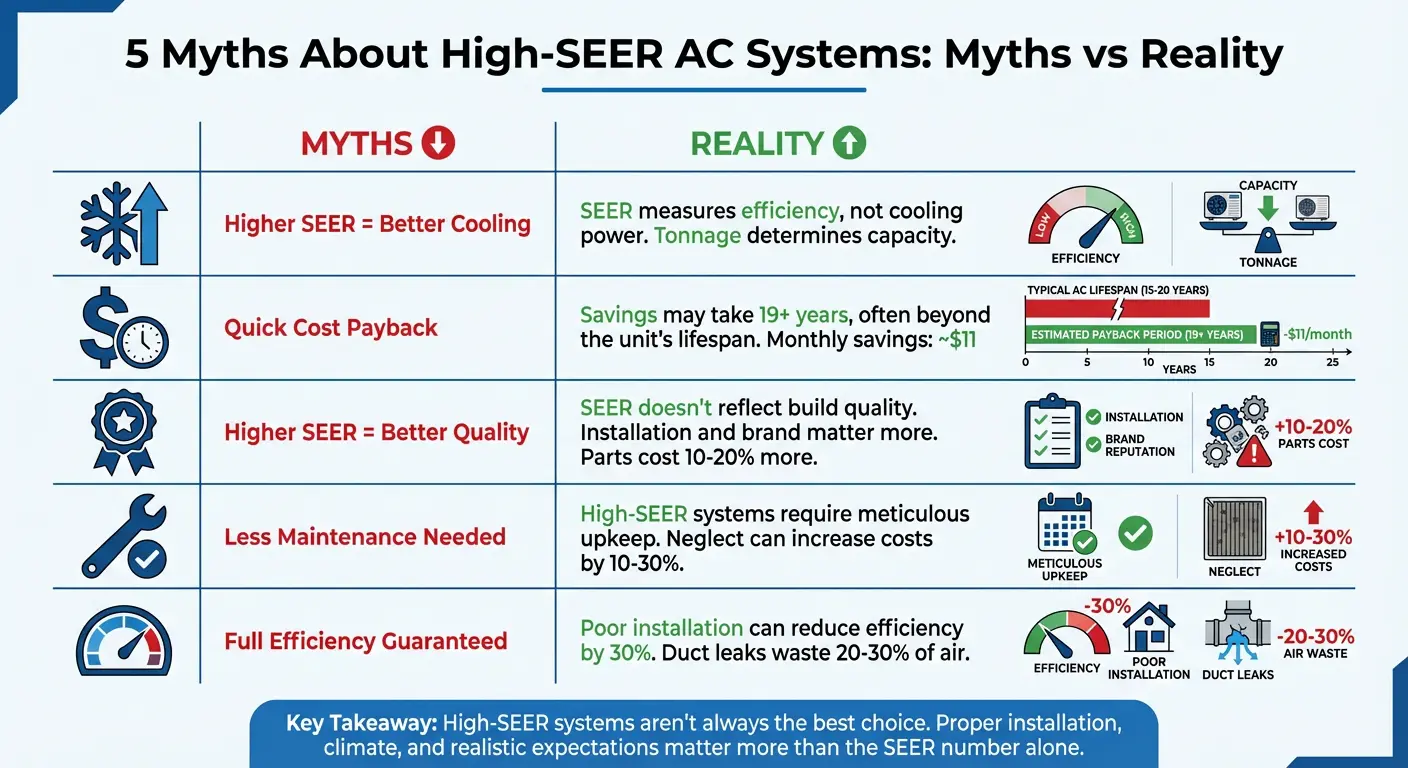
5 Common Myths vs Reality About High-SEER AC Systems
GOOD and BAD of High SEER Inverter HVAC!
1. Higher SEER Means Better Cooling Power
Many people mistakenly believe that a higher SEER (Seasonal Energy Efficiency Ratio) rating means an air conditioner cools faster or more effectively. In reality, SEER measures energy efficiency, not how quickly or powerfully a unit cools. The cooling capacity of an air conditioner is determined by its tonnage or BTU (British Thermal Unit) rating.
"SEER measures efficiency, not capacity. Tonnage handles capacity." – Mark Callahan, Author
Here’s how it works: If you compare a 20-SEER air conditioner to a 15-SEER unit with the same tonnage, both will cool your home at the same speed. The difference lies in energy consumption. The 20-SEER unit uses less electricity to achieve the same cooling result. Think of it like fuel economy in cars – a higher SEER rating means greater efficiency, not faster performance. For instance, a SEER 20 system moves 20 BTUs of heat per watt-hour of electricity. That’s double the efficiency of a SEER 10 unit, but it doesn’t translate to faster cooling.
If your cooling system isn’t performing well, the problem is more likely due to incorrect sizing or issues with ductwork rather than the SEER rating. To ensure your system is the right fit, a proper Manual J heat-load calculation is essential for determining the correct capacity.
Next, let’s tackle the misconception that high-SEER units guarantee rapid cost savings.
2. High-SEER Units Always Pay for Themselves Quickly
High-SEER systems are often marketed as a way to slash energy bills, but the actual savings might not live up to the hype. For instance, upgrading from a 15-SEER unit to a 20-SEER unit could lower your electricity bill by about $11 per month. However, the cost difference is significant – a 3-ton 15-SEER system costs around $5,750, while a 20-SEER unit is about $8,300, leaving a $2,550 gap. With these numbers, it could take over 19 years to break even, which is longer than the typical lifespan of 15 to 20 years.
"Higher-SEER-rated air conditioners are rarely worth the extra upfront cost in terms of long-term savings." – Tom Moor, HVAC.com
The climate where you live plays a big role in determining whether a high-SEER system is worth it. In places like Phoenix or Houston, where air conditioning is almost a year-round necessity, the payback period could be as short as 3 to 6 years. But in cooler areas like Seattle or Portland, annual savings might only be around $80, stretching the payback period to about 25 years. For northern homeowners, systems rated between 15 and 16 SEER often provide the best value, while those in the Southwest might see more benefits from units rated 17 to 20 SEER.
It’s also important to think about hidden costs. High-SEER systems often rely on specialized parts that can be 10% to 20% more expensive to repair or replace compared to standard components. If your ductwork isn’t compatible with the airflow needs of a high-SEER unit, additional costly upgrades might be required. While federal tax credits (up to $2,000 through the Inflation Reduction Act) and local utility rebates can help reduce these expenses, they typically won’t eliminate the long payback period.
If you’re planning to sell your home within five years, sticking with equipment that meets minimum regional efficiency standards is often the smarter choice. A future buyer is unlikely to recoup the extra cost of an ultra-high SEER system, making it a less appealing investment.
3. Higher SEER Means Better Quality Equipment
It’s a common misconception that a higher SEER rating automatically means better build quality or durability. SEER (Seasonal Energy Efficiency Ratio) is purely a measure of energy efficiency – it tells you how much cooling output you get for each watt of electricity consumed. It doesn’t reflect the construction quality or lifespan of the unit.
High-SEER systems often feature advanced components, such as inverter-driven compressors and sophisticated electronics, which boost efficiency but can also increase the likelihood of malfunctions compared to simpler, standard-efficiency models. Additionally, when these systems require repairs, their replacement parts usually cost 10% to 20% more than those for standard systems. This added complexity also makes proper installation and component compatibility even more essential.
The real keys to quality and longevity lie in factors like brand reputation, robust warranties, and professional installation. Even a top-tier 20-SEER unit won’t perform efficiently if it’s installed incorrectly. For example, mismatched indoor and outdoor coils can choke performance and may even void the manufacturer warranty.
"Installation quality is always the most important thing for residential HVAC project. So never sacrifice contractor quality for a lower price." – Rene Langer, Senior Comfort Specialist, PICKHVAC
To ensure long-term reliability, focus on hiring contractors who perform a Manual J heat-load calculation, match all system components, and provide thorough documentation for the installation. ENERGY STAR ratings and strong manufacturer warranties are far better indicators of reliability and performance than just the SEER rating.
4. High-SEER Systems Need Less Maintenance
It’s easy to think that high-SEER systems, being more advanced and efficient, would require minimal upkeep. But the reality is quite the opposite – these high-efficiency air conditioners are actually more sensitive to neglect compared to older, standard-efficiency models.
Older HVAC systems were often built to be more forgiving. They could handle dirty filters or clogged coils for years without major issues. High-SEER units, on the other hand, are precision-engineered with advanced components like ECM blower motors, precision expansion valves, and tighter airflow tolerances. These systems thrive in clean, balanced conditions, and even small issues like dust buildup or a slightly dirty filter can disrupt their operation. Such disruptions can lead to mechanical fatigue and, eventually, system failure.
Skipping regular maintenance doesn’t just lead to wear and tear – it can also hit your wallet. Cooling costs can spike by 10% to 30%, and the system’s lifespan can drop from the expected 12–15 years to just 7–10 years.
"High-efficiency systems are less forgiving of neglect." – Samantha Reyes, Smart Comfort by Samantha
To keep your system running smoothly, a few key maintenance steps are essential. Regularly change filters, use a custom maintenance checklist to stay on track, keep the outdoor condenser free of debris, and schedule annual professional inspections. These inspections should include refrigerant pressure checks, electrical testing, and coil cleanings. Plus, most manufacturers require proof of professional service to honor warranty claims, so maintaining detailed records of all tune-ups is crucial for protecting your investment.
"Routine maintenance is cost control, not an extra expense." – Samantha Reyes, Smart Comfort by Samantha
Up next, we’ll address the misunderstanding that a high-SEER upgrade automatically delivers its full rated efficiency.
5. Any High-SEER Upgrade Delivers Full Rated Efficiency
A high-SEER air conditioner might seem like a guaranteed way to maximize energy efficiency, but that’s not always the case. The SEER rating reflects a system’s maximum potential performance under controlled, ideal conditions – conditions that rarely exist in real homes.
The difference between rated and actual efficiency often comes down to factors like how well the system is installed, whether it’s compatible with your existing setup, and the overall condition of your home. Poor installation alone can slash efficiency by as much as 30%:
"A 16 SEER2 system that is not commissioned properly may perform worse than a well-commissioned 13.4 SEER2 system." – Fire & Ice
Another major culprit is ductwork. Roughly 20% to 30% of the air circulating through a standard duct system escapes due to leaks, gaps, or poor connections. Installing a high-SEER system without addressing leaky ducts is like putting premium fuel in a car with a clogged engine – it just won’t perform as intended. Similarly, outdated equipment like an old furnace or an incompatible blower motor can prevent the system from reaching its full efficiency potential.
To get the most out of your investment, proper commissioning is essential. This includes detailed checks of static pressure and refrigerant levels. If your contractor doesn’t bring up commissioning, that’s a major red flag. It’s also wise to have a professional evaluate your insulation and ductwork to ensure everything aligns with your system’s requirements. Working with certified experts, such as Eco Temp HVAC, including our HVAC Chicago team, can help ensure your system is properly sized, installed, and commissioned to deliver the efficiency you’re paying for.
"SEER2 is a promise. Commissioning is how that promise gets delivered. Don’t invest in efficiency only to lose it through poor installation." – Fire & Ice
Conclusion
High-SEER air conditioners might sound appealing, but they don’t guarantee top-notch performance. SEER ratings reflect the maximum potential efficiency under perfect conditions – not what you’ll necessarily experience day-to-day. For example, a 20-SEER system may save you just $11 a month, which often means the break-even point extends beyond the equipment’s typical lifespan.
This highlights why exaggerated claims can be misleading. The truth is, proper installation and realistic expectations often outweigh the SEER rating itself. Without quality ductwork, accurate system sizing, and professional setup, even the most advanced unit can fall short. As Tom Moor from HVAC.com explains:
"Higher-SEER-rated air conditioners are rarely worth the extra upfront cost in terms of long-term savings".
That said, high-SEER systems aren’t inherently a bad choice – they just aren’t ideal for every scenario. If you live in a milder climate or have a home with modest cooling needs and older ductwork, a 14 or 15-SEER system might strike the best balance between efficiency and cost. The key is understanding how to choose the right HVAC system for your home.
For expert guidance, consider working with professionals like Eco Temp HVAC, serving the Chicagoland area. Their certifications, including Mitsubishi Diamond Elite Contractor status, ensure they have the expertise to optimize your system’s performance – not just its theoretical efficiency. The best system isn’t necessarily the one with the highest SEER number; it’s the one tailored to your home’s unique needs, budget, and usage patterns, with careful consideration of factors like ductwork and insulation.
FAQs
What SEER should I choose for my climate?
A SEER rating of 16 or higher is typically a solid option for most areas. If you live in a hotter region, opting for a system with a higher SEER rating can lead to greater energy savings over time, which might make it more cost-efficient in the long run. Ultimately, the ideal SEER rating for your home will depend on your local climate and how much cooling your household needs throughout the year.
Will my ductwork limit a high-SEER system?
Properly designed ductwork and adequate airflow are critical for a high-SEER system to perform at its best. If the duct design is flawed or airflow is insufficient, the system’s efficiency can take a hit. Even the most efficient systems won’t reach their full potential without these essential components in place.
What should commissioning include?
Commissioning plays a key role in making sure your high-SEER air conditioning system is installed properly, functions as intended, and delivers top-tier performance. It ensures the system operates efficiently and reliably, helping you get the most out of your energy savings while maintaining dependable operation.