
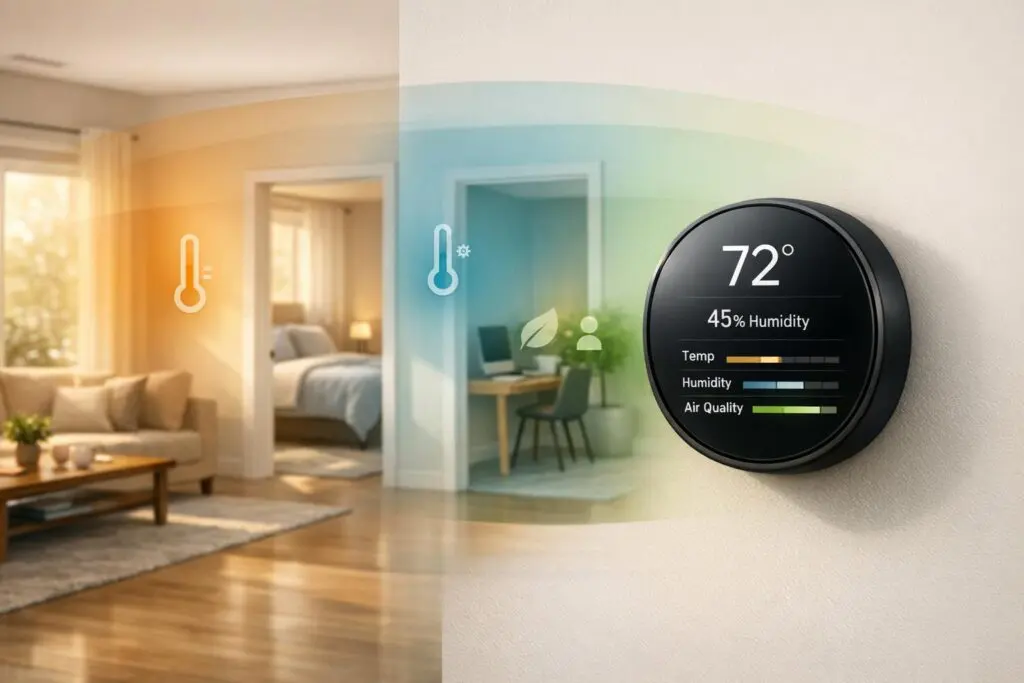
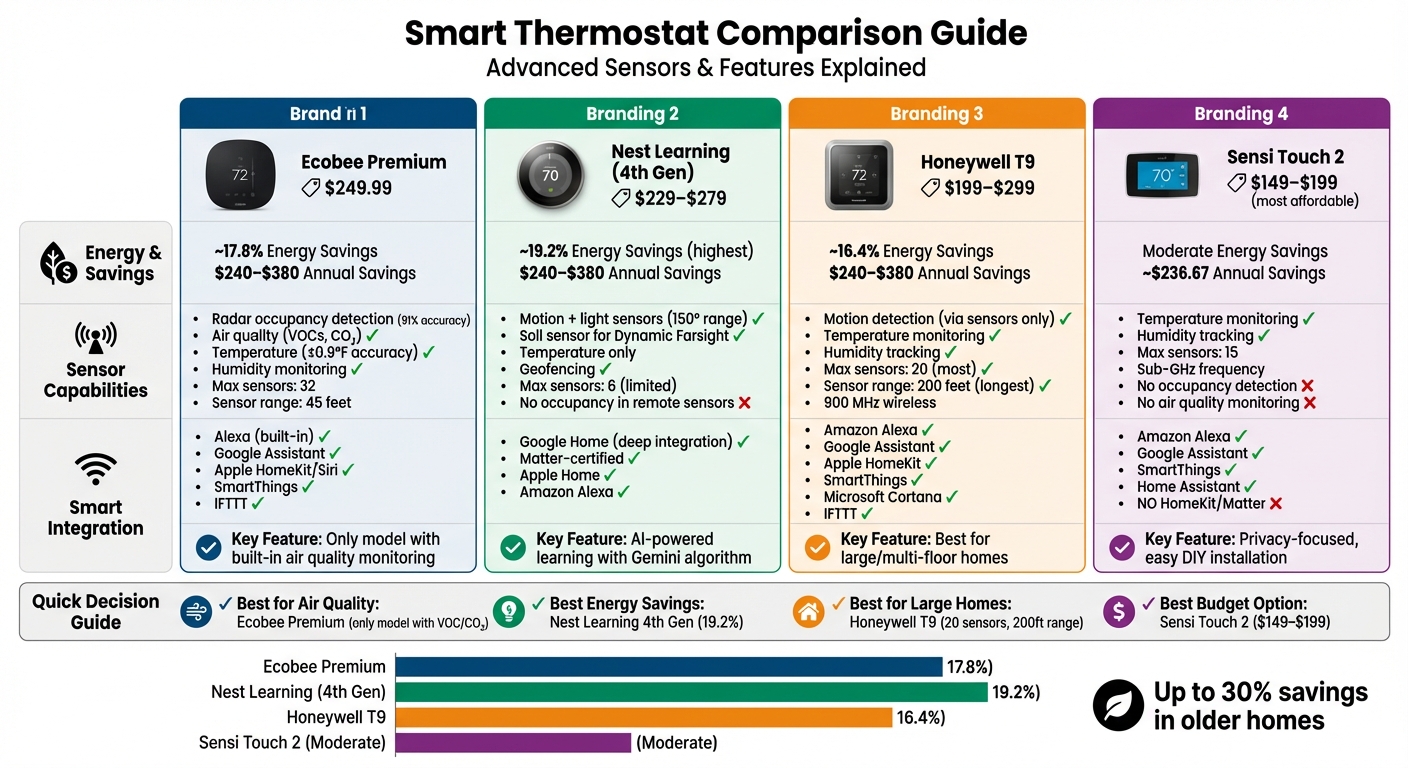
Smart thermostats are no longer just about setting schedules – they now include advanced sensors that monitor occupancy, temperature, humidity, and even air quality. These features improve HVAC efficiency and reduce energy waste, saving homeowners anywhere from $240–$380 annually, with older homes seeing reductions of up to 30%.
Here’s a breakdown of four popular models and their standout features:
- Ecobee Premium ($249.99): Uses radar for precise occupancy detection, tracks air quality (VOCs, CO₂), and supports up to 32 sensors. Works with Alexa, Siri, and Google Assistant.
- Nest Learning Thermostat (4th Gen, $229–$279): AI-powered scheduling, geofencing, and energy savings up to 19.2%. Limited to six remote sensors.
- Honeywell T9 ($199–$299): Best for large homes with a 200-foot sensor range and support for 20 sensors. Tracks temperature, humidity, and motion.
- Sensi Touch 2 ($149–$199): Budget-friendly, privacy-focused, and supports up to 15 sensors. Lacks air quality monitoring and AI features.
Quick Comparison
| Model | Price Range | Sensor Features | Smart Integration | Energy Savings |
|---|---|---|---|---|
| Ecobee Premium | $249.99 | Occupancy, air quality, temp | Alexa, Siri, Google | ~17.8% |
| Nest Learning (4th) | $229–$279 | Temp only (6 sensors max) | Google, Matter certified | ~19.2% |
| Honeywell T9 | $199–$299 | Temp, humidity, motion | Alexa, Google, HomeKit | ~16.4% |
| Sensi Touch 2 | $149–$199 | Temp, humidity | Alexa, Google, SmartThings | Moderate |
Each model caters to different needs, from energy efficiency to air quality monitoring and multi-room coverage. Choose based on your home’s layout, comfort preferences, and smart home setup, or schedule a professional installation to ensure peak performance.
Smart Thermostat Comparison: Features, Sensors, and Energy Savings
1. Ecobee Premium
Occupancy Detection
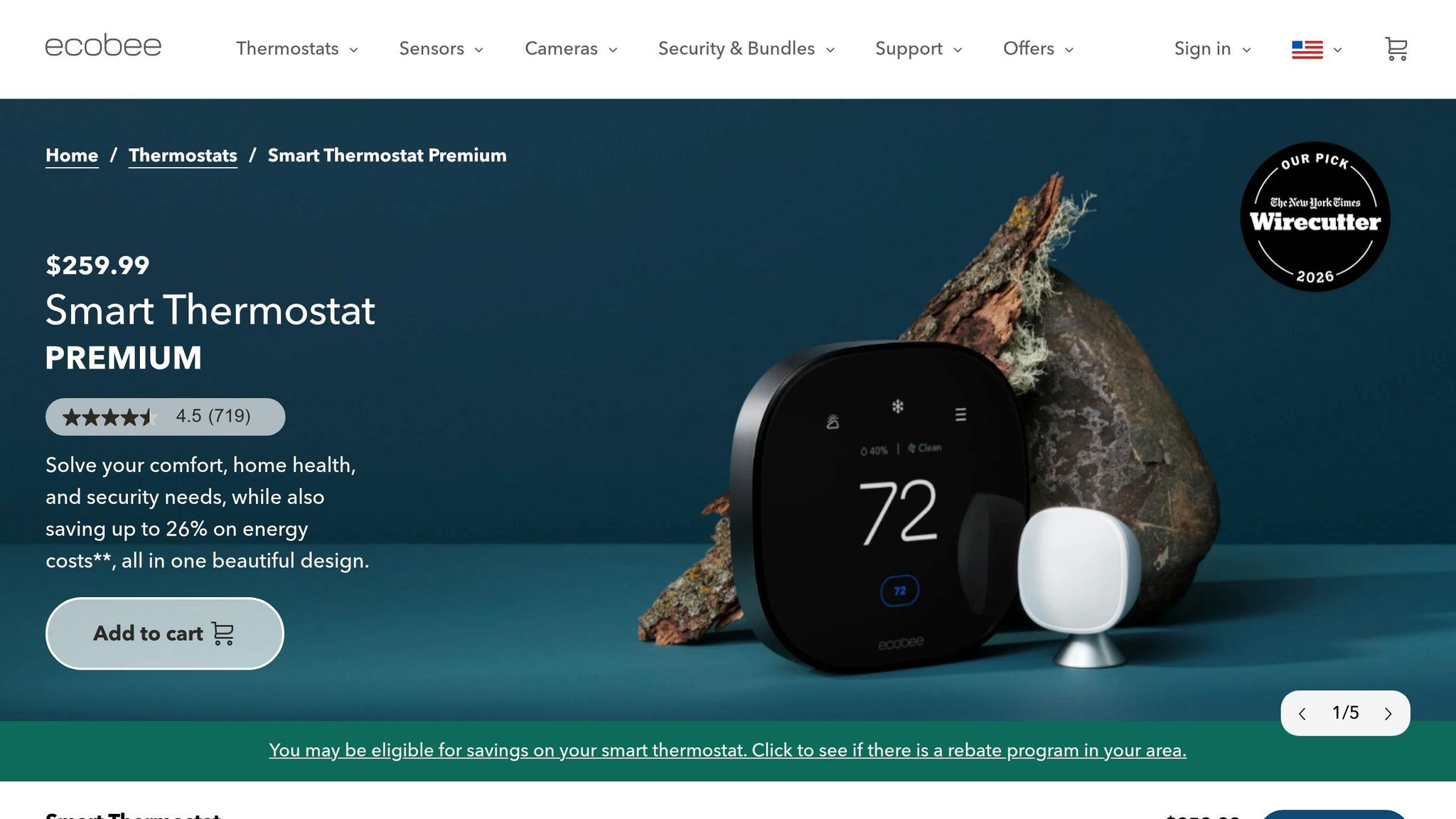
The Ecobee Premium uses cutting-edge radar technology instead of standard PIR sensors, allowing it to detect motion from greater distances and even through obstructions. This makes its presence detection more responsive and accurate.
It comes with one SmartSensor for monitoring additional rooms and supports up to 32 extra PIR-based sensors. These additional sensors have a range of 45 feet and a battery life of up to 5 years.
The "Follow Me" feature leverages data from both the main thermostat and remote sensors to calculate the average temperature in rooms that are actively being used. If a room is detected as unoccupied, the thermostat signals the HVAC system to scale back, reducing energy usage without compromising comfort. Additionally, the Eco+ engine optimizes efficiency by adjusting run times based on occupancy patterns and can even pre-cool or pre-heat your home according to Time of Use electricity rates.
Temperature Monitoring
The SmartSensor is equipped with a high-precision thermistor capable of measuring temperature with an accuracy of 0.9°F (0.5°C). Beyond just temperature, the Ecobee Premium also monitors air quality and humidity for a more comprehensive approach to home comfort.
Humidity and Air Quality Features
In addition to precise temperature readings, the Ecobee Premium comes with an Indoor Air Quality monitor that tracks volatile organic compounds (VOCs), estimated CO2 levels, and relative humidity. It rates air quality on a scale from "Clean" to "Poor" and provides alerts for issues like poor ventilation during cooking or when it’s time to replace an air filter using an HVAC filter replacement planner.
The thermostat also features an ACC+ terminal, which enables control over accessories like humidifiers, dehumidifiers, or ventilators. It can adjust cooling settings based on humidity levels, ensuring your home remains comfortable in various conditions.
"It moves the conversation from ‘is it hot enough?’ to ‘is the air healthy?’" – The Thermo Expert
Smart Home Integration
The Ecobee Premium integrates seamlessly with smart home ecosystems. It has built-in Alexa and supports Siri (via a HomePod hub), Apple HomeKit, Google Assistant, Samsung SmartThings, and IFTTT. Its 4-inch color touchscreen, with a resolution of 540 x 540 pixels, is 50% larger than earlier models. The device is made from zinc and glass, offering a sleek and modern design that stands out from conventional plastic thermostats.
Priced at $249.99, the Ecobee Premium includes a SmartSensor in the box, providing excellent value for its advanced features and integration capabilities.
sbb-itb-b5c10b1
2. Nest Learning Thermostat
Occupancy Detection
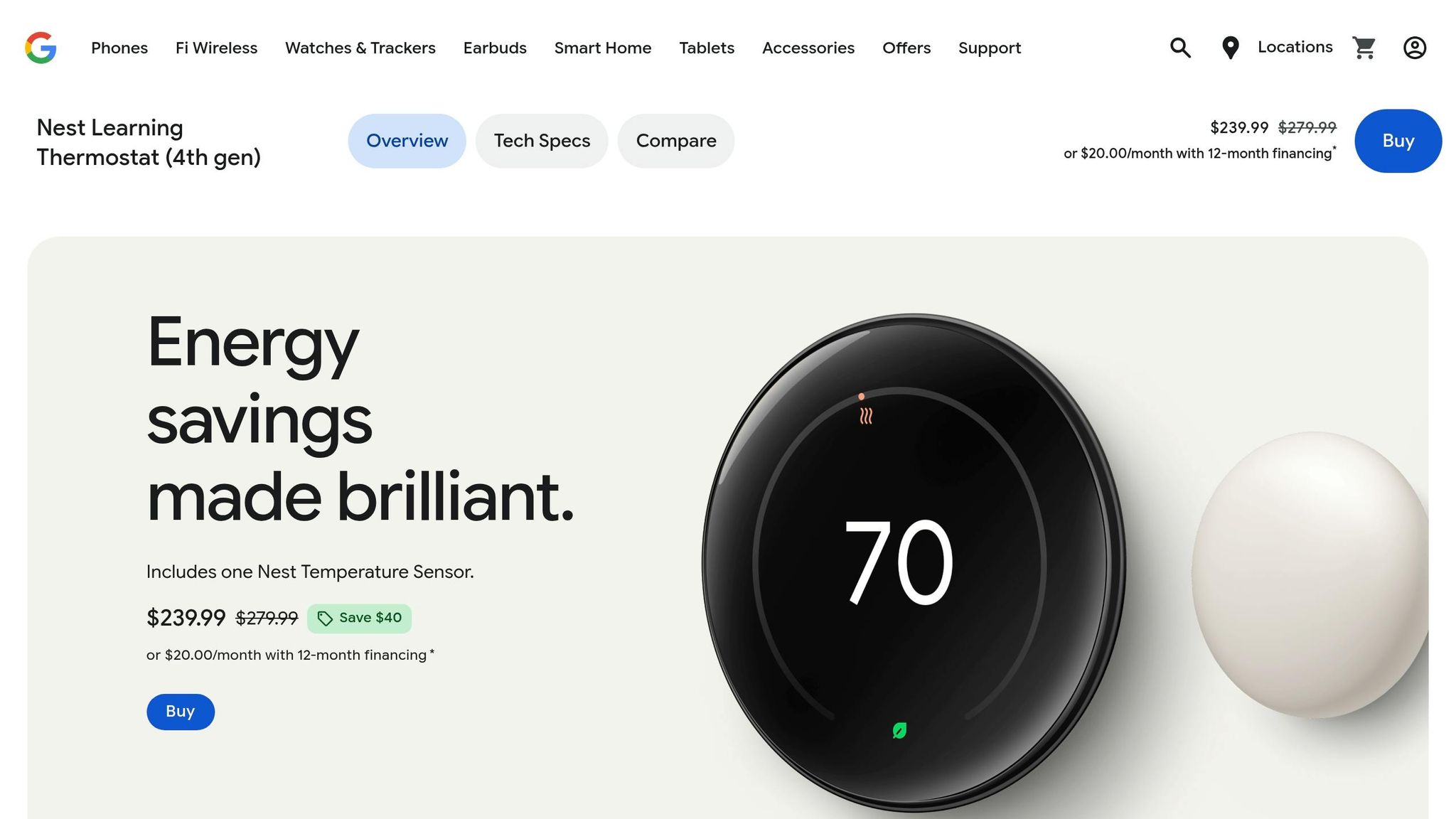
The Nest Learning Thermostat uses a combination of motion sensors, light sensors, and smartphone geofencing to figure out if someone is home or not. The 4th generation model takes it a step further with a Soli sensor that powers Dynamic Farsight. This feature lights up your thermostat to display air quality and weather details when it senses your approach. Its motion and light sensors can detect activity within a 150° range.
If the system determines that no one is home, it automatically switches to an energy-saving "Eco" mode. The 4th generation adds an Adaptive Eco feature, which considers outdoor temperatures to ensure your home feels just right within an hour of your expected return. It also learns your daily patterns using AI and adjusts temperatures based on geofencing as you approach your home.
These smart occupancy features work hand-in-hand with precise temperature control to deliver a comfortable and energy-efficient experience.
Temperature Monitoring
To tackle uneven temperatures in your home, the Nest Learning Thermostat supports up to six remote Nest Temperature Sensors. This setup lets you prioritize certain rooms at specific times or balance the temperature across multiple areas. The 4th generation model also factors in outdoor conditions, pausing heating on sunny days when natural warmth suffices or adjusting for comfort during humid weather. Additionally, its System Health Monitor keeps tabs on your HVAC system, sending alerts if it detects issues like the AC running but failing to cool.
Smart Home Integration
The 4th generation Nest Learning Thermostat is Matter-certified, which means it works seamlessly with any Matter-compatible smart home app, including Apple Home and Amazon Alexa. It integrates deeply with Google Home, allowing control via the Google Home app, Pixel Watch, or Google TV Streamer. The device features a domed crystal LCD display that’s 60% larger than its predecessor. At a price of $279.99, it comes with one 2nd generation Temperature Sensor included. Plus, it works with Nest Renew to shift energy usage to times when electricity is cheaper or the grid is cleaner.
"The Nest Learning Thermostat (4th gen) is our smartest, most advanced thermostat yet… it uses AI to automatically make micro-adjustments based on your patterns." – Adina Roth, Product Manager, Google Nest
3. Honeywell T9
Occupancy Detection
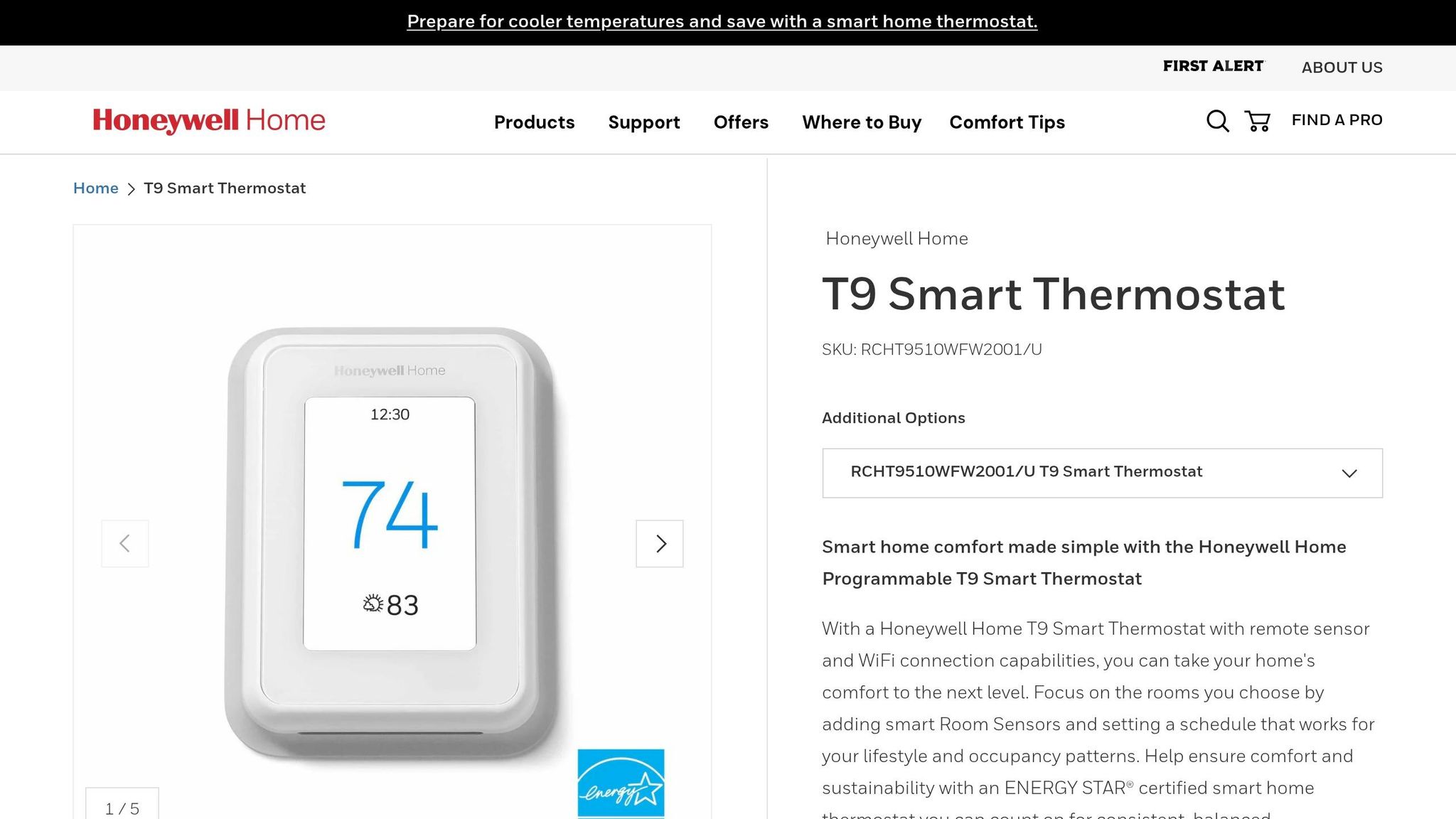
The Honeywell T9 thermostat takes a different approach to motion detection. Instead of relying on a built-in motion sensor, the main thermostat unit skips this feature entirely. Instead, it depends on external Smart Room Sensors to detect movement and identify which rooms are in use. You can link up to 20 wireless sensors to a single thermostat, giving you the ability to monitor a wide range of spaces in your home.
The system includes two modes for prioritizing rooms:
- Active Room: Focuses on rooms where motion is currently detected.
- Selected Rooms: Lets you manually choose which areas to prioritize.
If multiple rooms are occupied, the T9 calculates the average temperature of those rooms to maintain comfort. The sensors operate on a dedicated 900 MHz wireless frequency with a range of up to 200 feet. Jason D’Aprile from TechHive praised their performance:
"Honeywell’s sensors, however, are the best we’ve tested… they were much better at penetrating walls and other obstacles than what the competition has to offer".
Unlike other smart thermostats, the T9 responds instantly to motion or pre-set schedules. However, since the thermostat itself lacks motion detection, you’ll need to place a remote sensor in the same room if you want it included in occupancy tracking. These sensors also play a key role in temperature monitoring, which we’ll explore next.
Temperature Monitoring
The T9’s Smart Room Sensors do more than just track motion – they also measure temperature and humidity within a 200-foot range. You can configure the system to average temperatures across all active rooms or focus on specific spaces, like a nursery, for precise comfort. The thermostat is ENERGY STAR certified and uses smartphone geofencing to adjust settings automatically when you leave or return home.
Instead of controlling physical air dampers, the T9 creates virtual zones by averaging sensor data. If you’re looking for true independent temperature control in different rooms, you’ll need to install a separate zone control board and dampers. The thermostat also includes "Adaptive Intelligent Recovery", a feature that learns how long your HVAC system takes to reach the desired temperature and adjusts its timing to ensure your home is comfortable when you need it , a feature often optimized when paired with new furnaces.
Humidity and Air Quality Features
The T9’s sensors also monitor humidity levels, displaying the data on the thermostat. However, the thermostat cannot directly control HVAC-integrated humidifiers or dehumidifiers. It does offer maintenance reminders for components like air filters, humidifier pads, and UV bulbs, helping you keep your system in good shape. Additionally, the "Circulate" fan setting runs the fan about 33% of the time, promoting consistent air movement without engaging the full HVAC system.
Smart Home Integration
The T9 is compatible with a wide range of platforms, including Amazon Alexa, Google Assistant, Apple HomeKit, Microsoft Cortana, Samsung SmartThings, and IFTTT. For iOS users, setup is simple – just scan the HomeKit code directly on the thermostat screen. The Resideo app handles everything from geofencing to triggering "Home" or "Away" modes based on your smartphone’s location. It supports both 2.4 GHz and 5.0 GHz Wi-Fi networks and includes a C-wire power adapter for homes that need it.
The thermostat is priced between $169.99 and $179.99, while Smart Room Sensors are available for $41.99 each or $79.99 for a two-pack. Each sensor runs on two AAA batteries, which typically last about a year.
4. Sensi Touch 2
Temperature Monitoring
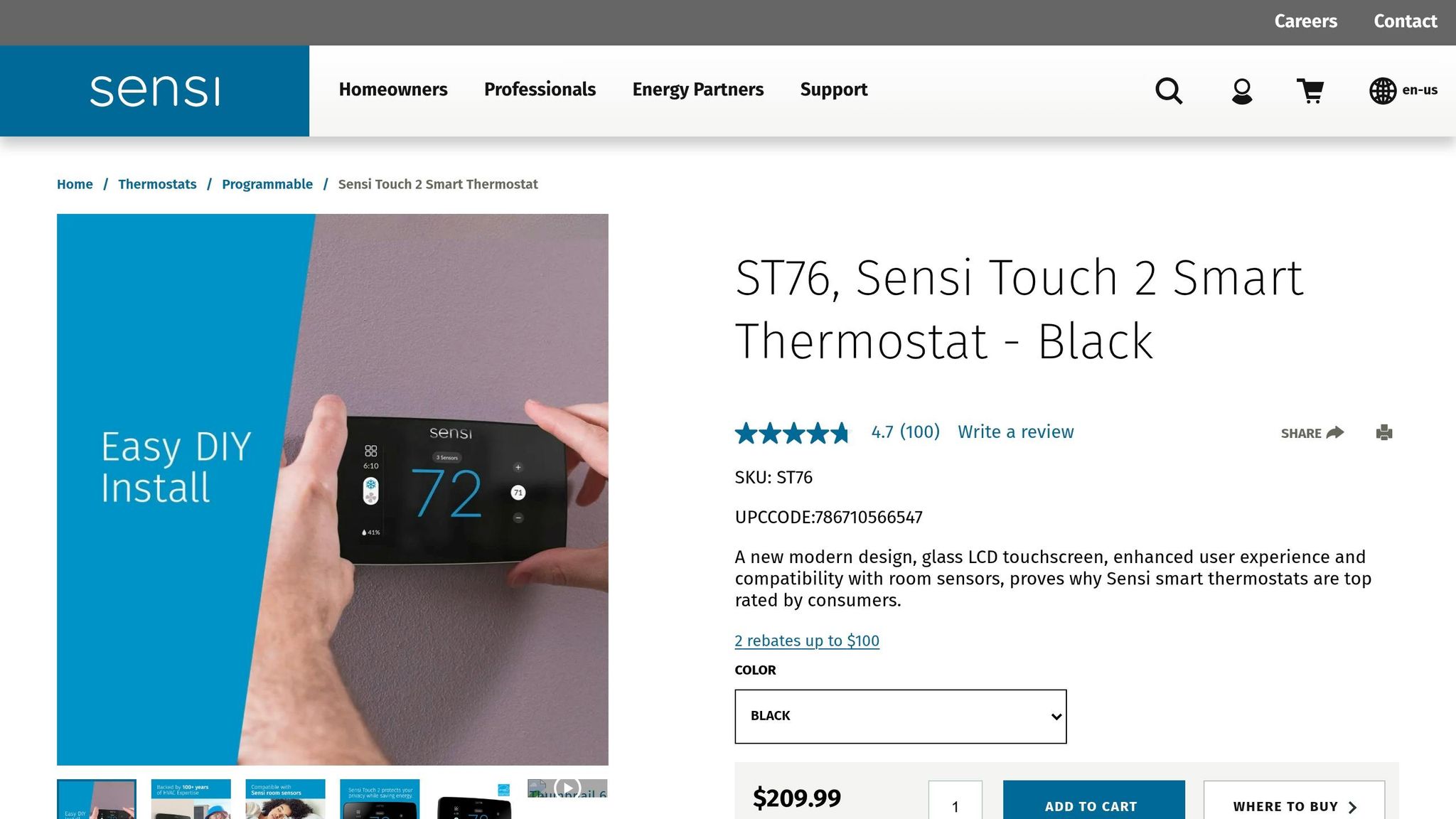
The Sensi Touch 2 stands out with its ability to regulate temperature efficiently while ensuring comfort throughout your home. It supports up to 15 remote room sensors that track both temperature and humidity, combining these readings with its built-in sensor to eliminate hot and cold spots for a more consistent indoor climate.
Thanks to Sensi Connect Technology, which operates on a Sub-GHz frequency, the thermostat maintains reliable, long-range wireless communication with its sensors. Users can fine-tune temperature offsets (up to 5°F) and adjust humidity levels (up to 25%) to suit their preferences. For homes using heat pumps, pairing the thermostat with outdoor sensors optimizes balance points and auxiliary lockout, leading to better energy efficiency.
The device features a 4.3-inch color LCD touchscreen, which is one of the largest displays in its category. With smart scheduling and geofencing, the Sensi Touch 2 can help users save an estimated $236.67 annually on energy costs. While its MSRP is $209.99, it’s often available for between $140.00 and $155.99. Additional remote sensors cost about $40.00 each, and for homes without a C-wire, an adapter kit is available for around $28.00. Beyond temperature control, this thermostat also manages indoor air quality and humidity.
Humidity and Air Quality Features
The Sensi Touch 2 addresses indoor air quality in several ways. Although it lacks a built-in air quality sensor, it integrates seamlessly with the Woosh Smart Air Filter. When paired with a Woosh indoor air quality sensor, the thermostat can activate the HVAC fan to improve air circulation whenever poor air quality is detected. It also includes built-in humidity sensors and can connect with an Equipment Interface Module to control additional air quality devices. Smart maintenance alerts and timely service reminders help users stay on top of filter replacements and system upkeep.
Smart Home Integration
The Sensi Touch 2 also excels in smart home compatibility. It works with major platforms like Amazon Alexa, Google Assistant, Samsung SmartThings, and Home Assistant. However, it does not support Apple HomeKit, Matter, or IFTTT. The thermostat connects via 2.4 GHz and 5 GHz Wi-Fi and includes built-in voice control. Using geofencing through the Sensi app, it can automatically adjust temperatures – typically by 3°F – when you leave home.
"The Sensi Touch 2 is a very good smart thermostat at its $210 MSRP–it’s a steal at its $140 street price." – Jason D’Aprile, TechHive
Copeland emphasizes user privacy by not selling personal data. Additionally, professional installations come with a 5-year warranty for added peace of mind.
7 Best Smart Thermostats In 2026 That Are ACTUALLY Worth It
Pros and Cons
Smart thermostats vary in features, with different strengths and compromises. Here’s a closer look at some popular models:
The Ecobee Premium is a standout choice for its monitoring capabilities. It’s the only option with built-in air quality sensors that track VOC and CO₂ levels. Plus, its SmartSensors boast around 91% accuracy in detecting both temperature and occupancy. However, it’s priced higher, between $250 and $260, and its air quality sensor doesn’t automatically activate the HVAC fan.
The Nest Learning Thermostat (4th Gen) shines in energy efficiency, delivering up to 19.2% savings. Its Gemini AI learning algorithm provides a true "set-it-and-forget-it" experience. On the downside, its remote sensors only measure temperature, lack occupancy detection, and are limited to six sensors. At about $280, it’s also the most expensive option.
For larger homes, the Honeywell T9 is noteworthy. Its 200-foot sensor range, supported by RedLINK technology, and compatibility with up to 20 sensors make it ideal for multi-floor temperature management. Its sensors track temperature, humidity, and motion, effectively addressing hot and cold spots. However, its app interface is simpler compared to Ecobee and Nest, and its energy savings are slightly lower at 16.4%.
The Sensi Touch 2 focuses on privacy and ease of installation. It’s the most budget-friendly choice, priced between $140 and $156. While it’s easy to set up, it lacks advanced AI features and air quality monitoring. Its sensors are limited to temperature and humidity tracking, without occupancy-based intelligence.
Here’s a quick comparison of the key points:
| Model | Key Strengths | Notable Limitations |
|---|---|---|
| Ecobee Premium | Tracks VOC and CO₂; ~91% occupancy accuracy; supports up to 32 sensors | Higher cost; air quality sensor doesn’t auto-trigger HVAC |
| Nest Learning (4th Gen) | Top energy savings (19.2%); advanced AI automation; sleek design | Sensors lack occupancy detection; 6-sensor limit; most expensive (~$280) |
| Honeywell T9 | 200-foot sensor range; supports 20 sensors; monitors temperature, humidity, and motion | Basic app interface; lower energy savings (16.4%) |
| Sensi Touch 2 | Privacy-focused; affordable ($140–$156); easy DIY setup | No air quality monitoring; lacks AI/occupancy features |
Conclusion
When selecting a smart thermostat, it’s essential to consider your specific needs and priorities. The Nest Learning Thermostat (4th Gen) offers impressive energy savings of 19.2% and adapts to your schedule for seamless operation. Its focus on energy efficiency comes at a competitive price, though it skips additional sensor features.
The Ecobee Premium provides a well-rounded option, combining approximately 17.8% energy savings with built-in air quality monitoring for VOCs and CO₂. Its compatibility with Alexa, Google Assistant, Apple HomeKit, and SmartThings makes it a versatile choice for smart home enthusiasts. Priced between $249 and $299, it’s a great pick for those who value air quality and multi-platform integration.
For larger homes, the Honeywell T9 shines with its extensive sensor coverage, supporting up to 20 sensors with a 200-foot range. It tracks temperature, humidity, and motion, ensuring comfort across multiple rooms. With energy savings of 16.4% and a price range of $199–$299, it’s a practical solution for multi-room management.
If affordability and privacy are at the top of your list, the Sensi Touch 2 is worth considering. It’s easy to install and reliable, though it lacks advanced AI and air quality features. Typically priced between $149 and $199, it’s a solid budget-friendly option.
These thermostats cater to various needs, from energy efficiency to privacy and multi-room comfort, ensuring there’s something for everyone.
FAQs
Do I need a C-wire to install a smart thermostat?
Whether or not you need a C-wire depends entirely on the thermostat model you’re using. For example, Nest thermostats are designed to function without a C-wire in many cases. On the other hand, brands like Honeywell, Emerson, and ecobee often require a C-wire to operate properly. If your system doesn’t have one, don’t worry – many thermostats come with adapter kits to help bridge the gap. Always check the specifications of your thermostat to ensure it’s compatible with your setup.
How many room sensors do I need for a multi-story home?
For homes with multiple stories, it’s a good idea to place a room sensor in each zone or important area. This helps maintain precise temperature control and can lead to better energy savings across your home.
Which sensor features actually reduce energy bills the most?
The best sensor features for cutting energy costs are occupancy detection and room-specific temperature monitoring. These technologies enable HVAC systems to adjust heating and cooling in real-time, based on whether a room is being used. This reduces unnecessary energy use and boosts overall efficiency.