
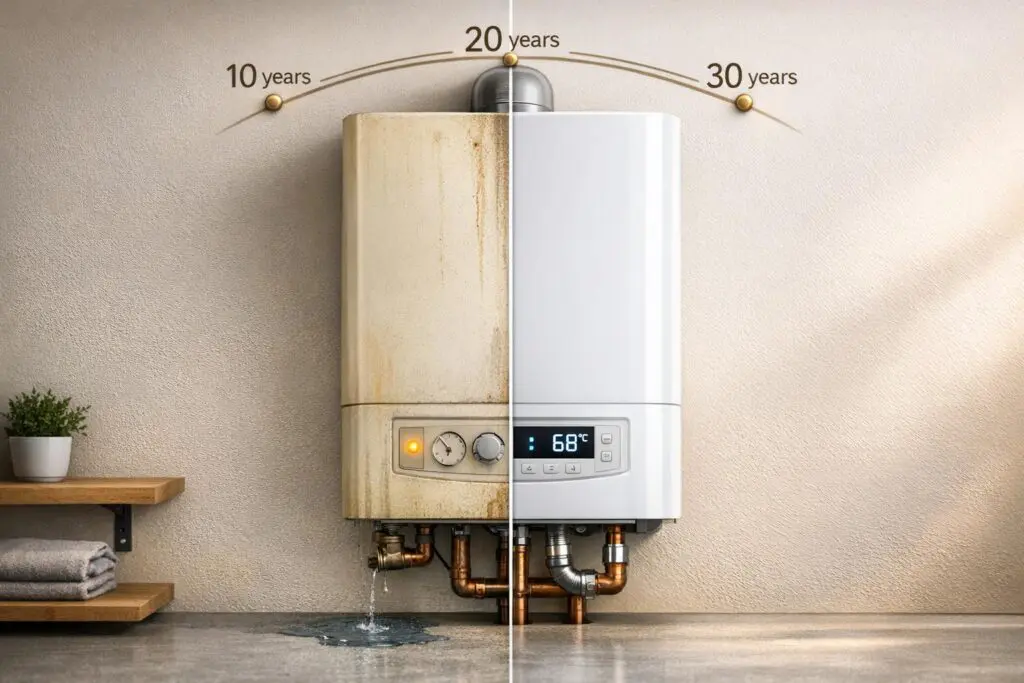
Boilers generally last 10 to 30 years, depending on the type and maintenance. Here’s a quick breakdown of lifespans by boiler type:
- Gas Boilers: 10–20 years
- Oil Boilers: Up to 20 years
- Electric Boilers: 8–10 years
- Condensing Boilers: Around 15 years
- Cast Iron Boilers: 20–30+ years
Over time, boilers lose efficiency and can become safety risks. For example, modern boilers operate at 92–94% efficiency, while older models may drop to just 60%, leading to higher energy bills. Signs like rising costs, frequent breakdowns, unusual noises, or corrosion often indicate it’s time to replace your boiler.
Key Takeaways:
- Boilers over 15 years old are less efficient and more prone to issues.
- Repairs costing 30–50% of a new boiler’s price often make replacement a smarter choice.
- New high-efficiency boilers can significantly reduce energy bills, with AFUE ratings of up to 98%.
Quick Comparison:
| Boiler Type | Lifespan | Efficiency (Modern) | Common Issues |
|---|---|---|---|
| Gas | 10–20 years | 92–94% | Mineral buildup, hard water |
| Oil | Up to 20 years | ~90% | Residue, frequent cleaning |
| Electric | 8–10 years | ~99% | Heating element wear |
| Condensing | ~15 years | 92–94% | Corrosion in heat exchanger |
| Cast Iron | 20–30+ years | ~85% | Rust, higher operating costs |
If your boiler is nearing its lifespan or showing signs of inefficiency, planning for a replacement can save you from unexpected breakdowns during peak heating season.
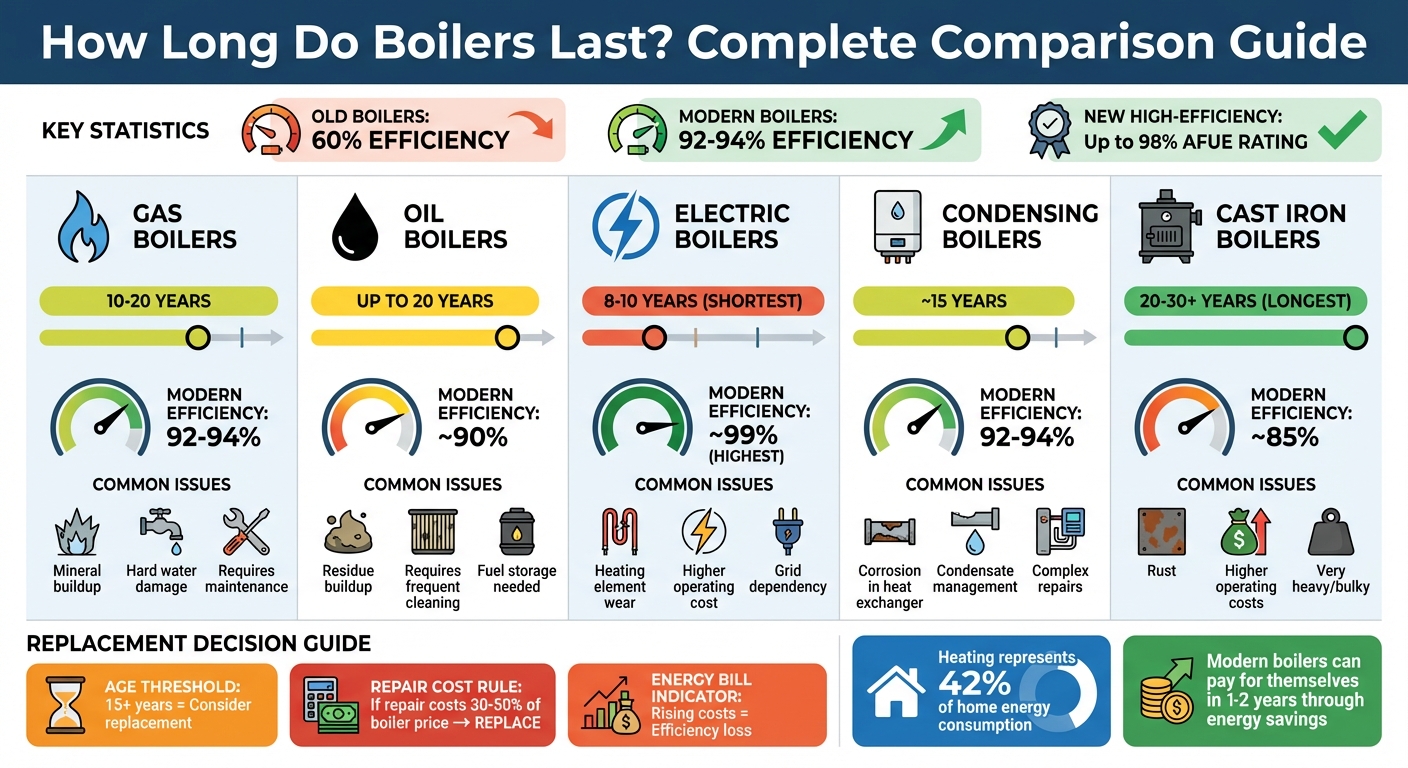
Boiler Types Lifespan and Efficiency Comparison Chart
10 TELL TALE SIGNS YOU NEED A NEW BOILER – Don’t Wait Till It’s Too Late!
sbb-itb-b5c10b1
Average Lifespan by Boiler Type
Boiler lifespans depend on their design, fuel type, and materials. Understanding these benchmarks can help you identify when a boiler might need replacing. Below is an overview of common boiler types, setting the foundation for later discussions on maintenance and replacement.
Gas Boilers
Gas boilers are a popular choice in many U.S. homes, typically lasting 10 to 15 years. With consistent maintenance, some models can stretch to 15–20 years. However, their lifespan is heavily influenced by factors like installation quality and water treatment. Hard water, for instance, can cause mineral buildup, damaging internal components over time.
Oil Boilers
Oil-fired boilers tend to outlast gas systems, often providing up to 20 years of reliable service. However, this longevity comes with a catch: they require regular professional servicing to remove the residue left behind by oil combustion.
Electric Boilers
Electric boilers, while free from combustion-related wear, generally last 8–10 years. Their shorter lifespan is primarily due to the rapid wear and tear on heating elements, which are integral to their operation.
Condensing Boilers
Modern condensing boilers usually have a lifespan of around 15 years. They stand out for their high efficiency, often achieving ratings between 92% and 94%. However, their design includes a second heat exchanger, which increases exposure to corrosive flue gases, accelerating wear and tear.
"Condensing boilers use a second heat exchanger and therefore have more exposure of combustion gas to the metal components, and this may cause earlier corrosion."
- First Choice Heating & Cooling
Cast Iron Boilers
Known for their durability, cast iron boilers often last 20 to 30 years or more. In fact, some older models have been known to operate for over 50 years. However, modern cast iron boilers are less common in residential settings due to their larger size and higher operating costs.
Each boiler type comes with its own set of challenges that can impact its longevity. These will be explored further in the next section.
| Boiler Type | Typical Lifespan | Advantage | Longevity Threat |
|---|---|---|---|
| Gas | 10–20 years | Consistent efficiency | Hard water/mineral buildup |
| Oil | Up to 20 years | Durable construction | Requires frequent cleaning |
| Electric | 8–10 years | No combustion risks | Heating element failure |
| Condensing | ~15 years | 90%+ efficiency | Corrosion in heat exchanger |
| Cast Iron | 20–30+ years | Extreme durability | Size and higher operating costs |
What Affects How Long Boilers Last
The type of boiler may set the stage for how long it will last, but it’s the external factors that truly determine its lifespan. Paying attention to these variables can help ensure your boiler serves you well for years to come.
Maintenance Practices
Regular maintenance can make a huge difference in how long your boiler lasts. With annual servicing, a boiler’s lifespan can stretch from 10–15 years to as long as 20–25 years. Skipping maintenance not only reduces efficiency but can also lead to faster wear and tear.
On top of that, many manufacturers require proof of annual servicing to keep warranties valid, especially for parts like the heat exchanger. Professional inspections are essential – they can catch hidden issues like rising CO2 emissions or short cycling (frequent on/off cycles) that wear out components faster.
"A professional boiler tune-up not only ensures that your system is running efficiently – it also helps us spot small issues before they turn into costly repairs or replacements." – Mitchell
Timing your maintenance is also important. Scheduling a tune-up during spring or summer means avoiding the winter rush and securing a more convenient appointment. In between professional checkups, you can take small steps like bleeding radiators to release trapped air and keeping an eye on the pressure gauge to make sure it stays within the recommended range.
Water Quality
The quality of your water can silently impact your boiler’s lifespan. Hard water, loaded with calcium and magnesium, can lead to scale buildup. This buildup harms internal components, reduces heat transfer efficiency, and may even clog drain valves or weaken cast iron sections. In closed-loop systems, water introduced through leaks or repairs brings in oxygen, which is a major cause of internal corrosion.
Proper water chemistry is key. If the pH levels are off, metals inside the boiler can corrode quickly, and sludge can form, reducing efficiency and creating a kettling noise – similar to a whistling kettle.
"Hydronic heating systems corrode without proper maintenance and become less efficient, leading to additional service calls and a shorter life span." – Jim Eichenser, Inside Sales and Tech Support Specialist, Oatey Co.
For homes in hard water areas, tools like water softeners or magnetic filters (e.g., the Magnaclean) can help prevent limescale and sludge buildup. Adding corrosion inhibitors annually can also maintain proper pH levels and protect new water entering the system. If buildup has already occurred, a professional powerflush might be necessary to clean out sediment and minerals.
Installation Quality
How your boiler is installed can make or break its longevity. Poor installation can lead to problems from day one. For instance, an oversized boiler tends to short cycle, wearing out parts like igniters and gas valves, while an undersized one may struggle to keep up during extreme cold, leading to overuse.
A professional installation ensures everything is done right. This includes proper near-boiler piping for even water circulation, which prevents hot spots that can damage heat exchange surfaces. It also involves setting up an efficient combustion air path and adjusting fuel feeds for safe and effective operation.
When installing a new boiler, it’s a good idea to get at least three quotes from local contractors. Make sure the technician performs a BTU calculation tailored to your home’s needs instead of just replacing the old unit with one of the same capacity. Many manufacturers also require proof of professional installation to validate warranties.
Operating Environment
Where your boiler is located matters more than you might think. Boilers placed in damp or poorly ventilated areas are more prone to rust and corrosion, which can drastically shorten their lifespan. Environments with extreme temperature fluctuations can also stress pipework and joints, leading to leaks over time.
To avoid these issues, place your boiler in a dry, well-ventilated area with enough combustion air. This is especially critical in regions like the Northeast and Midwest U.S., where harsh winters put extra strain on heating systems. About 9 million homes in these areas rely on boilers, making proper placement and protection even more important.
Usage and Load Patterns
How often and how hard you run your boiler also impacts its lifespan. Heavy or irregular use can wear it out faster. In areas with severe winters, boilers often require more frequent inspections to ensure safety controls are working properly.
"A boiler that short cycles all winter or runs with dirty water can wear out faster than one that heats a steady, balanced system." – Bernard Heating & Cooling
The secret to longevity lies in balance. A properly sized boiler that runs in steady, consistent cycles will last longer than one that constantly starts, stops, or operates at full capacity without breaks. These usage patterns, along with other signs of aging, can help you decide when it’s time to consider a replacement.
Signs Your Boiler Needs Replacement
Recognizing when your boiler is nearing the end of its lifespan can help you avoid unexpected breakdowns and costly emergency fixes. Below are some key warning signs that indicate your boiler might need replacing. These red flags suggest declining performance and can help you weigh the decision between repairs and a full replacement.
Age of the Boiler
How old is your boiler? Its age is one of the most reliable indicators of when it’s time to replace it. Residential gas boilers typically last between 10 and 20 years. If your boiler is approaching or has exceeded this range, it’s smart to start planning for a replacement, even if it seems to be working fine.
"Most boilers last between 10 to 15 years with proper maintenance. If yours is nearing or exceeding this age, it might be time to consider an upgrade." – Logan Donahue, ECI Comfort
Cast iron boilers, known for their durability, can last as long as 50 years with excellent maintenance. However, even the sturdiest models lose efficiency over time, making them more expensive to run compared to newer, more efficient systems. Other signs like increased energy bills or frequent repairs can further confirm the need for a replacement.
Rising Energy Bills
A noticeable increase in your energy bills, without any changes in your heating habits, is a strong indicator of declining boiler efficiency. Older boilers tend to work harder to maintain the same level of heat, which leads to higher fuel consumption.
"A spike in your energy bills without a clear reason could indicate that your boiler is working harder than it should." – Logan Donahue, ECI Comfort
To confirm this, compare your current utility bills with those from previous years. Upgrading to a modern boiler with an AFUE (Annual Fuel Utilization Efficiency) rating of 95% to 100% could drastically lower your heating expenses.
Frequent Breakdowns
If you’ve had to call a technician several times during the heating season, it’s a clear sign that your boiler is struggling. While regular maintenance can slow the aging process, it can’t stop it entirely. Frequent repairs usually mean that multiple components are wearing out simultaneously.
"If you’ve had to call a technician multiple times in the past year, it may be more cost-effective to invest in a new boiler." – Logan Donahue, ECI Comfort
A good rule of thumb: if a single repair costs 30–50% of what a new boiler would, it’s time to consider replacement. On average, boiler repairs range from $150 to $700. If these costs start piling up, it’s more practical to put that money toward a new system.
Visible Corrosion or Rust
Rust or corrosion on your boiler’s exterior is a red flag for internal damage. It often signals that the heat exchanger or tank has corroded, which can lead to leaks or even complete system failure. Corrosion weakens the structural integrity of the metal, and unfortunately, this damage is usually irreversible. Boilers installed in damp or poorly ventilated spaces are especially vulnerable to corrosion.
Unusual Noises or Leaks
Strange sounds like banging, whistling (known as kettling), or gurgling usually point to problems such as limescale buildup or trapped air within the system. Leaks, whether it’s a persistent drip or a puddle, are another serious issue that often signals internal component failure. These physical symptoms, combined with age and efficiency loss, paint a clear picture of a boiler on its last legs.
"A boiler leak is never a good sign… These leaks can cause serious water damage, and they can also mean trouble inside the boiler itself." – Sealed
Finally, keep an eye on your pilot light. A healthy flame burns blue. If it’s yellow or orange, this could indicate incomplete combustion, which might lead to a dangerous carbon monoxide leak.
Repair vs. Replacement: How to Decide
When your boiler starts showing signs of aging, deciding between repair and replacement becomes a key decision. Factors like the unit’s age, repair costs, and potential savings from a more efficient system all play a role. Making the wrong choice could lead to unnecessary expenses down the line.
Cost of Repairs vs. Replacement
A helpful rule of thumb is the 50% rule: if a repair costs 50% or more of what you’d pay for a new boiler, replacement is often the better option. For example, if a repair costs $3,500 and a new boiler is priced at $7,000, replacing it makes more financial sense.
"If the repair will cost anywhere close to 50% of what you’d pay to install a new boiler, replacement is the much smarter investment." – Keith Tolliver, Owner, Gene’s Refrigeration
Common boiler repairs include thermostat replacements ($100–$300), pressure relief valves ($200–$500), and circulator pumps ($500–$800). While these repairs might seem manageable, older systems often lack warranty coverage, leaving you to shoulder the full cost. In contrast, new boilers typically come with warranties lasting 5–10 years, making them a safer long-term investment.
Efficiency Gains with Modern Boilers
Older boilers, operating at around 70% efficiency, waste about 30% of the fuel they consume. Modern high-efficiency boilers, however, achieve AFUE (Annual Fuel Utilization Efficiency) ratings of 90% to 98%, which directly translates into lower heating bills. In fact, the energy savings from a new boiler can often cover its cost within one to two years.
"Often times, the energy savings from a new boiler replacement alone practically pays for the cost itself within a year or two." – Weil-McLain
Besides energy savings, modern boilers bring other benefits. Many include advanced safety features, such as sensors to reduce carbon monoxide risks, and they often integrate with smart thermostats for better energy management. They also run quieter, provide more consistent heating, and are less prone to breakdowns. With heating making up about 42% of energy consumption in U.S. homes, even small efficiency improvements can lead to noticeable savings. If your boiler is over 15 years old and your energy bills are climbing, upgrading could be one of the smartest investments for your home.
Comparison Table: Repair vs. Replacement
Here’s a quick breakdown to help you decide:
| Factor | Repair | Replace |
|---|---|---|
| Boiler Age | Generally under 10–12 years | Over 15 years |
| Repair Cost | Less than 50% of new unit cost | More than 50% of new unit cost |
| Efficiency | Maintains current (lower) AFUE | Achieves significant gains (90–98% AFUE) |
| Reliability | May face recurring issues | Comes with a new warranty and greater reliability |
| Safety | Fixes minor issues | Reduces risks like carbon monoxide leaks |
| Monthly Bills | Likely to stay high or increase | Expected to drop significantly |
Another factor to consider is part availability. Older boilers may require components that are hard to find, leading to longer repair times – especially inconvenient during winter. New systems often include warranties of 10–12 years, offering peace of mind against unexpected repairs.
How to Replace Your Boiler
Replacing an old boiler isn’t just about improving efficiency – it’s also about ensuring safety and reliability. Once you’ve decided it’s time for a new unit, careful planning and choosing the right equipment and installer are key steps.
Planning and Budgeting
In Chicago, replacing a residential boiler can cost anywhere from $4,000 to $9,000, depending on the type of unit and complexity of the installation. A standard replacement – where the new boiler is similar to the old one – typically falls between $4,000 and $6,500. If you’re opting for mid-range or high-efficiency models, expect costs to rise to $6,500 to $9,000. More complex retrofits, like switching from steam to hot water systems, can exceed $12,000.
Don’t forget to factor in additional costs like permits, which range from $100 to $300, and HVAC labor, which can cost between $125 and $245+ per hour. To get the best deal, collect at least three written estimates from reputable contractors. You should also explore financial incentives such as local utility rebates (e.g., ComEd), federal tax credits via EnergyStar.gov, and manufacturer discounts to reduce your expenses.
Timing your replacement can also save money. Replacing your boiler in the spring or fall – when demand for HVAC services is lower – can help you avoid peak-season labor surcharges.
Choosing the Right Boiler Type
When selecting a boiler, consider factors like fuel type, efficiency, and available space. In cities like Chicago, natural gas is the most common choice due to its availability, but oil and electric boilers are also options, each with varying operating costs. High-efficiency condensing boilers are particularly appealing, as they boast AFUE (Annual Fuel Utilization Efficiency) ratings of 90% or higher, leading to noticeable savings on energy bills. With proper care, these boilers can last 15 to 20 years.
Proper sizing is essential. A skilled contractor should perform a comprehensive heat loss calculation rather than simply matching the size of your old boiler. This ensures the new unit is neither too small nor too large for your home.
"A boiler that’s too large for the home will ‘short cycle,’ meaning that it will fire up and shut off quite frequently. Firing up and shutting down quickly is much harder on the unit than simply running for long periods of time, and results in unnecessary wear and tear." – Dan Vastyan, U.S. Boiler Company
If you’re tight on space, a combination (combi) boiler could be a great solution. These compact units handle both heating and hot water needs, making them ideal for smaller homes.
Professional Installation
Hiring the right installer is just as important as choosing the right boiler. Look for contractors with proper credentials, such as EPA 608 certification, to ensure the installation is safe and meets all regulations. Certifications specific to certain brands – like Navien Service Specialist or Mitsubishi Diamond Elite Contractor – demonstrate advanced expertise.
For example, Eco Temp HVAC in the Chicagoland area holds these specialized certifications and has an A+ rating with the Better Business Bureau, along with over 100 five-star reviews. Their technicians undergo background checks and drug testing, providing peace of mind alongside transparent pricing.
A professional installer will handle permits, ensure compliance with local building codes, and properly configure piping and venting. With expert installation, your new boiler should deliver reliable and efficient heating for the next 15 to 20 years.
Conclusion
Boilers generally provide dependable heating for 10–20 years, but their longevity depends on consistent maintenance, quality installation, and proper water treatment.
To recap, keep an eye out for warning signs like rising energy bills, frequent repairs, unusual noises, or visible corrosion. Upgrading to a modern condensing boiler can make a big difference, as these systems operate at 92–94% efficiency, compared to roughly 60% for older models. This upgrade can translate into noticeable savings on your heating costs.
If a repair is estimated to cost between 30–50% of a new boiler’s price, replacing the system often makes better financial sense. Timing your upgrade for the off-season – spring or summer – can also help you avoid higher costs and the stress of emergency repairs during winter.
The decision to repair or replace hinges on several factors, including cost and safety. Professional installation is crucial to ensure everything is done correctly. Certified technicians handle tasks like heat loss calculations, obtaining permits, and optimizing your boiler’s efficiency. For those in the Chicagoland area, Eco Temp HVAC provides certified installations with clear pricing and dependable service.
With proper maintenance and professional care, a new boiler can deliver efficient, reliable heating for 15 to 20 years. Addressing issues early and relying on expert service ensures your home stays warm and energy-efficient.
FAQs
How can I tell my boiler’s age?
You can figure out your boiler’s age by locating the manufacturing date or serial number on the unit itself. Another option is to check your purchase or installation records. If your boiler is over 10 to 15 years old, it’s a good idea to keep an eye out for signs of wear, like lower efficiency or the need for frequent repairs.
What boiler noises mean serious trouble?
Unusual noises coming from your boiler, like loud banging or booming, are often signs of delayed ignition or mineral buildup. On the other hand, hissing sounds might point to leaks or trapped air within the system. These sounds aren’t just annoying – they’re warning signals of internal problems that need immediate attention. If left unchecked, they could lead to more serious damage. Acting quickly can help keep your boiler running safely and efficiently.
Is a new boiler worth it for lower bills?
Replacing an old boiler with a new, high-efficiency model is a practical way to cut down on energy costs. Modern boilers are designed to use less fuel while running more efficiently, which means lower operating expenses over their expected lifespan of 15–20 years – provided they receive regular maintenance.