
If you’re deciding between new air conditioners like an inverter AC and a standard AC, here’s what you need to know:
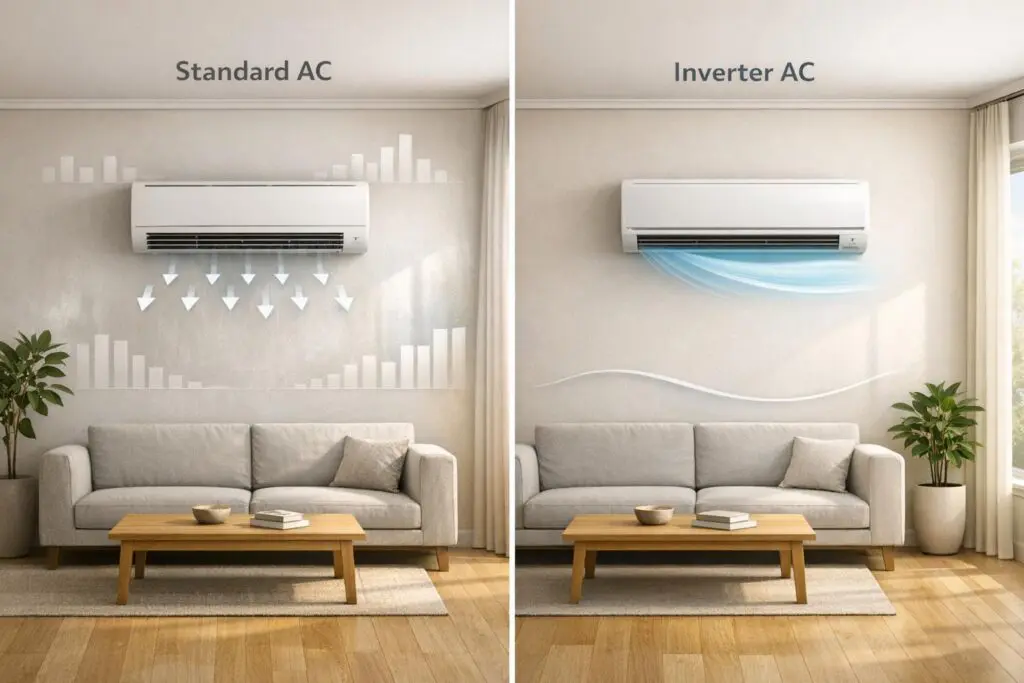
- Inverter ACs: Use variable-speed compressors to adjust cooling output based on room temperature. They operate more efficiently, reduce energy bills by 30–50%, maintain consistent temperatures, and are quieter. While they cost 20–30% more upfront, they save money in the long run, especially in spaces used for 8+ hours daily. They also manage humidity better, making them ideal for humid areas.
- Standard ACs: Use fixed-speed compressors that cycle on and off. They’re cheaper initially but consume more energy, leading to higher operating costs. Temperature fluctuations and higher noise levels are common. These are better suited for spaces with occasional or light use.
Quick Comparison:
| Feature | Inverter AC | Standard AC |
|---|---|---|
| Compressor Speed | Variable (25–100%) | Fixed (100% or 0%) |
| Energy Efficiency | 30–50% better | Lower |
| Temperature Control | Steady | Fluctuates |
| Noise Level | Quiet | Louder |
| Upfront Cost | Higher | Lower |
| Operational Cost | Lower | Higher |
| Lifespan | Longer | Shorter |
If you use your AC daily for long hours, an inverter model offers better performance and savings. For occasional use or budget constraints, a standard AC may suffice.
Inverter AC vs Standard AC: Complete Comparison Guide
Inverter ACs vs Non-Inverter ACs Comparison
sbb-itb-b5c10b1
How Inverter ACs Work
Inverter ACs rely on a variable-speed compressor that adjusts its capacity between 25% and 100% to meet the cooling needs of a room. The system uses an inverter to convert AC power to DC and then back to AC with varying frequency, allowing precise control over the compressor’s speed.
When a room’s temperature is far from the desired setting, the compressor ramps up quickly to full speed. Once the target temperature is reached, it slows down to maintain it – similar to how cruise control works in a car.
"An inverter compressor… operates almost continuously at a low speed on warm days, using the least amount of electricity to maintain the temperature. This consistent operation reduces temperature swings in the home, minimizes stress on the compressor, and extends its lifespan." – Mike Lea, Co-owner, Lea Heating & Air Conditioning
Unlike conventional ACs that completely shut off and restart frequently, inverter systems operate continuously at varying speeds. This avoids the energy-intensive spikes caused by the pressure equalizing between the condenser and evaporator circuits in traditional units. By staying active, inverter ACs prevent the energy waste associated with repressurizing the refrigerant.
Additionally, the gradual acceleration and deceleration of the compressor in inverter systems reduces mechanical wear and tear. The soft-start mechanism further protects the compressor, minimizing stress during startup. This design not only extends the lifespan of the unit but also ensures that the lubrication system keeps the compressor functioning smoothly, even at very low speeds over long periods.
Next, we’ll take a closer look at how standard ACs function to better understand the differences.
How Standard ACs Work
Standard air conditioners operate quite differently from inverter systems. Instead of adjusting speed, they rely on a fixed-speed compressor that either runs at full power or shuts off completely. When the room temperature rises above the thermostat setting, the compressor kicks in at 100% power to cool the space quickly. Once the desired temperature is reached, it shuts off entirely.
"With a standard air conditioner, when the temperature rises by a degree, the unit runs at full capacity to cool the home quickly, then shuts off, repeating that cycle all day." – Mike Lea, Co-owner, Lea Heating & Air Conditioning
This constant cycling is not energy-efficient and places extra strain on the system. Each time the compressor restarts, it requires a power surge – using 3 to 4 times more electricity than an inverter system during start-up. Additionally, energy is wasted as the refrigerant has to be repressurized every time the unit restarts. Over time, these frequent power surges and cycles wear down internal components, reducing the unit’s overall lifespan. You might also hear a noticeable "thump" when the compressor turns on, a telltale sign of the stress these systems endure.
Another downside to this cycling is the noticeable temperature fluctuations it creates. One moment the room may feel too cold, and the next, it might feel stuffy as the system shuts off. Additionally, when the compressor stops, the evaporator coils warm up, releasing condensed water back into the air. This process can cause uncomfortable humidity levels to rise.
These operational quirks underline the key differences between standard and inverter ACs, paving the way for a more detailed comparison of the two.
Inverter AC vs. Standard AC: Side-by-Side Comparison
Now that you know how these systems work, let’s look at the practical differences that can influence your budget, comfort, and overall experience. Below is a detailed comparison of key features, including energy use, temperature control, and maintenance costs.
| Feature | Inverter AC | Standard (Non-Inverter) AC |
|---|---|---|
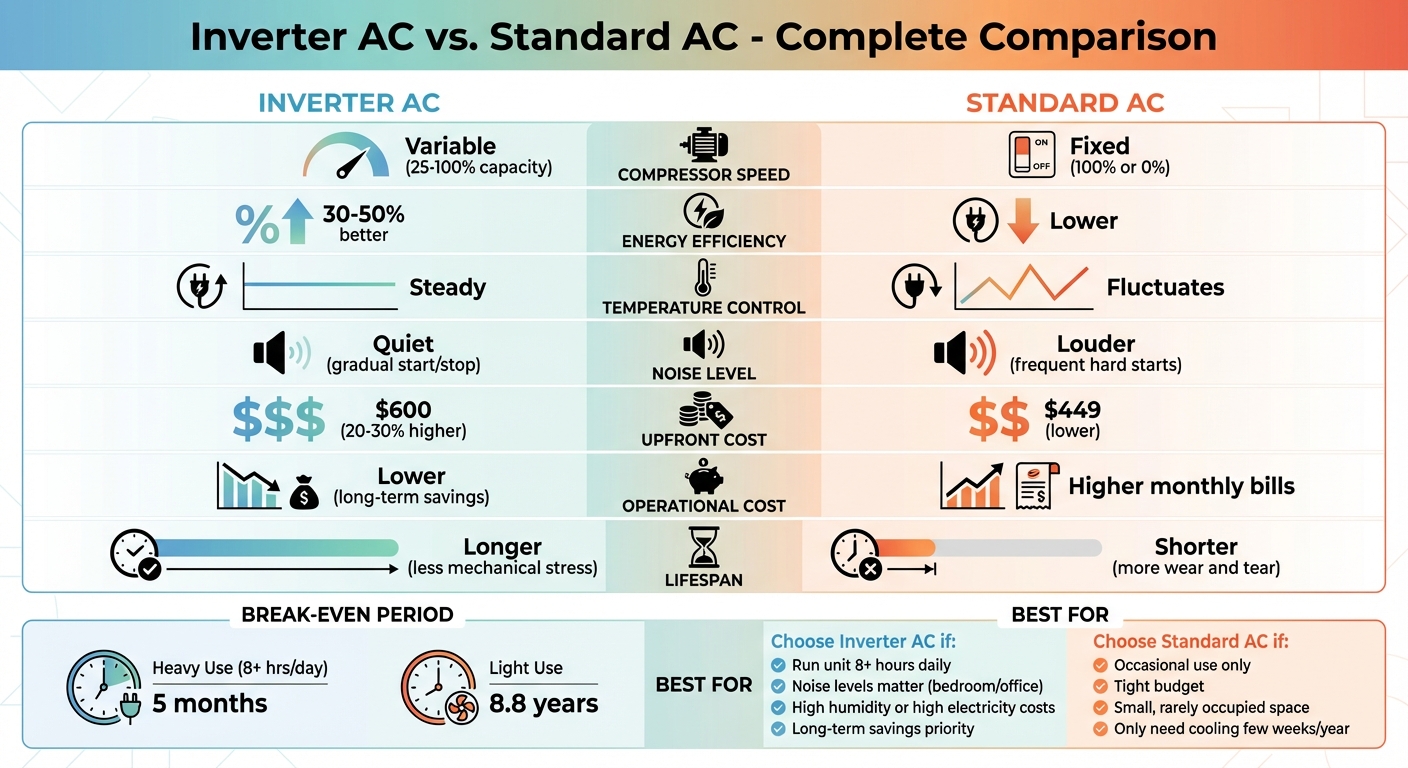
| Compressor Speed | Variable (25%–100% capacity) | Fixed (100% or 0%) |
| Energy Efficiency | 30–50% higher | Lower due to startup spikes |
| Temperature Control | Precise and consistent | Fluctuating (on/off cycles) |
| Noise Level | Quiet (gradual start/stop) | Louder (frequent hard starts) |
| Initial Cost | Higher | Lower |
| Operational Cost | Lower (long-term savings) | Higher monthly bills |
| Lifespan | Longer (less mechanical stress) | Shorter (more wear and tear) |
Energy Efficiency and Power Consumption
Inverter ACs are designed to tackle energy waste by cutting power consumption by 30% to 50% compared to standard models. This efficiency comes from their variable-speed compressors, which adjust cooling output to meet the room’s needs rather than shutting off completely. On the other hand, standard ACs consume more energy because their compressors start and stop frequently, with each restart drawing 3 to 4 times the power of continuous operation.
For example, while a 12,000-BTU inverter AC costs about $600 compared to $449 for a similar non-inverter model, the energy savings over time often make up for the higher initial price.
"Unlike traditional AC units that run at full power and cycle on and off, an inverter system adjusts its compressor speed to match the cooling demand. This results in more consistent indoor temperatures, reduced energy waste, and lower cooling bills."
- Jennifer Fletcher, Owner, Modern Air Solutions
These energy savings don’t just lower your bills – they also enhance cooling performance.
Cooling Performance and Temperature Control
Inverter ACs excel at maintaining a steady indoor temperature, eliminating the fluctuations typical of standard units. They can quickly ramp up to maximum cooling capacity to cool a hot room faster, then slow down to maintain the desired temperature. This responsiveness is why inverter systems are often rated highly for comfort.
Additionally, their ability to operate continuously at low speeds provides better dehumidification. This prevents the damp, sticky feeling that can occur when standard units cycle off and allow moisture to linger in the air.
"Inverters tend to cool the room more quickly. So they’ve tended to gravitate toward the top of our comfort ratings."
- Chris Regan, Head of Air Conditioner Testing, Consumer Reports
This precise temperature control also contributes to quieter operation.
Noise Levels and Comfort
One of the standout benefits of inverter ACs is their quiet operation. By running continuously at lower speeds, they avoid the loud startup noise that standard units produce. This can make a big difference, especially in bedrooms where noise levels impact sleep quality. Consumer Reports highlights that 24 out of their 32 recommended window AC models now use inverter technology, showing the growing preference for quieter systems.
But comfort isn’t the only area where inverter technology shines – it also offers durability benefits.
Maintenance, Durability, and Lifespan
Inverter ACs experience less mechanical stress because their compressors adjust gradually rather than turning on and off abruptly. This often results in a longer lifespan compared to standard units, which endure more wear and tear from frequent hard starts.
That said, inverter systems do come with more complex electronics. If an inverter control board fails, repairs can be pricier than fixing a standard unit’s simpler components, like a capacitor. However, these units generally break down less often, balancing higher repair costs with improved reliability and lower overall maintenance expenses over their lifetime.
Cost Analysis: Upfront Price vs. Long-Term Savings
When choosing an air conditioner, the sticker price is just one piece of the puzzle. Inverter models typically cost 20%–30% more upfront than standard units. For example, a 12,000-BTU GE Profile inverter AC is priced at around $600, while a standard model costs approximately $449 – a $151 difference. This price gap reflects the advanced technology in inverter units, such as variable-frequency drives and sophisticated controllers, which are pricier than the fixed-speed components found in standard models.
The key question is whether energy savings can make up for the higher initial cost. Inverter ACs can reduce electricity bills by 30%–50% compared to standard units, thanks to their ability to avoid energy-draining start-stop cycles. According to the Department of Energy, this translates to annual savings of about $17 for light use.
| AC Type | Upfront Cost | Annual Energy Savings | Break-Even Period |
|---|---|---|---|
| Standard (Non-Inverter) | $400–$450 | $0 (Baseline) | N/A |
| Inverter (Window/Light Use) | $600 | ~$17 | ~8.8 years |
| Inverter (Split/Heavy Use) | $600 | ~$480 ($40/month) | 5 months |
The break-even period largely depends on how often you use your AC. If you run your unit for 8 or more hours daily in a main living area or bedroom, the $200 price premium for an inverter model can be recouped in just 5 months. However, in spaces like guest rooms, where the AC is used only 2–4 hours a day, the energy savings may not offset the higher upfront cost.
"Inverter ACs are more expensive to purchase but you’re paying less to operate them, so there’s a good chance you’ll recoup the price difference over time."
- Chris Regan, Head of Air Conditioner Testing, Consumer Reports
It’s also essential to choose the right size. An undersized inverter AC won’t deliver its promised efficiency. On top of that, repairs can be pricier post-warranty due to the complexity of inverter components compared to the simpler mechanical parts in standard units.
This breakdown helps you weigh the upfront cost against potential long-term savings to decide which AC type aligns with your usage and budget.
Which AC Type Is Right for You?
Deciding on the right AC type and choosing the ideal air conditioning company depends heavily on how often you use it and what you value more – lower upfront costs or long-term efficiency. If you’re running the unit daily for long hours, like in a master bedroom, home office, or main living area, an inverter AC is the way to go. Its variable-speed compressor keeps the temperature steady without the constant on-off cycles, making it perfect for light sleepers or anyone who wants consistent comfort. Plus, this efficient operation helps cut down on energy waste and cooling costs.
On the other hand, if the space is used only occasionally, a standard AC might be a better fit. With its lower initial cost, it’s a practical choice for rooms that don’t see much daily use. As product tester Camryn Rabideau explains:
"If you only turn on your air conditioner during the hottest days of summer, a standard window air conditioner is probably fine for your needs and will be easier on your wallet".
One critical factor to keep in mind is proper sizing. An undersized inverter unit won’t deliver its efficiency benefits. However, even for smaller spaces, inverter units are often the better option if used daily, as they excel at dehumidification and prevent that damp, sticky feeling.
Here’s a quick comparison to help you decide:
| Choose Inverter AC If: | Choose Standard AC If: |
|---|---|
| You run the unit 8+ hours daily | You use the space only occasionally |
| Noise levels matter (e.g., bedroom or home office) | You’re working with a tight budget |
| You live in a high-humidity or high-electricity-cost area | The space is small and rarely occupied |
| Long-term savings and comfort are priorities | You only need cooling for a few weeks per year |
Mike Lea from Lea Heating & Air Conditioning highlights the benefits of inverter ACs:
"They’re very quiet units and provide higher efficiency than standard scroll-compressor air conditioners, which can translate into significant long-term energy savings".
So, if you’re looking for quiet, efficient cooling with lower energy costs over time, an inverter AC is worth considering. But for occasional use or when budget constraints take priority, a standard AC can get the job done. The choice ultimately comes down to your daily habits, budget, and whether you value consistent comfort or a lower upfront investment.
Conclusion
Inverter ACs shine when used daily or for extended periods. They operate quietly, maintain steady temperatures, and avoid the constant cycling that can wear out components over time. Thanks to their variable-speed compressors, these systems adjust continuously to meet cooling demands, reducing energy consumption and extending their lifespan – though they come with a higher upfront cost.
On the other hand, standard ACs are more budget-friendly initially (e.g., $449 compared to $600) and make sense for spaces where cooling is needed infrequently. If your usage is limited to a few weeks a year or the hottest days, the energy savings from an inverter unit may not offset the higher purchase price, making a standard model the more practical choice.
The decision ultimately comes down to your usage patterns and budget. Inverter systems are ideal for high-use scenarios, especially in humid environments where their superior dehumidification can keep you comfortable without needing to lower the thermostat significantly. Standard units, however, are better suited for occasional use or when minimizing upfront costs is a priority. This balance of trade-offs has been a central theme throughout this article.
For those in the Chicagoland area, Eco Temp HVAC offers expert air conditioning services to help homeowners and businesses make the best choice. Their certified technicians provide personalized evaluations, considering your space, cooling needs, and energy goals. Whether you’re looking for an inverter system for year-round efficiency or a standard unit for seasonal cooling, Eco Temp HVAC ensures you get the right system. With service locations in Chicago, St. Charles, Bartlett, Lemont, Downers Grove, and Palatine, they deliver quick and reliable installation and maintenance to keep your AC running smoothly.
Proper sizing is essential – units that are too small won’t deliver the expected efficiency, while oversized systems waste energy. Professional advice ensures you invest in a system that fits your needs for the long term.
FAQs
How does an inverter AC’s variable-speed compressor improve energy efficiency?
An inverter AC uses a variable-speed compressor to improve energy efficiency by adjusting its speed based on the cooling or heating needs. Unlike traditional ACs that frequently switch on and off, an inverter AC maintains a consistent operation. This approach reduces energy use, keeps indoor temperatures stable, lowers electricity costs, and helps the unit last longer by reducing wear and tear.
What are the long-term financial benefits of choosing an inverter AC compared to a standard AC?
Opting for an inverter AC can save you money in the long run. Unlike traditional air conditioners that run at a fixed speed, inverter ACs adjust their compressor speed to match the cooling demand. This means they use less energy and keep indoor temperatures more stable, which can lead to noticeable reductions in your electricity bills.
While inverter ACs might cost more upfront, their energy efficiency can translate into big savings over time, making them a smart investment for homeowners. Plus, their ability to maintain consistent performance helps reduce wear and tear, which could mean fewer maintenance expenses down the road.
Is an inverter air conditioner better for managing humidity than a standard AC?
Inverter air conditioners tend to handle humidity more effectively than standard units. Here’s why: instead of operating at fixed speeds like traditional ACs, inverter models adjust their compressor speed to maintain a consistent temperature. This steady operation doesn’t just save energy – it also improves their ability to dehumidify the air.
By keeping the indoor climate more stable, inverter systems create a more comfortable environment and help minimize that unpleasant sticky or damp feeling that often accompanies high humidity levels.