
Installing a boiler in Illinois requires strict adherence to safety and legal standards to protect lives and property. Here’s what you need to know:
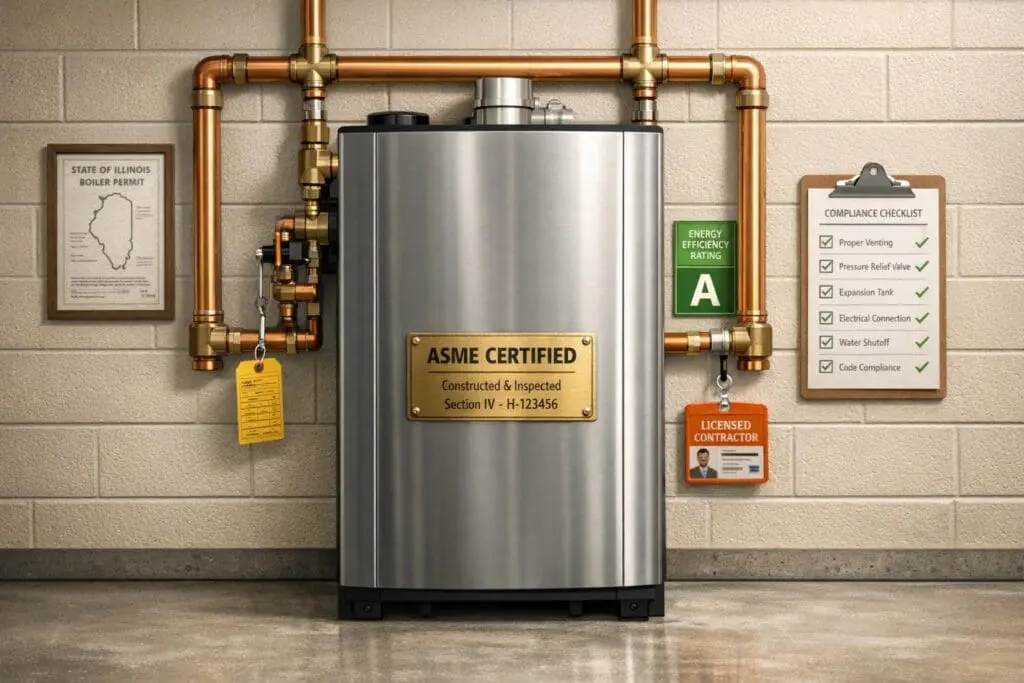
- State Requirements: Boilers must comply with the ASME Boiler and Pressure Vessel Code and display the ASME Code Symbol Stamp.
- Inspections: High-pressure boilers need annual inspections; low-pressure boilers require inspections every two years.
- Permits: A permit is mandatory for installation or replacement, and inspections are required before operation.
- Energy Efficiency: Boilers must meet the 2021 International Energy Conservation Code, with a minimum 84% AFUE efficiency.
- Exemptions: Private residences, small multi-family buildings, and certain equipment (e.g., farm equipment) are exempt from state rules.
- Contractor Licensing: Only licensed professionals can perform installations, and welded repairs require an "R-Stamp."
Staying informed about these regulations helps avoid violations and ensures safety during installation and operation.
Illinois Boiler and Pressure Vessel Safety Act
The Boiler and Pressure Vessel Safety Act (430 ILCS 75) sets statewide standards for the installation, operation, and maintenance of boilers and pressure vessels. This law is enforced by the Office of the State Fire Marshal, which works alongside the Board of Boiler and Pressure Vessel Rules. The Board is responsible for creating definitions, rules, and regulations that carry legal authority.
What the Act Covers
The Act governs steam boilers (both fired and unfired), hot water boilers, and pressure vessels throughout Illinois. It relies on the American Society of Mechanical Engineers (ASME) Boiler and Pressure Vessel Code for new construction standards. For maintenance and repairs, it incorporates the National Board Inspection Code (NBIC) and American Petroleum Institute (API) standards.
Equipment must be registered and undergo regular inspections, and owners are required to keep records to ensure safe operation. Operating without a valid Inspection Certificate results in daily violations. If an incident involving injury or death occurs, owners must notify the Chief Inspector within 24 hours. Failing to do so can lead to fines ranging from $501 to $10,000 for corporations or government entities.
Although the Act broadly regulates boiler systems, specific types of installations are exempt.
Who Needs to Follow These Rules
The Act primarily applies to commercial and industrial properties but includes several exemptions. For instance, private residences and multi-family buildings with fewer than six units are not subject to state inspection requirements. Additionally, boilers located in cities with populations exceeding 500,000 – like Chicago – are exempt, as these cities have their own inspection requirements under local building codes. Property owners can consult with HVAC experts in Chicago to ensure compliance with these specific municipal requirements.
Other exemptions include farm equipment used exclusively for agricultural purposes, boilers regulated by federal authorities, and small hobby steam engines (e.g., miniature locomotives) with an inside diameter of 12 inches or less. Boilers within nuclear facilities fall under the jurisdiction of the Illinois Emergency Management Agency (IEMA), rather than the State Fire Marshal.
sbb-itb-b5c10b1
Permits and Inspections for Boiler Installation
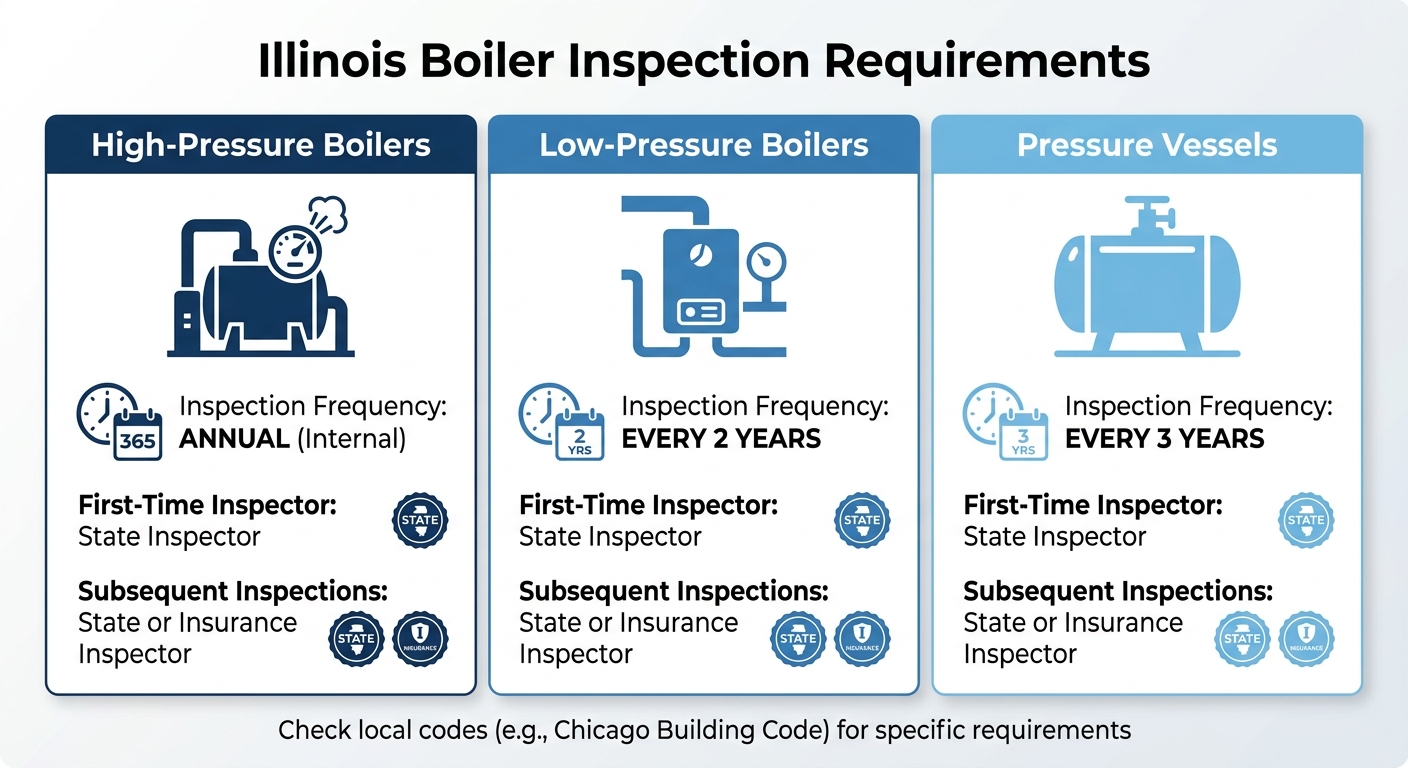
Illinois Boiler Inspection Requirements by Type and Frequency
In Illinois, adhering to boiler safety standards means obtaining the right permits and completing all necessary inspections. These steps ensure compliance and help maintain safety.
How to Get a Permit
If you’re installing or replacing a boiler in Illinois, you’ll need a permit – this applies to nearly every jurisdiction in the state. To begin, owners must notify the Division of Boiler and Pressure Vessel Safety to register the equipment and schedule an initial inspection. For high-pressure boilers, the Department of Labor or the Division of Boiler and Pressure Vessel Safety manages oversight. On the other hand, local building departments usually handle permits for low-pressure residential and commercial systems.
When applying, you’ll need to submit ASME data reports along with the completed permit application. These forms are typically available on the State Fire Marshal or local building department websites. Once the boiler is installed, the installer is responsible for conducting ASME-required acceptance tests. Copies of the test results, along with the manufacturer’s data reports, must be submitted to the code official. Additionally, the installer must provide control diagrams and permanent operating instructions. It’s important to note that non-code boilers are not allowed anywhere in Illinois.
Once your permit is approved, follow the required inspection process to ensure everything meets the necessary standards.
Required Inspections
After obtaining your permit, inspections are the next step. All first-time inspections – whether for new or used equipment – must be conducted by a state inspector from the Division of Boiler and Pressure Vessel Safety. Once the inspection is passed and the fee is paid, you’ll receive a Certificate of Inspection, which must be displayed in the equipment room.
For subsequent inspections, boilers covered by insurance can be inspected by commissioned insurance company inspectors. It’s also mandatory to maintain a log for each registered boiler to comply with state regulations. If the installation includes any welded repairs to pressure equipment, ensure the company performing the work is licensed by the Division of Boiler and Pressure Vessel Safety and holds an "R" Stamp.
Inspection Requirements by Boiler Type
The frequency of inspections depends on the type of boiler or pressure vessel. Here’s a breakdown:
| Boiler/Vessel Type | Inspection Interval | Governing Authority/Inspector |
|---|---|---|
| High-Pressure Boilers | Annual (Internal) | State Inspector (First-time); State or Insurance (Subsequent) |
| Low-Pressure Boilers | Every 2 Years | State Inspector (First-time); State or Insurance (Subsequent) |
| Pressure Vessels | Every 3 Years | State Inspector (First-time); State or Insurance (Subsequent) |
It’s worth double-checking local codes, like the Chicago Building Code, as they may have different requirements for inspection intervals or licensed operators compared to the Illinois State Plumbing Code.
Installation Codes and Technical Standards
Required Standards and Codes
Boiler installations in Illinois must meet a range of safety and efficiency standards. At the core is the ASME Boiler and Pressure Vessel Code (BPVC), which mandates that new boilers be designed, constructed, and certified according to ASME Section I or IV. Proper documentation of this certification is a must.
The International Mechanical Code (IMC) 2024 oversees all aspects of installation, alteration, and repair work. This includes safety controls, maintenance protocols, and testing procedures. For energy efficiency, the Illinois Energy Conservation Code applies. It incorporates the International Energy Conservation Code (IECC) 2021 for residential projects and ASHRAE 90.1 for commercial buildings.
Control systems are regulated based on the boiler’s size. Boilers with capacities under 12,500,000 Btu/hr must comply with ASME CSD-1, while larger systems need to meet NFPA 85 standards. Specific boiler types also require UL certification: UL 726 for oil-fired units, UL 834 for electric boilers, and UL 2523 for solid-fuel models.
Ventilation and Piping Rules
Proper ventilation and piping are critical for safe boiler operation. Discharge piping for safety and relief valves must be rigid, rated for high temperatures, and designed to allow gravity flow without traps. These pipes must terminate no more than 6 inches above the floor or the flood level rim of a waste receptor. For high-pressure steam boilers, safety valves must vent directly to the outside.
Each boiler requires shutoff valves in both the supply and return piping, except in systems using a single low-pressure steam boiler. Adequate clearance is also essential – there must be at least 18 inches of unobstructed space around all sides of the boiler to allow for inspection and servicing. If the discharge termination point isn’t easily visible to building occupants, a leak detection monitor with an alarm must be installed.
These technical specifications are essential to ensure compliance with Illinois boiler installation regulations.
Energy Efficiency and Documentation Requirements
Mechanical ComCheck and Energy Code Compliance
Energy efficiency documentation plays a crucial role in ensuring compliance with installation codes. In Illinois, all privately funded commercial and residential buildings must adhere to the Illinois Energy Conservation Code (20 ILCS 3125/15). Starting November 30, 2025, the state adopted the 2024 edition of the International Energy Conservation Code (IECC), including Illinois-specific amendments, as the governing standard. For commercial structures, this code incorporates the requirements outlined in ASHRAE 90.1-2022.
To document compliance, Mechanical ComCheck software is used for commercial mechanical systems, including boilers. This software ensures that equipment meets or exceeds the minimum efficiency ratings mandated by the IECC. Federal regulations establish baseline efficiency standards for non-weatherized gas boilers. However, many newer installations exceed these baselines, achieving efficiencies above 90% AFUE to align with modern performance expectations.
Once installation is complete, contractors must provide all required test documents and manufacturer’s data reports, as specified by the ASME Boiler and Pressure Vessel Code, to the appropriate code official. It’s essential to check for local amendments, as cities like Chicago may have additional requirements, including specific boiler maintenance standards.
Proper documentation of energy efficiency goes hand-in-hand with ensuring contractors are appropriately licensed for boiler installations.
Contractor Licensing Requirements
Contractor licensing requirements are designed to align with Illinois’ safety and regulatory standards. Unlike some states, Illinois does not offer a unified state HVAC contractor license. Instead, licensing is managed by state agencies and local municipalities. Boiler contractors must secure the necessary local HVAC registration, particularly in home-rule areas like Chicago.
For high-pressure boilers – those operating above 15 psig for steam or 160 psig for water – operators are required to hold a license under the Illinois Boiler and Pressure Vessel Safety Act (225 ILCS 217/). Additionally, any welded repairs to pressure equipment must be performed by companies licensed by the Division of Boiler and Pressure Vessel Safety and holding an "R-Stamp" as per the National Board Inspection Code. Systems that fail inspection or experience malfunctions require expert boiler repair to restore compliance. If the system involves potable water connections, contractors must also comply with the Illinois Plumbing License Law (225 ILCS 320), overseen by the Illinois Department of Public Health.
Summary
Illinois boiler installation codes are in place to prioritize safety. According to the State Fire Marshal, these rules are designed to protect both lives and property in spaces like schools, hospitals, factories, and other public areas. For residents and businesses in the Chicagoland area, these regulations ensure a high standard of safety.
The Illinois Boiler and Pressure Vessel Safety Act (430 ILCS 75) serves as the primary legal framework. It mandates the registration and inspection of most boilers and pressure vessels. Additionally, all new boilers must meet the requirements of the ASME Boiler and Pressure Vessel Code and carry the appropriate ASME Code Symbol Stamp.
These codes cover everything from design to inspection and maintenance, ensuring systems operate safely. Compliance involves several critical steps, including obtaining permits, scheduling regular inspections, and keeping detailed records. Installations must also align with the Illinois Energy Conservation Code, which requires documentation through tools like Mechanical ComCheck. Only licensed professionals are allowed to perform installations, and any welded repairs must be handled by companies with an R-Stamp from the Division of Boiler and Pressure Vessel Safety. Equipment owners are also responsible for maintaining logs and displaying inspection certificates in the equipment room.
Adhering to these codes is essential for safety, operational efficiency, and avoiding unnecessary costs. Beyond legal compliance, following these guidelines contributes to safer and more efficient boiler operations across Illinois. For those in need of expert boiler installation services in Chicagoland, as well as furnace installation in Chicago, Eco Temp HVAC offers professional assistance.
FAQs
Do Chicago boilers follow state or city rules?
Boilers in Chicago are required to follow Illinois state regulations covering their installation, operation, and inspection. The state’s boiler inspection program extends across all areas, including Chicago, to ensure boilers meet safety standards and comply with applicable codes.
What qualifies as a high-pressure boiler in Illinois?
In Illinois, a high-pressure boiler is classified as one that operates at pressures exceeding 15 pounds per square inch gauge (psig) for steam or 160 psig for hot water. These limits are set by Illinois boiler regulations to prioritize safety and regulatory compliance.
What paperwork do I need after a boiler install?
After installing a boiler in Illinois, you’ll need to secure a boiler permit, schedule an inspection for the installation, and gather documentation that confirms compliance with state codes. This typically includes inspection reports and certificates of compliance. Be sure all paperwork adheres to Illinois boiler regulations to avoid any issues.