
Neglecting your tankless water heater can cost you – both in efficiency and lifespan. Regular maintenance is key to keeping it running smoothly for 20+ years. Here’s what you need to know:
- Mineral buildup is the top issue, especially in hard water areas, reducing efficiency by 20-30%.
- Perform annual descaling (or every 6 months in hard water regions).
- Clean filters regularly: monthly to annually, depending on water hardness.
- Inspect for leaks, blockages, and performance issues every 2 months.
- Always shut off power and water before maintenance to ensure safety.
- Leave complex tasks like gas line checks or electrical repairs to professionals.
With proper care, you’ll avoid cold showers, high energy bills, and costly repairs. Keep a maintenance log and schedule professional service annually to ensure long-term reliability.
Tankless Water Heater Descale and Filter Service
sbb-itb-b5c10b1
Safety Steps and Preparation
Before you even think about working on your tankless water heater, make sure to shut everything down properly. Start with the electrical power – this is critical to prevent thermal shock to the heat exchanger and to protect the control board. For electric models, flip the circuit breaker at your main panel. If you have a gas unit, cut power to the igniter and fan, then turn the manual gas shut-off valve a quarter turn so the handle is perpendicular to the gas pipe.
Next, close the cold water inlet and hot water outlet service valves. Fully closed valves will have their handles perpendicular to the pipes. To relieve system pressure, open a hot water faucet. Double-check that the unit is off by confirming the display is dark, the system is silent, and only cold water flows.
"Isolate the Electrical Supply (Always First)… This step is critical to prevent thermal shock or scalding." – Denommee Plumbing, HVAC & Electric
Residual heat can still be dangerous, so give the unit 10–15 minutes to cool down before handling any internal components. If you’re working on a gas unit, ventilate the area by opening windows or doors, and make sure there are no flammable materials nearby.
Once everything is safely shut down, gather the tools and supplies you’ll need for maintenance.
Tools and Supplies You’ll Need
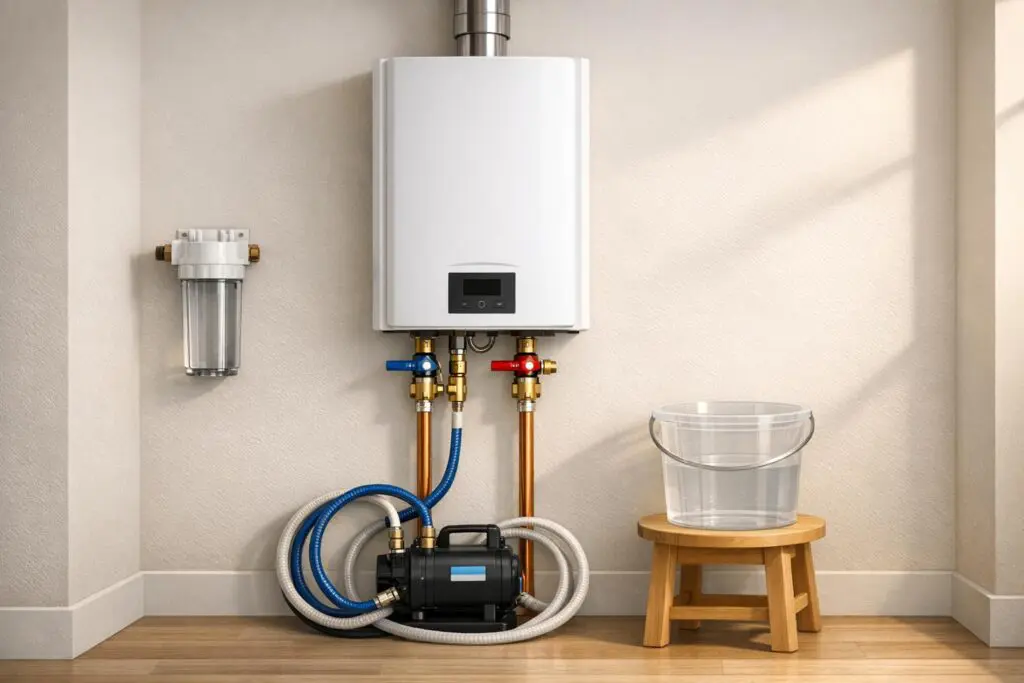
For most maintenance tasks, you’ll need a few essentials: a 1/6 HP submersible pump to circulate the descaling solution, two 3–4-foot washing machine hoses, and a 5-gallon bucket. For descaling, use 2–3 gallons of white vinegar (5% acidity) for a gentler clean, or 1 quart of commercial descaler if there’s heavy buildup.
Other handy tools include an adjustable wrench or channel locks, a soft brush or vacuum for cleaning filters, and basic safety gear like gloves and goggles to protect against splashes or debris. For cleaning the exterior, a lint-free cloth with warm water and mild detergent works well. Just remember – never spray water directly on the unit or its remote control.
When to Call a Professional
While you can handle routine maintenance like cleaning filters, checking vent terminations, and descaling the heat exchanger, some situations call for professional help. If you notice gas leaks, rusty or discolored water, strange banging or popping noises, or complex error codes, it’s time to call a licensed technician.
"DIY repairs may be unsafe and can void the manufacturer’s warranty." – Denommee Plumbing, HVAC & Electric
Tasks involving gas lines, burners, flame sensors, igniters, or internal electrical components should also be left to the pros. Annual professional service typically costs between $150 and $350, which can save you from much bigger headaches down the line. If you’re in the Chicagoland area, Eco Temp HVAC is a Navien Service Specialist, offering certified care for your tankless water heater.
Regular Visual and Performance Checks
Every two months, take some time to perform a visual inspection of your unit. Start by cleaning the exterior with a lint-free cloth and warm water. While doing this, keep an eye out for dents, cracks, rust, or mineral deposits on the casing. If you have a gas-fired model, check the base for scorch marks – these could signal combustion or venting problems. Use a maintenance log to track your findings for future reference.
Inspect the Exterior
Make sure the unit has the proper clearance recommended by the manufacturer – generally about 12 inches on all sides. Also, confirm that combustible items like paper, chemicals, or cleaning supplies are not stored nearby.
"Check the appliance exterior for physical damage, corrosion, or indications of a water leak." – Nick Gromicko and Ben Gromicko, InterNACHI
Check for Leaks or Moisture
Inspect pipe joints, valves, and unions for any signs of leaks, dampness, or moisture buildup. Look for telltale signs like water stains on the floor, puddles near the base, or mineral deposits around fittings – these can indicate slow leaks or past issues. If you have a condensing model, ensure the condensate drain line and trap are free of debris to avoid backups. If you notice a small leak at a connection, try gently tightening the fitting. Persistent leaks, however, call for professional water heater repair.
Once you’re confident there are no moisture issues, shift your attention to ventilation.
Venting and Air Intake Inspection
Blocked vents can pose a serious safety hazard by causing carbon monoxide buildup. Check that the exhaust vents and air intakes are clear of obstructions like debris, dust, soot, snow, or even animal nests. Carefully inspect the vent pipe for cracks, holes, or loose sections that could allow exhaust gases to escape. Additionally, make sure outdoor vent hoods have enough space around them, free from overgrown vegetation.
"A blocked vent is a safety concern that can lead to dangerous carbon monoxide buildup." – Stewart Heating, Plumbing & Air Conditioning
Monitor Display and Performance
After completing the visual and physical checks, test the unit’s performance. Pay attention to any error codes displayed on the control panel, especially those related to flow or ignition problems, which could hint at internal issues like moisture or leaks. Examine the control panel for damage and note any active error codes for further investigation.
Finally, test the hot water at multiple faucets in your home. Confirm that the water flow and temperature are consistent and match the unit’s digital display. Keep in mind that water temperatures above 125°F (52°C) can cause severe burns in just a few seconds.
Annual Flushing and Descaling Process
Keeping your tankless water heater clean is key to maintaining peak performance. Regular flushing prevents mineral buildup, ensuring your system runs efficiently. It’s recommended to flush your heater once a year to clear out deposits from the heat exchanger. For areas with hard water (over 7 grains per gallon), you should descale every six months instead. Even a thin layer of scale – just 1/8 inch – can reduce heat transfer efficiency by 20%–30%.
Preparation Steps
Start by isolating the unit according to safety guidelines. Slowly open the purge port valves to release any built-up pressure. Remove and clean the mesh inlet water filter screen. To set up the flushing system, connect one hose from a submersible pump (1/6 to 1/4 HP) placed in a 5-gallon bucket to the cold water service port. Attach another hose from the hot water service port back into the bucket to create a circulation loop.
Descaling Procedure
Pour 3–4 gallons of white vinegar into the bucket to break down mineral deposits. For tougher buildup, you can use a commercial descaler following the manufacturer’s instructions. Open the service valves and let the pump circulate the solution for 60–90 minutes if using vinegar, or 45 minutes if using a commercial product.
"Cleaning your on-demand heater once a year is the easiest way to keep it running efficiently for years." – Hernan Donahue, Founder, Donahue’s Workshop
Once the circulation is complete, turn off the pump, close the service valves, and dispose of the used solution. Flush the system with fresh cold water for 5–10 minutes by opening the cold water inlet valve and running water through the service port. To ensure no vinegar smell remains, run a hot water tap until the odor is gone. After rinsing, proceed to the final steps.
Post-Flushing Checks
Disconnect the hoses, replace the service valve caps, and reopen the main isolation valves. Restore the gas supply and power, then run a hot water tap for several minutes to remove any trapped air and confirm normal operation. If the display shows a maintenance or service code, reset the system by turning the power off and on. Regular maintenance like this not only helps your unit last up to 20 years but can also save you $108–$180 annually in energy costs.
Cleaning and Inspecting Key Parts
After completing the annual flush, it’s important to inspect and clean specific components to keep your system running smoothly.
Clean the Inlet Water Filter
The inlet water filter, also known as the sediment strainer, captures large particles and sediment before they can reach the heat exchanger. Cleaning frequency depends on water hardness:
- Soft water: Clean annually
- Moderately hard water: Every six months
- Hard water: Every three months
- Very hard water: Monthly to every three months
To clean the filter, start by turning off the power and water supply. Open a hot water tap to relieve pressure. Next, unscrew the filter plug located near the cold water inlet, placing a bucket underneath to catch any drips. Rinse the filter screen with cold water, and if needed, soak it in vinegar to remove stubborn buildup. When reinstalling, hand-tighten the filter to avoid damaging the threads. Typically, filters last one to two years unless they become physically damaged.
"Without an adequately functioning water heater [filter], large particles can damage the mechanical components of your water heater, resulting in breakdowns." – Intellihot
Check Air Intake and Internal Filters
After cleaning the inlet filter, turn your attention to the air intake. For gas-powered units, the air intake filter prevents dust from entering the combustion chamber. These filters are usually located at the bottom or side of the unit. Remove the filter using the appropriate tools, then vacuum or gently brush away dust. If necessary, rinse the filter with cold water, ensuring it dries completely before reinstallation – any leftover moisture can cause malfunctions.
Inspect the air intake filter every six months, or more often in dusty conditions. Additionally, check the exhaust vent area for debris or blockages that could impair performance.
Test the Pressure Relief Valve
The pressure relief valve is a key safety feature that prevents excessive pressure buildup. Test this valve annually by placing a bucket under the discharge pipe and lifting the test lever for two to three seconds. Water should flow freely and stop immediately after the lever is released. If water continues to drip or no water comes out, the valve needs to be replaced. Skipping this test could lead to costly system repairs.
Once this is complete, move on to inspecting the system’s gas, condensate, and electrical components.
Inspect Gas, Condensate, and Electrical Systems
For gas connections, apply soapy water to check for leaks – bubbles indicate a leak that needs immediate professional water heater service. If your unit is a condensing model, follow the manufacturer’s instructions to clean the condensate trap.
Lastly, inspect the electrical components. Look for signs of corrosion, loose wiring, or overheating, such as discolored terminals. Be vigilant for any moisture near the unit, as it could signal a developing issue. Regular checks can help you catch problems early and avoid more significant repairs down the line.
Maintenance Schedule and Records
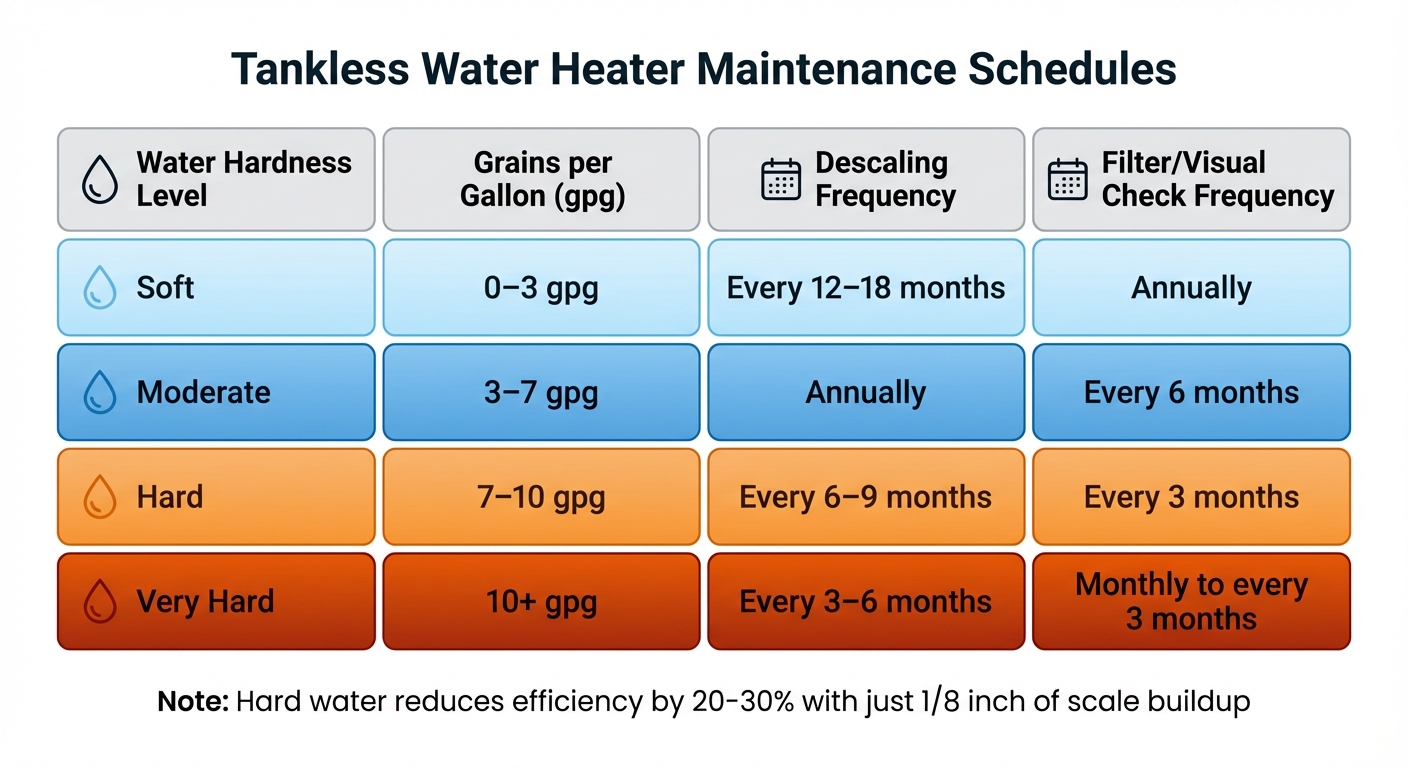
Tankless Water Heater Maintenance Schedule by Water Hardness Level
Keeping track of maintenance activities is crucial to safeguarding your investment and ensuring warranty coverage – especially for key components like the heat exchanger.
Recommended Maintenance Schedule
How often you need to perform maintenance largely depends on your water’s hardness, measured in grains per gallon (gpg). Hard water leads to mineral buildup, which can reduce efficiency by 20% to 30% with just 1/8 inch of scale.
| Water Hardness Level | Grains per Gallon (gpg) | Descaling Frequency | Filter/Visual Check Frequency |
|---|---|---|---|
| Soft | 0–3 gpg | Every 12–18 months | Annually |
| Moderate | 3–7 gpg | Annually | Every 6 months |
| Hard | 7–10 gpg | Every 6–9 months | Every 3 months |
| Very Hard | 10+ gpg | Every 3–6 months | Monthly to every 3 months |
This chart serves as a guide for scheduling and recording your maintenance activities.
Printable Maintenance Log
A maintenance log is an easy way to keep your records in order. Include columns for Date, Task Description, Findings/Error Codes, and Technician/DIYer Name. Store the log near your water heater so it’s handy during maintenance. Be sure to document all tasks, such as descaling, filter cleaning, and any part replacements or adjustments. If you notice unusual sounds or odors, jot them down immediately – this can help identify recurring issues or patterns. A thorough maintenance history is invaluable for technicians diagnosing problems or when filing warranty claims.
Professional Service Recommendations
While routine tasks like descaling and filter cleaning are manageable on your own, some jobs are better left to certified professionals. These include combustion analysis, gas pressure adjustments, flame sensor servicing, and advanced diagnostics. Professional maintenance acts as a safety net, ensuring your system operates reliably. Annual professional service typically ranges from $150 to $350, a small price to protect your $2,500 to $4,500 system and maintain energy savings that could exceed $2,000 over two decades.
Eco Temp HVAC, a Navien Service Specialist, offers expert tankless water heater maintenance. Their certified technicians provide services like system flushing, safety tests, combustion and vent inspections, technical diagnostics, and condensate management for condensing models. Available 24/7, they serve areas including Chicago, St. Charles, Bartlett, Lemont, Downers Grove, and Palatine, delivering fast and dependable support when you need it most.
Conclusion
Taking care of your tankless water heater can be the difference between enjoying it for over 20 years or dealing with an early breakdown. Skipping annual maintenance is one of the biggest reasons these systems fail prematurely – mineral buildup not only lowers efficiency but could also void your warranty. This checklist is your go-to guide for keeping your heater running smoothly.
"Mineral buildup is the silent performance killer of tankless water heaters." – Eccotemp
Key tasks like descaling, cleaning filters, and conducting visual inspections help prevent scale buildup on the heat exchanger. This ensures your system stays efficient and delivers hot water reliably. Setting the temperature to 120°F (49°C) can also reduce scale formation. Plus, the checklist lets you adjust your maintenance routine based on your water’s hardness level.
For more advanced maintenance – like gas pressure adjustments, combustion analysis, or complex diagnostics – it’s best to call in the pros. Eco Temp HVAC, with its Navien Service Specialist certification, has technicians trained to handle these critical tasks safely and effectively. They’re available 24/7 and serve the Chicagoland area, including Chicago, St. Charles, Bartlett, Lemont, Downers Grove, and Palatine, offering quick support when you need it.
Sticking to regular maintenance can save you thousands in repair costs while keeping your heater energy-efficient for years to come. Keep a log of your maintenance, stay on top of system performance, and schedule professional service annually. Use this checklist as your guide to ensure years of reliable and efficient hot water.
FAQs
How do I know if my water is hard?
Hard water is easy to spot if you know what to look for. Start by testing for minerals like calcium and magnesium. You can use water test strips for a quick check or even try a simple soap test – if the water doesn’t lather well and leaves soap scum, it’s likely hard. Another option is to review your municipal water report, which often provides details about water hardness in your area.
Why does this matter? Hard water can lead to scale buildup in appliances, such as tankless water heaters, which can hurt their efficiency and shorten their lifespan. Regular testing and maintenance can help you avoid these issues and keep your appliances running smoothly.
What are the signs my tankless heater needs descaling?
Signs that your tankless water heater might need descaling include lower hot water output, fluctuating water temperatures, and increased energy consumption. These problems are often caused by mineral buildup, which can clog the system, restrict water flow, and make heat transfer less efficient.
Can I safely descale my tankless water heater myself?
Yes, you can descale your tankless water heater on your own if you have the right tools, materials, and a clear understanding of the process. Generally, this involves using a descaling solution or vinegar, drain hoses, a submersible pump, and a bucket. That said, if you’re uncertain about the steps or live in an area with hard water, it’s a good idea to call a professional. This ensures you avoid any potential damage or safety issues. For best performance, descaling should be done once a year.