
The Nest 3rd Gen and 4th Gen thermostats both help reduce energy costs, but the 4th Gen offers newer features that may save you more in the long run. Here’s a quick breakdown:
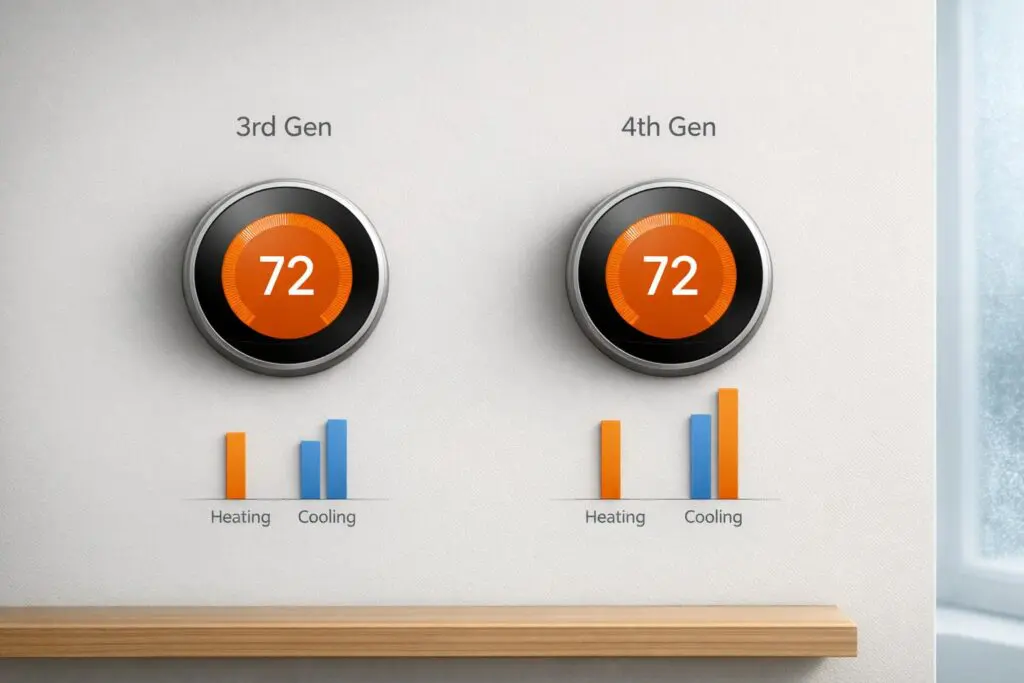
- Nest 3rd Gen: Priced at $169, it includes features like Auto-Schedule, Home/Away Assist, and Energy History. Average heating savings are 9.6%, with cooling savings up to 17.5%.
- Nest 4th Gen: At $279.99, it adds Adaptive Eco, Natural Heating/Cooling, and a bundled temperature sensor. Heating savings can reach 12%, but cooling savings are similar to the 3rd Gen.
For Chicago residents, where heating costs are significant, both models can save $136–$172 annually. The 4th Gen’s advanced tools make it a better choice for those with complex HVAC systems or uneven home temperatures.
Quick Comparison
| Feature | Nest 3rd Gen | Nest 4th Gen |
|---|---|---|
| Price | $169 | $279.99 |
| Heating Savings | 9.6%–12% | Up to 12% |
| Cooling Savings | 15%–17.5% | Up to 15% |
| Bundled Sensor | No | Yes |
| Advanced Features | Basic automation | AI-driven tools |
The 4th Gen is worth the extra cost if you want more precise energy management and integration with modern smart home setups. Otherwise, the 3rd Gen remains a solid budget-friendly option.
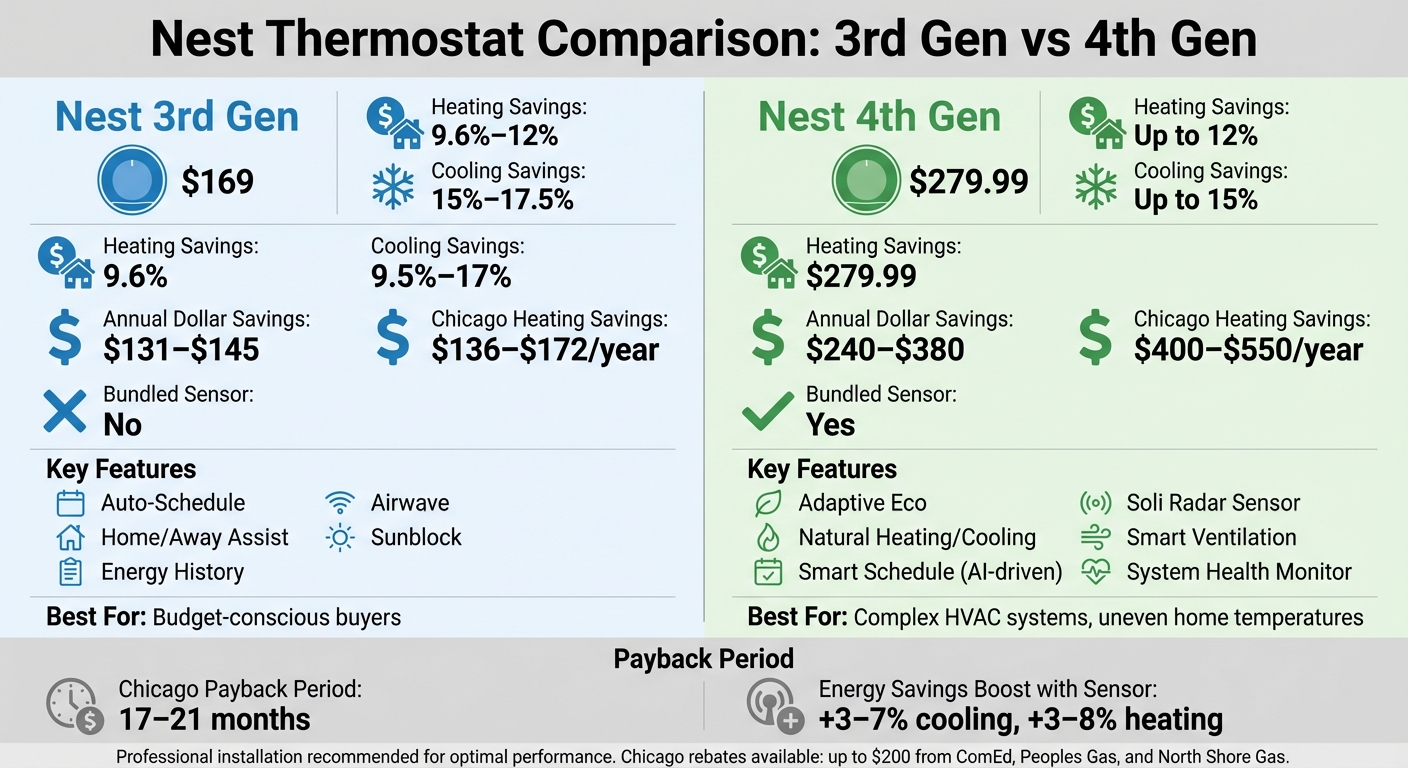
Nest 3rd Gen vs 4th Gen Energy Savings Comparison
Energy-Saving Features: Nest 3rd Gen vs. 4th Gen
Nest 3rd Gen Energy-Saving Features
The Nest 3rd Gen thermostat helps cut down on energy waste with a range of automated features. Its Auto-Schedule learns your heating and cooling preferences during the first week of use, then creates a schedule tailored to your habits.
With Home/Away Assist, the thermostat uses motion sensors and your phone’s location to detect when you’re out. It then switches to Eco Temperatures to save energy. When you set an energy-efficient temperature, the Nest Leaf icon appears on the display as a visual cue.
For cooling, Airwave minimizes compressor runtime by circulating leftover cool air using only the fan. Sunblock prevents unnecessary cooling by using an ambient light sensor to avoid false temperature readings caused by direct sunlight. Additionally, the Energy History tool provides a 10-day log, showing when your system was running and why.
The Furnace Heads-Up feature tracks furnace power cycles and warns you about inefficiencies or potential malfunctions. A monthly Home Report summarizes your energy usage, giving you a clear picture of your consumption patterns. With ten temperature sensors – seven more than the original Nest model – the 3rd Gen also delivers more precise temperature readings.
Next, let’s see how the 4th Gen builds on these capabilities with smarter, AI-driven tools.
Nest 4th Gen Energy-Saving Features
The Nest 4th Gen takes energy-saving to the next level by refining existing features and introducing advanced tools. Adaptive Eco adjusts settings based on outdoor conditions. For instance, during extremely cold days, it prevents indoor temperatures from dropping too low, ensuring your HVAC system doesn’t work overtime to restore comfort when you return.
Natural Heating and Cooling reduces HVAC usage by analyzing outdoor weather. As Anish Kattukaran, Head of Product at Google Home, explains:
"If it’s a sunny winter day and your home heats up a few degrees on its own, the thermostat will automatically pause heating to save energy".
This feature even factors in humidity levels to balance comfort and energy efficiency.
The 4th Gen’s Smart Schedule uses advanced AI to learn your habits more quickly and accurately than its predecessor. Instead of making changes automatically, it suggests adjustments through the Google Home app, allowing you to approve or decline them. As Kattukaran notes:
"We wanted to take the black box approach out of it. It’s an incredibly intelligent device, but that shouldn’t mean you don’t know what’s going on".
With the addition of the Soli Radar Sensor, Home/Away detection becomes even more accurate, outperforming standard motion sensors. Smart Ventilation monitors outdoor air quality, bringing in fresh air when conditions are good and pausing ventilation when pollutants or wildfire smoke are detected. The System Health Monitor keeps tabs on your HVAC’s performance, flagging issues like slow temperature adjustments, which could indicate inefficiencies.
Another upgrade is the 12-terminal backplate, which improves compatibility with more complex HVAC systems compared to the 10 terminals on the 3rd Gen.
sbb-itb-b5c10b1
Energy Savings Performance Comparison
Side-by-Side Energy Performance Data
Both the Nest 3rd and 4th Gen thermostats deliver measurable energy savings, with the 4th Gen showing a slight edge due to its advanced automation features. According to independent research analyzing data from 1,359 homes, Nest thermostats achieve an average savings of 9.6% on gas heating (56 therms per year) and 17.5% on electric cooling (585 kWh per year). Google suggests that the 4th Gen can save around 12% on heating bills and 15% on cooling bills.
In colder regions like Chicago, where annual heating consumption ranges from 1,100 to 1,400 therms, these percentages translate into savings of approximately $136 to $172 per year, with a payback period for a smart thermostat installation ranging from 17 to 21 months.
| Metric | Nest 3rd Gen | Nest 4th Gen |
|---|---|---|
| Heating Savings | 9.6%–12% | Up to 12% |
| Cooling Savings | 15%–17.5% | Up to 15% |
| Annual Dollar Savings (Avg) | $131–$145 | Similar range |
| Chicago Heating Savings | $136–$172 | $136–$172 |
| Included Hardware | Thermostat only | Thermostat + Sensor |
| Seasonal Savings Boost | +3–7% cooling, +3–8% heating | +3–7% cooling, +3–8% heating |
One key advantage of the 4th Gen is its bundled temperature sensor, which helps address temperature imbalances in different rooms. Previously, this required purchasing a separate sensor for the 3rd Gen.
While the raw data is compelling, real-world user experiences shed even more light on the differences in energy savings.
User Feedback on Energy Savings
User reviews highlight how energy savings can vary widely depending on prior thermostat habits. Homeowners who previously left their thermostats at constant temperatures or neglected setback adjustments (often called "high-savers") report savings three to five times larger than those with already-efficient manual schedules.
Frequent travelers and those with irregular routines particularly appreciate the 4th Gen’s presence sensing and Adaptive Eco features, which optimize energy use during absences. On the other hand, users who are home most of the time, like retirees, often see smaller reductions – sometimes as low as 2.8% or $23 annually.
Jennifer Pattison Tuohy, a Senior Reviewer at The Verge, gave the 4th Gen a glowing 9/10 rating, noting:
"The learning Nest is the only thermostat with an algorithm that automatically adjusts your heating and cooling schedule based on how you use it, and the fourth-gen is smarter than ever."
Consumer Reports also ranked the 3rd Gen #2 out of 48 smart thermostats, awarding it an impressive 89/100 overall score, underscoring the consistent performance of both models. Interestingly, about 34% of homes experience energy fluctuations of over 10% annually due to lifestyle changes, regardless of the thermostat used.
Next, let’s dive into how Chicagoland’s challenging winters influence these savings.
How Chicagoland Climate Affects Thermostat Performance
Chicago Weather and Energy Efficiency
Chicago’s extreme weather swings – from subzero winters to hot, humid summers – put thermostats to the test. A thermostat’s ability to respond quickly to these fluctuations can have a big impact on energy bills. For instance, during sunny winter days, the Nest 4th Gen’s "Outdoor Monitoring" feature can pause heating, letting natural sunlight warm your home. In humid months, it works with dehumidifiers and ventilation systems to bring in fresh air only when outdoor conditions are suitable.
The thermostat’s Adaptive Eco mode is another standout feature. It adjusts based on outdoor temperatures to maintain your comfort settings without overburdening your HVAC system. This is especially handy during Chicago’s extreme cold snaps and heatwaves, where constant adjustments are necessary. Plus, it can send alerts when extreme temperatures are pushing your HVAC system to its limits.
But even the smartest thermostat can’t perform at its best without proper installation and upkeep.
Installation and Maintenance for Better Energy Savings
Getting the most out of your thermostat starts with proper installation and regular maintenance. For example, relocating a Nest thermostat from a sun-exposed exterior wall to a ventilated interior wall saved one homeowner 16% on heating costs over just three months.
A C-wire (common wire) is another key factor. While Nest thermostats can work without one, a C-wire ensures stable power, especially during high-demand periods. Without it, 15% of systems relying on power adapters may experience power cycling issues. Installing a C-wire professionally can cost between $30 and $180, depending on the complexity of the job.
For homes with heat pumps, using the thermostat’s "Heat Pump Balance" settings can make a big difference. Choosing the "Max Savings" option delays auxiliary heat during cold snaps, improving efficiency.
If you’re in the Chicago area, Eco Temp HVAC offers professional smart thermostat installation services. They ensure proper placement, system configuration, and reliable C-wire installation. Bundling installation with annual HVAC maintenance can cut service costs. Routine maintenance – like changing filters and tuning up your system – keeps everything running smoothly and efficiently.
Don’t forget about local rebates, either. Chicago residents can take advantage of offers through the ComEd Marketplace, which provides a $100 instant discount. Combined incentives from Peoples Gas and North Shore Gas can add up to $200, making smart thermostats an even smarter investment.
Conclusion: Which Nest Thermostat Saves More Energy?
Main Differences Between the Two Models
When it comes to energy savings, the Nest 4th Gen clearly outpaces the 3rd Gen. The 4th Gen offers an impressive 19.2% energy savings, compared to the 3rd Gen’s 10–15% range. In terms of dollars, this translates to an annual savings of $240–$380 for the 4th Gen, while the 3rd Gen saves roughly $131–$145. For colder areas like Chicago, where heating demands are higher, the 4th Gen could save homeowners as much as $400–$550 each year.
The key to the 4th Gen’s efficiency lies in its Adaptive Eco mode and Natural Heating and Cooling features. Unlike the static Eco settings of the 3rd Gen, the 4th Gen dynamically adjusts based on outdoor conditions and can even pause your HVAC system when the weather allows. Another standout feature is the inclusion of a Nest Temperature Sensor, valued at around $39, which helps manage uneven temperatures in larger homes by avoiding unnecessary heating or cooling of unused spaces.
For those with complex HVAC systems or new installations, the advanced features of the 4th Gen justify its $279.99 price point. Meanwhile, the 3rd Gen, priced at $169, remains a cost-effective choice for budget-conscious buyers.
However, it’s important to remember that even the best thermostat needs proper installation to achieve its full energy-saving potential.
The Value of Professional Thermostat Installation
A thermostat’s placement and setup are just as critical as its features when it comes to optimizing energy use. Poor installation can cause temperature readings to deviate by 8–12°F, leading to inefficiencies like short-cycling and wasted energy.
Professional installation ensures that everything works as intended. For example, a proper C-wire setup prevents power-cycling issues, which are common with high-efficiency furnaces. In systems like heat pumps, incorrect configuration can inadvertently trigger auxiliary heat, leading to higher energy bills rather than savings.
Eco Temp HVAC provides expert smart thermostat installation across Chicagoland, including areas like Chicago, St. Charles, Bartlett, Lemont, Downers Grove, and Palatine. Their certified technicians handle everything from optimal placement to accurate system configuration and C-wire setup. Installation costs typically range from $30 to $180, depending on the complexity, and can be bundled with a custom HVAC maintenance checklist for added convenience.
Lastly, don’t overlook potential rebates from your local utility provider – they can help offset your initial investment in a smart thermostat.
New Nest Learning Thermostat -4th Gen vs 3rd & 2nd Gen
FAQs
How fast does each Nest learn my schedule?
The 3rd generation Nest Learning Thermostat typically needs a few days to adapt to your schedule. On the other hand, the 4th generation model steps up with advanced AI capabilities. It not only adjusts more quickly but also tracks your presence more effectively, enabling it to learn your habits faster and with improved precision.
Do I need a C-wire for my HVAC system?
Whether you need a C-wire depends on your thermostat model and the wiring already in your home. Many modern smart thermostats, such as the Nest 3rd or 4th Gen, often rely on a C-wire to maintain a steady power supply. This is particularly important if you’re dealing with power interruptions or frequent battery depletion. If your setup doesn’t include a C-wire, you can explore solutions like a Nest Power Connector or a C-wire adapter to supply power without the hassle of major rewiring.
Will a temperature sensor lower my energy bills?
Yes, a temperature sensor can help cut energy bills by making heating and cooling systems more efficient. Smart thermostats, such as the Nest, use sensors to monitor room-specific conditions and adjust temperatures accordingly. This prevents unnecessary energy use. Research indicates these devices can reduce gas heating costs by 9.6% and electric cooling costs by 17.5%, leading to yearly savings of around $131–$145. It’s a practical way to curb waste and save on utilities.