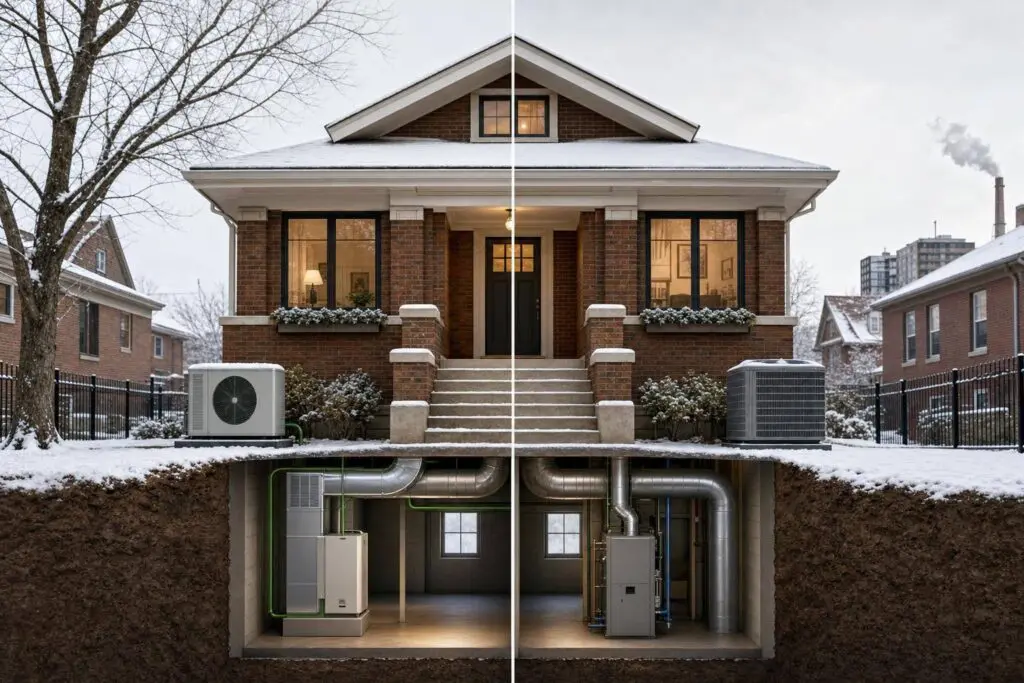

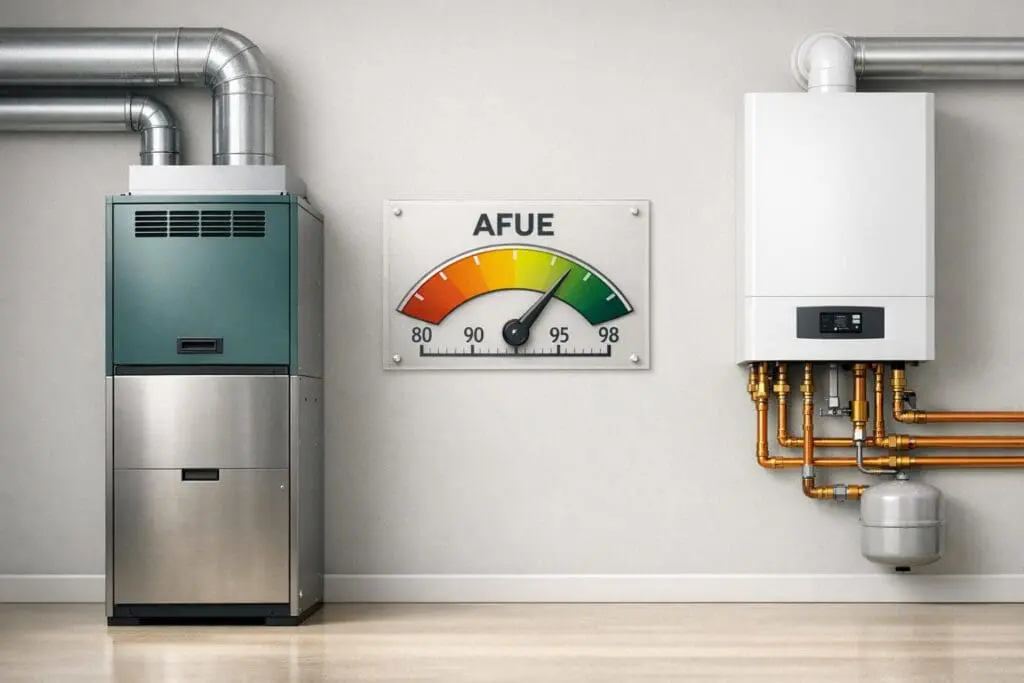
AFUE (Annual Fuel Utilization Efficiency) measures how efficiently a furnace or boiler converts fuel into heat over a heating season. Think of it like MPG for your heating system – the higher the percentage, the less fuel is wasted. For example, an 80% AFUE furnace wastes 20% of the fuel, while a 95% AFUE unit wastes just 5%. This efficiency impacts energy bills, comfort, and environmental considerations, especially in colder climates like Chicagoland.
Key Takeaways:
- Higher AFUE = Greater Efficiency: A 95% AFUE system can save $200–$400 annually compared to an 80% system.
- Modern Systems Are More Efficient: Older furnaces operate at 56%–70% AFUE, while high-efficiency models reach up to 98.5%.
- Installation & Maintenance Matter: Even a 95% AFUE furnace won’t perform well with leaky ducts or improper installation.
- Federal Standards & Incentives: Minimum AFUE for gas furnaces is 80%, but new regulations will require 95% by 2028. ENERGY STAR systems may qualify for tax credits and rebates.
Choosing the right system means balancing upfront costs, energy savings, and properly sizing your home’s furnace. High-efficiency systems cost more initially but pay off through lower utility bills and better performance.
How AFUE Works
How AFUE Is Calculated
AFUE (Annual Fuel Utilization Efficiency) is expressed as a percentage using this formula:
AFUE = (Annual Heat Output in BTUs ÷ Annual Fuel Input in BTUs) × 100
This percentage tells you how many BTUs of usable heat are delivered for every 100 BTUs of fuel consumed. The “heat input” refers to the fuel’s raw BTU potential, while the “heat output” represents the heat actually transferred into your home’s air (for furnaces) or water (for boilers). The gap between these two numbers reflects efficiency losses.
For example, a furnace with a 95% AFUE rating delivers 95 BTUs of heat while losing just 5 BTUs through exhaust. To ensure consistent comparisons, this efficiency is tested following ASHRAE Standard 103, which assumes a baseline fuel input of 100 million BTUs.
This calculation forms the basis for understanding how AFUE differs from other efficiency metrics.
AFUE vs. Other Efficiency Metrics
Knowing how AFUE is calculated helps explain how it stands apart from other measures of efficiency. AFUE is often mistaken for thermal efficiency or combustion efficiency, but they are not the same. Thermal efficiency measures peak performance under steady-state conditions, while AFUE provides a season-long average that accounts for real-world factors like startup and cooldown cycles. These transients can reduce efficiency compared to steady-state operation.
“AFUE differs from the true ‘thermal efficiency’ in that it is not a steady-state, peak measure of conversion efficiency, but instead attempts to represent the actual, season-long, average efficiency.” – Wikipedia
For instance, a furnace with a peak thermal efficiency of 78% might only achieve an AFUE of 64% once seasonal cycling is factored in.
AFUE also differs from metrics like SEER and HSPF, which measure efficiency for ductless mini-split cooling systems and heat pumps, respectively. Here’s a quick comparison:
| Metric | Application | What It Measures |
|---|---|---|
| AFUE | Furnaces, Boilers | Seasonal percentage of fuel converted to heat |
| SEER | Air Conditioners, Heat Pumps (Cooling) | Seasonal ratio of cooling output to energy input |
| HSPF | Heat Pumps (Heating) | Seasonal ratio of heat output to electricity used |
| Thermal Efficiency | Combustion Equipment | Instantaneous, peak efficiency at steady-state operation |
In the U.S., AFUE is the standard metric for fuel-burning heating systems because it reflects actual, seasonal performance rather than idealized lab conditions.
What AFUE Does Not Measure
While AFUE provides a solid understanding of a furnace or boiler’s efficiency, it has its limits. It only rates the efficiency of the equipment itself – not the entire heating system.
“AFUE doesn’t include the heat losses of the duct system or piping, which can be as much as 35% of the energy output of the furnace when ducts are located in the attic, garage, or other partially conditioned or unconditioned space.” – U.S. Department of Energy
This means that even a 95% AFUE furnace could perform poorly if paired with leaky ducts in an uninsulated attic. Similarly, a high-rated boiler can lose efficiency if the hydronic piping is not insulated properly.
AFUE also does not account for electricity used by blower motors and controls, nor does it address efficiency losses caused by short-cycling in oversized systems. This is why professional load calculations and proper system sizing are essential to achieving the best possible real-world efficiency.
sbb-itb-b5c10b1
AFUE Ratings by Furnace and Boiler Type
AFUE Ranges by System Type
When it comes to AFUE (Annual Fuel Utilization Efficiency), not all heating systems are created equal. Two key factors – fuel type and whether the system uses condensing technology – play a big role in determining efficiency.
Gas furnaces offer the broadest range of AFUE ratings. Older models, often decades old, operate at just 56%–70% AFUE, meaning nearly half the fuel is wasted. Modern standard-efficiency (non-condensing) gas furnaces usually range between 80% and 83%. High-efficiency condensing gas furnaces, however, can hit an impressive 98.5% AFUE. There’s a noticeable gap between 81% and 89% AFUE for gas furnaces. This is because exhaust gases in that range are cool enough to form corrosive condensation but too warm for PVC venting, so manufacturers skip over this range entirely and focus on 90%+ models with stainless steel secondary heat exchangers.
Oil furnaces generally peak lower, with most models falling between 81% and 87% AFUE. Very few exceed 90%. For gas and oil boilers, the story is similar. Non-condensing gas boilers range from 80% to 86%, while condensing models can reach up to 97%. Meanwhile, electric furnaces and boilers technically achieve 95%–100% AFUE because they don’t lose energy through flue gases. However, high electricity rates often make them more expensive to operate than gas systems, despite their near-perfect efficiency rating.
| System Type | Efficiency Category | AFUE Range |
|---|---|---|
| Gas Furnace (Older) | Low Efficiency | 56% – 70% |
| Gas Furnace (Standard) | Standard Efficiency | 80% – 83% |
| Gas Furnace (High-Efficiency) | Condensing | 90% – 98.5% |
| Oil Furnace | Standard/Mid Efficiency | 81% – 87% |
| Gas Boiler (Non-Condensing) | Standard Efficiency | 80% – 86% |
| Gas Boiler (Condensing) | High Efficiency | 90% – 97% |
| Electric Furnace/Boiler | Near-Perfect Efficiency | 95% – 100% |
Minimum AFUE Standards in the U.S.
Federal regulations set minimum AFUE standards for new heating equipment sold in the U.S., and these vary by fuel type and system design.
| Heating System Type | Federal Minimum AFUE |
|---|---|
| Natural Gas Furnace | 80% |
| Oil Furnace | 83% |
| Gas-Fired Hot Water Boiler | 82% |
| Oil-Fired Hot Water Boiler | 84% |
| Gas-Fired Steam Boiler | 80% |
| Oil-Fired Steam Boiler | 82% |
These standards are evolving. In 2023, the U.S. Department of Energy finalized a rule requiring non-weatherized gas furnaces to meet a 95% AFUE minimum by December 2028, effectively mandating condensing technology nationwide. This rule was upheld in November 2025 by the U.S. Court of Appeals for the D.C. Circuit, despite challenges from the gas industry.
For those aiming higher, ENERGY STAR certification sets stricter benchmarks. Gas furnaces in Northern states must achieve 95% AFUE, while those in Southern states need at least 90%. Gas boilers require 90%, and oil boilers must hit 87% to qualify.
How to Find and Read AFUE Ratings
You can find a system’s AFUE rating on the yellow EnergyGuide label attached to the unit. This label prominently displays the AFUE percentage along with estimated annual operating costs. If the label isn’t available, check the model number on the equipment’s nameplate and search for it in the AHRI (Air-Conditioning, Heating, and Refrigeration Institute) directory online.
Understanding the AFUE number is simple: an 84% AFUE means 84 cents of every dollar spent on fuel is converted into heat, while 16 cents is lost through exhaust. For example, a 95% AFUE furnace wastes just 5 cents per dollar. Upgrading to new furnaces with 95% AFUE can save homeowners between $200 and $400 annually on heating bills, especially in colder regions where heating systems run for extended periods.
AFUE Furnace Ratings | What Does It Mean?
Choosing the Right AFUE System for Your Home or Business
AFUE Ratings by Heating System Type: Efficiency & Cost Comparison
Furnace vs. Boiler Efficiency: The Basics
The key difference between furnaces and boilers lies in what they circulate: air vs. water. Furnaces use a blower fan to push heated air through ductwork, warming spaces quickly. On the other hand, boilers move hot water through pipes to radiators or radiant floor systems, delivering steady and consistent heat during chilly winters.
Both systems can achieve high AFUE ratings but perform differently in real-world conditions. For instance, condensing gas boilers can reach 90%–97% AFUE, while non-condensing cast iron boilers generally range between 80% and 86%. However, lifespan is a factor to consider – high-efficiency condensing boilers typically last 15–20 years, while cast iron boilers can surpass 25 years with proper care. This makes durability as much a part of the decision as efficiency.
These fundamental differences set the stage for evaluating the trade-offs involved in your investment, as explored further below.
High-Efficiency vs. Standard-Efficiency Systems
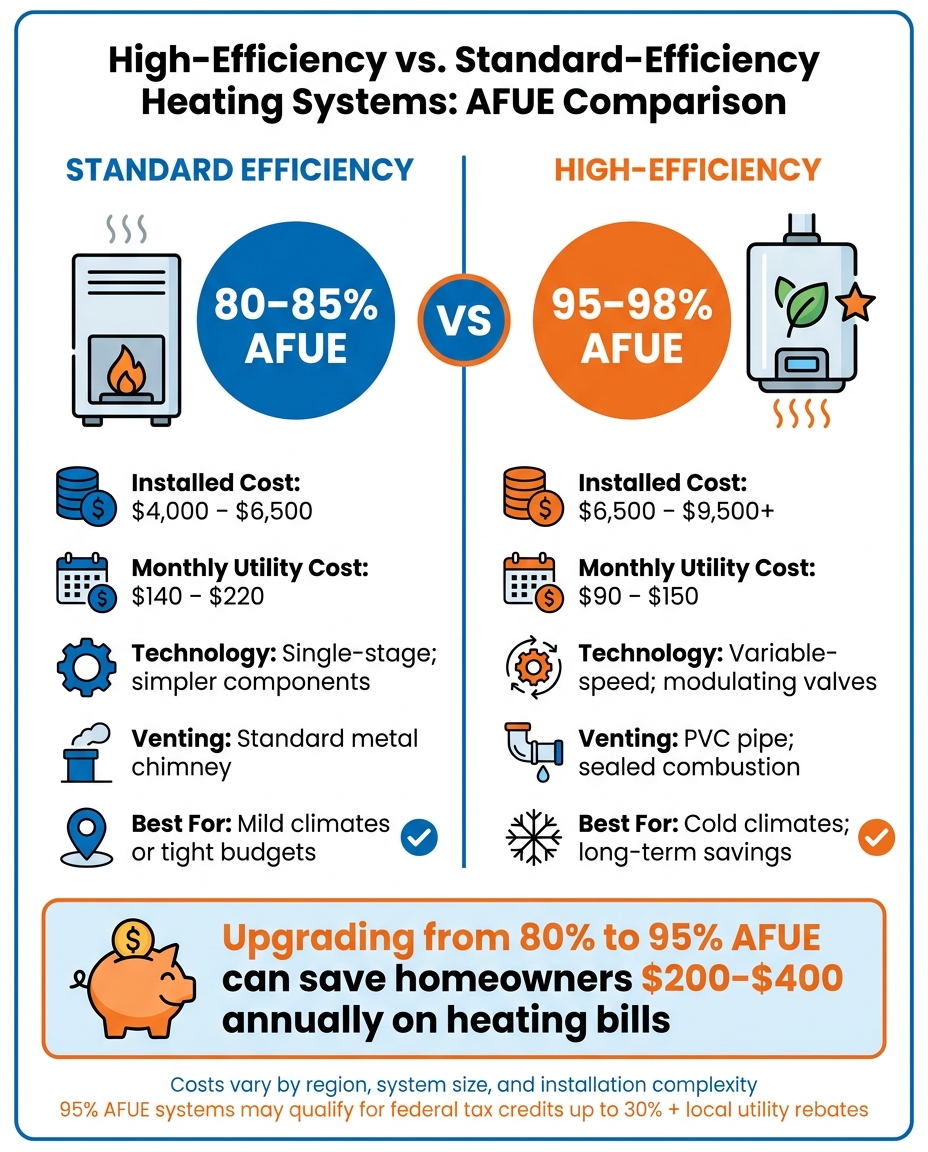
In Chicagoland, where winters demand heavy use of heating systems, the case for high-efficiency units becomes stronger. While the upfront cost of a high-efficiency system is higher, the return on investment comes much sooner due to energy savings. Standard-efficiency systems (80%–85% AFUE) typically cost between $4,000 and $6,500 installed, whereas high-efficiency systems (95%–98% AFUE) range from $6,500 to $9,500 or more.
| Feature | Standard Efficiency (80–85% AFUE) | High-Efficiency (95–98% AFUE) |
|---|---|---|
| Installed Cost | $4,000 – $6,500 | $6,500 – $9,500+ |
| Monthly Utility Cost | $140 – $220 | $90 – $150 |
| Technology | Single-stage; simpler components | Variable-speed; modulating valves |
| Venting | Standard metal chimney | PVC pipe; sealed combustion |
| Best For | Mild climates or tight budgets | Cold climates; long-term savings |
In colder climates, a 95% AFUE furnace can save homeowners $200–$400 annually compared to an 80% model. For many, the roughly $1,500 price difference between a standard unit and a 98% AFUE furnace can pay off in just over two years through energy savings alone. High-efficiency systems also offer more consistent indoor temperatures due to variable-speed blowers and modulating gas valves. Additionally, models with 95%+ AFUE ratings often qualify for federal tax credits of up to 30% and local utility rebates, helping offset the initial cost.
“In colder climates where heating demand is higher for longer, a furnace with even 1% higher AFUE can be worth the investment.” – Lennox
How Eco Temp HVAC Helps You Choose the Right System
Choosing the right AFUE system involves more than just picking the highest number on a label. It requires a careful look at your home’s size, insulation, existing infrastructure, and how long you plan to stay in the property. For example, installing an oversized high-efficiency unit can lead to short-cycling, which wastes energy and reduces performance, regardless of the system’s AFUE rating.
At Eco Temp HVAC, homeowners and businesses across Chicagoland – from Chicago to Downers Grove, Bartlett, and Palatine – receive expert guidance through professional load calculations and on-site assessments. This ensures the system is properly sized to avoid energy waste and maximize efficiency. As an American Standard Customer Care Dealer and Navien Service Specialist, Eco Temp HVAC offers a range of high-efficiency systems tailored to the demands of Northern climates, delivering the performance and savings their AFUE ratings promise.
Improving Efficiency Beyond AFUE
Boosting the efficiency of a heating system involves more than just its AFUE rating. Factors like installation quality, regular maintenance, and advanced controls all play a part in ensuring optimal performance.
Why Proper Installation Matters
While an AFUE rating measures how effectively a unit converts fuel into heat, it doesn’t consider energy losses that happen after the heat is generated. In fact, as much as 35% of heating energy can escape through leaky ducts, poor insulation, or drafty windows.
To avoid these inefficiencies, a detailed load calculation is critical. This calculation considers your home’s size, layout, insulation, and windows to determine the correct BTU capacity. Skipping this step can lead to oversized systems that short-cycle or undersized ones that struggle to meet heating demands.
Venting design is another key factor. High-efficiency condensing units produce acidic condensation, which can corrode standard metal flues. These systems require sealed PVC venting to function safely and efficiently. Poor venting design not only reduces efficiency but can also pose safety risks.
“Installation quality is always the most important thing for a residential HVAC project. So never sacrifice contractor quality for a lower price.” – Rene Langer, Senior Comfort Specialist, PICKHVAC
Once the system is installed correctly, maintaining it properly is essential to sustain its efficiency.
Keeping AFUE Ratings Intact with Regular Maintenance
A furnace or boiler’s AFUE rating reflects its efficiency when it’s new and well-maintained. Over time, neglecting maintenance can lead to a drop in performance. For instance, soot buildup on a heat exchanger can lower efficiency by as much as 10%. Additionally, common furnace problems and wear and tear on components can further impact energy use.
Annual professional tune-ups are the best way to maintain your system’s efficiency. These service visits typically include cleaning the heat exchanger and blower assembly, inspecting for cracks in the heat exchanger to prevent carbon monoxide leaks, checking vent connections and flues, and ensuring proper combustion settings. For boilers, technicians also test pressure-relief valves and remove sediment from the water system.
“Annual furnace maintenance is recommended to keep your system running at its rated efficiency. Neglected systems can lose efficiency over time, leading to higher energy costs.” – Travis Baugh, Digital Brand Marketing Manager, Bryant
Companies like Eco Temp HVAC offer maintenance plans tailored to keep systems running efficiently across Chicagoland. Their certified technicians handle everything from cleaning components to conducting safety inspections, helping homeowners avoid the gradual decline in efficiency caused by deferred upkeep.
Smart Controls That Improve Heating Efficiency
In addition to proper installation and maintenance, smart controls can significantly enhance your heating system’s performance. These controls help reduce fuel consumption by adjusting settings when the home is unoccupied or during nighttime hours, all without compromising comfort.
For boiler systems, outdoor reset controls adjust the boiler’s water temperature based on outdoor conditions, ensuring the system provides just the right amount of heat for the current weather. When combined with zoning systems that heat only occupied areas, these smart controls help close the gap between a system’s AFUE rating and its actual performance in your home.
Conclusion: Making Smart Decisions About AFUE
Key Points to Remember
Think of AFUE like the MPG (miles per gallon) rating for your heating system – the higher the percentage, the less fuel is wasted. For example, an 80% AFUE furnace wastes 20¢ of every dollar spent on fuel, while a 95% AFUE unit only wastes 5¢. Over time, this difference can translate into noticeable savings on your heating bills.
When choosing the right HVAC system and AFUE rating, consider your climate, usage patterns, and budget. In colder regions like Chicago, where heating systems work overtime during long winters, a 95%+ AFUE furnace can save you a lot of money in the long run. On the other hand, if you live in a milder area, an 80% AFUE furnace might be more cost-effective. Just remember, efficiency isn’t only about the AFUE rating – proper installation, correct system sizing, and regular maintenance are all critical to getting the most out of your heating system.
Why Choose Eco Temp HVAC?
If you’re ready to make the most of your heating system, working with experienced professionals is key. Eco Temp HVAC is a trusted name in the Chicagoland area, backed by certifications like the American Standard Customer Care Dealer, Navien Service Specialist, and Mitsubishi Diamond Elite Contractor. That last certification even allows them to offer a 12-year warranty on eligible Mitsubishi products.
Eco Temp HVAC’s team handles everything from calculating the right system size for your home to installation, maintenance, and even smart thermostat setup. Their goal? To ensure your heating system operates at its rated AFUE efficiency from day one. With service locations in Chicago, St. Charles, Bartlett, Lemont, Downers Grove, and Palatine, they offer fast, reliable support – available 24/7 for all your heating needs across Chicagoland.
For expert advice and top-notch service, Eco Temp HVAC has you covered.
FAQs
Is a 95% AFUE furnace always worth it in Chicagoland?
A 95% AFUE furnace makes a lot of sense for homeowners in the Chicagoland area, thanks to its high efficiency and ability to cut costs during harsh winters. With potential annual savings of $200–$400 on utility bills and the added perk of improved warranties, it’s a smart long-term choice for many households.
Can leaky ducts or poor sizing lower my efficiency?
Leaky ducts or incorrectly sized systems can seriously impact your heating system’s efficiency. These issues lead to energy loss, forcing your furnace or boiler to work overtime just to keep your home at a comfortable temperature. This not only reduces the system’s overall performance but also drives up energy usage – and, ultimately, your utility bills.
Do high-AFUE systems require special venting or drainage?
High-AFUE systems are designed to be highly efficient, but they often need special venting and drainage systems to handle the condensation they generate. To ensure durability and safety, these systems typically rely on stainless steel or non-corroding metal vent pipes. They also feature sealed combustion chambers, which help keep harmful gases from leaking into your home. Proper installation is key to maintaining both the safety and performance of these systems.