
Want to save on heating costs? Start by understanding boiler efficiency ratings. These ratings tell you how well a boiler converts fuel into heat. A higher percentage means less waste and more savings. For example, upgrading from a 56% to a 90% efficient boiler can cut energy bills by 10%–30% and reduce carbon emissions by up to 2.5 tons annually.
Key metrics to focus on:
- AFUE (Annual Fuel Utilization Efficiency): Shows the percentage of fuel converted into heat.
- ENERGY STAR Certification: Highlights boilers that exceed federal efficiency standards (90%+ for gas, 87%+ for oil).
Condensing boilers, with efficiencies as high as 98.5%, recover heat from exhaust gases, making them more efficient but costlier upfront. Non-condensing models are simpler and may suit homes with older systems.
Pro Tip: Check the yellow EnergyGuide label and ENERGY STAR logo when shopping. Proper installation by certified professionals is critical to maximize performance and savings.
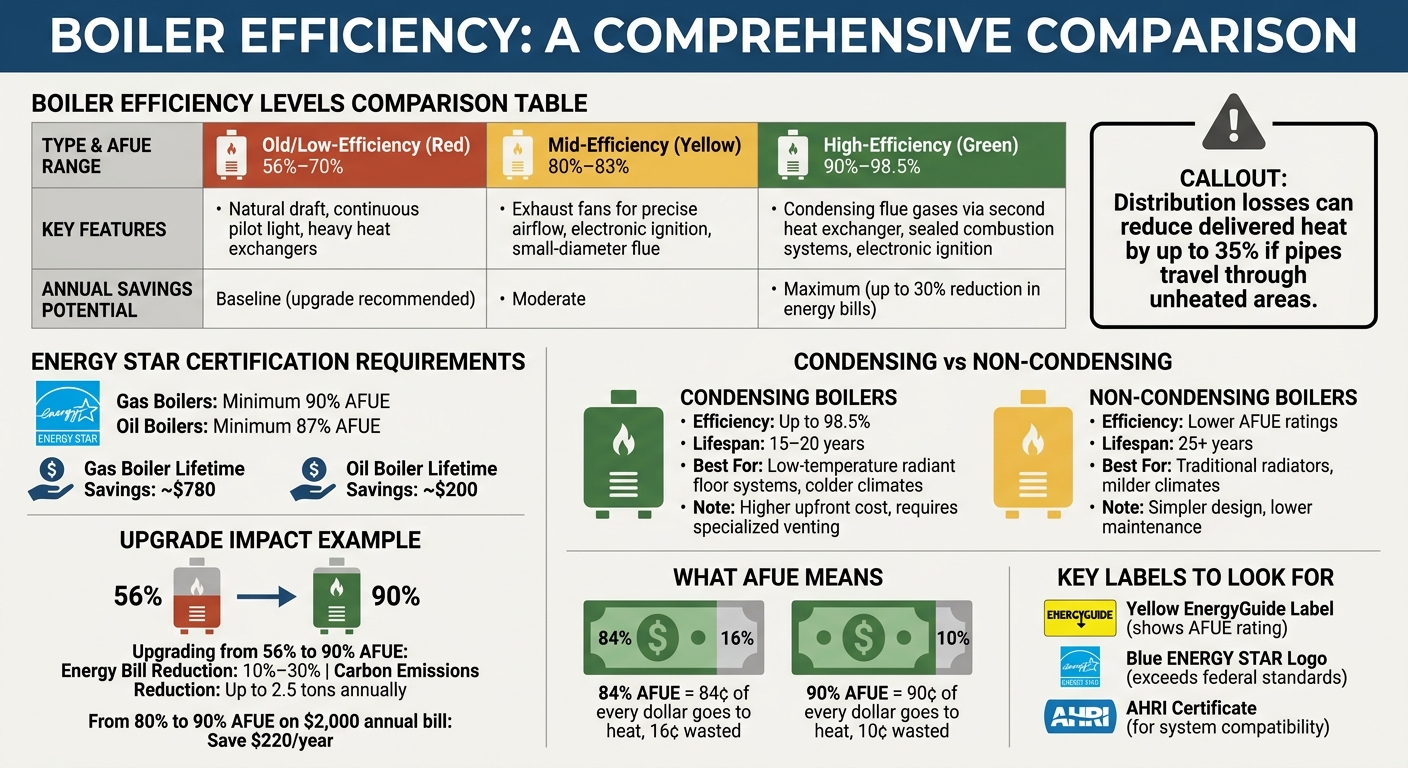
Boiler Efficiency Ratings Comparison: AFUE Levels, Features, and Savings
Understanding Boiler Efficiency Ratings: What Do They Mean?
sbb-itb-b5c10b1
What Are Boiler Efficiency Ratings?
Boiler efficiency ratings show how effectively a boiler converts fuel into heat, with any remaining percentage representing energy lost through exhaust. By law, all new boilers must display these ratings, making it easier to compare models side by side.
For example, a boiler with an 84% efficiency rating means 84 cents of every dollar spent on fuel is used to generate heat, while the remaining 16 cents is wasted. However, this figure only reflects the boiler’s performance and doesn’t account for distribution losses. These losses can cut delivered heat by as much as 35% if pipes or ducts travel through unheated areas like attics or basements .
Two key systems help identify efficient boilers: Annual Fuel Utilization Efficiency (AFUE) and ENERGY STAR certification. AFUE provides a precise percentage rating, while ENERGY STAR acts as a quick reference for models that surpass federal efficiency standards. Let’s take a closer look at AFUE, the primary measurement for boiler performance.
AFUE: The Main Efficiency Metric
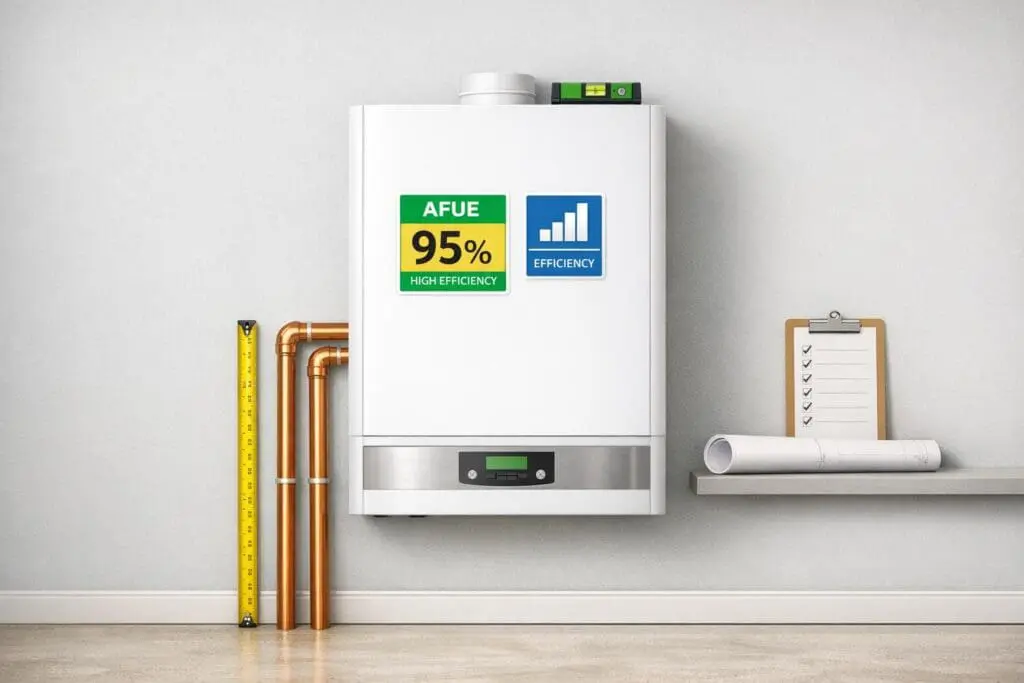
AFUE represents the ratio of a boiler’s annual heat output to the total fossil fuel energy it consumes over a year. Boilers fall into different categories based on their AFUE ratings and technological features, as outlined below:
| Efficiency Level | AFUE Range | Key Features |
|---|---|---|
| Old/Low-Efficiency | 56%–70% | Natural draft, continuous pilot light, heavy heat exchangers |
| Mid-Efficiency | 80%–83% | Exhaust fans for precise airflow, electronic ignition, small-diameter flue |
| High-Efficiency | 90%–98.5% | Condensing flue gases via a second heat exchanger, sealed combustion systems |
High-efficiency boilers stand out due to their advanced condensing technology. This system captures heat from exhaust gases that would typically escape, boosting overall efficiency. They also replace outdated standing pilot lights with electronic ignition and use sealed combustion systems, which draw in outdoor air instead of relying on pre-heated indoor air . However, these systems produce acidic exhaust, requiring specialized venting materials or chimney liners instead of standard masonry chimneys.
ENERGY STAR Certification
Another important efficiency marker is ENERGY STAR certification, which highlights boilers that exceed federal minimum standards. For gas boilers to earn this certification, they must achieve at least 90% AFUE, while oil boilers need a minimum of 87% AFUE. These benchmarks were updated in January 2024 to reflect advancements in heating technology.
ENERGY STAR-certified gas boilers operate about 6% more efficiently than standard federal models, while certified oil boilers are approximately 1% more efficient. Over its lifetime, a certified gas boiler can save homeowners around $780, and a certified oil boiler saves about $200. Additionally, the ENERGY STAR Rebate Finder can help you locate utility rebates that may apply to these high-efficiency units.
How to Compare Boiler Efficiency Ratings
Reading AFUE Labels and Energy Guides
When shopping for a new boiler, look for two key labels that make comparing efficiency straightforward. The yellow EnergyGuide label, mandated by the Federal Trade Commission, prominently displays the boiler’s AFUE (Annual Fuel Utilization Efficiency) rating. This label also estimates annual operating costs based on national averages and compares the unit’s efficiency to similar models, giving you a clear picture of how it stacks up.
Another label to watch for is the blue ENERGY STAR logo, which identifies models that outperform federal efficiency standards. If you’re planning to pair your boiler with other components, like a heat pump, check for an AHRI (Air-Conditioning, Heating, and Refrigeration Institute) certificate. This ensures all components work together efficiently as a system.
Once you’ve reviewed these labels, consider how the boiler’s design impacts its performance.
Comparing Boiler Types and Performance
One of the biggest decisions you’ll face is choosing between condensing and non-condensing boilers. Non-condensing boilers are simpler in design, with standard combustion systems that lose heat through the flue. These units generally have lower AFUE ratings. On the other hand, condensing boilers are more advanced, using a secondary heat exchanger to capture additional heat from water vapor. This design allows them to achieve efficiencies as high as 98.5%.
While condensing boilers come with a higher upfront cost, they provide notable long-term savings, especially in colder climates. However, they have a shorter lifespan (15–20 years compared to 25+ years for non-condensing models) and require more maintenance due to the acidic condensate they produce. If you’re using traditional radiators, a non-condensing boiler might be a better fit. But for low-temperature radiant floor systems, condensing boilers are often the optimal choice.
After understanding these differences, the next step is to calculate potential savings to see if the investment pays off.
Estimating Energy Savings
To estimate how much you could save with a new boiler, use this formula:
(Old AFUE ÷ New AFUE) × Current Bill = New Bill.
For example, if your current boiler has an 80% AFUE and you spend $2,000 annually on heating, upgrading to a 90% AFUE boiler would reduce your annual costs to about $1,780 (80 ÷ 90 × $2,000) – a savings of $220 per year.
According to the Federal Energy Management Program‘s July 2024 data, upgrading to a 97% AFUE model could save you $1,824 in lifetime energy costs compared to an 84% AFUE base model. Additionally, an ENERGY STAR-certified gas boiler with 90% AFUE is considered a smart investment if its price premium is within $1,150 of a standard 84% AFUE model. These calculations help you weigh the upfront cost against the long-term savings, giving you a clearer sense of your payback period – how long it will take for energy savings to cover the initial price difference.
Factors to Consider When Choosing an Efficient Boiler
Matching Boiler Efficiency to Your Home
When selecting a boiler, it’s important to think beyond efficiency ratings and consider factors like climate, fuel type, and your home’s specific features. These elements play a key role in determining how well a boiler will meet your heating needs. For instance, in colder climates, investing in a high-efficiency boiler (90%–98.5% AFUE) often results in noticeable savings on heating bills. However, in milder regions, the higher upfront cost of a 95% AFUE boiler might not be worth it compared to a lower-rated model.
The type of fuel your boiler uses also has a big impact. Gas boilers must meet a minimum of 90% AFUE to qualify for ENERGY STAR, while oil boilers need to achieve at least 87% AFUE. Electric boilers, which have an impressive 95%–100% AFUE due to no flue loss, often end up being less cost-effective because of high electricity prices.
Improving your home’s insulation and upgrading windows can also make a difference, ensuring your boiler operates efficiently. It’s a good idea to have a contractor perform a Manual J load calculation to avoid oversized systems that waste energy. Additionally, high-efficiency boilers often produce acidic exhaust, which may require updated venting systems or specialized chimney liners, especially if your home has older, unlined masonry chimneys.
Once you’ve chosen a boiler that matches your home’s heating needs, the next critical step is ensuring it’s installed correctly.
Why Professional Installation Matters
Even the most efficient boiler won’t perform as it should without proper installation. While AFUE ratings are tested in controlled environments, real-world performance depends heavily on how well the system is installed and configured. For example, heat losses through uninsulated pipes in spaces like garages or attics can reduce energy output by as much as 35%. Professional installers address these issues by insulating pipes and carefully balancing the system.
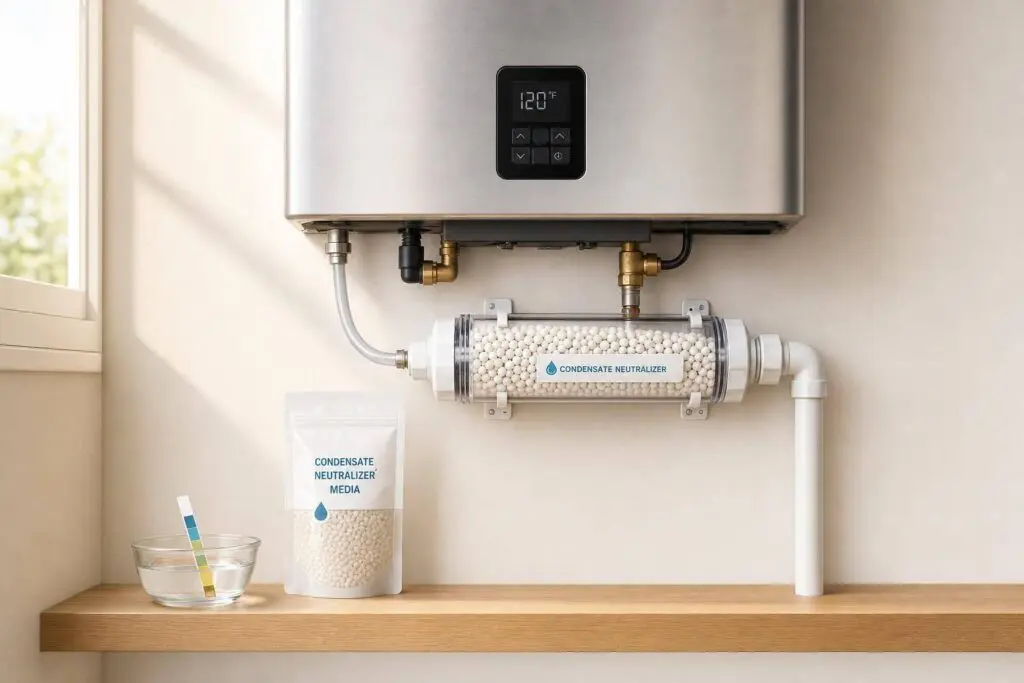
Certified technicians provide a range of services to ensure your boiler runs efficiently and safely. They fine-tune controls to optimize water and air temperature, perform combustion-efficiency tests to set a performance baseline, and inspect heat exchangers to prevent carbon monoxide leaks. For condensing boilers, they also manage acidic condensate and verify that venting systems meet safety standards.
Eco Temp HVAC’s team of certified technicians, including specialists with Navien Service credentials, ensures proper sizing, venting, and calibration for peak performance. Serving the Chicagoland area, they focus on delivering real energy savings – not just efficiency numbers on paper.
Conclusion
Boiler efficiency ratings are straightforward once you break them down. The AFUE (Annual Fuel Utilization Efficiency) rating tells you how effectively a boiler converts fuel into usable heat. For example, a boiler with a 90% AFUE means 90% of the fuel is used to heat your home, while the remaining 10% escapes through the chimney. When shopping for a new boiler, look for the ENERGY STAR label – it highlights models that go beyond federal standards and offer better energy savings.
While these ratings set a baseline, the actual performance of your boiler depends heavily on proper installation and upkeep. Condensing boilers, which boast AFUE ratings between 90% and 98.5%, are excellent for colder climates, delivering significant savings. In milder regions, mid-efficiency boilers might be a practical choice. Upgrading from an older, low-efficiency boiler (with around 56% AFUE) to a 90% AFUE model can also make a big environmental impact, cutting carbon dioxide emissions by roughly 1.5 tons per year for gas systems.
That said, even the most efficient boiler won’t deliver its full potential without proper setup and maintenance. Certified professionals play a critical role in ensuring your system is sized correctly, vented safely, and fine-tuned for optimal performance. These steps are essential to turn those efficiency ratings into real-world savings.
Eco Temp HVAC’s team of certified technicians, including Navien Service Specialists, has the skills to make sure your boiler performs at its best. Serving the Chicagoland area, they handle everything from precise load calculations to ongoing maintenance, ensuring your boiler’s efficiency ratings translate into noticeable energy savings for your home.
FAQs
Is a higher AFUE always worth it?
When considering a higher AFUE (Annual Fuel Utilization Efficiency) rating, it’s not always the best choice for every situation. While a higher rating means better efficiency, other factors – like the cost of installation and your home’s heating requirements – are just as important. The real savings on your gas bill can differ, so it’s essential to weigh whether the energy savings over time are enough to offset the initial investment.
Will my home work with a condensing boiler?
Your home may be suitable for a condensing boiler, a high-efficiency heating system with an AFUE rating of up to 97%. These boilers are designed to recover heat from exhaust gases, allowing them to operate more efficiently than traditional, non-condensing models.
To determine if a condensing boiler is right for your home, you’ll need to evaluate a few key factors, such as your current heating system, the available space, and the type of fuel you use. It’s always a good idea to consult a professional HVAC technician. They can assess your setup, ensure proper installation, and help you get the best performance from your system.
Why can my real savings differ from the AFUE label?
AFUE ratings show how effectively fuel is turned into heat over a year, but they don’t tell the whole story when it comes to energy savings. Real-world factors like duct or pipe heat loss (which can reach up to 35%), the quality of the installation, regular maintenance, and whether the system is properly sized for your home play a big role in your actual energy costs. These factors can cause your expenses to differ from what the AFUE rating alone might suggest.