
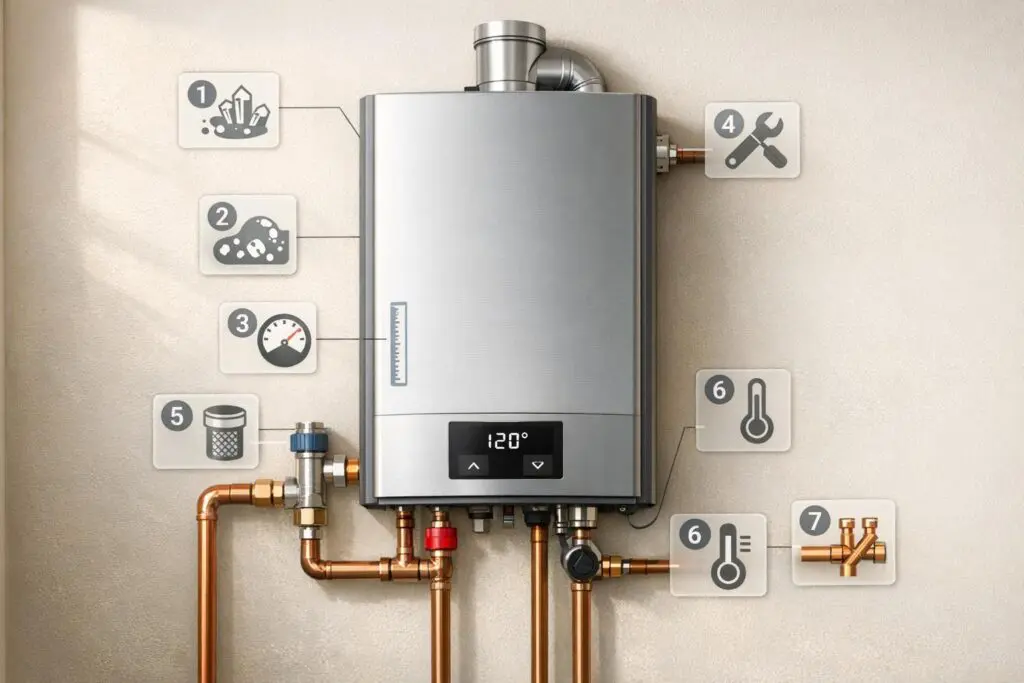
Tankless water heaters are efficient, but they can sometimes deliver inconsistent water temperatures. Common issues include mineral buildup, water pressure changes, incorrect sizing, improper installation, clogged filters, faulty flow sensors, and plumbing cross-connections. These problems often lead to hot-cold-hot cycles, also known as the "cold water sandwich." Regular maintenance, proper installation, and addressing specific system issues can help ensure a steady hot water supply.
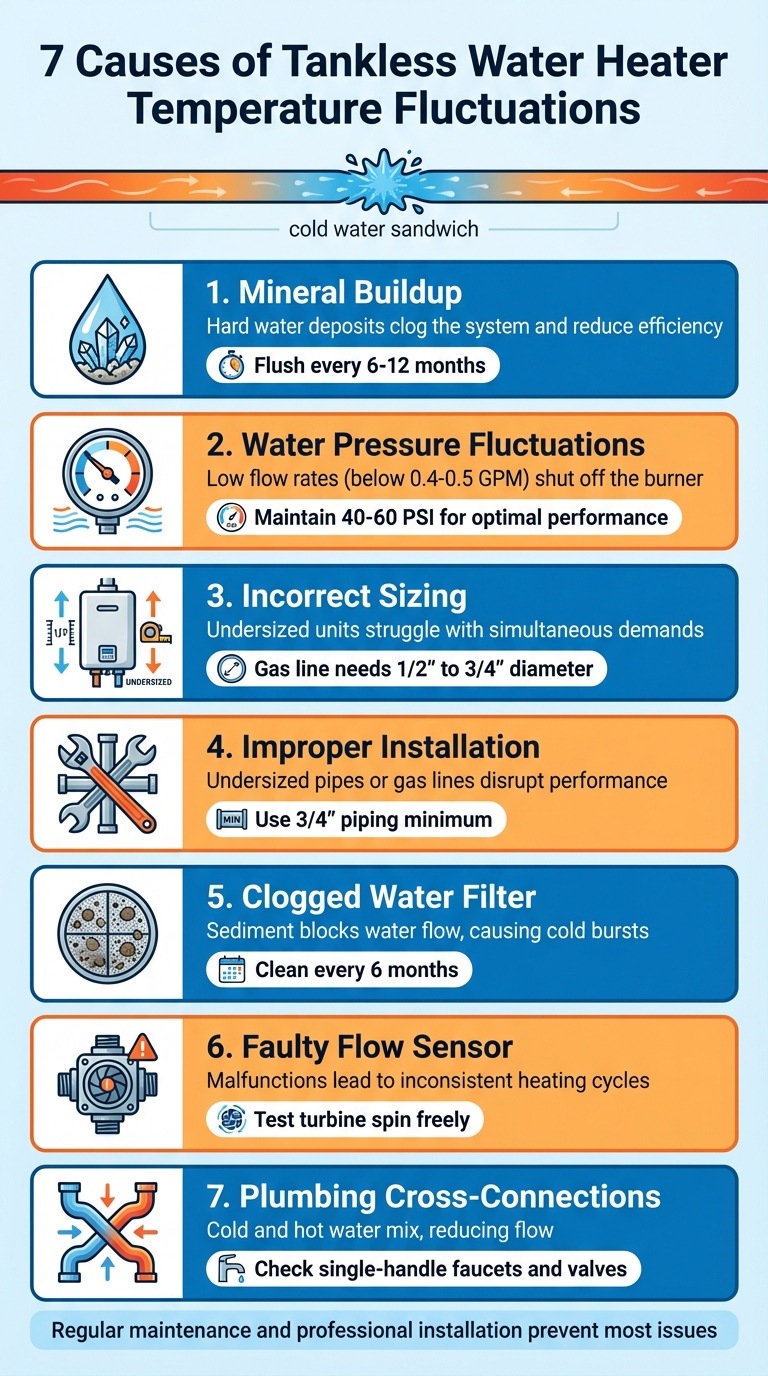
Here’s a quick breakdown of the main causes:
- Mineral buildup: Hard water deposits clog the system and reduce efficiency.
- Water pressure fluctuations: Low flow rates can shut off the burner.
- Incorrect sizing: An undersized unit struggles with simultaneous demands.
- Improper installation: Issues like undersized pipes or gas lines disrupt performance.
- Clogged water filter: Sediment blocks water flow, causing cold bursts.
- Faulty flow sensor: Malfunctions lead to inconsistent heating cycles.
- Plumbing cross-connections: Cold and hot water mix, reducing flow and causing disruptions.
Routine maintenance, such as descaling and cleaning filters, is key. If problems persist, professional inspections can address more complex issues like faulty sensors or plumbing errors.
7 Common Causes of Tankless Water Heater Temperature Fluctuations
Fluctuations in Water Temperature in Tankless Heaters Causes and Solutions
sbb-itb-b5c10b1
1. Mineral Buildup
Hard water, which contains high levels of calcium and magnesium, often leads to scale deposits in tankless water heaters. This problem is especially common with well water, as it typically carries more minerals and debris.
Tankless water heaters have long, narrow pipes that make even small amounts of scale buildup a bigger issue. According to Eccotemp:
Well water can cause a quicker buildup of debris in your tankless water heater making it difficult for water to travel through the long, narrow path to the heat exchanger.
When scale builds up, it acts as insulation on the heating elements, reducing their efficiency. It can also restrict water flow to the point where it falls below the 0.4–0.5 GPM (gallons per minute) activation threshold. This can result in sudden bursts of cold water.
Mineral deposits don’t just affect the heater itself. They can clog faucet aerators and showerheads, disrupting water pressure and leading to the "cold water sandwich" effect – where hot and cold water alternate unpredictably.
To prevent these problems, flush your heater with a descaling solution or white vinegar every 6–12 months. If you live in a hard water area, consider installing a water softener. Additionally, clean the inlet filter regularly and soak fixtures to keep them working properly.
2. Water Pressure Fluctuations
Tankless water heaters rely on a minimum flow rate – typically 0.4 to 0.5 GPM – to activate the gas burner. When water pressure drops below this threshold, the burner shuts off, which can leave you with an unpleasant blast of cold water mid-shower.
This issue often leads to what’s known as the "cold water sandwich" effect. Here’s how it unfolds: you get hot water initially, then cold water hits as the burner shuts off due to low flow, and finally, hot water returns once the burner kicks back on.
Water pressure fluctuations are particularly noticeable during peak usage times, such as early mornings (6 AM to 9 AM) and evenings (5 PM to 8 PM), when households are simultaneously running showers, dishwashers, and other appliances. During these high-demand periods, municipal water pressure can drop, making it harder for your heater to deliver consistent temperatures. Ideally, residential water pressure should stay between 40 and 60 PSI for optimal performance.
Another common issue is a failing pressure-reducing valve (PRV). These valves, which regulate water pressure, usually last 10–15 years. When they start to fail, they can cause sudden and unpredictable shifts in pressure. If you suspect your PRV is the problem, replacing it typically costs $50 to $150, plus labor for installation.
To keep water pressure steady, try these tips:
- Avoid running high-demand appliances like washing machines or dishwashers while showering.
- Check and clean the inlet filter to ensure proper water flow.
- If you’re using a well system, make sure the pressure stays at least 30 PSI to prevent disruptions.
For persistent water pressure issues, you can always reach out to Eco Temp HVAC for professional assistance.
3. Incorrect Sizing
An undersized tankless water heater struggles to handle simultaneous hot water demands. For example, if you’re running a shower and a dishwasher at the same time, the heat exchanger can become overwhelmed by the water volume. This often leads to noticeable drops in water temperature, causing the unpredictable temperature swings many people experience.
The issue becomes even more pronounced if the gas line feeding the unit is too small. These systems typically require a gas line between 1/2 inch and 3/4 inch in diameter to supply enough fuel to the burner. If the gas line is undersized, the burner can’t generate enough heat, leading to inconsistent water temperatures as the unit cycles between hot and cold. Ensuring the correct sizing of both the unit and the gas line is key to maintaining steady performance.
When sized correctly, a tankless water heater delivers a continuous stream of hot water. However, an undersized unit may also create a "cold water sandwich" effect when switching between fixtures, where brief bursts of cold water interrupt the hot water flow.
To address these issues, first verify that your gas line meets the recommended diameter of 1/2 inch to 3/4 inch. If it does and you’re still experiencing temperature drops, consider upgrading your gas meter or adding a five-gallon buffer tank to stabilize the system. These adjustments can help ensure consistent hot water delivery. For a professional evaluation and tailored solutions, reach out to Eco Temp HVAC.
4. Improper Installation
A tankless water heater won’t deliver consistent performance if it’s installed incorrectly. Poor installation can lead to frustrating temperature fluctuations.
One common issue is undersized water piping. For example, using 1/2" piping instead of the recommended 3/4" restricts water flow, which directly impacts temperature stability. Lavallee Systems explains:
An incorrectly installed tankless water heater might not function optimally, leading to temperature fluctuations as the system struggles to balance flow and heating.
This problem becomes even more noticeable when multiple fixtures are in use. Turn on a second tap, and the temperature at the first fixture might drop instantly.
Another frequent problem is an undersized gas line, which can cause "flame failure." This happens when the burner can’t maintain the necessary heat, leading to unpredictable water temperatures or even a complete system shutdown. Similarly, incorrect venting or placing the unit too close to obstructions can block airflow, affecting combustion. Eccotemp highlights:
Installing your water heater too close to other objects can block the air supply and create a fire hazard.
Incompatible plumbing fixtures can also wreak havoc on temperature consistency. For instance, non–pressure-balanced shower valves may cause sudden spikes or drops in temperature when other fixtures are used. Additionally, using valve stems designed for traditional tank heaters instead of tankless systems can exacerbate these issues.
To ensure proper installation, check that your gas line matches the unit’s specifications, that vent pipes are correctly connected and unobstructed, and that your hot water supply piping is at least 3/4" in diameter. If you’re still experiencing temperature fluctuations, consider having a professional, like Eco Temp HVAC’s certified technicians, inspect your system. They can identify and fix installation problems to restore consistent performance.
While proper installation is essential for avoiding these issues, regular maintenance is equally important to keep your tankless water heater running smoothly.
5. Clogged Water Filter
Tankless water heaters come with a small inlet filter designed to catch debris. Over time, sediment and mineral deposits – especially common in well water – can clog this filter. When that happens, water flow drops below the 0.4–0.5 GPM activation threshold, causing the burner to shut off or cycle, which leads to those annoying cold bursts in the shower.
Hot Water Talk explains:
If your tankless unit is equipped with the inlet filter screen, it might be dirty, restricting water flow. The filter can be found at the bottom of the unit.
To fix this, start by turning off the gas, electricity, and water shutoff valves. Locate the inlet filter at the bottom of the heater, remove it, and rinse it under running water. If you spot a mineral buildup, soak the filter in vinegar to dissolve the deposits before putting it back. It’s a good idea to check and clean this filter every six months – or more often if you use well water or have hard water.
If cleaning the filter doesn’t solve the issue, it might be time to call in the pros. Eco Temp HVAC has Navien Service Specialist-certified technicians who can inspect your system. They can also advise on whether a water softener could help if hard water is causing rapid buildup. Persistent problems may require further professional troubleshooting.
6. Faulty Flow Sensor
The flow sensor plays a crucial role in your tankless water heater. It tracks water flow and signals the control board to activate the burners. Typically, a flow rate of 0.4–0.5 GPM is enough to trigger the system. However, when the sensor becomes dirty or malfunctions, it can send incorrect signals, causing the burners to cycle unpredictably. This often results in those annoying bursts of hot and cold water.
Acme Plumbing Co. explains the issue like this:
A sensor might detect flow but miss early signs of temperature droop. Another sensor might misread burner activity, which leads to short heating cycles or rapid water fluctuations.
Why do flow sensors fail? Hard water is usually the culprit. Minerals like calcium and magnesium can accumulate on the sensor’s turbine, preventing it from spinning smoothly. When this happens, the sensor may stop working entirely or provide inaccurate readings. Symptoms include the heater failing to ignite, shutting down unexpectedly, or running continuously even when no water is being used. Regular maintenance of the sensor, much like cleaning filters, is essential to avoid these issues.
If you suspect a problem, here’s a simple test: remove the sensor and blow into the inlet. The turbine should spin freely for several seconds. PJmax, a Group Moderator Emeritus at DoItYourself.com, offers this advice:
Blow into the inlet of the flow sensor. Listen for the spinning impeller; it should spin freely for a few seconds. If it comes to rest abruptly or doesn’t spin at all, it needs to be cleaned or replaced.
For cleaning, a 30-minute soak in vinegar or lemon juice might do the trick. If that doesn’t work, you’ll need to replace the sensor. To prevent future buildup, consider descaling the system every 6 to 12 months. If you live in an area with hard water, installing a water softener can provide long-term protection.
Need professional help? Eco Temp HVAC‘s Navien Service Specialist-certified technicians can test your sensor, check for error codes, and even advise on water treatment systems. Pairing regular descaling with sensor checks ensures your tankless water heater runs smoothly and efficiently.
7. Plumbing Cross Connections
Plumbing cross connections happen when cold and hot water mix, which can reduce water flow and even shut down your tankless water heater. For these systems, this issue is particularly troublesome because the cold water mixing with the hot supply lowers the flow through the heater. Once the flow drops below the 0.4–0.5 GPM activation threshold, the burner shuts off, causing those dreaded cold water bursts.
The usual suspects? Single-handle faucets with worn-out cartridges, faulty mixing valves, and recirculation systems without proper check valves. Other potential culprits include washing machine shut-off valves and Reverse Osmosis (RO) systems. Just like maintaining filters and sensors, addressing cross connections is crucial for keeping your system running reliably.
Here’s how to check for a cross connection: First, turn off the cold water supply valve to your tankless water heater. Next, open all the hot water faucets in your home and let them run for about five minutes. If water continues to flow from any hot faucet, you probably have a cross connection. To narrow it down, leave one hot faucet open and listen at each fixture. The one where you hear water running is likely the source of the problem.
If you have a recirculation pump, turn it off overnight. If the temperature fluctuations are gone the next day, the issue is likely a failed check valve in the recirculation line. Replacing the faulty cartridge or check valve should restore normal performance.
Fixing plumbing cross connections is just as important as addressing sensor or installation problems to ensure a steady hot water supply. Not sure how to tackle it? Eco Temp HVAC‘s certified technicians can help diagnose plumbing issues, test your system, and recommend the right solution to keep your tankless water heater working flawlessly.
Maintenance Plans: Basic vs. Advanced
Keeping your tankless water heater in top shape requires regular upkeep to avoid problems like temperature swings. Basic maintenance plans focus on essential tasks: flushing the system with a descaling solution every six months, cleaning the water inlet filter, and checking air intake and exhaust vents for blockages. These steps help tackle common issues like scale buildup and restricted water flow.
For more in-depth care, advanced maintenance plans go a step further. They include technical diagnostics and servicing to address more complex problems, such as sensor errors or gas pressure inconsistencies. Technicians use specialized tools like manometers to measure gas pressure, ensure dip switches are set correctly, update firmware, and inspect internal components for potential malfunctions. Advanced plans also involve testing for plumbing cross-connections, calibrating flow sensors to maintain the critical 0.5 GPM activation threshold, and inspecting combustion systems to avoid errors like "Error 90", which signals poor combustion caused by mineral buildup.
Professional maintenance is typically recommended every 6–12 months, though homes in areas with hard water may require more frequent service. Hard water poses a unique challenge for tankless systems since scale can build up faster in the narrow heat exchanger passages compared to traditional tank heaters.
For those seeking tailored care, Eco Temp HVAC offers both basic and advanced maintenance plans specifically designed for tankless water heaters. Their Navien Service Specialist certification ensures technicians are equipped to handle detailed diagnostics, confirm proper gas line sizing, and perform firmware updates to keep your system running efficiently. With service locations across Chicagoland – including Chicago, St Charles, Bartlett, Lemont, Downers Grove, and Palatine – they provide timely assistance when issues arise.
Opting for an advanced plan can help catch problems early, such as failing flow sensors or sediment buildup, before they lead to system failures or the dreaded "cold water sandwich" effect. These plans also include thorough safety checks often missing from basic plans, like testing for gas leaks and clearing vent obstructions, which can pose serious risks if left unaddressed.
Conclusion
Tankless water heater temperature fluctuations can often be avoided by addressing a few common issues. Routine maintenance is key – this includes flushing the system twice a year with a descaling solution and cleaning the inlet filter screens to maintain proper water flow. These steps can help prevent problems like the cold water sandwich effect [5,32]. Additionally, professional installation plays a critical role. Certified technicians ensure your unit is the right size for your household’s hot water needs, verify that gas lines meet manufacturer requirements, and eliminate plumbing cross-connections that can cause those annoying hot-cold-hot cycles. They also fine-tune flow sensors and maintain the recommended 30 psi water pressure, keeping your system running efficiently [5,32]. If issues persist, local professionals can provide quick and effective solutions.
For homeowners in the Chicagoland area dealing with temperature fluctuations, Eco Temp HVAC offers 24/7 repair, maintenance, and troubleshooting services. Their Navien Service Specialist-certified technicians are equipped to handle everything from basic descaling to complex diagnostics and sensor repairs. With service locations in Chicago, St Charles, Bartlett, Lemont, Downers Grove, and Palatine, help is always nearby.
Don’t let inconsistent hot water disrupt your routine. Schedule an expert inspection today. Whether you need emergency repairs, a professional evaluation, or a complete maintenance plan, certified professionals can ensure your tankless water heater delivers steady, reliable hot water for years to come.
FAQs
How can I tell if my tankless heater is short-cycling from low flow?
If your tankless water heater keeps turning on and off within a few minutes, it could be short-cycling. Here’s what to look out for: the flame goes out, the fan kicks into high gear, and then the system re-ignites shortly after. This pattern is often caused by low water flow, which makes it hard for the heater to maintain steady operation.
What’s the fastest way to pinpoint a plumbing cross-connection?
The fastest way to identify a plumbing cross-connection is by scheduling a professional inspection. This process involves spotting any unintentional mixing of hot and cold water lines. Professionals use methods like pressure tests or a detailed visual inspection of the plumbing system to confirm the issue. A comprehensive check ensures the problem is diagnosed and addressed correctly.
When should I call Eco Temp HVAC instead of trying DIY fixes?
If your tankless water heater is showing persistent temperature swings or mechanical problems like faulty flow sensors, corroded pipes, or ignition failures, it’s time to call Eco Temp HVAC. While basic troubleshooting, such as adjusting the settings or checking flow rates, might resolve minor issues, more complex problems often require professional attention. Their certified technicians can handle challenges like plumbing crossovers, sediment buildup, or electrical malfunctions, ensuring your system operates safely and efficiently.