
Tankless water heaters can save energy and reduce costs for industrial facilities. Unlike traditional systems, they heat water only when needed, minimizing energy waste. With up to 96% efficiency, these systems can lower annual energy costs by $50 per unit compared to storage tanks. They also last longer – up to 20 years – and take up less space, making them ideal for demanding environments like laundromats, kitchens, and manufacturing plants.
Key Points:
- Efficiency: High-efficiency models save 24%–34% on energy costs.
- Lifespan: Tankless systems last 15–20 years versus 7–15 years for tank systems.
- Capacity: Cascaded setups handle high demand and offer redundancy.
- Cost Considerations: Installation costs vary; condensing models are pricier but more efficient.
- Maintenance: Annual descaling is crucial for long-term performance.
For industrial setups, accurate demand calculations, proper sizing, and professional installation are essential to ensure reliability and compliance with safety codes.
KBIS / IBS 2025 – Stiebel Eltron – C Series Commercial High-Capacity Tankless Water Heater
sbb-itb-b5c10b1
Industrial Hot Water Requirements
To meet the operational needs of industrial processes, precise hot water management is essential. Industrial facilities often require large volumes of consistently heated water for tasks like manufacturing, cleaning, and other facility services. For example, a single industrial dishwashing station needs water at 140°F to ensure proper sanitation, while manufacturing processes might demand even higher temperatures delivered simultaneously across multiple areas.
Calculating Peak Demand
Understanding peak demand starts with adding up the simultaneous flow rates of all fixtures and processes. A key part of this calculation is the temperature rise (ΔT), which is the difference between the incoming groundwater temperature and the desired output temperature.
Groundwater temperatures in the U.S. typically range from 37°F in northern regions to 77°F in the south. The formula to calculate energy requirements is: GPM × 500 × ΔT ÷ efficiency. Facilities in colder climates, like Minnesota, face a steeper challenge. For instance, achieving a 140°F output from 37°F groundwater requires a 103°F temperature rise, demanding significantly more energy than a facility in Texas with 65°F inlet water.
For systems with demands exceeding 8 GPM or 200,000 BTU/h, cascaded systems – where multiple units are connected in parallel – offer both increased capacity and redundancy. To ensure peak performance, gas-powered systems need a supply pressure of 5–7 inches water column, while electric units require substantial dedicated circuits. For example, a 36 kW electric unit needs at least 150 amps at 240 volts.
These calculations are crucial for designing systems capable of reliably handling the varied demands of industrial operations.
Industrial Applications
Once demand is calculated, these metrics can be applied to specific environments such as laundromats or commercial kitchens. Facilities like laundromats, commercial kitchens, multi-shower locker rooms, industrial cleaning systems, and sanitation stations often require a constant supply of water heated to 140°F to meet operational standards.
Modulating burners, with turndown ratios ranging from 5:1 to 25:1, ensure precise heat adjustments to match demand, preventing temperature fluctuations. Additionally, condensing water heaters, which recover heat from exhaust gases, offer 90–98% thermal efficiency, compared to the 78–82% efficiency of non-condensing models. For facilities operating 24/7, even small efficiency improvements can lead to substantial energy savings over time. However, performance can be compromised if efficiency is lost due to hard water buildup.
Selection Criteria for Industrial Tankless Water Heaters
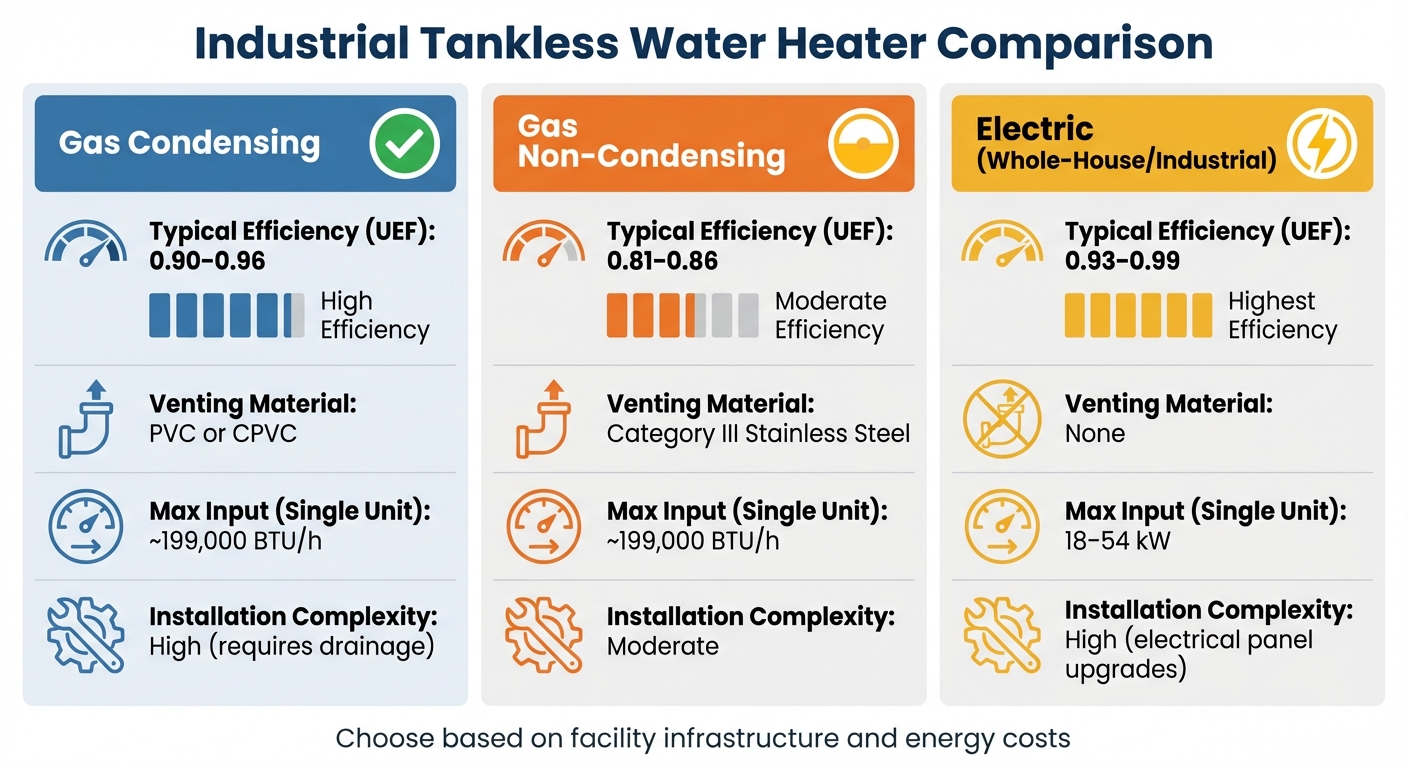
Industrial Tankless Water Heater Types Comparison: Gas Condensing vs Non-Condensing vs Electric
Choosing the right industrial tankless water heater means finding the right balance between capacity, efficiency, and durability. This ensures you manage upfront costs effectively while maintaining long-term reliability.
Capacity and Flow Rate
Start by determining your facility’s peak demand. Use fixture unit tables from the International Plumbing Code (IPC) or Uniform Plumbing Code (UPC) to calculate the total gallons per minute (GPM) needed when all equipment runs simultaneously. Keep in mind that advertised GPM ratings are often based on ideal conditions, which may not hold true in colder climates. Real-world performance can vary significantly depending on your location.
For facilities where a single unit can’t handle the demand, consider setting up a cascaded system. This involves multiple heaters running in parallel, which increases total flow capacity and ensures uninterrupted operation even if one unit needs maintenance. Before committing to a specific capacity, double-check that your gas meter and lines can support the required BTU input. Insufficient gas supply can cause temperature fluctuations during peak usage.
| Feature | Gas Condensing | Gas Non-Condensing | Electric (Whole-House/Industrial) |
|---|---|---|---|
| Typical Efficiency (UEF) | 0.90–0.96 | 0.81–0.86 | 0.93–0.99 |
| Venting Material | PVC or CPVC | Category III Stainless Steel | None |
| Max Input (Single Unit) | ~199,000 BTU/h | ~199,000 BTU/h | 18–54 kW |
| Installation Complexity | High (requires drainage) | Moderate | High (electrical panel upgrades) |
Energy Efficiency and Fuel Type
Condensing gas models stand out with efficiency ratings of up to 96% by recapturing heat from exhaust gases, compared to the 78–85% range for non-condensing units. This efficiency boost can lead to significant savings, especially in facilities that operate around the clock. Another benefit of condensing units is their ability to use PVC venting, which is far less expensive than the stainless steel venting required for non-condensing models. This difference can save you $300–$800 in material costs.
Electric units, while highly efficient on-site (0.93–0.99 UEF), come with hefty electrical demands. For example, a 36 kW unit needs a dedicated 150-amp, 240-volt circuit – about eight times the demand of a typical 50-gallon electric water heater. Upgrading your electrical panels to handle this load could cost between $1,500 and $4,000. Keep in mind that while electric models are efficient at the point of use, their overall environmental impact depends on your region’s energy grid mix.
For high-demand applications, natural gas is usually the most cost-effective option, while propane offers a cleaner-burning alternative with lower greenhouse gas emissions compared to electricity generated from coal or oil. Beyond energy costs, durability plays a key role in minimizing downtime and maintenance costs.
Durability and Maintenance Requirements
Industrial environments demand water heaters that can handle continuous use. Hard water – defined as water with more than 11 grains per gallon of minerals – can accelerate scale buildup on heat exchangers, reducing efficiency and leading to early failure. In such cases, installing a descaling system or scheduling yearly professional descaling is a smart move to protect your equipment.
Condensing units need extra attention because they produce mildly acidic condensate (pH 3.5–5.0) that must be neutralized before draining. Regularly replacing neutralizer cartridges is essential to maintain proper drainage. Many modern industrial-grade models now include self-diagnostic systems and mobile app connectivity, providing real-time alerts to help prevent costly downtime.
Proper sizing is another key factor for durability. Units that are too small may run at maximum capacity constantly, which can shorten the lifespan of the heat exchanger. On the other hand, oversized units may short-cycle frequently, causing wear on the igniter and added thermal stress. Routine maintenance is critical to ensuring the unit operates efficiently and lasts as long as possible, which is especially important in demanding industrial settings.
Cost Analysis: Initial, Operating, and Lifecycle Expenses
When choosing a tankless water heater for industrial use, it’s essential to look beyond the upfront cost. While the initial price is a factor, operating expenses and the unit’s lifespan play an equally important role in the decision-making process.
Installation Costs
Installation costs can vary widely depending on the existing infrastructure. For example, upgrading gas lines to accommodate a tankless system might cost anywhere from $200 to $800, depending on the distance from the gas meter. If you’re switching to an electric unit, you may need to upgrade the electrical panel, which can cost between $1,300 and $3,000 to handle the increased amperage.
Condensing tankless units add another layer of complexity. They require Category IV stainless steel venting and condensate management systems, which can add $300 to $700 to the bill. Labor costs for these installations can be significant, often requiring 8–12 hours from licensed professionals. Permit fees, while relatively minor, typically range from $50 to $300, depending on local regulations. If the installation site is difficult to access or requires structural modifications, labor costs can increase by 10% to 15%.
Here’s a breakdown of installation costs for different types of systems:
| Project Type | Unit Cost Range | Typical Installation Cost | Common Infrastructure Add-Ons | Total Installed Range |
|---|---|---|---|---|
| Whole-House/Light Commercial Electric | $400–$900 | $300–$600 | Panel upgrade: $1,300–$3,000 | $700–$4,500 |
| Whole-House Gas Non-Condensing | $500–$1,000 | $400–$800 | Gas line upsizing: $200–$800 | $900–$2,600 |
| Whole-House Gas Condensing | $900–$2,000 | $600–$1,200 | Cat. IV venting + condensate: $300–$700 | $1,500–$3,900 |
| Light Commercial Gas (Multi-unit) | $1,500–$3,500+ | $1,200–$3,000 | Gas manifold, commercial venting | $3,000–$8,000+ |
Once installation costs are accounted for, it’s important to consider operational efficiency and long-term savings.
Operating Savings and Efficiency
The real financial benefits of a tankless water heater emerge over time. By heating water on demand, these systems eliminate standby heat loss, which translates into lower energy bills. On average, annual energy costs for tankless systems are $195, compared to $245 for traditional storage tanks. However, tankless systems do require annual maintenance, such as descaling, which can cost $200 or more.
The lifespan of a tankless water heater is another major advantage. These units typically last 15 to 20 years, nearly double the 8 to 12 years of a traditional tank system. While the initial investment is higher, the extended lifespan and energy efficiency lead to lower overall costs in the long run.
A 20-year cost analysis highlights this difference:
| Cost Category | Storage Tank (Traditional) | Tankless (On-Demand) |
|---|---|---|
| Initial Purchase & Install | $1,000 | $4,500 |
| Annual Energy Cost | $300–$600 | $150–$300 |
| Annual Maintenance | $100–$200 | $150–$300 |
| Equipment Lifespan | 8–12 Years | 20–25 Years |
| Replacement Costs (20 yrs) | $2,000 (2 replacements) | $0 |
| Total 20-Year Expense | $14,000 | $13,500 |
For facilities using 41 gallons or less of hot water per day, tankless systems are 24% to 34% more energy efficient than traditional tanks. For higher-volume users exceeding 86 gallons per day, the efficiency margin narrows to 8% to 14%.
Installation Requirements for Industrial Facilities
Setting up a tankless water heater in an industrial environment involves detailed planning to address space constraints, infrastructure needs, and compliance with regulations. High-capacity models typically measure around 24–30″H x 20–25″W x 8–10″D. For wall-mounted units, allow for clearances of 12″ at the top, 24″ in front, 4–6″ on the sides, and 12″ at the bottom to ensure proper airflow and maintenance access.
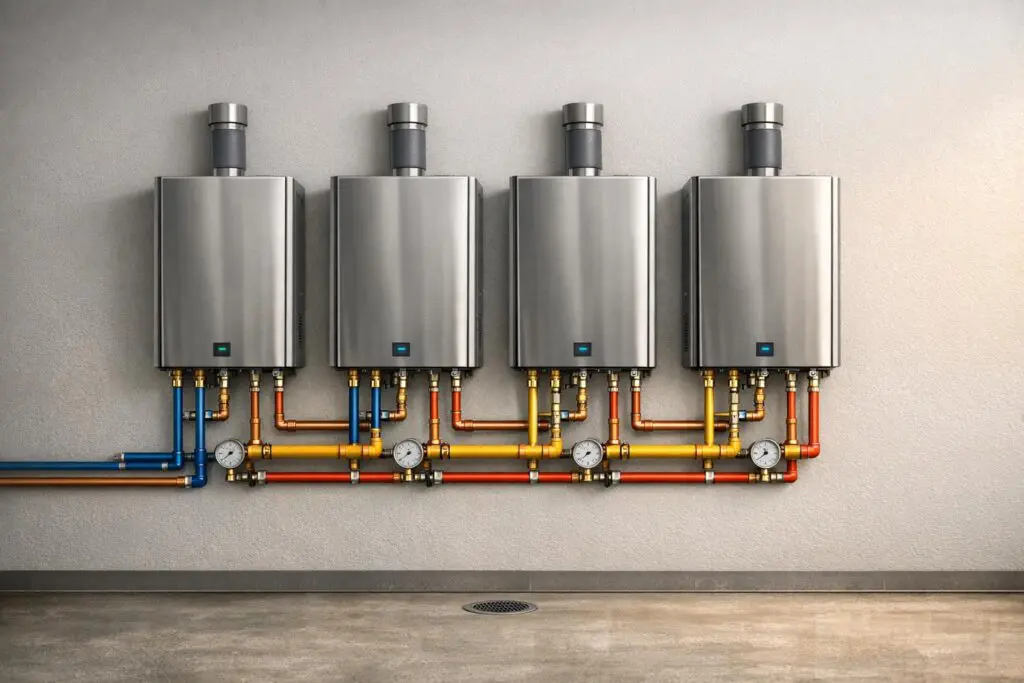
For systems exceeding 200,000 BTU/h, a cascaded (manifolded) configuration with a lead-lag controller is recommended. This setup helps balance workloads across units and offers redundancy for uninterrupted operation. This approach is particularly useful when dealing with peak demand scenarios, as it enhances both capacity and reliability.
Venting Considerations
Proper venting is critical for safe and efficient operation. Non-condensing units, which produce exhaust temperatures between 300°F–500°F, require Category III or IV stainless steel venting. Condensing models, on the other hand, lower exhaust temperatures to 90°F–120°F using a secondary heat exchanger. This allows for more affordable Category IV PVC/CPVC venting. However, acidic condensate produced by condensing units must be managed, and some local codes may require a neutralizer for safe drainage.
For indoor gas-fired units, compliance with NFPA 54 Chapter 9 is essential to ensure adequate fresh air for combustion. Outdoor-rated units eliminate venting and combustion air requirements but must include freeze-protection features in areas where temperatures drop below 32°F.
Retrofitting vs. New Installations
Retrofitting an existing system comes with unique challenges. High-BTU gas units may require upsizing of existing gas lines, while electric models with capacities of 18–36 kW often necessitate electrical panel upgrades. Circuit sizing must follow the National Electrical Code, which mandates 125% of the appliance’s load.
New installations, however, provide more flexibility. They allow for designing the infrastructure from scratch, enabling optimal placement of units and efficient routing of venting and condensate lines. Whether retrofitting or starting fresh, all modifications must meet building codes and safety standards, often requiring professional water heater services to ensure compliance.
Building Codes and Standards Compliance
All installation requirements must align with both local and national codes. Gas-powered units must adhere to the International Fuel Gas Code (IFGC) and NFPA 54 (National Fuel Gas Code), while electric models should comply with NFPA 70 (National Electrical Code). Water supply and drainage requirements are governed by the International Plumbing Code (IPC). Always consult your local Authority Having Jurisdiction (AHJ), as they may impose stricter regulations, especially concerning venting materials and condensate disposal.
To ensure safety, maintain a minimum clearance of 24″ between the water heater, hot water output pipes, and any combustible materials. When installing units on upper floors or in sensitive areas, consider using a drip pan connected to a drain or an active leak detector with a shut-off valve to minimize property damage risks. In areas with hard water (above 11 grains per gallon), plan for annual descaling to prevent mineral buildup, which can impact efficiency and reduce the unit’s lifespan.
Conclusion
Choosing the right tankless water heater for industrial use requires careful planning. Start with accurate demand calculations, factoring in simultaneous flow rates and temperature rise. Be sure to account for the coldest groundwater temperatures during winter to avoid disruptions when demand peaks. For facilities with significant usage, cascaded systems provide both capacity and redundancy, ensuring smooth operations even during high-demand periods.
The decision between condensing and non-condensing models affects both initial and ongoing costs. Condensing units, while typically more expensive upfront, deliver better efficiency and allow for more affordable venting options compared to non-condensing units. When maintained properly, these systems often last longer, making them a smart long-term choice.
Professional installation is non-negotiable for industrial setups. Factors like gas line capacity, electrical modifications, and adherence to local codes require the expertise of certified installers. Many top-tier brands also mandate certified installation to maintain warranty coverage, which is critical for equipment that can cost anywhere from $1,000 to $3,500. These technical requirements highlight the importance of hiring skilled professionals.
Expert service providers are essential for maximizing the benefits of these systems. In the Chicagoland area, Eco Temp HVAC offers specialized industrial tankless water heater installations. As a Navien Service Specialist, their certified technicians are equipped to handle the complexities of high-efficiency condensing units and smart-home integrations. With an A+ Better Business Bureau rating – an achievement earned by only about 2% of HVAC providers – Eco Temp HVAC guarantees installations are done correctly. Their "Done right or it’s free" policy and thorough maintenance plans help extend the lifespan of your system to its full 20-year potential while minimizing downtime.
To protect your investment and ensure optimal performance, regular maintenance is key. This includes annual descaling and real-time system monitoring, which can enhance energy efficiency by 24% to 34%. Partnering with certified professionals for installation, sizing, and upkeep ensures your system operates efficiently and remains compliant with all regulations.
FAQs
How do I size a tankless water heater for my facility’s peak demand?
To properly size a tankless water heater for peak demand, start by figuring out the total flow rate you’ll need. This is measured in gallons per minute (GPM) and reflects the combined water usage during your busiest time. For example, if you expect to run a shower (2.5 GPM) and a kitchen faucet (1.5 GPM) simultaneously, your peak demand would be 4 GPM.
Next, calculate the required temperature rise. This involves subtracting the incoming water temperature from your desired hot water temperature. If your incoming water is 50°F and you want it heated to 120°F, the temperature rise would be 70°F.
Finally, ensure the unit you choose has the capacity – measured in BTUs or kilowatts – to handle both the flow rate and temperature rise. This will help maintain consistent performance without drops in temperature or pressure.
When should I choose a condensing unit instead of a non-condensing one?
When energy efficiency and long-term cost savings matter most – especially in situations involving high water demand or continuous operation – consider a condensing unit. These units boast efficiency ratings of 0.90 or higher by reclaiming heat from exhaust gases, which helps cut down on energy expenses over time. While they’re particularly suited for industrial applications or areas where higher efficiency standards are mandated, keep in mind that their advanced condensate management system can lead to higher initial costs.
What maintenance do industrial tankless heaters need in hard-water areas?
In regions with hard water, industrial tankless water heaters require consistent descaling to eliminate mineral deposits and water softening to prevent future buildup. Skipping these steps can reduce the efficiency of the heat exchanger and may even cause the system to fail earlier than expected. Regular maintenance is key to keeping the system running smoothly and extending its lifespan.