

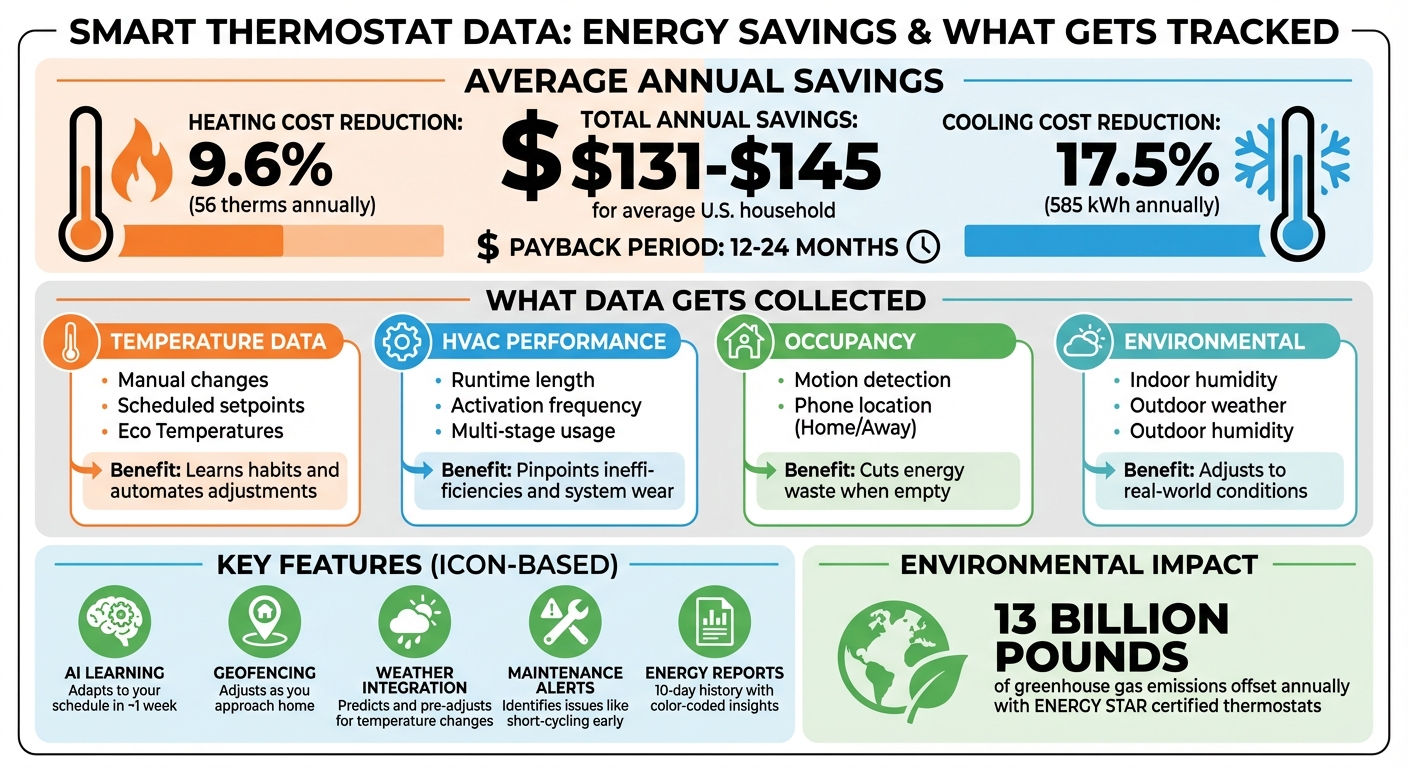
Smart thermostats do more than adjust your home’s temperature – they collect and analyze data to save energy, reduce costs, and improve HVAC performance. By tracking temperature preferences, HVAC runtime, occupancy patterns, and even local weather, these devices create energy-efficient schedules tailored to your habits. Studies show they can cut heating costs by 9.6% and cooling costs by 17.5%, translating to $131–$145 in annual savings for the average U.S. household.
Key takeaways:
- Data collected: Temperature settings, runtime, occupancy, humidity, and weather.
- Energy insights: Spot patterns, reduce waste, and track savings with dashboards and reports.
- AI-powered adjustments: Learn your preferences, predict changes, and optimize comfort.
- Maintenance benefits: Identify issues like short-cycling early and schedule service based on actual usage.
Smart thermostats not only lower bills but also help extend the life of your HVAC system. With features like geofencing, demand response participation, and personalized schedules, they offer a smarter way to manage your home’s heating and cooling.
Smart Thermostat Energy Savings and Data Collection Overview
Home IQ Reporting for ecobee, Cor, and Housewise

sbb-itb-b5c10b1
What Data Do Smart Thermostats Collect?
Smart thermostats gather a variety of information about your home’s heating and cooling system. They keep track of temperature preferences, system performance, occupancy habits, and environmental factors – all in real time.
The data collection process is automatic. Your thermostat records manual temperature changes, pre-set schedules, and desired temperatures for different times of the day. It also monitors how often and how long your HVAC system runs, including details about multi-stage systems – whether it’s operating on the first, second, or third stage to maintain your comfort. A 2025 study involving 5,014 U.S. homes using ecobee devices revealed that analyzing runtime data can uncover hidden efficiency issues by examining the relationship between outdoor temperatures and indoor settings.
Motion sensors and smartphone-based geofencing are used to determine whether you’re home or away. This occupancy data enables the thermostat to switch to energy-saving "Eco Temperatures" when it detects an empty house. Additionally, it tracks indoor humidity levels and outdoor weather conditions, both of which influence how effectively your cooling system operates.
"Smart thermostats… track your daily activity to intelligently adjust the temperature." – Tyler Lacoma, Editor, CNET
Here’s a breakdown of the main types of data collected and how they enhance your HVAC system’s performance:
| Data Category | What Gets Tracked | How It Helps |
|---|---|---|
| Temperature | Manual changes, scheduled setpoints, Eco Temperatures | Learns your habits and automates temperature adjustments |
| HVAC Performance | Runtime length, activation frequency, multi-stage usage | Pinpoints inefficiencies and potential system wear |
| Occupancy | Motion detection, phone location (Home/Away) | Cuts down on energy waste when the house is empty |
| Environmental | Indoor humidity, outdoor weather and humidity | Adjusts system settings to match real-world conditions |
For example, Google Nest thermostats provide a 10-day Energy History, using color-coded bars – orange for heating and blue for cooling – to show when and for how long your system was active. This visual tool makes it easier to identify patterns and see whether weather changes, manual adjustments, or automated schedules are affecting your energy use. These insights lay the groundwork for a deeper understanding of your energy consumption, which we’ll explore in the next section.
How Smart Thermostat Data Shows Energy Usage Patterns
Your smart thermostat takes the raw data it collects and turns it into easy-to-understand insights about your home’s energy use. Through monthly reports and visual dashboards, it helps you see exactly where your heating and cooling expenses are going.
Spotting Trends in Energy Consumption
The thermostat’s dashboard breaks down HVAC runtime by day, week, or month, making it simple to spot spikes in energy use. These spikes might come from manual overrides, automated schedules, or extreme weather events. The dashboard also highlights patterns you might not notice otherwise. For instance, recurring spikes in a 10-day summary could reveal frequent manual adjustments that bypass your automated schedule. Interestingly, about 34% of homes experience year-to-year energy changes greater than 10%, often due to lifestyle changes or shifts in weather.
Recognizing these patterns can help you find ways to cut back on energy use. For example, cooling costs tend to be easier to reduce than heating costs. Many people are more willing to let their homes reach a higher temperature in the summer – like 78°F – when they’re away, compared to lowering the thermostat to 58°F during winter absences. These habits, combined with outdoor temperature changes, directly affect how hard your HVAC system works.
Connecting Outdoor Temperatures with HVAC Usage
To dig even deeper, smart thermostats analyze the relationship between indoor and outdoor temperatures. This is often measured using "delta T", which represents the gap between the outdoor temperature and your indoor setpoint. This metric helps determine how much effort your HVAC system needs to maintain your desired indoor climate.
Take homeowner Dan Schroeder in Utah as an example. Between November 2015 and April 2016, he used data from his Ecobee 3 thermostat to evaluate his 936-square-foot home’s heating performance. He calculated his home’s thermal conductance at 344 Btu/hr/°F by comparing his furnace’s 75,000 Btu/hr output with the temperature gap between indoors and outdoors. He realized his furnace was far more powerful than necessary – it only needed to produce 14,000 Btu/hr, running just 20% of the time, even on the coldest nights. By lowering his thermostat to 48°F during absences, he cut his annual natural gas use by 35%, saving 18.4 decatherms in total.
Using Smart Thermostat Data to Improve HVAC Efficiency
Smart thermostat data isn’t just about controlling your home’s temperature – it’s a powerful tool for improving HVAC performance. By analyzing this data, you can identify potential issues early, schedule maintenance more effectively, and track your energy savings over time.
Detecting System Problems and Inefficiencies
Your thermostat’s runtime logs can uncover hidden problems with your HVAC system. For example, short-cycling, where the system frequently turns on and off, is a common issue that often stems from poor thermostat placement. If your thermostat is installed near a window or on an exterior wall, it may read temperatures inaccurately, leading to inefficiencies.
Back in 2017, an HVAC technician found a Nest thermostat installed on an exterior wall near a sunny window. The morning sun caused the sensor to read temperatures 8–12°F higher than the actual room temperature, triggering short-cycling and discomfort. After relocating the thermostat, the homeowner saw an 8–12°F improvement in temperature accuracy and achieved 16% heating savings over three months.
Your thermostat data can also highlight other inefficiencies, such as premature activation of electric strip heat. Adjusting the "Heat Pump Balance" setting to "Max Savings" on high-efficiency heat pumps could save you $300 or more annually. Additionally, remote sensor data can identify rooms that are consistently too hot or too cold, often pointing to issues like poor airflow or ductwork problems.
These insights not only improve comfort but also pave the way for smarter maintenance decisions.
Scheduling Preventive Maintenance
Instead of sticking to a rigid maintenance schedule, use runtime-based triggers to determine when your system needs attention. Smart thermostats track how long your HVAC system operates, allowing you to schedule tasks like filter changes or professional tune-ups using an HVAC maintenance checklist based on actual usage rather than arbitrary calendar dates.
"HVAC system runtime is a crucial metric for establishing the connection between system operation and energy performance." – You-Jeong Kim, University of Illinois
You can also monitor how your system’s runtime correlates with outdoor temperatures. If your HVAC starts running longer to maintain the same comfort level while outdoor conditions remain stable, it could signal issues like a clogged filter, refrigerant leak, or mechanical wear. Considering that professional service calls typically cost $120 to $180, catching these problems early through data monitoring can save you from costly emergency repairs.
By aligning maintenance schedules with actual system performance, you not only extend the life of your HVAC system but also make it easier to track energy savings.
Measuring Energy Savings Over Time
Smart thermostat data helps you measure the impact of system upgrades or changes in behavior. Over time, this data confirms whether your efforts are paying off. For instance, optimized thermostat schedules have been shown to reduce gas heating costs by 9.6% and electric cooling costs by 17.5%.
A 2014 study conducted by Vectren Indiana analyzed data from 300 homes and found that, when adjusted for weather, heating energy use dropped by 12.5%, and cooling energy use decreased by 13.9% after schedule optimizations. This kind of weather normalization is crucial, as about 34% of homes experience energy fluctuations of more than 10% year-to-year due to lifestyle changes alone. Without data-driven tracking, it’s tough to isolate actual efficiency improvements.
Monthly energy reports from your thermostat can also benchmark your usage against similar homes in your area. This comparison helps you gauge whether your HVAC system is performing efficiently or if there’s room for improvement. Over time, these insights validate the benefits of early problem detection and proactive maintenance, ensuring your system operates at peak efficiency.
How AI and Machine Learning Improve Smart Thermostat Control
AI and machine learning are taking smart thermostat control to the next level. These systems don’t just rely on static programming – they learn from your habits, predict your preferences, and adapt over time. By analyzing how you interact with the thermostat, tracking occupancy patterns, and factoring in outdoor weather, they aim to cut down on energy waste while keeping your home comfortable.
Personalized Temperature Adjustments
Machine learning works by observing how you manually adjust your thermostat. Take the Nest Learning Thermostat as an example: it spends about a week studying your schedule and temperature preferences before it starts self-programming. During this learning phase, every adjustment you make helps it build a tailored schedule.
"Nest actually programs itself by learning your behavior patterns and desired temperatures for certain days and times during the week, and then building a schedule for your HVAC." – HowStuffWorks
To make these adjustments even more precise, the system pulls data from multiple sources. Motion sensors, with a 150-degree detection range, track activity to determine if a room is occupied. Light sensors and temperature readings from different areas of your home add to this data. When the system detects no activity, it automatically switches to energy-saving mode, which can reduce heating bills by about 12% and cooling costs by 15%. Geofencing adds another layer, adjusting temperatures as you approach home. Even external factors, like sunlight affecting room temperature, are considered to ensure accurate control.
This personalized approach doesn’t just enhance comfort – it lays the groundwork for smarter, predictive energy management.
Predictive Adjustments for Energy Savings
AI doesn’t just react – it predicts. Using local weather forecasts, these systems can adjust settings before conditions change. For instance, if a cold front is expected, the thermostat might pre-heat your home so it’s comfortable when temperatures drop.
Another key feature is the calculation of your home’s thermal signature. This refers to how quickly your home heats or cools based on factors like insulation, HVAC capacity, and outdoor conditions. By understanding this, the thermostat can estimate how long it will take to reach your desired temperature. This insight helps reduce runtime while maintaining consistent comfort.
Some smart thermostats also participate in demand response programs during peak grid hours, automatically tweaking settings to ease the strain on the electrical grid. Considering that HVAC systems account for roughly 50% of a home’s energy use, these predictive and adaptive features can lead to noticeable energy savings over time.
How to Analyze and Use Your Smart Thermostat Data
Your smart thermostat collects detailed data about your home’s heating and cooling habits. This information can help you identify inefficiencies and fine-tune your settings for better energy management. Here’s how to make sense of that data and put it to work.
Reading Data Through App Dashboards
The app dashboard is your gateway to understanding your thermostat’s performance. Most smart thermostats feature an "Energy History" or "Energy Dashboard" that breaks down usage patterns by day, week, or month. For instance, in the Google Home app, you can navigate to Home > Climate > Thermostat > Energy Dashboard to see your energy use.
These dashboards often use color-coded bars – orange for heating and blue for cooling – and allow you to tap on specific days to view HVAC runtime. Icons provide insight into usage changes, such as manual temperature adjustments, weather impacts, or automatic Eco Temperature settings. Look for indicators like a "Leaf" icon, which highlights days when energy-efficient settings were used to lower consumption.
You can also review Home/Away data to see energy savings when no one is home. If you notice high usage during unoccupied periods, consider adjusting your Eco Temperature settings – lowering the heating threshold or raising the cooling threshold can make a difference. For heat pump users, the "Heat Pump Balance" setting is worth checking. If auxiliary heat is being used frequently, switching to a "Max Savings" mode can help cut costs.
Joining Energy-Saving Programs
Smart thermostats can also connect you with utility programs that promote energy savings. Many utility companies offer demand response programs, where your thermostat adjusts settings during peak grid hours to reduce strain on the electrical system. In return, you might receive rebates or credits.
Additionally, many providers offer rebates ranging from $50 to $125 for installing ENERGY STAR-certified smart thermostats. Research supports the benefits: smart thermostats save, on average, 9.6% on gas heating (about 56 therms annually) and 17.5% on electric cooling (roughly 585 kWh annually). In hotter climates like Phoenix or Las Vegas, cooling energy savings can be even higher – between 1,050 and 1,488 kWh per year.
Simulating Seasonal Impacts on HVAC Usage
Smart thermostats typically store up to 10 days of detailed energy history, making it easy to compare current usage with past patterns. This can help you identify when cooling needs start to surpass heating – or vice versa.
Before extreme weather seasons, try experimenting with Eco Temperature settings. For example, as winter approaches, you could lower your heating Eco Temperature from 60°F to 53°F and check the Energy History the next day to see if runtime decreased without compromising comfort. Many thermostats also integrate local weather forecasts, allowing you to adjust schedules ahead of sudden temperature changes.
Since heating and cooling account for nearly half of the average American household’s annual energy bill – totaling over $900 – these seasonal adjustments can lead to noticeable savings.
Use these tips to maximize your thermostat’s potential, and if you need expert advice, reach out to Eco Temp HVAC for tailored solutions to enhance efficiency and savings.
Conclusion
Smart thermostats offer a clear edge when it comes to managing your home’s comfort and energy expenses. Unlike traditional thermostats, they provide detailed, actionable insights – like runtime hours, occupancy trends, and system performance metrics – so you’re never left guessing about energy usage or unexpected bill spikes.
Research highlights the impact: homeowners save an average of 9.6% on gas heating (about 56 therms annually) and 17.5% on electric cooling (roughly 585 kWh per year). Most users recoup their investment in 12 to 24 months. On a larger scale, adopting ENERGY STAR certified smart thermostats could help offset 13 billion pounds of greenhouse gas emissions each year.
These savings go beyond just dollars and cents. By tracking runtime, you can address maintenance needs before they escalate into costly repairs. Energy reports help pinpoint wasteful habits, while features like weather-based adjustments and learning algorithms automate efficiency – tying together the data-driven tools and maintenance strategies discussed earlier.
"The savings aren’t about the device – they’re about the gap between your old thermostat habits and what the smart features can automate." – HVAC Calculator Hub Team
Whether your goal is cutting costs, extending the life of your HVAC system, or reducing your environmental impact, leveraging smart thermostat data is the way forward. If you’re unsure how to interpret the data or want to fine-tune your system, Eco Temp HVAC can provide expert advice and tailored solutions.
Start using your smart thermostat’s insights today to enjoy better comfort, lower bills, and a longer-lasting HVAC system.
FAQs
Is my smart thermostat tracking when I’m home?
Smart thermostats have the ability to figure out when you’re home thanks to their built-in motion sensors and activity tracking features. By detecting movement and learning your daily patterns, they can adjust settings to enhance both energy efficiency and comfort.
What does unusually long HVAC runtime mean?
Unusually long HVAC runtime happens when your system operates more often or for longer stretches than usual. This can stem from factors like extreme weather, a system struggling to perform efficiently, or heightened heating and cooling needs. As a result, you might notice a spike in energy consumption. If this continues, it’s a good idea to check your system’s efficiency or reach out to a professional to pinpoint the issue and enhance its performance.
How do I use thermostat data to cut my bill?
To cut down on energy costs, take a closer look at your smart thermostat’s energy usage insights. These insights reveal your heating and cooling patterns, helping you identify areas for improvement. Fine-tune your thermostat settings to prioritize efficiency, particularly when no one is home. Features like scheduling and geo-fencing can further minimize unnecessary energy use. Keep an eye on your utility bills to measure the impact – small tweaks informed by thermostat data can add up to noticeable savings over time.