
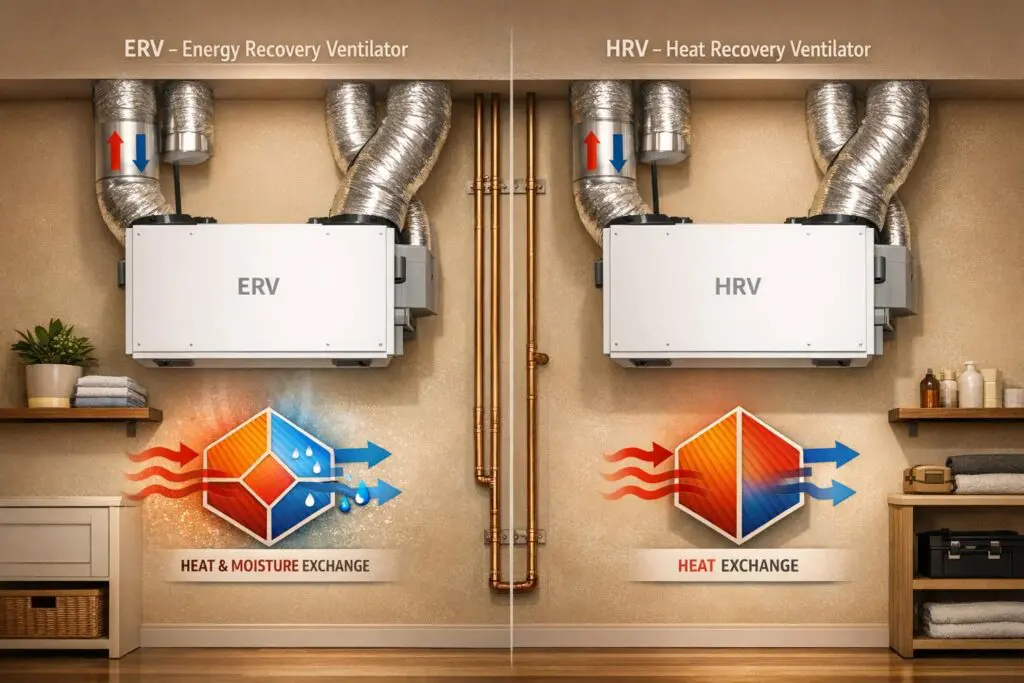
When deciding between an Energy Recovery Ventilator (ERV) and a Heat Recovery Ventilator (HRV), it all comes down to climate and moisture control needs. Both systems improve indoor air quality by exchanging stale indoor air with filtered outdoor air, but they differ in how they handle heat and humidity:
- HRVs recover heat only, making them ideal for cold, dry climates. They transfer warmth from outgoing air to incoming air but don’t manage moisture.
- ERVs recover both heat and moisture, making them better for humid climates or areas with seasonal humidity changes. They help maintain balanced indoor humidity while transferring heat.
Key takeaway:
- Choose an HRV for cold, dry winters.
- Opt for an ERV in humid or mixed-climate regions.
Quick Comparison:
| Feature | HRV (Heat Recovery Ventilator) | ERV (Energy Recovery Ventilator) |
|---|---|---|
| Heat Recovery | Yes | Yes |
| Moisture Control | No | Yes |
| Best Climate | Cold, dry winters | Humid summers or mixed climates |
| Efficiency | 70–80% heat recovery | 70–80% heat + 40–60% moisture recovery |
Both systems save energy and improve air quality, but the choice depends on your climate and comfort needs.
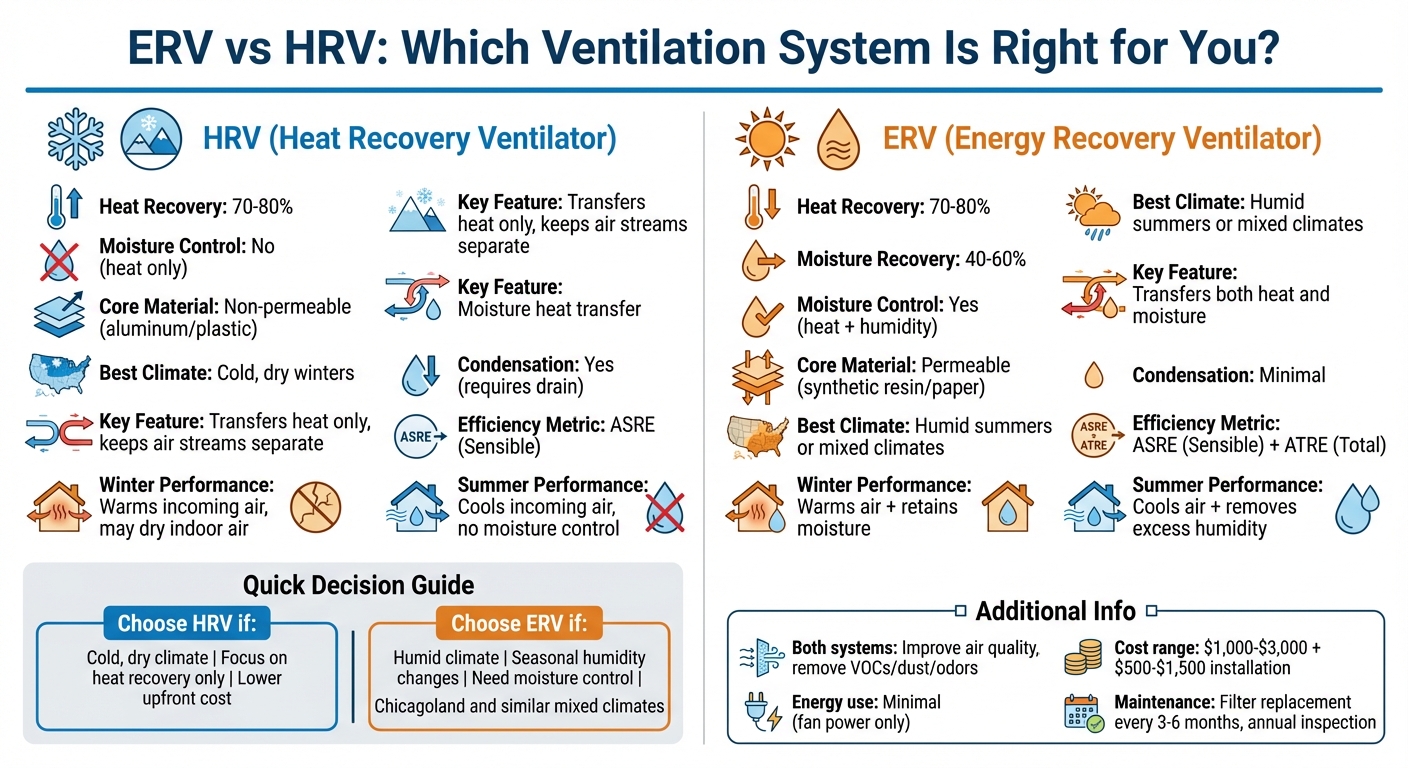
ERV vs HRV Comparison Chart: Features, Efficiency, and Best Climate Use
HRV vs. ERV – What’s the Difference?
How HRV Systems Work
An HRV system works by transferring heat from the warm, stale air leaving your home to the cold, fresh air coming in. At the heart of this process is the heat exchanger core, typically made from aluminum or plastic. These materials are non-permeable, meaning they allow heat to pass through solid plates while keeping the incoming and outgoing airflows completely separate.
The system uses two separate blower fans to keep the air moving. One fan draws fresh outdoor air into your home, while the other expels stale indoor air, maintaining balanced air pressure throughout your space. As the air streams pass through narrow channels in the heat exchanger, they come close enough to transfer heat efficiently without mixing. Most residential systems use either a cross-flow design – where air streams move at right angles to each other – or a counter-flow design, where the streams run parallel but in opposite directions. Both designs maximize the surface area available for heat transfer.
Since HRVs only transfer heat (not moisture), condensation often forms when warm indoor air cools against the cold plates. This requires a condensate drain to manage the water buildup. According to the U.S. Department of Energy, high-quality HRV systems can recover around 70% to 80% of the heat energy from outgoing air. This efficiency takes some of the workload off your heating and cooling systems.
In winter, the HRV uses heat from the exhaust air to warm up the chilly outdoor air before it enters your home. In summer, the system works in reverse, using the cool air inside your air-conditioned home to pre-cool the hot outdoor air. Many modern HRV units also feature a summer bypass damper, which allows fresh air to bypass the heat exchanger entirely during mild weather. This feature serves as a stepping stone to the added capabilities of ERV systems, which also manage moisture exchange.
How ERV Systems Work
An ERV system works much like an HRV, but with one key difference: it transfers both heat and moisture between air streams. This added feature makes ERVs especially useful in areas with high humidity or significant seasonal changes.
At the heart of the system is a moisture-permeable core, made from specialized materials like synthetic resin or certain types of paper. Unlike the rigid aluminum or plastic plates used in HRVs, this core allows water vapor to pass through while keeping the two air streams completely separate. This design not only helps conserve energy but also maintains balanced indoor humidity levels, offering a more refined approach to managing your home’s environment.
The system is highly efficient at transferring both heat and moisture. In the winter, it captures warmth and humidity from the stale indoor air being expelled and transfers them to the cold, dry air coming in from outside. This helps combat the dryness that often plagues indoor spaces during colder months. In the summer, the process flips: the ERV removes heat and excess moisture from the hot, humid outdoor air before it enters your home, transferring them to the cooler, drier exhaust air. This pre-conditioning reduces the workload on your cooling system, making it more efficient.
The moisture transfer happens naturally, as heat and water vapor flow from areas of higher concentration to lower concentration. This passive process requires no extra energy beyond what’s needed to power the two blower fans that circulate air through the system. It’s a simple yet effective mechanism that keeps your indoor air comfortable year-round.
Main Differences Between ERV and HRV
The key distinction between Energy Recovery Ventilators (ERVs) and Heat Recovery Ventilators (HRVs) lies in what they recover. ERVs handle both sensible heat (temperature) and latent heat (moisture), while HRVs focus solely on sensible heat. This difference comes down to their core construction: HRVs use non-permeable materials like aluminum or plastic to block moisture, whereas ERVs rely on permeable materials, such as specialized paper or desiccant wheels, to transfer moisture.
These design differences translate into varying performance, especially during extreme weather. In winter, HRVs warm up incoming cold air but can dry out indoor air. ERVs, on the other hand, not only warm the air but also help retain moisture, which supports better humidity control . During summer, HRVs cool incoming hot air but don’t address moisture. ERVs go a step further by also removing excess humidity, improving indoor comfort and lightening the cooling load.
"In a humid climate, energy recovery ventilation works considerably better than heat recovery ventilation." – Lawrence Berkeley National Laboratory
When it comes to heat energy recovery, both systems perform similarly . However, ERVs recover 40% to 60% of moisture as well, making them a better fit for regions with fluctuating humidity levels. In contrast, HRVs are ideal for cold, dry climates where managing moisture isn’t as critical.
sbb-itb-b5c10b1
Efficiency, Energy Savings, and Air Quality Comparison
Both HRVs and ERVs are designed to recover 70–80% of the heat energy from indoor air, as measured by Adjusted Sensible Recovery Efficiency (ASRE) for HRVs and a combination of ASRE and Adjusted Total Recovery Efficiency (ATRE) for ERVs. The Home Ventilating Institute (HVI) defines ASRE as the efficiency of temperature transfer, while ATRE accounts for both heat and moisture transfer. HRVs excel in ASRE since they focus solely on sensible heat recovery, whereas ERVs perform well in both ASRE and ATRE due to their ability to handle both heat and moisture.
"Most energy recovery ventilation systems can recover 70-80% of the heat energy in the indoor air and transfer it to the incoming fresh air." – Anne Fonda, Content Writer, Trane
In humid climates, ERVs provide an added benefit by reducing the workload on air conditioners and dehumidifiers, leading to lower cooling costs. During winter, they help retain indoor humidity, which can reduce the need for standalone humidifiers. On the other hand, HRVs are ideal for cold, dry climates where the focus is on retaining heat without managing moisture. Both systems are energy-efficient, operating on minimal electricity to power small circulation fans, making them economical to run throughout the year.
Both HRVs and ERVs improve air quality by continuously exhausting stale indoor air and replacing it with filtered fresh air, effectively removing pollutants such as dust, odors, and volatile organic compounds (VOCs). The main distinction lies in humidity control. ERVs transfer water vapor between air streams, helping maintain balanced indoor moisture levels, which can prevent mold growth and window condensation. HRVs, however, do not manage humidity, which can result in overly dry air during winter or increased dampness in humid summers.
| Feature | HRV | ERV |
|---|---|---|
| Heat Recovery Rate | 70–80% | 70–80% |
| Humidity Control | None (heat only) | Transfers moisture between air streams |
| Energy Use | Minimal (fan power only) | Minimal (fan power only; reduces HVAC latent load) |
| Pollutant Removal | Removes VOCs, dust, odors | Removes VOCs, dust, odors |
| Efficiency Metric | ASRE (Sensible) | ASRE (Sensible) + ATRE (Total) |
| Best Climate | Cold, dry winters | Humid summers, varying seasons |
To maintain optimal efficiency and air quality, regular maintenance is crucial. This includes cleaning or replacing filters and inspecting the heat exchanger core. Dirty filters can restrict airflow, significantly reducing energy savings and the system’s ability to remove pollutants. These maintenance practices, along with performance considerations, are critical when deciding which system is best suited for your climate.
Which System Works Best for Different Climates
For homes in cold, dry climates, HRVs (Heat Recovery Ventilators) are a great fit. They efficiently recover heat without introducing excess moisture into the air. But if winter dryness leads to issues like cracked lips, static electricity, or even damage to wooden furniture or floors, an ERV (Energy Recovery Ventilator) might be the better choice. Its ability to retain moisture can help combat these common winter discomforts.
In humid climates, ERVs clearly take the lead. According to Lawrence Berkeley National Laboratory:
"In a humid climate, energy recovery ventilation works considerably better than heat recovery ventilation"
ERVs are particularly effective at managing moisture. During the summer, they pre-dehumidify incoming air, reducing the strain on your cooling system. In winter, they help maintain indoor humidity levels, which boosts both comfort and energy efficiency. This makes ERVs especially valuable in regions with significant seasonal shifts.
Take Chicagoland, for example. With its hot, sticky summers and cold, dry winters, homeowners often find ERVs to be the ideal choice. ERVs balance humidity year-round, making them a practical solution for most homes. While HRVs might work for properties dealing with excessive condensation, the consistent moisture control of an ERV tends to be the better option in this area.
To determine the right ventilation system for your home, calculate the required airflow (CFM). Multiply your home’s square footage by the ceiling height, then multiply that result by 0.35, and finally divide by 60. For precise selection and sizing, it’s always a good idea to consult a certified HVAC professional, such as Eco Temp HVAC.
Choosing Between ERV and HRV for Your Home
When deciding between an Energy Recovery Ventilator (ERV) and a Heat Recovery Ventilator (HRV), your choice should hinge on two main factors: climate and your home’s construction. ERVs are designed to handle both heat and moisture transfer, making them ideal for humid climates or regions with noticeable seasonal changes. On the other hand, HRVs focus solely on heat recovery, making them a better fit for colder, drier climates. Additionally, the way your home is built plays a role. Modern homes with tight seals benefit significantly from these systems since they prevent stale air buildup and reduce the risk of mold, which can result from poor ventilation.
Proper sizing and installation are critical to getting the most out of your system. A certified technician will ensure the unit is correctly integrated with existing ductwork to maintain balanced airflow. As Verde emphasizes:
"The best way to decide which system is right for you is to consult with a qualified HVAC contractor. They can assess your needs and recommend the best system for your building".
Cost is another important consideration. ERV units typically cost between $1,000 and $3,000, with installation adding another $500 to $1,500. While ERVs are often slightly pricier than HRVs, their ability to manage moisture makes them a worthwhile investment in humid regions.
To evaluate system efficiency, compare the ASRE (Apparent Sensible Recovery Efficiency) and ATRE (Total Recovery Efficiency) ratings from the HVI directory. Higher percentages indicate better energy recovery performance.
For homeowners in Chicagoland, Eco Temp HVAC provides expert consultation, installation, and maintenance services. Their certified technicians can assess your specific needs, ensure your system is properly sized, and optimize its performance for long-term reliability. To keep your system running smoothly, regular maintenance is essential – this includes replacing filters every three to six months and scheduling annual heat exchanger inspections.
FAQs
What’s the difference between an ERV and an HRV, and which one is right for my home?
Choosing between an Energy Recovery Ventilation (ERV) system and a Heat Recovery Ventilation (HRV) system comes down to your home’s location, climate, and specific ventilation needs. HRVs work best in colder, drier climates because they transfer heat without impacting humidity levels. This keeps your home warm while maintaining energy efficiency. On the flip side, ERVs are ideal for humid or moderate climates, as they transfer both heat and moisture, helping to regulate indoor humidity year-round.
When deciding, think about your local weather, how airtight your home is, and whether managing indoor humidity is important to you. For instance, in a city like Chicago, where summers are humid, but winters tend to be dry, an ERV might offer better comfort throughout the year. If you’re unsure which option suits your home, Eco Temp HVAC can evaluate your needs and recommend the right system to improve both comfort and energy savings.
What kind of maintenance do ERV and HRV systems need?
ERV and HRV systems need consistent upkeep to work efficiently and maintain good air quality. Here are some key maintenance tasks to keep in mind:
- Clean or replace filters every 3–6 months, depending on your indoor air conditions. Clean filters ensure proper airflow and prevent dirt from clogging the system.
- Inspect and clean the heat exchange core once a year. Dust or debris buildup can reduce the system’s performance, so it’s important to follow the cleaning instructions provided by the manufacturer.
- Check fan operation and motor performance regularly. Pay attention to any unusual noises or vibrations, and confirm that the system is circulating the right amount of air.
- Clear the condensate drain and pan (especially for ERVs) to avoid water damage or mold growth.
While many of these tasks can be handled by homeowners, it’s wise to leave major repairs or adjustments to a certified HVAC technician. Scheduling an annual professional inspection can help identify potential problems early and ensure your system stays in top condition for years to come.
Can an ERV help lower energy costs in humid climates?
Yes, an Energy Recovery Ventilator (ERV) can help cut down on energy costs, particularly in humid climates. ERVs work by transferring both heat and moisture between the stale air leaving your home and the fresh air coming in. During hot and humid weather, this process pre-cools and dehumidifies the incoming air before it enters your home. The result? Your air conditioning system doesn’t have to work as hard, which means lower electricity use and reduced energy bills.
ERVs aren’t just useful in summer – they offer benefits year-round. In colder months, they recover residual heat from the outgoing air, making them an energy-efficient option for homes in moisture-heavy regions like the Midwest. For those in the Chicagoland area, Eco Temp HVAC can evaluate your home’s ventilation needs and install an ERV to help you save on energy costs while enhancing your indoor air quality.