
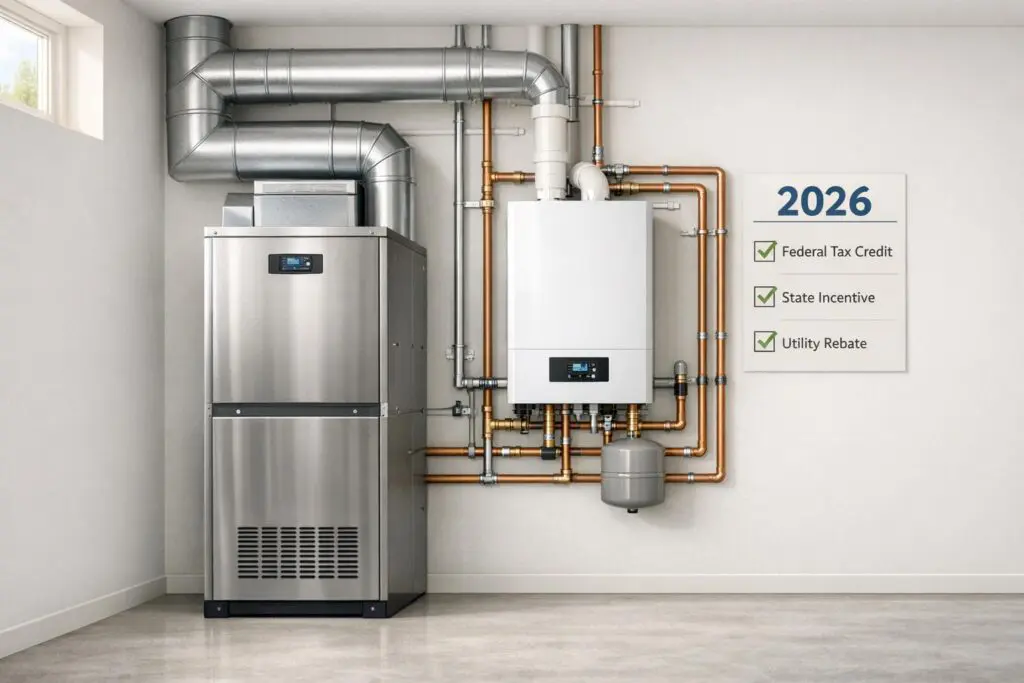
Federal tax credits for residential furnaces and boilers ended in 2025, but there are still options to save on energy-efficient upgrades in 2026. While homeowners can no longer claim credits under the Energy Efficient Home Improvement Credit (Section 25C), commercial property owners and home builders can benefit from the Section 179D deduction and Section 45L credit for qualifying projects completed before June 30, 2026.
For residential upgrades, homeowners can explore state-level incentives, utility rebates, and programs like Illinois’ weatherization and low-income energy assistance initiatives. High-efficiency systems, such as new furnaces with 97% AFUE or higher, can reduce energy costs and emissions while qualifying for local savings opportunities.
Key Points:
- Residential tax credits for furnaces and boilers expired after 2025.
- Commercial and builder incentives (Sections 179D, 45L) remain available through mid-2026.
- Homeowners can still save through state programs and utility rebates.
- To claim federal credits, ensure equipment meets specific efficiency standards and includes a Qualified Manufacturer Identification Number (QMID).
Even without federal residential credits, energy-efficient upgrades can cut costs and improve heating performance when paired with local incentives. Always verify eligibility and required documentation before proceeding with installations.
Federal tax breaks for some home energy upgrades ending soon
sbb-itb-b5c10b1
The Energy Efficient Home Improvement Credit Explained
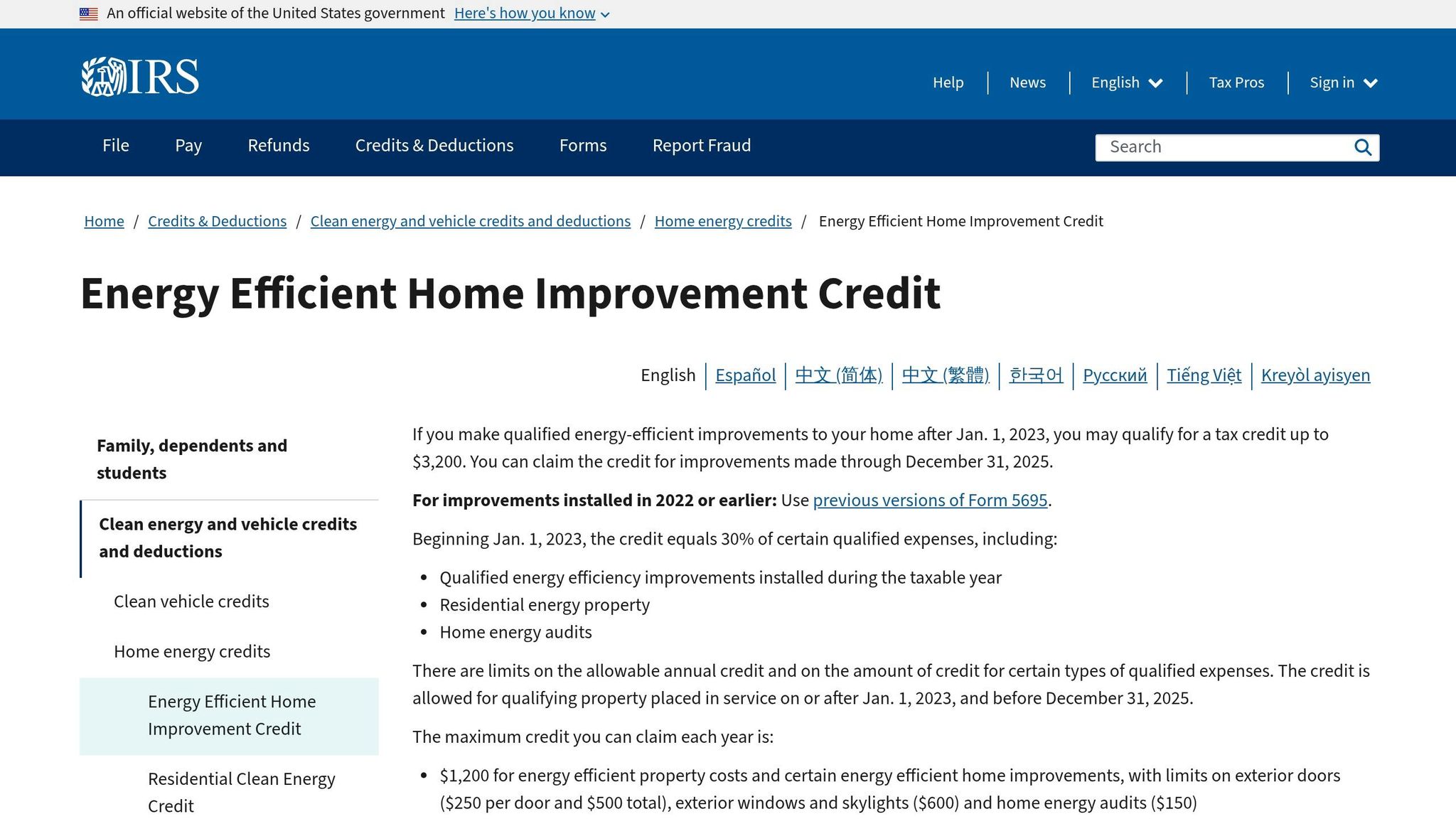
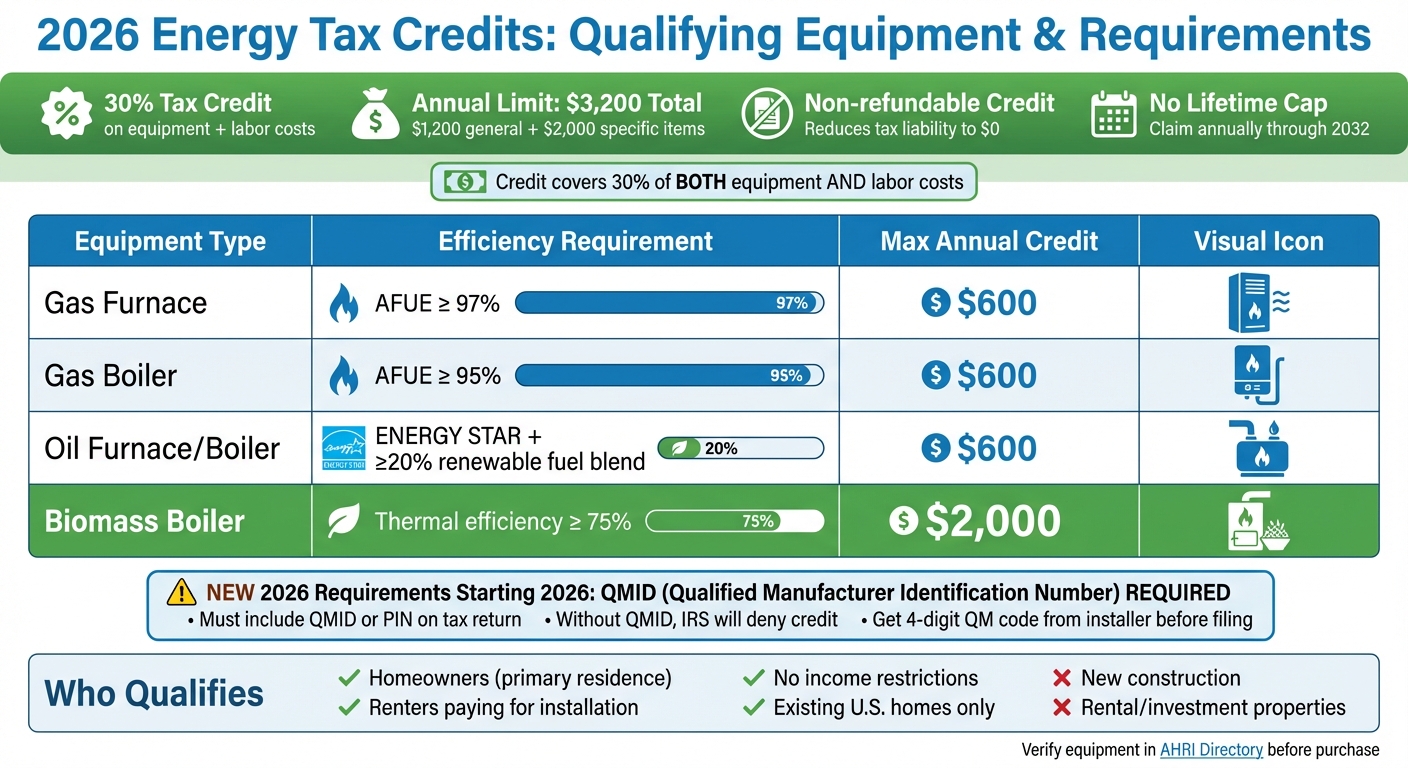
2026 Energy Tax Credits for Furnaces and Boilers Comparison Chart
How the Credit Works
The Energy Efficient Home Improvement Credit (EEHIC) offers a 30% tax credit on eligible equipment and labor costs. Unlike tax deductions, which lower your taxable income, this credit directly reduces the amount of taxes you owe, dollar for dollar.
It’s important to note that the credit is nonrefundable. This means it can bring your tax liability down to zero, but it won’t result in a refund or carry forward to future years. However, there’s no lifetime cap on this credit – you can claim the maximum annual amount for eligible improvements every year through 2032.
For the 2026 tax year, homeowners can claim up to $3,200 annually: $1,200 for general energy-efficient upgrades (such as furnaces and boilers) and $2,000 for specific items like heat pumps or biomass boilers. To qualify, the equipment must be installed in an existing U.S. home that you use as your residence. New construction and rental properties are generally not eligible.
Let’s dive into the specific upgrades that will qualify for the 2026 credit.
Qualifying Upgrades for 2026
Knowing the exact requirements for eligible equipment is key to maximizing your credit. For example, natural gas, propane, and oil furnaces and boilers can qualify for a maximum credit of $600 per item. Biomass boilers, on the other hand, are eligible for a higher limit of $2,000.
| Equipment Type | Efficiency Requirement | Max Annual Credit |
|---|---|---|
| Gas Furnace | AFUE ≥ 97% | $600 |
| Gas Boiler | AFUE ≥ 95% | $600 |
| Oil Furnace/Boiler | ENERGY STAR; ≥ 20% renewable fuel blend | $600 |
| Biomass Boiler | Thermal efficiency rating ≥ 75% | $2,000 |
To ensure your equipment qualifies, it must meet the Consortium for Energy Efficiency’s (CEE) highest efficiency tier as of January 1, 2026. You can verify compliance by checking the AHRI Directory or reviewing the manufacturer’s certification statement.
These guidelines help set the stage for new reporting requirements coming in 2026.
What’s New in 2026
Beginning in 2026, you’ll need to include a Qualified Manufacturer Identification Number (QMID) or Product Identification Number (PIN) for each qualifying item when filing your tax return. Without this information, the IRS will deny your credit.
Ile Kauppila, SEO Writer at Air Conditioner Lab, highlights how this change benefits homeowners:
"The EEHIC dramatically increases the amount of tax credit available to you… you can claim six times as much credit every single year."
Only equipment from qualified manufacturers that provide these identification numbers will be eligible. Make sure your installer gives you the QMID or the manufacturer’s 4-digit QM code before you file your 2026 tax return.
Eligibility Requirements for Tax Credits
Here’s a closer look at the eligibility rules for claiming these tax credits, covering who qualifies, efficiency standards, and location-specific guidelines.
Who Qualifies for the Credit?
Several groups can take advantage of these credits: homeowners upgrading their primary residence, renters footing the bill for installations, and owners of second homes used as residences. Importantly, there are no income restrictions for eligibility. However, the credit only applies to properties you personally occupy – so investment or rental properties don’t qualify. Additionally, this benefit is limited to existing homes located in the United States; newly constructed homes are not eligible.
Required Efficiency Standards
To qualify, your new system must meet specific efficiency benchmarks:
- Gas Furnaces: Must have ENERGY STAR certification and an AFUE (Annual Fuel Utilization Efficiency) of at least 97%.
- Gas Boilers: ENERGY STAR certification is required with an AFUE of at least 95%.
- Oil Furnaces and Boilers: These systems must also be ENERGY STAR certified and come with manufacturer certification confirming compatibility with fuel blends containing at least 20% biodiesel, renewable diesel, or second-generation biofuels.
- Biomass Boilers: A thermal energy efficiency rating of at least 75% is required.
For assurance, check the AHRI Directory to confirm your unit meets these standards. Be cautious of marketing claims like "up to" efficiency levels, which may not guarantee compliance.
Location-Based Requirements
The federal tax credit mandates that the property be within the United States. Efficiency standards for furnaces and boilers are applied nationwide, so there aren’t any region-specific variations, including for Illinois or the Chicagoland area.
That said, local incentives can offer additional savings. For instance, Chicagoland homeowners may combine federal credits with local utility rebates. Utilities like CenterPoint Energy often provide rebates that complement the $600 federal tax credit. To find rebates in your area, use the Energy Star "Rebate Finder" tool to search for Illinois-specific programs based on your zip code.
How to Claim Your Tax Credit in 2026
Claiming your energy tax credit in 2026 is a straightforward process that involves four main steps – from choosing the right HVAC system to submitting the proper paperwork. Here’s how to get it done.
Step 1: Choose a Qualifying System
To qualify for the tax credit, your furnace or boiler must meet specific efficiency standards. For natural gas, propane, or oil furnaces, the Annual Fuel Utilization Efficiency (AFUE) must be at least 97%. Boilers, on the other hand, require an AFUE of 95% or higher. These high-efficiency systems can help you save on fuel costs over time.
Before purchasing, verify the model in the AHRI Directory to ensure it meets the eligibility requirements. This step ensures you’re not misled by claims of "up to" certain efficiency levels, which may not reflect the actual performance. Additionally, confirm that the manufacturer provides a Qualified Manufacturer Identification Number (QMID) – a unique four-character code you’ll need for your 2026 tax return.
Once you’ve identified a qualifying system, the next step is scheduling a professional installation.
Step 2: Work with Certified Installers, Like Eco Temp HVAC
Proper installation is key to claiming your tax credit and ensuring your system operates efficiently. Certified contractors can handle both the installation and the necessary documentation. The tax credit covers 30% of the total cost, including both the equipment and labor. Installation expenses alone can make up 30% to 50% of your total claim.
Certified installers, such as Eco Temp HVAC, ensure your system meets all efficiency standards. With certifications like American Standard Customer Care Dealer and Navien Service Specialist, they provide the expertise needed to meet the credit requirements and supply the necessary paperwork.
"Your HVAC contractor should provide an itemized invoice separating equipment costs from labor. Since both qualify for the credit, this breakdown helps maximize your claim." – Greenwashing Index
Step 3: Gather All Necessary Documentation
To claim the credit, you’ll need to collect specific documents:
- An itemized invoice from your installer that separates equipment and labor costs (both are eligible for the 30% credit).
- A Manufacturer Certification Statement.
- The AHRI Certificate for your system, which can be obtained using your model number.
- The QMID provided by your installer.
The IRS requires you to report the QMID on your tax return to qualify for the credit. As stated by the IRS, "For each item of qualifying property placed in service, no credit will be allowed unless the item was produced by a qualified manufacturer and the taxpayer reports the Qualified Manufacturer Identification Number (QMID) for the item on their tax return".
Keep all these documents for three to seven years in case of an audit.
Step 4: File Your Tax Forms
To claim your credit, complete IRS Form 5695 (Residential Energy Credits), specifically Part II, which covers the Energy Efficient Home Improvement Credit. Include the QMID for your equipment, calculate 30% of your total eligible costs, and apply the $600 cap per unit.
It’s important to note that this is a nonrefundable credit, meaning it can only reduce your tax liability to zero. The overall annual limit for all energy efficiency improvements is $3,200, and this limit resets each year through 2032. If you’re planning multiple upgrades, consider spreading them across different tax years to maximize your benefits.
Combining Tax Credits with Other Savings Programs
You can combine federal tax credits with state and local programs to save even more. When calculating the 30% federal tax credit, subtract any utility rebates from your qualified costs first. For example, if your utility company offers a $500 rebate, the federal credit will apply to the reduced amount. These combined savings can make upgrading your furnace or boiler much more affordable.
Utility Company Rebates
Utility companies in the Chicagoland area offer rebates for energy-efficient heating equipment. For instance, Ameren Illinois has helped customers save over $352 million on gas costs since 2008. Programs from other utilities, like ComEd and Peoples Gas, also offer rebates on qualifying upgrades. Ameren Illinois is even providing Sensi Smart Thermostats for just $5 through March 31, 2026.
Additionally, many local utilities provide free energy assessments to help you identify eligible upgrades and potential rebates. These assessments are a great way to find out how you can save even more.
Illinois State and Local Programs
Beyond utility rebates, Illinois offers several state and local incentives. The U.S. Department of Energy has allocated $263 million to the Illinois EPA for two major rebate programs – HOMES and HEAR. These programs are designed to assist low-income households earning less than 80% of the Area Median Income.
For qualifying households, the Illinois Home Weatherization Assistance Program (IHWAP) can provide up to $20,000 for weatherization and HVAC repairs or replacements. Additionally, the Low Income Home Energy Assistance Program (LIHEAP) helps cover winter heating costs for eligible households.
One important note from the Illinois EPA:
"Illinois does not intend to offer retroactive rebates through the IRA Home Energy Rebate Program; only program-approved projects will be eligible for rebates following the program’s launch".
This means you should wait for official program approval before starting your project if you plan to claim these rebates.
How Eco Temp HVAC Helps You Save More
Navigating the maze of rebate programs and tax credit requirements can feel overwhelming. That’s where Eco Temp HVAC comes in. They help customers identify high-efficiency furnaces and boilers that meet the criteria for available incentives, including those that align with the Consortium for Energy Efficiency (CEE) highest efficiency standards. Their certified technicians also provide the documentation you’ll need to make claiming these incentives easier.
As an American Standard Customer Care Dealer and Navien Service Specialist, Eco Temp HVAC ensures expert guidance throughout the process. With service locations across Chicagoland – including Chicago, St. Charles, Bartlett, Lemont, Downers Grove, and Palatine – they’re ready to help homeowners stack federal tax credits with state and utility rebates for maximum savings.
Conclusion
Main Points to Remember
Switching to a 2026 energy-efficient furnace or boiler comes with notable financial advantages. Homeowners can claim a federal tax credit covering 30% of equipment and installation costs, with specific limits of up to $600 for qualifying gas furnaces (97% AFUE or higher) and boilers (95% AFUE or higher). Additionally, the Energy Efficient Home Improvement Credit has no lifetime dollar cap, allowing you to claim up to $3,200 annually in tax credits for eligible improvements through 2032.
Upgrading to high-efficiency systems also slashes monthly heating costs. For instance, a furnace with 97% AFUE converts nearly all fuel into heat, offering a 17% efficiency boost compared to standard 80% AFUE models. Plus, replacing an older system with a high-efficiency heat pump can lower your home’s carbon emissions by 3 to 4 tons of CO₂ annually.
To claim these credits, ensure you have the right paperwork, such as a Manufacturer Certification Statement, an AHRI Certificate, and an itemized invoice. Starting in 2026, you’ll also need to include the Qualified Manufacturer Identification Number (QMID) on your tax return. Certified installers can assist with securing the necessary documentation and verifying that your system meets efficiency standards.
These highlights emphasize the financial and environmental benefits of energy-efficient upgrades, along with the importance of proper installation and documentation.
Why Choose Eco Temp HVAC?
Understanding tax credit rules, efficiency standards, and rebate programs can be complicated. Eco Temp HVAC takes the guesswork out of the process by helping you choose furnaces and boilers that meet 2026 standards and by providing all the required documentation for tax credits. As an American Standard Customer Care Dealer and Navien Service Specialist, their certified technicians ensure professional installation and compliance with IRS requirements.
With service locations across Chicagoland – including Chicago, St. Charles, Bartlett, Lemont, Downers Grove, and Palatine – Eco Temp HVAC is available 24/7. They’re dedicated to energy-efficient solutions, whether you’re upgrading a residential furnace or a commercial boiler. Their team works with you to maximize federal tax credits, tap into utility rebates, and reduce your long-term heating expenses.
FAQs
Can I still get a federal tax credit for a new furnace or boiler in 2026?
Federal tax credits for energy-efficient furnaces and boilers will still be available in 2026 under the Energy Efficient Home Improvement Credit. This program covers qualifying upgrades made up until December 31, 2025. Make sure to review the eligibility requirements to ensure your new furnace or boiler meets the necessary standards.
What is a QMID, and where can I find it for my HVAC equipment?
A QMID is a 4-character code assigned by the IRS to manufacturers participating in the 25C energy efficiency tax credit program. This code helps verify that equipment meets the necessary standards for the credit.
You can locate the QMID in two ways:
- Check the IRS QMID directory.
- Reach out directly to the equipment manufacturer.
Having this code is crucial when claiming the tax credit for energy-efficient home upgrades.
Can I use utility rebates and still claim the federal energy credit?
Yes, it’s possible to combine utility rebates with the federal energy credit for qualifying HVAC systems in 2026. You can take advantage of both incentives, provided the system complies with the federal energy credit requirements.