
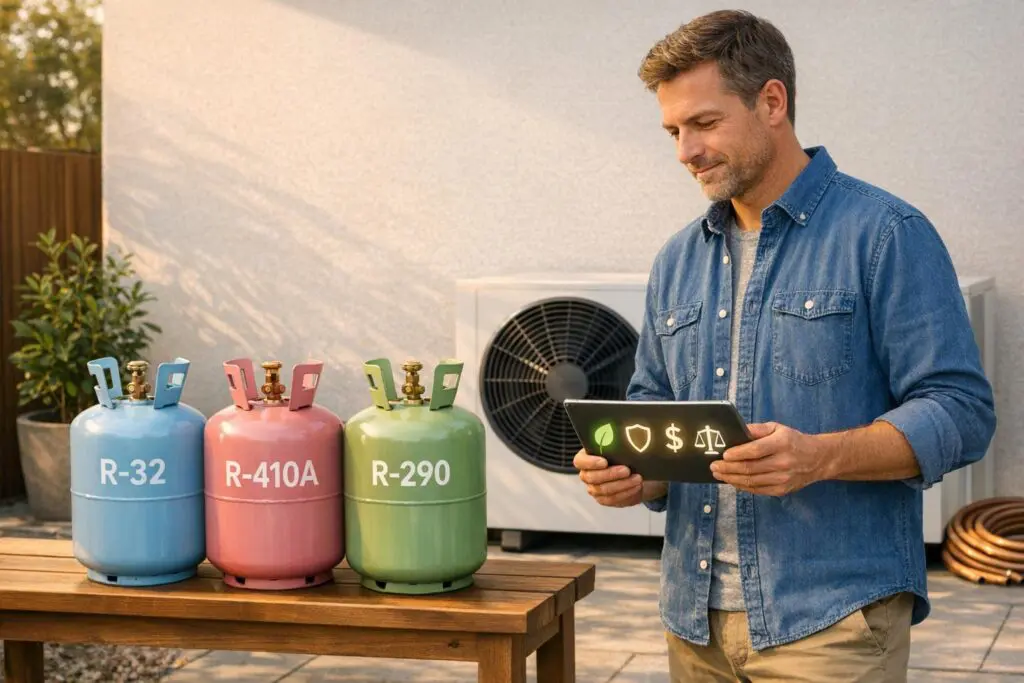
When picking a refrigerant for your HVAC system, here’s what you need to know:
- R-410A is being phased out: Starting January 1, 2025, the EPA will ban R-410A for new residential and light commercial systems due to its high GWP (2,088). It’s still usable for existing systems but will become more expensive over time.
- R-32 offers better efficiency and a lower GWP: With a GWP of 675, it’s a better environmental choice than R-410A. It also uses 20–30% less refrigerant and delivers up to 15% energy savings. However, it’s mildly flammable (A2L), so proper installation and safety measures are required.
- R-290 (propane) is the most eco-friendly option: With a GWP of just 3, it’s ideal for reducing climate impact. It works best in smaller systems due to its high flammability (A3) and strict charge limits. Installation costs are higher because of additional safety requirements.
Quick Comparison:
| Feature | R-410A | R-32 | R-290 (Propane) |
|---|---|---|---|
| GWP | 2,088 | 675 | 3 |
| Safety Class | A1 (Non-flammable) | A2L (Mildly flammable) | A3 (Highly flammable) |
| Efficiency | Standard | 10–15% better | 5–15% better |
| Cost | Baseline | 10–15% higher | 20–30% higher |
| Regulatory Status | Phasing out | Recommended | Limited use |
If you’re upgrading or replacing your system, consult a certified HVAC professional to ensure compliance with regulations and proper handling of refrigerants. The right choice depends on your climate, budget, and system requirements.
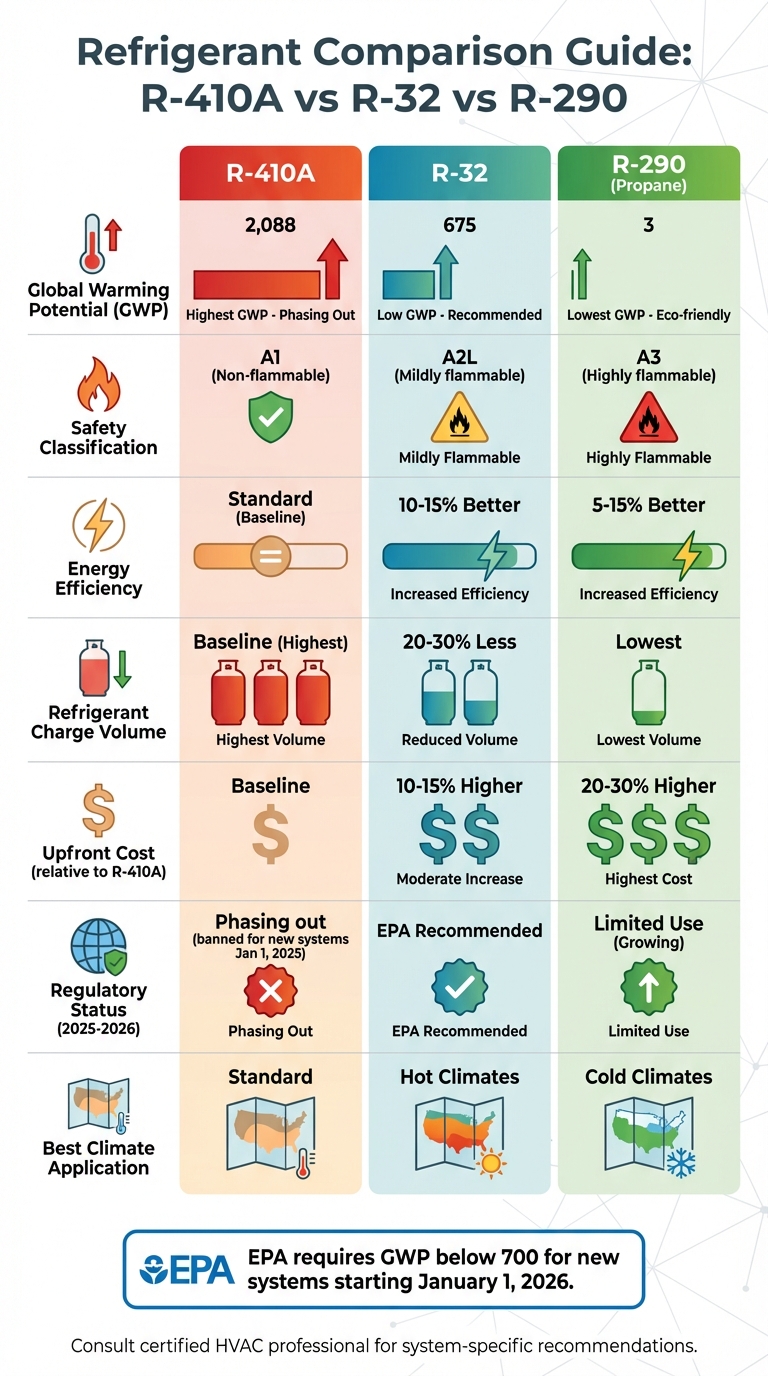
R-32 vs R-410A vs R-290 Refrigerant Comparison Chart
R-410A: The Current Standard Refrigerant
R-410A Properties and Applications
For over 20 years, R-410A has been the go-to refrigerant for residential air conditioning, commanding around 40% of the global refrigerant market as of 2023. It’s a 50/50 blend of R-32 and R-125, forming a near-azeotropic mixture that operates under 40% to 70% higher pressures compared to older R-22 systems. Its ASHRAE A1 safety classification ensures it is non-flammable and has low toxicity.
R-410A gained popularity because it has zero ozone depletion potential, making it the natural replacement for R-22 after chlorine-based refrigerants were phased out. It also improves heat transfer efficiency and supports higher SEER ratings, which can help reduce electricity usage. However, due to its high operating pressures and the need for synthetic POE oil as a lubricant, servicing should only be handled by EPA-certified technicians specializing in AC repair.
"R-410A is a perfectly good refrigerant, but there’s a new product on the market: R-32 coolant." – Allie Ogletree, Contributing Writer, Angi
The cost of a 25-pound container of R-410A ranges from $75 to $175, while installing a new R-410A system through professional cooling services can cost between $3,200 and $6,800. It’s crucial to note that R-410A should never be used in R-22 systems, as the higher pressures can lead to equipment failure. Despite its efficiency and heat transfer benefits, R-410A’s environmental impact has drawn significant regulatory attention, as outlined below.
Regulations Affecting R-410A
R-410A’s environmental footprint has led to strict regulations targeting its use. Under the American Innovation and Manufacturing (AIM) Act, there is a mandated 85% reduction in HFC consumption by 2036, with R-410A being a key focus due to its high global warming potential (GWP). Starting January 1, 2025, manufacturers must stop producing new residential and light commercial systems that use R-410A. Any systems produced before this deadline must be installed by January 1, 2026, to comply with EPA regulations.
Additionally, the EPA’s Technology Transitions Program bans refrigerants with a GWP above 700 in most new installations, effectively phasing out R-410A, which has a GWP of 2,088. While existing systems can still be serviced using reclaimed or stockpiled R-410A, homeowners should prepare for rising refrigerant costs – some forecasts suggest price increases of up to 50% as production quotas tighten. The risk of refrigerant leaks during maintenance further amplifies environmental concerns, driving the push toward safer, lower-GWP alternatives.
sbb-itb-b5c10b1
R-32: Improved Efficiency with Lower Environmental Impact
R-32 Efficiency and GWP Advantages
R-32 has positioned itself as a strong alternative to R-410A, largely due to its much lower global warming potential (GWP). With a GWP of just 675 – about one-third of R-410A’s 2,088 – R-32 offers a more environmentally friendly profile. Beyond its GWP advantage, R-32’s thermodynamic properties enable it to deliver 8% to 12% better energy efficiency compared to R-410A systems, while also transferring heat more effectively with a smaller refrigerant mass. This means systems using R-32 typically require 20% to 30% less refrigerant, which reduces both emissions from potential leaks and overall energy consumption.
For instance, Daikin U.S. Corp. shared in October 2020 that lab tests on rooftop systems with inverter-driven compressors showed efficiency gains of up to 12% when switching from R-410A to R-32. By March 2025, approximately 370 million R-32 air conditioning units were estimated to have been sold worldwide, cutting about 590 million tons of CO₂ emissions in total.
"R-32’s properties can help HVAC engineers design systems that have a lower greenhouse-gas emissions impact than R-410A. R-32 has greater latent heat capacity than R-410A, which means that R-32 systems could be designed to achieve the same capacity performance by circulating less refrigerant at a lower flow rate through the compressor."
– Anuj Mistry, Daikin U.S. Corp.
Another practical advantage of R-32 is that it is a single-component refrigerant, not a blend. This simplifies production, recycling, and reclamation processes. While R-32 systems may initially cost 10% to 15% more, the energy savings typically offset these costs within two years. However, proper safety measures are essential when designing and installing R-32 systems to maximize these benefits.
R-32 Safety Requirements
Unlike R-410A, which has a non-flammable A1 classification, R-32 is rated A2L, meaning it is mildly flammable. Its burning velocity is less than 10 cm/s, which prevents horizontal flame spread; flames tend to rise instead of spreading outward.
To address this, R-32 systems must use components certified as non-ignition sources. Technicians working with these systems should rely on spark-proof tools and A2L-compatible recovery machines equipped with brushless motors. In spaces where people are present, refrigerant detection systems are often required. These systems automatically activate ventilation or shut down operations if a leak is detected. Additionally, because R-32 operates at higher discharge temperatures than R-410A, certain design modifications – such as liquid injection technologies – may be necessary to protect the compressor.
"All installers of A2L systems will have to follow A2L safety precautions and procedures. R-32 should not be used in systems designed for R-410A."
– Nathan Walker, Senior Vice President, Goodman Manufacturing
It’s important to note that R-32 is not a direct replacement for R-410A. Systems must be specifically designed for R-32, with adjustments made to components like expansion valves, liquid line pipes, and solenoid valves. Installation teams must also be certified in A2L-specific safety practices, which include leak detection, emergency response, and safe brazing techniques. Proper training and adherence to safety protocols are essential for ensuring the safe and efficient use of R-32.
R-290: Low Environmental Impact with Safety Trade-offs
R-290 Environmental Benefits and Efficiency
R-290, also known as propane, stands out as the most environmentally friendly refrigerant among the three major options. With a Global Warming Potential (GWP) of just 3, it significantly outperforms R-32 (GWP 675) and R-410A (GWP 2,088) in minimizing climate impact. This natural hydrocarbon refrigerant also boasts zero ozone depletion potential and breaks down in the atmosphere within just a few weeks, preventing long-term environmental buildup.
In addition to its eco-friendly profile, R-290 delivers impressive energy performance. Systems using R-290 achieve 5% to 15% energy savings compared to R-410A, making it a cost-efficient choice over time. Its affordability is further enhanced by exemptions from environmental taxes that typically apply to high-GWP refrigerants. Adoption of R-290 has gained traction in Europe, where stricter F-Gas regulations spurred a 20% increase in heat pump installations by 2025.
Another advantage is its simplicity in system design. As a single-component refrigerant, R-290 eliminates glide issues, which can complicate the operation of multi-component blends. These qualities make R-290 an appealing option for energy-conscious applications. However, despite its environmental and efficiency benefits, safety concerns remain a major trade-off.
R-290 Safety Concerns and Restrictions
While R-290’s environmental credentials are impressive, its A3 classification indicates a high level of flammability, with a flash point of –104°C (–155°F). This characteristic limits its use to smaller systems and enforces strict charge limits – typically between 150 g (around 5.3 oz) and 500 g (about 17.6 oz), depending on the specific application and regional regulations.
"R290 adoption in European heat pumps rose 20% in 2025 due to F-Gas regulations. With proper safety measures, it’s as safe as your outdoor BBQ grill."
– Mark Thompson, European Heat Pump Association
Because of its flammability, R-290 is mainly used in small-charge, self-contained refrigeration systems like reach-in coolers, vending machines, and display cases. For residential use, manufacturers often opt for monobloc (packaged) designs, which place the refrigerant circuit outdoors to reduce indoor safety risks. These systems also require specialized components, such as leak detection sensors, explosion-proof electrical parts, and spark-proof tools. Additionally, technicians working with R-290 must hold certifications specific to handling A3 refrigerants.
These safety precautions contribute to higher upfront costs. On average, R-290 systems are 20% to 30% more expensive to install than R-410A systems. Despite these challenges, R-290 remains a compelling choice for applications where environmental impact and energy efficiency are top priorities.
Side-by-Side Comparison of R-32, R-410A, and R-290
Comparison Table
Here’s a quick breakdown of how R-410A, R-32, and R-290 stack up across various factors that matter to both homeowners and HVAC professionals:
| Feature | R-410A | R-32 | R-290 (Propane) |
|---|---|---|---|
| GWP | 2,088 | 675 | 3 |
| ODP | 0 | 0 | 0 |
| Safety Class | A1 (Non-flammable) | A2L (Mildly flammable) | A3 (Highly flammable) |
| Cooling SEER | 6.27 | 6.94 | 6.80 |
| Heating SCOP | 3.50 | 3.87 | 4.00 |
| Charge Volume | Baseline (highest) | 20–30% lower | Lowest |
| Optimal Climate | Standard | Hot | Cold |
| Upfront Cost (relative to R-410A) | Baseline | 10–15% more | 20–30% more |
| 2026 Regulatory Status | Phasing Out | Recommended | Growing Popularity |
Data sourced from industry research.
This table highlights some key distinctions, helping you make sense of the trade-offs between these refrigerants. For instance:
- Efficiency and Climate Suitability: R-32 stands out for cooling in hot climates, while R-290 shines in heating performance, especially in colder conditions. Both outperform R-410A in energy efficiency metrics like SEER and SCOP.
- Environmental Impact: R-290 is the clear leader with an ultra-low GWP of 3, making it far more eco-friendly than R-410A or even R-32.
- Cost Considerations: While R-32 typically costs 10–15% more upfront, its energy savings can balance out the initial expense. R-290, on the other hand, carries a higher premium (20–30% more), largely due to its stricter safety requirements.
R-410A, once a popular choice, is losing favor due to its high GWP and increasing regulatory restrictions. Maintenance costs are also climbing, with refrigerant repair prices up by about 50%, making it a less attractive long-term option.
"Modern safety systems make A2L and A3 refrigerants as safe as traditional options. The key is proper installation and maintenance by certified professionals." This is especially true when scheduling a professional HVAC installation for systems using newer refrigerants. – Jennifer Rodriguez, HVAC Safety Specialist
Ultimately, selecting the right HVAC system and refrigerant depends on your specific needs, including climate, energy efficiency goals, and budget.
Refrigerant Comparison: R290 vs. R32 vs. R410A
How to Choose the Right Refrigerant for Your System
Picking the right refrigerant hinges on several factors: local climate, the type of system, your budget, and current regulations. A poor choice can lead to higher costs, regulatory violations, or reduced system efficiency.
Start by looking at regulations, as they significantly narrow your options. For instance, starting January 1, 2026, the EPA will require most new residential and light commercial systems to use refrigerants with a GWP (Global Warming Potential) below 700. This change eliminates R-410A for new installations. Both R-32 (GWP 675) and R-290 (GWP 3) meet this requirement, but your final decision should depend on your climate and performance needs.
In warmer climates, R-32 delivers 10–20% better efficiency. On the other hand, R-290 performs better in colder environments but is typically restricted to smaller, self-contained units due to stricter safety regulations. These factors make it crucial to match the refrigerant to your system’s setup and your local weather conditions.
Budget also plays a big role. While R-32 systems cost 10–15% more upfront, they can lower electricity bills by 5–10% over time. R-290 systems, however, come with a higher initial investment – 20–30% more – because of their flammability rating and the additional safety measures required. Another important point: retrofitting existing R-410A systems is not an option. Both R-32 and R-290 are incompatible with R-410A hardware, meaning a complete system replacement is usually necessary. Given these complexities, consulting a professional is crucial.
Working with Certified HVAC Professionals
Because of the technical and safety challenges tied to these refrigerants, this isn’t something you can tackle on your own. Both R-32 and R-290 require specialized equipment, rigorous safety standards, and certified technicians to handle them.
"Modern safety systems make A2L and A3 refrigerants as safe as traditional options. The key is proper installation and maintenance by certified professionals." – Jennifer Rodriguez, HVAC Safety Specialist
For those in the Chicagoland area, Eco Temp HVAC provides certified installation and maintenance services for refrigerant systems. Their technicians can evaluate your home’s specific needs – considering factors like climate, system size, and local codes – to recommend the best solution. If your current R-410A system is 15 years or older, it’s worth getting a professional evaluation. This is especially true as R-410A prices have already increased by about 50% and are expected to climb further.
Conclusion
Shifts in environmental regulations and growing concerns about climate impact are driving changes in refrigerant options. R-410A, once the go-to refrigerant with a GWP of 2,088, is being phased out due to its environmental footprint. Alternatives like R-32, with a GWP of 675, offer better efficiency, while R-290, with an impressively low GWP of 3, remains limited to smaller systems due to flammability concerns.
The EPA’s AIM Act is a major force behind these changes, requiring an 85% reduction in high-GWP refrigerants by 2036. Starting January 1, 2026, most new residential HVAC systems will need to use refrigerants with a GWP below 700, effectively phasing out R-410A. This isn’t just about meeting legal requirements – it’s also about making smart investments. Maintenance costs for R-410A systems have already risen by about 50%, making them increasingly impractical. These developments highlight the importance of informed decision-making for both homeowners and industry professionals.
Selecting the right refrigerant isn’t a simple task – it requires careful consideration of technical specifications, safety protocols, and regulatory guidelines. For those in the Chicagoland area, Eco Temp HVAC offers certified technicians equipped with the latest training in A2L refrigerant protocols. Their team can assess your system’s needs using an HVAC maintenance checklist – factoring in local codes, system size, and regional climate – to recommend options that balance cost-effectiveness with environmental responsibility. This aligns with the earlier emphasis on the importance of A2L-certified expertise and system optimization.
Whether you’re upgrading an old system or installing a new one, transitioning to lower-GWP refrigerants is unavoidable. Partnering with certified professionals ensures your system operates safely, efficiently, and in compliance with evolving regulations – all while keeping long-term costs under control.
FAQs
Can I keep using my R-410A system after 2025?
Yes, you can keep using your R-410A system even after 2025. Although new systems will start using refrigerants like R-32 or R-454B to align with phasedown regulations, operating your current R-410A system will still be allowed.
Will an R-32 system raise my home insurance or code requirements?
Installing an R-32 system probably won’t affect your home insurance premiums or code requirements. Although R-32 has a mild flammability rating (A2L classification), it adheres to established safety standards and is deemed safe for residential applications. That said, certain safety procedures may need to be observed during installation to ensure compliance with regulations.
Is R-290 (propane) available for whole-home HVAC systems?
Yes, R-290 (propane) is becoming more common in residential HVAC systems, including heat pumps and air conditioners. However, since it is highly flammable, using it safely requires strict safety precautions and specific system adjustments to minimize risks.