
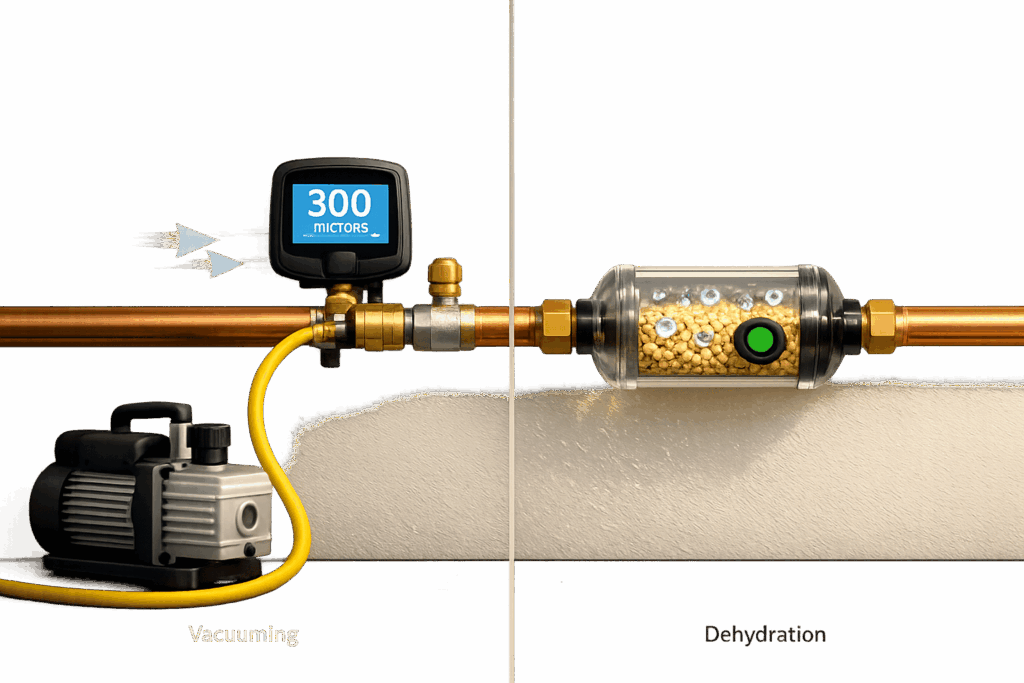
When preparing HVAC refrigerant lines, vacuuming and dehydration are two critical steps that serve distinct purposes. Vacuuming removes air and non-condensable gases by lowering system pressure, while dehydration focuses on eliminating moisture, which can cause corrosion, acid formation, and system failures.
Here’s the key takeaway: Vacuuming is a preliminary step to remove gases, and dehydration ensures all moisture is gone by reducing water’s boiling point, allowing it to vaporize. Both steps are essential for proper HVAC performance, preventing costly damage, and ensuring long-term reliability.
Quick Overview:
- Vacuuming: Removes air and gases; starts moisture removal below 1,000 microns.
- Dehydration: Eliminates moisture; effective below 500 microns.
- Why It Matters: Moisture leads to acid formation, corrosion, and ice blockages.
- Verification: Decay test ensures no moisture remains.
Both processes require precise tools and techniques, such as digital micron gauges, high-vacuum pumps, and Schrader core removal tools, to achieve optimal results.
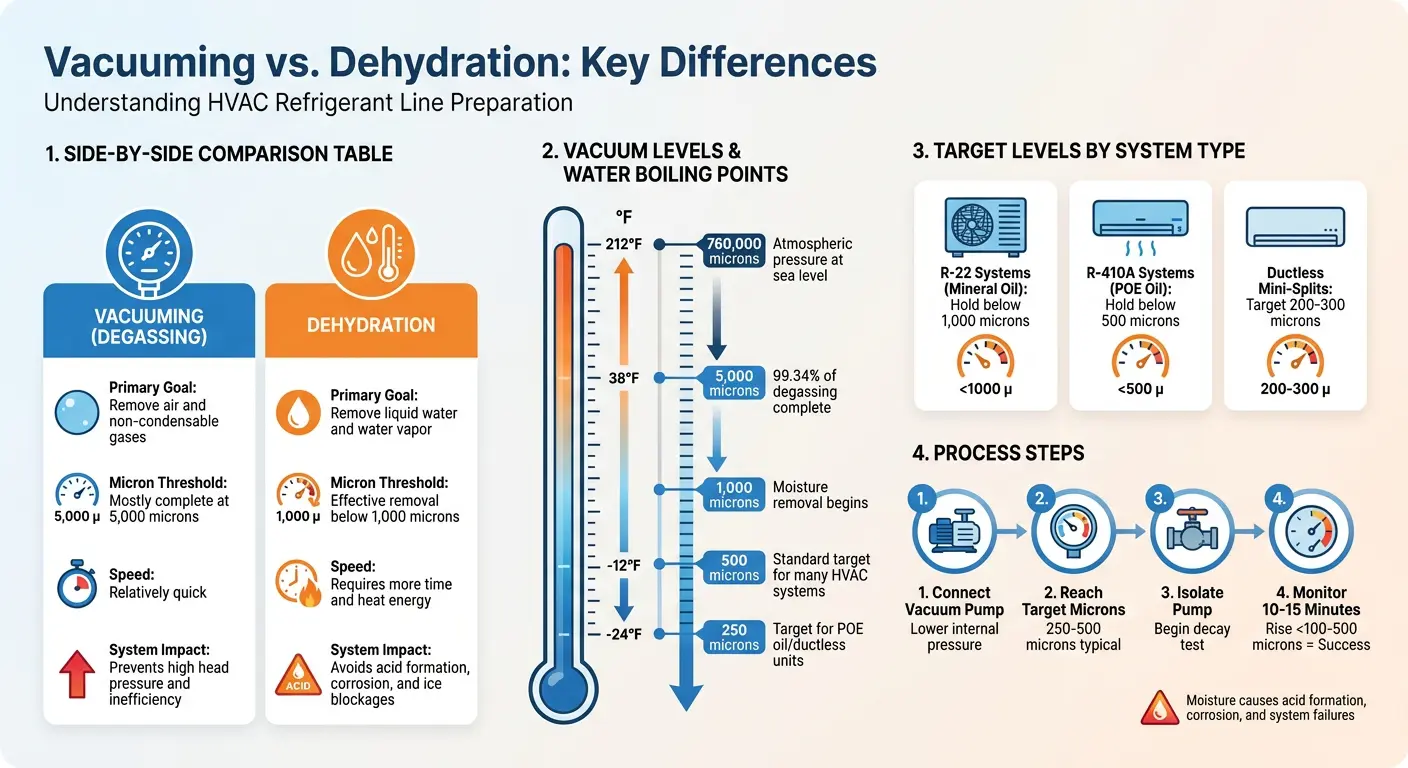
Refrigerant Line Vacuuming vs Dehydration: Process Comparison and Micron Levels
HVAC Full Vacuum Procedure From Start to Finish!
What is Refrigerant Line Vacuuming?
Refrigerant line vacuuming, also called evacuation, is the process of removing air, non-condensable gases, and moisture from HVAC systems before adding refrigerant. This step is crucial to ensure optimal system performance and avoids early failures.
The science behind it is simple: lowering pressure reduces water’s boiling point. At normal atmospheric pressure (14.7 psi), water boils at 212°F. But when a vacuum pump reduces the pressure inside refrigerant lines, water can boil at much lower temperatures – even below freezing. For instance, at 25,400 microns, water boils at about 80°F, while at 500 microns – a common target for HVAC systems – it boils at -12°F.
"A vacuum pump does not ‘suck out’ the liquid moisture, but rather causes it to boil into a vapor state which can be harmlessly removed from the system and exhausted through the vacuum pump." – Century Tool
This process serves two main purposes: removing gases and eliminating moisture. Significant moisture removal only begins when the vacuum drops below 1,000 microns. Typically, technicians aim for levels between 200 and 500 microns, with some manufacturers requiring levels below 300 microns to uphold warranties.
Skipping proper vacuuming can lead to serious issues. Residual moisture reacts with refrigerants to create hydrochloric and hydrofluoric acids, which corrode metal parts and damage copper surfaces. It can also mix with refrigerant oil, forming sludge that reduces lubrication and clogs components like strainers and capillary tubes. These problems can cause long-term damage, reduce the system’s lifespan, and void equipment warranties.
How Vacuuming Works
Vacuuming starts when a technician connects a high-vacuum pump to the refrigerant lines and reduces the internal pressure. As the pressure drops, water’s boiling point also decreases, causing any moisture to vaporize and exit the system through the pump.
Vacuum levels are measured in microns, with atmospheric pressure at sea level being approximately 760,000 microns and a perfect vacuum at 0 microns. Lower pressures allow moisture to evaporate more effectively, but achieving these levels requires proper technique and patience.
| Vacuum Level (Microns) | Boiling Point of Water (°F) | Significance |
|---|---|---|
| 760,000 | 212°F | Atmospheric pressure at sea level |
| 5,000 | 38°F | 99.34% of degassing complete |
| 500 | -12°F | Standard target for many HVAC systems |
| 250 | -24°F | Target for systems using POE oil/ductless units |
High-quality vacuum pumps feature a gas ballast, which helps release moisture without letting it condense into the pump oil. Technicians typically open the gas ballast at the start of evacuation when moisture levels are high and then close it around 2,000 microns to achieve a deeper vacuum.
Once the target vacuum is reached, the job isn’t over. A decay test is performed by isolating the pump and monitoring the system for 10–15 minutes. If the pressure rises by less than 100–500 microns, the system is confirmed to be dry and leak-free. As Jim Bergmann from MeasureQuick puts it:
"Pulling below 500 microns and being below 500 microns are two totally different things".
Achieving these vacuum levels requires the right tools and equipment, which play a critical role in the process.
Tools and Equipment Needed
To perform refrigerant line vacuuming effectively, technicians rely on specialized tools designed for creating and measuring deep vacuums. Standard manifold gauges used for refrigerant charging aren’t precise enough for this task.
The backbone of the process is a two-stage high-vacuum pump. When properly maintained, these pumps can reach vacuum levels as low as 5–30 microns. A digital micron gauge is used to verify pump performance; if the gauge doesn’t quickly drop to 50–100 microns, it’s time to change the pump oil.
Digital micron gauges are indispensable for accurately measuring deep vacuum levels. Unlike analog gauges, they provide real-time readings, ensuring precise control during the evacuation.
Using vacuum-rated hoses with larger diameters (3/8" or 1/2") significantly improves airflow and shortens evacuation time. Standard 1/4" hoses, designed for positive pressure, can collapse under vacuum and restrict flow. In fact, 1/2" hoses can cut evacuation time by up to 16 times compared to 1/4" hoses.
Schrader core removal tools are another key component. By removing these cores during evacuation, technicians can increase flow through service ports, cutting pump-down times in half. The cores are reinstalled after the decay test ensures the system is dry.
Additional tools include high-quality vacuum pump oil (which should be replaced regularly), thread sealants to prevent small leaks at connections, and dry nitrogen for triple evacuation procedures. In this method, the system is alternately evacuated and flushed with dry nitrogen to tackle stubborn moisture.
What is Refrigerant Line Dehydration?
Refrigerant line dehydration is the process of removing moisture from HVAC systems by reducing internal pressure until water turns into vapor. While vacuuming eliminates both air and moisture, dehydration focuses only on getting rid of water vapor and any leftover liquid. Below, we’ll explore how this process safeguards HVAC equipment and how technicians ensure all moisture is removed.
Here’s why the distinction matters: removing air and removing moisture happen at different rates. For instance, at 5,000 microns, about 99.34% of air is gone, but significant moisture removal doesn’t start until the vacuum drops below 1,000 microns.
At a vacuum level of 254 microns, water boils at -24°F. This means moisture can vaporize and be evacuated even in colder conditions. The vacuum pump plays a key role here by creating the low-pressure environment needed for this vaporization.
How Dehydration Protects HVAC Systems
Moisture left in refrigerant lines can cause serious damage to HVAC systems. Here’s how:
- Corrosion: Moisture reacts with refrigerants, forming hydrofluoric and hydrochloric acids that corrode metal parts.
- Sludge Formation: When moisture mixes with refrigeration oil, it creates sludge that clogs strainers and capillary tubes while also reducing lubrication.
- Freeze-Ups: Moisture can form ice crystals at expansion valves, which blocks refrigerant flow and halts the system.
"Moisture with oil forms sludge, and moisture with refrigerant forms hydrofluoric and hydrochloric acids. All of these can cause permanent damage to the refrigeration system." – Jim Bergmann, MeasureQuick
The process becomes even trickier when the pressure drops below the triple point of water, around 4,580 microns. At this stage, liquid water becomes unstable and may freeze. If ice forms, it must sublimate – go directly from solid to vapor – which takes much longer than evaporating liquid water. Pulling a vacuum too quickly on a wet system can actually make moisture removal harder.
Different systems have varying dehydration requirements. For instance, systems using mineral oil (like R-22) can hold at below 1,000 microns, but systems with POE oil (like R-410a), which is highly moisture-absorbent, need to hold at 500 microns or less. Once dehydration is complete, confirming that all moisture has been removed is crucial for system reliability.
How to Verify Moisture Removal
After dehydration, technicians must confirm that no moisture remains. The best way to do this is with an electronic micron gauge and a decay test, as analog manifold gauges can’t measure the deep vacuum levels required.
Here’s how it works: Once the vacuum reaches the target level (usually between 250 and 500 microns), the vacuum pump is isolated from the system. The pressure is then monitored for at least 10 minutes – adding an extra minute for each ton of system capacity. If the vacuum holds steady with less than a 100–500 micron rise during this time, the system is free of moisture. A significant rise in pressure before leveling off indicates that moisture is still evaporating.
"Pulling below 500 microns and being below 500 microns are two totally different things. A good vacuum rig coupled to a large pump can overpower the dehydration process, pulling below 500 but not removing the moisture, which simply takes time." – Jim Bergmann, MeasureQuick
In colder environments, technicians may apply external heat to system components during the decay test. If the micron reading spikes when heat is applied, it’s a sign that moisture is still present and being boiled off. For particularly tough cases, such as after a compressor burnout, the triple evacuation method is used. This involves alternating between vacuuming and purging with dry nitrogen to effectively remove any remaining moisture.
Main Differences Between Vacuuming and Dehydration
Vacuuming and dehydration are often mistaken for one another, but they serve very different purposes when preparing refrigerant lines. Understanding these differences is crucial for ensuring proper system functionality.
Differences in Purpose
Vacuuming – also called degassing or evacuation – is aimed at removing air and non-condensable gases like nitrogen and oxygen from refrigerant lines. Once the system reaches 5,000 microns, 99.34% of the air removal is complete. This step ensures the system operates efficiently by eliminating gases that could lead to high head pressure.
Dehydration, on the other hand, targets moisture removal, including liquid water and water vapor. Removing moisture is much harder because water molecules cling tightly to the system’s internal surfaces. As Jim Bergmann from MeasureQuick explains:
"At 5000 microns, 99.34% of the degassing has occurred, but the moisture removal is just beginning".
Effective dehydration doesn’t begin until the system is pulled down to below 1,000 microns.
Here’s a quick comparison:
| Feature | Vacuuming (Degassing) | Dehydration |
|---|---|---|
| Primary Goal | Remove air and non-condensable gases | Remove liquid water and water vapor |
| Micron Threshold | Mostly complete at 5,000 microns | Effective removal below 1,000 microns |
| Difficulty | Relatively quick | Requires more time and heat energy |
| System Impact | Prevents high head pressure and inefficiency | Avoids acid formation, corrosion, and ice blockages |
The differences in purpose naturally lead to variations in the processes used.
Differences in Process
The methods and tools for vacuuming and dehydration are distinct.
For vacuuming, technicians use standard vacuum pumps and manifold gauges, along with large-diameter hoses (3/8" or 1/2") and core removal tools. These tools maximize flow and allow the system to reach the target micron level quickly.
Dehydration, however, is more complex. It typically involves two-stage vacuum pumps with gas ballasts, digital micron gauges, and extended hold times. For systems with heavy contamination, the triple evacuation method is often employed. This alternates between vacuuming and nitrogen sweeps to help carry moisture out of the system. Systems using POE oil (common with R-410A refrigerants) must reach 250 microns and maintain a vacuum below 500 microns. For systems with mineral oil (like R-22), the target is below 1,000 microns.
Verification also differs between the two. With vacuuming, success is confirmed by reaching the target pressure. Dehydration, however, requires a decay test. This involves isolating the vacuum pump and monitoring the micron level for 15 minutes. A rise of less than 100–500 microns during this time indicates that moisture has been effectively removed.
When to Use Vacuuming vs. Dehydration
Understanding when to use vacuuming versus dehydration depends on the type of installation and the specific repair needs.
Evacuation involves a two-step process: first, removing atmospheric air (degassing), and then eliminating moisture (dehydration). The method varies depending on whether you’re dealing with a new system installation or servicing an existing one.
New Installation Requirements
For new refrigerant line installations, a full evacuation is essential to remove both air and any moisture introduced during assembly. Factory-supplied line sets often contain air or nitrogen, and moisture can easily enter through open connections during the installation process. Standard systems typically require technicians to pull the vacuum down to at least 500 microns, while ductless mini-splits often need targets between 200–300 microns to meet manufacturer warranties.
In new systems, the main focus is on degassing – removing the bulk of trapped air. Since these systems have minimal moisture contamination, dehydration primarily addresses trace amounts of moisture once a lower vacuum level is achieved. Using the right tools and equipment can make this process faster and more efficient.
Repair and Service Requirements
When a system is reopened, air and moisture can quickly contaminate the lines. This is especially problematic in systems using POE oil with R-410A refrigerant, as the oil strongly bonds with moisture. In these cases, a more extensive dehydration process is required. Technicians generally aim to complete dehydration at around 250 microns, ensuring decay holds below 500 microns.
For more complex repairs – such as compressor burnouts or systems exposed to prolonged contamination – the triple evacuation method is often used to thoroughly remove moisture.
"A proper evacuation may take 15 minutes, 15 hours, or 15 days. It simply takes what it takes".
These varying needs highlight the importance of tailoring the evacuation process to each situation, which is a key part of Eco Temp HVAC’s methodology.
Eco Temp HVAC‘s Approach

Accurate evacuation is critical for HVAC system performance and long-term reliability. Eco Temp HVAC ensures every installation and repair meets manufacturer specifications. Whether it’s installing a Mitsubishi ductless mini-split in Palatine or servicing an R-410A system in Downers Grove, their certified technicians use advanced tools like digital micron gauges and decay testing to confirm complete dehydration. Their Mitsubishi Diamond Elite Contractor certification also requires strict adherence to evacuation protocols, helping maintain the 12-year warranty.
Serving residential and commercial clients across Chicago, St. Charles, Bartlett, Lemont, Downers Grove, and Palatine, Eco Temp HVAC’s commitment to proper evacuation prevents premature system failures and promotes energy efficiency.
Conclusion
Understanding these processes is key to keeping your HVAC system running smoothly. Vacuuming is the mechanical process of lowering the system’s internal pressure to remove non-condensable gases, while dehydration is the result – removing moisture by encouraging it to vaporize under reduced pressure.
Getting rid of moisture is critical. If left inside the system, moisture can create sludge that clogs components and disrupts lubrication. Worse, when moisture reacts with refrigerant, it produces hydrofluoric and hydrochloric acids that corrode metal parts and damage compressor windings. As Jim Bergmann from MeasureQuick puts it:
"Moisture with oil forms sludge, and moisture with refrigerant forms hydrofluoric and hydrochloric acids. All of these can cause permanent damage to the refrigeration system".
Performing a decay test to confirm moisture removal is an essential step in maintaining system integrity. This detailed process not only prevents costly equipment failures but also helps uphold manufacturer warranties. In the long run, it ensures energy efficiency and dependable performance for your HVAC system.
The certified technicians at Eco Temp HVAC understand that proper evacuation takes time and precision. Whether they’re choosing and installing a new system in St. Charles or repairing one in Chicago, they rely on digital micron gauges and conduct decay tests to meet stringent dehydration standards. This attention to detail safeguards your investment and ensures your system operates efficiently for years to come.
FAQs
What vacuum level should my system reach in microns?
During the dehydration process, it’s important to achieve a vacuum level below 500 microns. This ensures that all moisture is thoroughly removed, which is key to keeping the system running efficiently and avoiding problems caused by leftover moisture.
How can I tell if a rising micron reading is a leak or moisture?
When the micron reading starts climbing, it could mean one of two things: either there’s a leak, or some leftover moisture is still in the system. To figure out which it is, try a decay test. Here’s how: hold the vacuum steady for 15 minutes and keep an eye on the micron level. If it remains stable between 100 and 500 microns, you’re likely in the clear – no leaks or lingering moisture to worry about.
When is triple evacuation with nitrogen really necessary?
When refrigerant systems are heavily contaminated or hold a lot of moisture, triple evacuation with nitrogen becomes essential. This method ensures thorough removal of non-condensables and moisture, which helps prevent problems like acid formation and sludge accumulation. It’s a critical step to safeguard the system’s components and ensure it operates efficiently under these challenging conditions.