
Refrigerant leaks in HVAC systems can lead to poor cooling, higher energy bills, and costly repairs. Early detection is crucial to prevent further damage and maintain efficiency. Look out for these common signs:
- Warm air from vents: AC runs but doesn’t cool effectively.
- Hissing or bubbling noises: Indicates refrigerant escaping.
- Frozen evaporator coils: Ice buildup due to low refrigerant levels.
- Higher indoor humidity: System struggles to remove moisture.
- Rising energy bills: AC works harder, consuming more electricity.
- Oily residue or stains: Visible signs of leaks in the system.
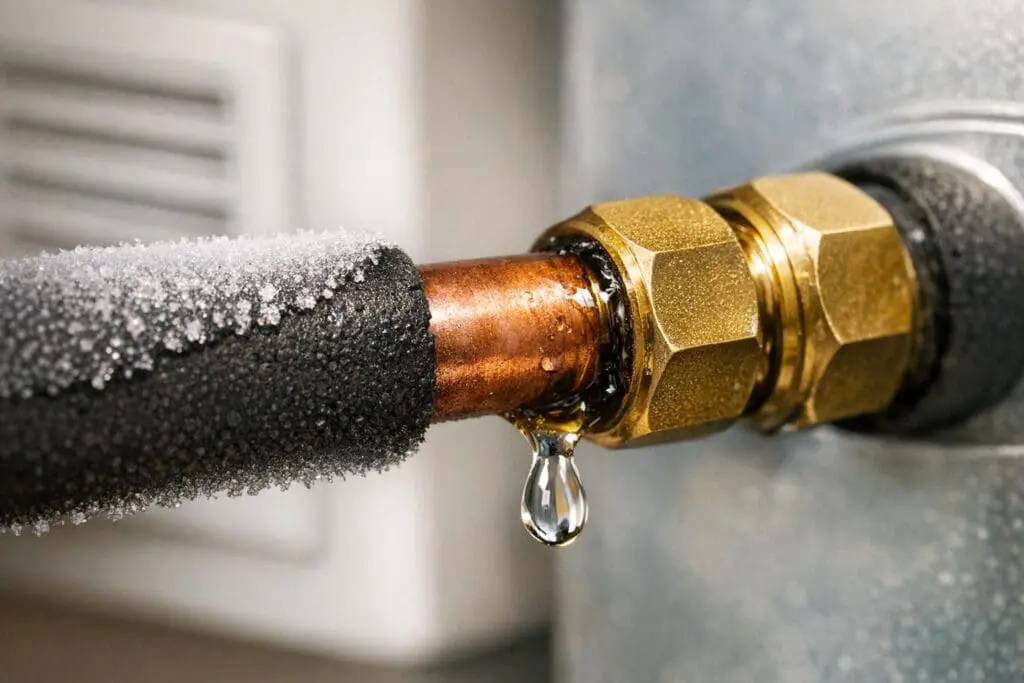
- Ice on refrigerant lines: Low pressure causes freezing.
- Frequent system cycling: AC runs constantly without cooling properly.
- Weak airflow from vents: Blocked coils reduce air circulation.
If you notice any of these issues, turn off your system immediately and contact a licensed technician for AC repair. Repairs typically range from $250 to $1,600, but ignoring the problem could lead to a full system replacement costing $3,900 to $8,000. Regular maintenance can help catch leaks early and save you money.
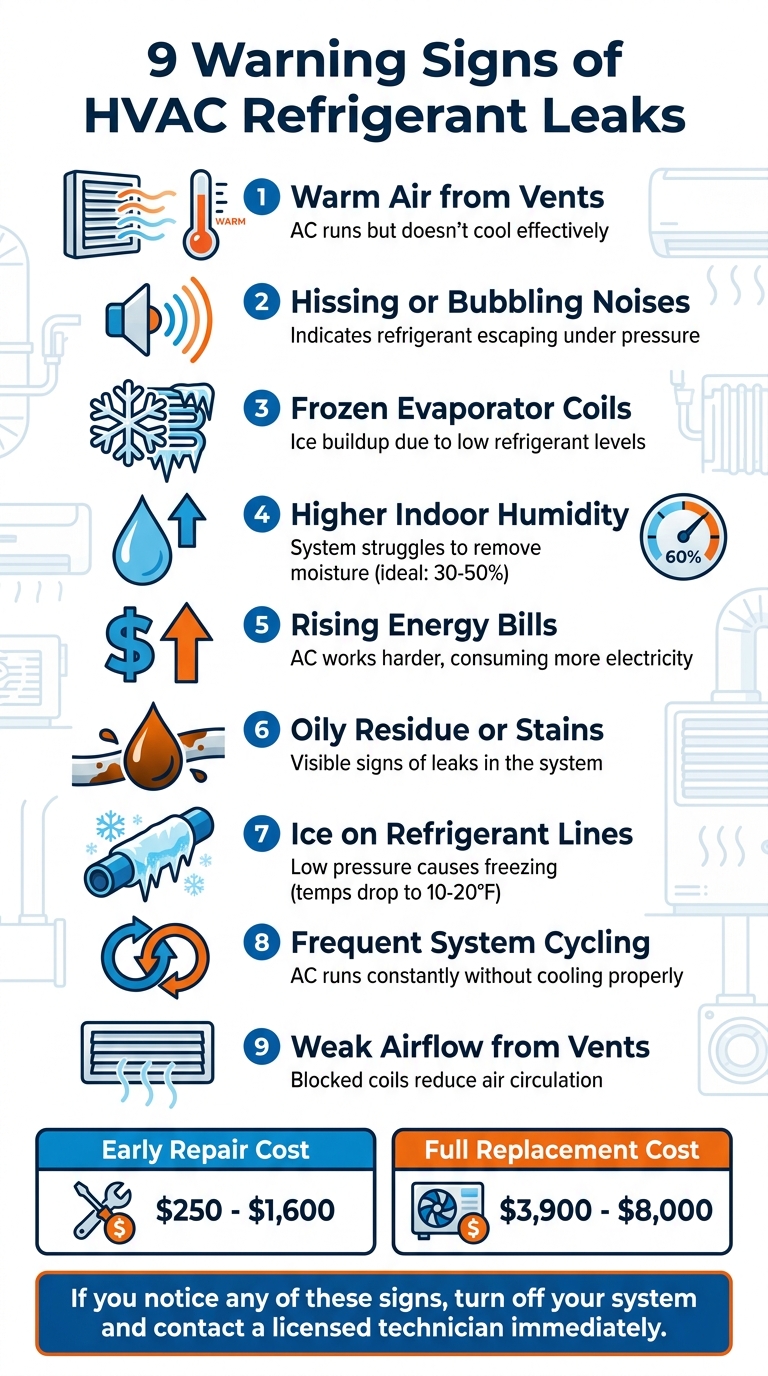
9 Warning Signs of HVAC Refrigerant Leaks
Where to Find R-22 & R-410A LEAKS on AC Units! Top 10 Spots!
sbb-itb-b5c10b1
1. Warm Air Coming from Vents
If your AC is running but only blowing warm air, a refrigerant leak could be the culprit. Refrigerant plays a crucial role in cooling by absorbing heat from inside your home and releasing it outdoors. Without enough refrigerant, your system simply can’t cool effectively.
"Without the refrigerant, there’s no way to remove heat from your home. The system might turn on and run. There will be air coming out of the vents. But the air won’t be cold at all." – Jason Peavey, Co-founder, PV Heating, Cooling & Plumbing
When refrigerant levels are too low, the evaporator coils can’t cool the air properly. This forces your AC to work overtime, running continuously as it struggles to reach the thermostat’s set temperature.
Before jumping to conclusions, check your air filter. A clogged filter can restrict airflow and mimic symptoms of a refrigerant issue. If the filter is clean but the warm air continues, turn off your AC immediately to avoid damaging the compressor. Avoid the temptation to add refrigerant yourself – this job requires a licensed professional who can safely locate leaks, seal them, and recharge the system.
Repair costs can vary widely, typically falling between $200 and $1,500. Systems using older, phased-out refrigerants like R-22 often come with higher repair expenses.
Next, keep an ear out for unusual noises that may signal a leak.
2. Hissing or Bubbling Noises
Strange noises coming from your HVAC system could mean trouble – specifically, a refrigerant leak. A hissing sound often points to refrigerant gas escaping under high pressure, typically through a small crack in the coils or refrigerant lines. On the other hand, bubbling noises might suggest a more serious leak or even air entering the system as refrigerant levels drop.
"There may be a hole or crack in the coils that the refrigerant runs through, which can produce a hissing sound when the system is running. A larger leak can produce a bubbling sound." – Justin Huntington, Director of Product Management – Indoor Cooling, Lennox
These noises are most commonly heard near the indoor air handler or the outdoor compressor. However, not every hissing sound means there’s a refrigerant issue. For instance, if the hissing lasts only 10–15 seconds during startup, it could simply be high internal compressor pressure, not a leak. Additionally, hissing near vents might indicate leaky ductwork instead. Either way, if the sounds persist, it’s best to have a professional perform HVAC services to diagnose the issue.
If you notice ongoing hissing or bubbling, turn off the system immediately. Running your HVAC with a refrigerant leak can overwork the compressor and potentially lead to a complete system failure. Repair costs for refrigerant leaks can range from $250 to $1,600, but if the damage is extensive, replacing the entire unit might set you back $3,900 to $8,000. Getting a professional diagnosis early can save you from more costly repairs down the line.
And remember – don’t try to add refrigerant yourself. Handling refrigerant isn’t a DIY job. Licensed technicians use tools like electronic probes, UV dyes, and nitrogen pressure tests to pinpoint even the smallest leaks safely and accurately.
3. Frozen Evaporator Coils
Seeing ice on your evaporator coils is a clear sign of trouble, often pointing to a refrigerant leak. These coils, located inside your air handler, are responsible for absorbing heat from your home’s air. When refrigerant levels drop due to a leak, the system’s pressure decreases, causing the refrigerant’s temperature to fall below 32°F. Instead of condensing and draining, moisture from the air freezes upon contact with the coils.
"Regardless of the root cause, a frozen coil always exhibits the same conditions – low pressure and low temperature in the evaporator." – Gary McCreadie, HVAC Tech and Creator, HVAC Know It All
As ice builds up, it creates a layer of insulation that prevents the coils from absorbing heat effectively. This leads to even more ice forming, compounding the problem. The growing ice layer not only reduces the system’s ability to cool your home but also blocks airflow through the coil. You might notice water pooling around your indoor unit as the ice melts, or see frost forming on the copper refrigerant lines connecting your indoor and outdoor units. This chain reaction of freezing can severely impact cooling efficiency and signal more significant system issues.
If you notice ice on the coils or refrigerant lines, turn off your system right away. Running it in this condition risks damaging the compressor. HVAC technician Tony Marino explains, "That ice build-up can crack the coil or surrounding parts. You end up with a burnt-out system and an angry technician bill". Replacing an evaporator coil can cost between $800 and $1,500. However, if the damage extends to the compressor, a full system replacement may be necessary, which could run you anywhere from $3,500 to $8,000.
If you’ve checked the air filter and it’s clean but the ice remains, it’s time to call a licensed technician. They can identify and seal the leak using tools like electronic detectors or UV dyes. Simply adding refrigerant without fixing the leak won’t solve the problem.
4. Higher Indoor Humidity
If your home feels damp or stuffy while your air conditioner is running, it could signal a refrigerant leak. Your HVAC system does more than just cool the air – it also removes moisture. It works by drawing warm indoor air over cold evaporator coils, where moisture condenses and drips into a drain pan to be expelled outside. But when refrigerant levels are low, the system struggles to cool the air enough for condensation to occur, leaving excess moisture in the air instead.
"When your system is low on refrigerant, it can’t remove heat and moisture from the air as effectively. That means your home might start to feel more like a sauna than a comfortable escape from the summer heat." – Morris-Jenkins
For a comfortable home, indoor humidity should stay between 30% and 50%. You can use a hygrometer to keep an eye on these levels. If humidity climbs above 50%, it can lead to mold, mildew, musty odors, and even health problems.
If you notice excessive humidity, inspect your thermostat, check your air filters, and look for ice or water around the indoor unit – these may point to low refrigerant. Fixing a refrigerant leak typically costs between $250 and $1,600. However, ignoring the issue could lead to severe damage, potentially requiring a full AC replacement or repair, which can cost anywhere from $3,900 to $8,000. If the problem persists, it’s best to call a licensed technician to identify and repair the leak.
5. Rising Energy Bills
An unexpected jump in your energy bills might signal a refrigerant leak. When your HVAC system is low on refrigerant, it struggles with heat exchange, forcing the unit to run longer to maintain your preferred temperature.
"When refrigerant levels drop, your AC has to work harder and run longer to reach the same temperature. That means more electricity is used for less cooling power." – Total Comfort
Lowering the thermostat in response only worsens the problem. The system, already under strain, is pushed even harder, which can further reduce cooling efficiency and drive up costs. This noticeable increase in your energy bill can serve as an early warning sign to investigate your system.
To spot this issue early, compare your current energy bill to the same month from the previous year. Look for unexplained increases, especially during the summer. If you suspect a leak, turn off your system to avoid damaging the compressor. Staying on top of routine maintenance and keeping a close eye on your energy usage can help you identify leaks before they cause bigger problems.
6. Oily Residue or Stains
Physical signs, like greasy spots or dark stains on your HVAC system, can point to a refrigerant leak. This happens because refrigerant and compressor oil circulate together in a sealed system, and a leak allows both to escape.
"Oil will also escape with the freon if leaking." – Charley L. Bottger
Oil residue on components is a clear indicator that your system might be struggling. Check areas such as copper refrigerant lines, condenser valves, and evaporator coils for oily patches. Since the system is sealed, any external oil presence strongly suggests a leak. While refrigerant gas itself is colorless and odorless, the oil it carries often provides the only visible clue.
To verify a leak, try a soap test: apply a dish soap solution to the suspected area. If bubbles form, it means pressurized gas is escaping. Clean the area and inspect it again after a few days – if the oily film returns, you’ve likely confirmed an active leak.
Be cautious, though. Don’t confuse oil stains with water droplets or flux residue from installation, which hardens into a shellac-like finish. If your system was recently serviced, leftover oil from gauges might be the culprit rather than an actual leak. If oil stains are confirmed, turn off your system immediately to prevent compressor damage and contact a professional for HVAC services in Crest Hill, IL.
7. Ice on Refrigerant Lines
Ice forming on refrigerant lines is a clear warning sign of refrigerant loss, which can escalate into serious system damage if left unchecked. When refrigerant leaks, it lowers the system’s internal pressure and temperature – sometimes dropping to 10–20°F. This extreme cold causes moisture to freeze on exposed surfaces, like the refrigerant lines, creating visible ice buildup.
"When refrigerant levels in your AC system decrease, the pressure inside your evaporator coil also decreases. The temperature in the coil drops in tandem… the chillier temperatures cause ice to form on the coil and lines." – Justin Stevens, Director of Field Operations, George Brazil HVAC
Ice often appears on the copper refrigerant lines leading to the outdoor unit. This layer of ice acts as a barrier, preventing the refrigerant from effectively absorbing heat. As a result, the system may start blowing warm air instead of cooling your home. In severe cases, the ice buildup can grow thick enough to damage key components permanently.
If you notice ice on your refrigerant lines, take immediate action. Turn your thermostat to "OFF" and set the fan to "ON" to promote air circulation, which can help melt the ice over the next 3 to 4 hours. Before assuming the worst, check your air filter – clogs can also lead to icing. If the ice persists, shut off your system entirely and contact a professional technician. Attempting to refill refrigerant on your own is not only illegal but also harmful to the environment unless the leak is properly repaired.
"Not enough refrigerant in the system can also lead to compressor failure, as the compressor needs to work harder to properly release heat from the refrigerant, which can lead to a total failure of your system." – Jarod Meyer, Content Manager, Mattioni Plumbing, Heating & Cooling
8. Frequent System Cycling
Low refrigerant levels can cause your HVAC system to cycle continuously without ever reaching the desired temperature.
As Jarod Meyer, Content Manager at Mattioni Plumbing, Heating & Cooling, explains:
"A system that is low on refrigerant will not be able to efficiently release heat from inside the home. You may also notice your system running more than normal…"
On particularly hot days – when outdoor temperatures climb above 80°F – even a small refrigerant leak (as little as 2 lbs) can force the system to run nonstop. This constant operation not only strains the compressor but also speeds up wear and tear on essential components, potentially leading to compressor failure and the need for a full system replacement.
Frequent cycling also impacts energy consumption. If you notice higher utility bills alongside constant cycling, a refrigerant leak could be the culprit. Start by checking the air filter to rule out blockages, but if the problem continues, turn off the system immediately and reach out to a certified technician for AC repair.
9. Weak Airflow from Vents
Another sign of a refrigerant leak is weak airflow coming from your vents.
When refrigerant levels drop, system pressure decreases. This leads to overcooling of the evaporator coils, which can cause ice to form and block airflow through the ducts.
As Cool Today explains:
"If those coils are frozen over, it basically blocks the air passing over the coils and into your duct system. This blockage results in a significantly weaker air flow."
Low refrigerant can also make the air coming from your vents feel warm. On top of that, it forces the system to work harder, putting extra strain on the compressor. Over time, this can cause serious damage and even lead to system failure.
If you notice weak airflow, check that your air filter isn’t clogged. Then, inspect the evaporator coils in the air handler for ice buildup. If the coils keep freezing, it’s a strong sign of a refrigerant leak.
If you suspect a leak, turn off your system immediately. Adding refrigerant yourself isn’t safe or legal – this job requires a licensed professional. Call a certified technician to perform a leak test, repair the issue, and recharge your system properly.
Get Professional Help from Eco Temp HVAC

Once you’ve spotted the warning signs of a refrigerant leak, getting professional help is no longer optional – it’s essential. Refrigerant leaks aren’t just a hassle; they’re a safety concern, an environmental issue, and even a legal matter. According to federal law, only EPA Section 608 certified technicians are allowed to handle refrigerants. These substances are tightly regulated because they pose serious risks to both health and the environment.
"Adding refrigerant without fixing the leak is unsafe and often illegal. It can harm the environment and pose health risks. Always leave this job to a licensed technician." – Total Comfort
Low refrigerant levels can do more than just reduce your system’s efficiency. They put extra strain on the compressor and can even cause health issues for those exposed, such as dizziness, nausea, or respiratory irritation. While professional repairs typically cost between $250 and $1,600, this is a fraction of the cost of replacing an entire system, which can run from $3,900 to $8,000.
To protect both your HVAC system and your family’s health, professional repairs are a must. Eco Temp HVAC specializes in diagnosing and repairing refrigerant leaks across the Chicagoland area. They’re available 24/7 for emergency services and boast certified technicians with credentials like Mitsubishi Diamond Elite Contractor and Navien Service Specialist. Whether you’re in Chicago, St. Charles, Bartlett, Lemont, Downers Grove, or Palatine, they offer quick and reliable service.
If you suspect a refrigerant leak, it’s important to act fast. Shut down your system and reach out to Eco Temp HVAC at ecotemphvac.com. Their team uses advanced tools to pinpoint leaks, repair any damage safely, and recharge your system to meet manufacturer standards. This approach not only safeguards your health and equipment but also helps protect the environment.
Conclusion
Refrigerant leaks only get worse over time. If you’ve noticed warm air blowing from your vents, hissing noises, frozen evaporator coils, or rising energy bills, these could all be signs that your system is losing the refrigerant it needs to keep your home cool. Ignoring these warning signs doesn’t just drive up utility costs – it can also put your compressor at risk of failure and even pose potential health risks.
Catching a refrigerant leak early can save you a lot of money. If you address the problem before it damages the compressor, repairs might cost anywhere from $200 to $1,500. But if you wait until the system fails entirely, you could be looking at a replacement bill between $3,900 and $8,000. Scheduling regular annual maintenance is a simple way to spot small issues before they turn into costly emergencies. Acting quickly when problems arise can make all the difference.
Keep in mind that refrigerants are regulated substances, and only EPA-certified professionals are authorized to handle them legally and safely. If you suspect a leak, it’s essential to shut off your system and contact a licensed technician immediately.
Eco Temp HVAC is here to help. Serving the entire Chicagoland area, their certified technicians are available 24/7 for emergency repairs. Using advanced leak detection tools, they’ll pinpoint the issue, fix it correctly, and recharge your system to meet manufacturer standards. Don’t let a small leak turn into a big problem – visit ecotemphvac.com today to schedule an inspection and protect your system.
FAQs
Is it safe to stay in the house if my AC is leaking refrigerant?
No, staying in the house when your AC is leaking refrigerant is not safe. Breathing in refrigerant gases can cause health problems such as headaches, dizziness, and trouble with breathing. These risks are even higher for children and pets. It’s crucial to fix the leak as soon as possible to keep everyone safe.
Can a dirty air filter cause the same symptoms as a refrigerant leak?
A dirty air filter can indeed lead to similar issues, such as lower cooling performance and added stress on your HVAC system. However, these are distinct problems. A dirty filter blocks airflow, while a refrigerant leak reduces the system’s ability to cool effectively because of low refrigerant levels. Both situations need to be addressed promptly to keep your HVAC system running smoothly and efficiently.
How do technicians find the leak before recharging refrigerant?
Technicians use a step-by-step approach to identify refrigerant leaks. They begin by examining pressure readings and conducting a superheat or subcooling analysis to verify if a leak might exist. If a leak is suspected, they employ techniques such as visual inspections to spot oil residue or frost buildup, electronic leak detectors, or UV dye kits to pinpoint the problem area. For further accuracy, tools like soap bubble tests or tracer gas testing are often utilized to confirm the exact location of the leak.