
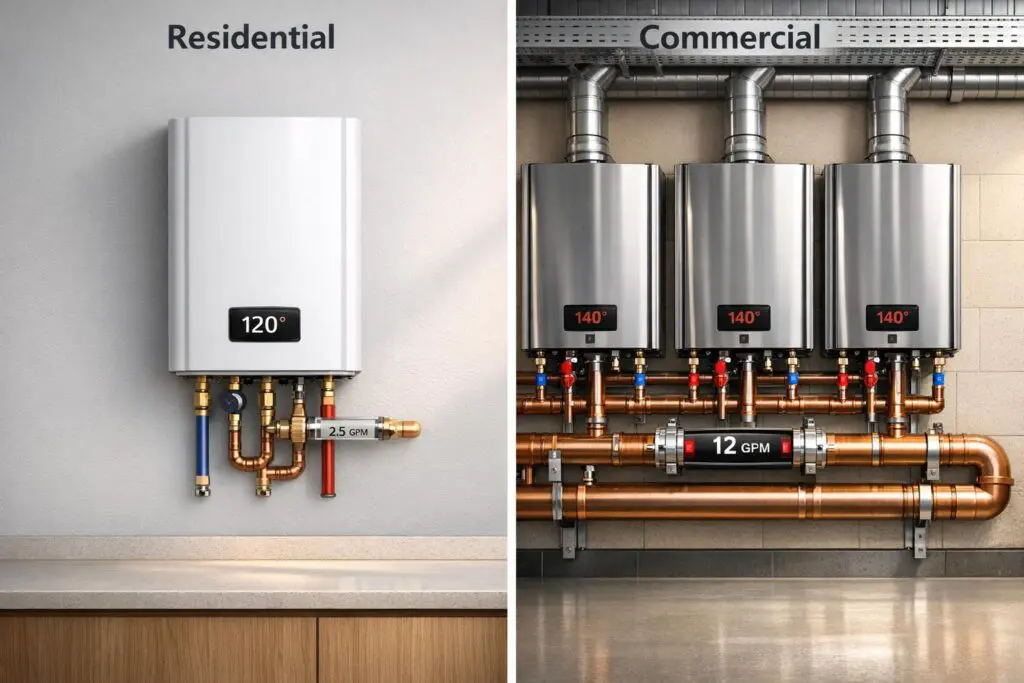
When choosing a tankless water heater, size matters – both for homes and businesses. Residential systems focus on meeting simultaneous usage needs like showers and dishwashers, while commercial systems handle much higher demand, such as in hotels or restaurants. Proper sizing ensures consistent hot water, energy efficiency, and avoids costly mistakes like undersized or oversized units.
Key Takeaways:
- Residential Systems: Typically require 3.0–4.0 GPM, with occasional spikes up to 6.0–8.0 GPM. Focus on peak usage, like multiple fixtures running at once.
- Commercial Systems: Must handle heavy, simultaneous demand. Often exceed 15 GPM using cascaded units or storage tanks.
- Temperature Rise: Affects sizing; colder climates require larger units to heat water effectively.
- Fuel Type: Gas systems provide higher flow rates and temperature rises compared to electric models.
Quick Comparison:
| Feature | Residential Tankless | Commercial Tankless |
|---|---|---|
| Flow Rate | 3–10 GPM | 15+ GPM (system total) |
| BTU Rating | Lower (household use) | ≥ 4,000 BTU/h per gallon |
| Configuration | Single unit | Multiple units, storage tanks |
| Primary Factor | Fixture GPM, temp rise | Peak demand, industrial load |
Proper sizing avoids issues like cold showers in homes or failing sanitation standards in businesses. For precise sizing, calculate flow rate, temperature rise, and consider factors like local groundwater temperatures and hard water.
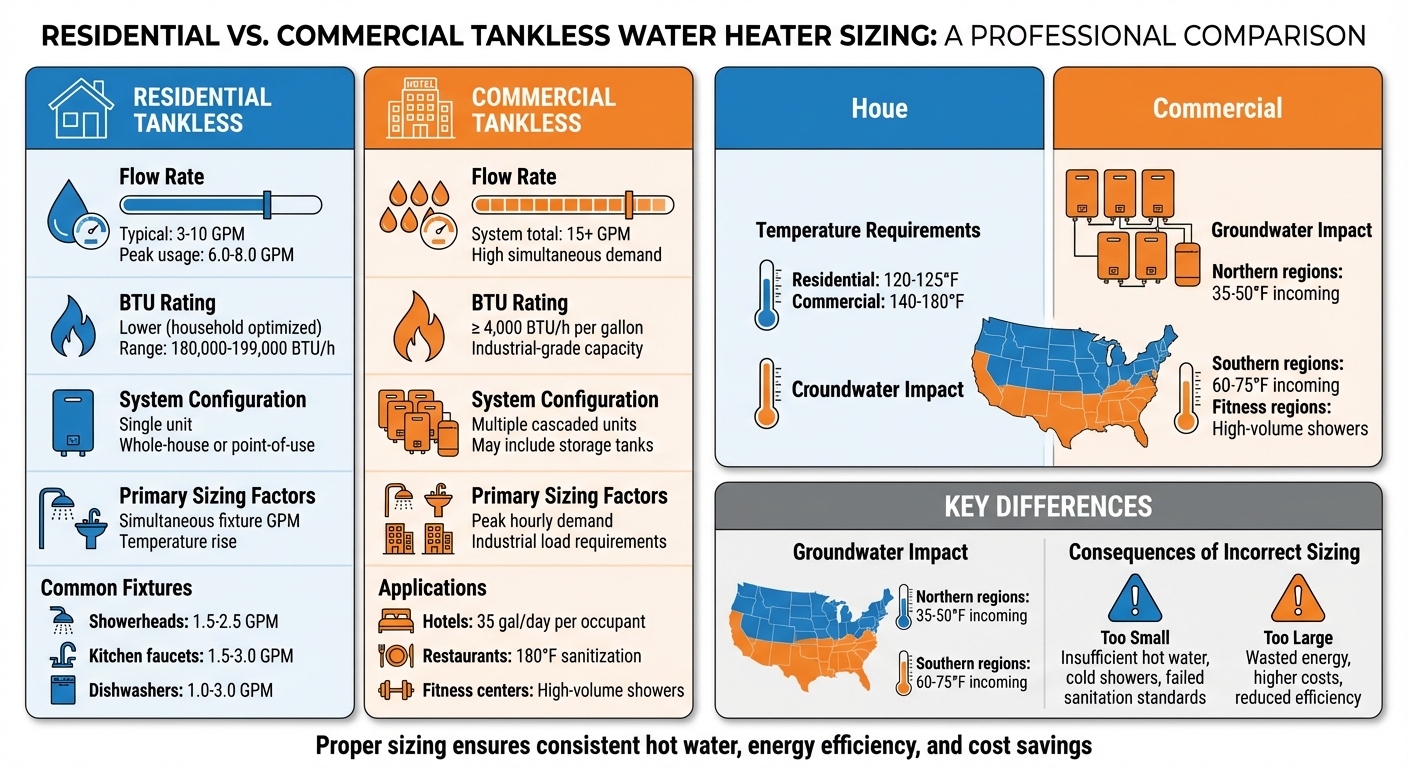
Residential vs Commercial Tankless Water Heater Sizing Comparison Chart
How to Size a Tankless Water Heater (Step-by-Step Guide + FREE Calculator)
sbb-itb-b5c10b1
How Tankless Water Heater Sizing Works
Tankless water heaters operate differently from traditional tank-style systems. Instead of storing hot water, they heat it on demand. Their sizing is based on two main factors: flow rate (measured in gallons per minute, or GPM) and temperature rise (the difference between the incoming water temperature and the desired hot water temperature).
The math behind sizing is consistent for both residential and commercial systems, though the demands differ. Residential systems typically require around 5 GPM, while commercial setups often need much higher flow rates. Gas-powered units measure their heating capacity in BTU/h (British Thermal Units per hour). Higher BTU ratings allow the unit to handle greater flow rates and higher temperature rises. To estimate the heating capacity needed, the formula is: BTU/h ≈ 500 × GPM × ΔT.
Calculating Flow Rate Requirements
To determine the flow rate you need, consider the fixtures that will run simultaneously during peak usage. For a typical home, this might include two showers, a kitchen faucet, and a dishwasher. Add up the flow rates for each fixture:
- Standard showerhead: 1.5 to 2.5 GPM
- Kitchen faucet: 1.5 to 2.2 GPM
- Dishwasher: 1.0 to 2.0 GPM
If all these are running at once, the total flow rate could range from about 5.5 to 9.2 GPM.
For most homes, peak flow rates usually fall between 3.0 and 4.0 GPM, though occasional spikes can reach 6.0 to 8.0 GPM. Commercial systems, however, often exceed these numbers. To handle such high demand, many businesses use cascading systems, which activate additional units as needed. For example, a second heater might kick in when the first unit reaches 80% of its capacity.
Once you know the flow rate, the next step is to factor in the temperature rise and regional water temperature variations.
Temperature Rise and Regional Differences
The temperature rise is the difference between the incoming water temperature and the desired output temperature. For instance, if you want water at 120°F and your incoming water is 50°F, the required temperature rise is 70°F. Groundwater temperatures vary widely, from 35°F in colder northern areas to 75°F in warmer southern regions.
This variation plays a big role in sizing. A unit capable of delivering 5 GPM at a 70°F rise may only manage 3.5 GPM if the temperature rise increases to 100°F. So, a household in a colder state like Iowa may need a unit rated for 10 GPM, while a similar home in Florida might only require 7 GPM.
Commercial systems face even greater challenges since they often need to produce water at 140°F to 180°F for sanitization, compared to the 120°F to 125°F typical in homes. For year-round reliability, always calculate based on the coldest groundwater temperatures expected during winter .
These factors form the foundation for sizing both residential and commercial tankless water heaters, as explored in the next sections.
Sizing Residential Tankless Water Heaters
Residential tankless water heaters are designed to meet the water needs of typical households, where usage patterns tend to be more predictable than in commercial settings. Most homes require a unit that can handle 3.0 to 4.0 GPM during peak usage, with occasional spikes reaching 6.0 to 8.0 GPM. The key is to focus on your realistic peak demand – how many fixtures you’ll actually use at the same time – instead of adding up the flow rates for every fixture in the house. Once you’ve identified this scenario, calculate the total demand by summing the flow rates of those specific fixtures.
Flow Rates for Common Household Fixtures
To figure out your household’s hot water needs, it’s important to understand the flow rates of individual fixtures. Here’s a quick breakdown:
- Showerheads: 1.5 to 2.5 GPM
- Bathroom faucets: 0.5 to 1.5 GPM
- Kitchen faucets: 1.5 to 3.0 GPM
- Dishwashers: 1.0 to 3.0 GPM
- Clothes washers: 1.5 to 6.0 GPM
- Bathtub fills: 1.0 to 6.0 GPM
If you’re unsure about a fixture’s flow rate, you can measure it by running water into a bucket for one minute and noting the volume. Add up the flow rates of all the fixtures you’ll use at the same time to determine your total water demand.
Estimating Total GPM for Multiple Fixtures
When estimating peak water usage, sum the flow rates of fixtures that might run simultaneously. Here’s a general guide:
- 1 to 2 fixtures: Around 3.5 GPM
- 2 to 3 fixtures: About 5.0 GPM
- 3 to 4 fixtures: Approximately 7.0 GPM
For example, a family of three or four might use two showers at the same time, with a sink running intermittently. This scenario would require around 5.0 to 7.0 GPM.
"If your water heater is too small, your home won’t have enough hot water to meet demand, which is an obvious inconvenience, and overloading the unit may cause premature wear and tear."
– Navien Inc.
It’s also important not to oversize your water heater. A unit that’s too large is unlikely to operate at full capacity and will cost more upfront without providing additional benefits.
How Groundwater Temperature Affects Sizing
Flow rates aren’t the only factor to consider – groundwater temperature plays a big role in determining the right size for your tankless water heater. Colder incoming water requires the heater to work harder to reach the desired temperature. In northern regions, groundwater temperatures typically range from 35°F to 50°F, while in southern areas, they’re usually between 60°F and 75°F.
For instance, a family of five in a northern state might need a unit capable of delivering 10 GPM to handle the colder water, whereas the same family in a southern state could get by with a 7 GPM unit because the incoming water is warmer.
To estimate your local groundwater temperature, hold a thermometer under a cold-water faucet for one minute. For colder climates, gas-fired units with outputs between 180,000 and 199,000 BTU/h are generally recommended to meet simultaneous demand.
Sizing Commercial Tankless Water Heaters
Sizing a commercial tankless water heater is a bit more intricate than sizing one for a home. Why? Because commercial facilities – like hotels, restaurants, and apartment buildings – often face constant, simultaneous demand for hot water. Unlike a household where people might stagger showers or wait to run the dishwasher, commercial systems need to deliver hot water to multiple users at once. This means the system must handle the peak simultaneous demand – the maximum number of gallons needed when all fixtures are in use at the same time.
Meeting Peak Demand in Commercial Buildings
When determining the right size for a commercial system, two key factors come into play: storage capacity (how much hot water is immediately available) and input power (measured in BTU/hr), which affects the recovery rate. For instance, a gas-fired unit with an input of 199,000 BTU can produce roughly 193 gallons of hot water per hour at a 100°F temperature rise. This calculation assumes heating 40°F groundwater to a set temperature of 140°F.
Different industries have unique hot water needs. Restaurants, for example, require water heated to 180°F for dishwashing to meet sanitization standards. Hotels often experience a surge in demand during morning shower times, while apartment buildings see peak usage in the evening. Fitness centers, on the other hand, deal with high-volume demand after work hours.
"Size too small and you won’t have enough hot water to run your business, especially during peak operating times. But size too large and you’ll end up spending excess money in both upfront capital and long-term operating costs." – Reliable Water Services
Here’s a quick look at how demand varies by industry:
| Industry | Peak Demand Timing | Key Fixture Requirements |
|---|---|---|
| Restaurants | Dinner rush | 180°F sanitizing water, prep sinks, bar sinks, mop sinks |
| Hotels | Morning (6:30 AM) | Multiple showers, hot tubs, pools, lobby restrooms |
| Apartments | Evening (6:00 PM) | Simultaneous showers, laundry machines |
| Fitness Centers | After-work hours | High-volume showers, steam rooms, pools, hot tubs |
To meet these demands effectively, many systems rely on Navien condensing tankless water heaters and boilers working together – a concept explored in the next section.
Using Multiple Units and Cascading Systems
In commercial setups, it’s common to install multiple smaller units connected in parallel. This approach, known as a cascading system, offers several benefits. It ensures redundancy, meaning if one unit goes offline, the others can keep things running. It also extends the lifespan of the equipment by distributing the workload evenly. However, space constraints in boiler rooms and the capacity of existing venting systems may limit how many units can be installed.
This type of configuration is particularly useful for industries with varying and demanding hot water needs, which we’ll dive into shortly.
Industry-Specific Sizing Requirements
Different industries have distinct hot water requirements. For example, salons need hot water for hairdresser sinks, spa baths, pedicure stations, and hot towel treatments. Restaurants often use a two-heater system: one for general hot water needs and another "booster" heater to reach the 180°F required for dishwashing sanitization. When replacing an existing unit, it’s essential to reassess fixture counts and peak demand to ensure the new system meets current needs. Tools like manufacturer-specific calculators and consultations with local experts can help fine-tune these calculations.
Geography also plays a role. Recovery rates are typically based on a 100°F water temperature rise, but actual needs depend on local groundwater temperatures. For high-demand applications, gas-fired systems are often the go-to choice. Doubling the BTU input of a gas unit nearly doubles its recovery rate, while doubling the kilowatts of an electric unit only increases recovery by about 1.75 times.
Commercial systems require more capacity and flexibility compared to residential setups. They’re designed to handle the heavy, simultaneous usage that comes with running a business efficiently.
Residential vs. Commercial Sizing Requirements
Side-by-Side Comparison
When it comes to sizing water heating systems, residential and commercial setups differ significantly. Residential units are built for lighter, intermittent use – think morning showers and evening dishwashing – and typically manage a flow rate of 6–10 GPM. These systems have lower BTU ratings tailored for household fixtures.
On the other hand, commercial systems are designed for heavy, continuous demand. They often rely on cascaded units paired with storage tanks to handle peak loads. According to the Department of Energy, commercial water heaters must have an input rating of at least 4,000 BTU per hour per gallon of stored water. With flow rates exceeding 15 GPM, these systems can meet the needs of high-demand environments, such as restaurants or hotels, by combining multiple units in a cascading setup.
| Feature | Residential Tankless | Commercial Tankless |
|---|---|---|
| Typical Flow Rate | 2–10 GPM | 15+ GPM (system total) |
| BTU Rating | Lower (household optimized) | ≥ 4,000 BTU/h per gallon |
| System Configuration | Single unit; whole-house or point-of-use | Multiple units; may include storage tanks |
| Primary Sizing Factor | Simultaneous fixture GPM and temperature rise | Peak hourly demand and industrial load |
| Fuel Sources | Gas, electric | Gas, electric, oil-fired |
These differences make it clear why proper sizing is so important – choosing the wrong system can lead to major issues.
Problems with Incorrect Sizing
Using a water heater that’s too small for a residential setup can quickly cause problems. For example, if a shower running at 2.5 GPM and a faucet using 0.75 GPM are active simultaneously, but the system is only rated for 2 GPM, you’ll experience cooler water at the fixtures.
On the flip side, oversizing a residential unit can be a waste of money. You’ll pay for heating capacity that isn’t fully utilized, and efficiency may drop over time. In commercial settings, under-sizing is even riskier. It can result in failing to meet health and sanitation standards, especially in places where dishwashers require water temperatures around 140°F. When water moves too quickly through the system, there’s less time for it to heat properly, leading to performance issues if flow rates exceed the unit’s capacity for the desired temperature rise.
Eco Temp HVAC: Tankless Water Heater Sizing in Chicagoland
Navien Service Specialist Certification
In Chicagoland, where water temperatures can swing drastically with the seasons, accurate sizing for tankless water heaters is crucial. Eco Temp HVAC’s Navien Service Specialist certification equips their technicians with the expertise to use NaviSizer, a tool designed to calculate precise BTU/h and GPM requirements. This process considers factors like the number of household members, bathrooms, fuel type, and, most importantly for Chicagoland, local groundwater temperatures. Since winter temperatures can drop significantly, sizing calculations are based on the coldest days to ensure reliable hot water supply even during the harshest months.
For commercial properties with higher demands, certified specialists can design cascading systems. In these setups, an additional unit activates once the primary system hits 80% capacity, ensuring uninterrupted performance during peak usage. This specialized certification allows Eco Temp HVAC to tackle the unique challenges of the Chicagoland climate while delivering systems that perform consistently all year.
Service Areas Across Chicagoland
Eco Temp HVAC provides service throughout Chicagoland, covering areas like Chicago, St. Charles, Bartlett, Lemont, Downers Grove, and Palatine. Their wide reach ensures quick, localized assistance for both residential and commercial installations. Thanks to their deep understanding of the region, they can customize each installation to meet specific needs, whether for a home or a business. With 24/7 availability, Eco Temp HVAC is ready to assist with emergency hot water issues or system sizing consultations, making them a reliable option when unexpected problems arise.
Guaranteed Customer Satisfaction
Eco Temp HVAC prioritizes proper sizing and efficient operation for every tankless water heater installation. Their certified technicians ensure systems are tailored to meet the specific demands of each property. For instance, a single-family home might need 5 GPM to handle multiple fixtures at once, while a commercial property could require cascaded units to manage heavy, consistent usage. Accurate sizing not only ensures better performance but also minimizes downtime, highlighting the importance of getting the details right from the start. By focusing on energy efficiency and reliability, Eco Temp HVAC delivers solutions that keep customers satisfied and systems running smoothly.
Conclusion
Sizing tankless water heaters for residential and commercial use follows distinct principles. Residential systems are tailored for intermittent household use, handling lower flow rates. On the other hand, commercial systems must manage much higher demands – such as up to 35 gallons per day per occupant in hotels – and are equipped with 316L stainless steel heat exchangers built to endure millions of thermal cycles.
The differences don’t stop there. Commercial units exceeding 200,000 BTU/hr require ASME HLW certifications and masterless controls to ensure system integrity and avoid failure. Attempting to use a residential unit in a commercial setting often results in poor performance and system inadequacy.
Proper sizing is crucial for both reliability and cost efficiency. Undersized systems struggle to maintain consistent temperatures during peak demand, while oversized units consume unnecessary energy and lead to higher upfront costs. For instance, gas-fired tankless heaters can achieve a 70°F temperature rise at a flow rate of 5 GPM.
"A properly sized water heater will meet your household’s hot water needs while operating more efficiently." – Department of Energy
To ensure your water heater meets both immediate and long-term needs, expert guidance is essential. Certified professionals, like Eco Temp HVAC, bring specialized knowledge, including Navien Service Specialist certification and experience with cascading systems, to deliver reliable and efficient installations throughout Chicagoland.
FAQs
How do I find my home’s true peak hot-water GPM?
To figure out your home’s peak hot-water GPM (gallons per minute), start by adding up the flow rates of all the fixtures that might be used at the same time – like showers, faucets, and appliances. Next, calculate the temperature rise by subtracting your region’s groundwater temperature from your desired hot water temperature (usually around 120°F). These two numbers together will help you decide the maximum flow rate your tankless water heater needs to manage effectively.
What temperature rise should I size for in winter?
In the winter months, plan for a temperature increase of about 70°F when sizing your tankless water heater. For instance, if the incoming groundwater temperature is 37°F, a 70°F rise will deliver water at roughly 107°F – just right for typical household use. This method ensures you get a good mix of hot water flow and efficiency without going overboard on capacity.
When do I need a cascaded commercial tankless system?
When a single tankless water heater can’t keep up with high hot water demands – like in hotels, hospitals, or industrial facilities – a cascaded commercial tankless system becomes essential. By linking multiple units together, these systems can handle flow rates reaching several hundred gallons per minute. This ensures a steady and dependable hot water supply, even during peak usage times, making it perfect for large-scale operations that need continuous, high-volume hot water.