
When your HVAC system stops working or starts breaking down repeatedly, the question is always the same:
Should you repair it, or is it time to replace it?
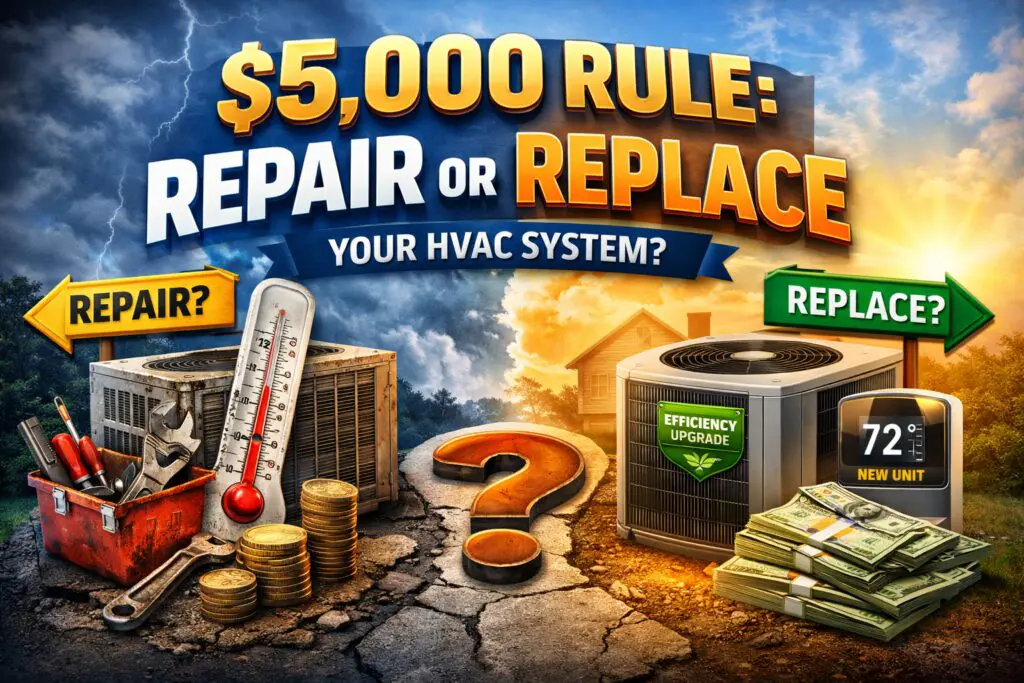
One common guideline homeowners hear about is the $5,000 rule for HVAC. It is a simple formula designed to help decide when repairs stop making financial sense. While the rule can be helpful, it is often misunderstood and, in many cases, outdated.
Below, we explain how the $5,000 rule actually works, when it applies, when it does not, and how HVAC professionals truly evaluate whether repair or replacement is the smarter long-term move.
What Is the $5,000 Rule for HVAC?
The $5,000 rule is a basic calculation used to compare the cost of repairing an HVAC system versus replacing it.
Here is how it works:
-
Multiply the age of your HVAC system by the cost of the repair
-
If the result is greater than $5,000, replacement is usually the better long-term option
Example
If your system is 12 years old and the repair estimate is $500:
12 × 500 = $6,000
In this case, replacing the system may be more cost-effective than continuing to repair aging equipment.
The logic behind the rule is simple.
Older systems are closer to the end of their lifespan, and large repair bills often delay an inevitable replacement rather than prevent it.
How the $5,000 Rule Works in Real Life
Here is how the rule looks when applied to common situations homeowners face:
-
8-year-old system + $400 repair
8 × 400 = $3,200
→ Repair usually makes sense -
12-year-old system + $600 repair
12 × 600 = $7,200
→ Replacement should be strongly considered -
15-year-old system + $300 repair
15 × 300 = $4,500
→ Borderline case where other factors matter more
This is why the $5,000 rule should be treated as a starting point, not a final decision-making tool.
Why the $5,000 Rule Is No Longer Enough
The biggest issue with the $5,000 rule is that it was created when:
-
HVAC equipment was cheaper
-
Efficiency standards were lower
-
Repair labor costs were lower
Those assumptions no longer hold true.
Modern systems are more efficient, more complex, and often more expensive to repair. At the same time, energy costs are higher, meaning inefficient systems can cost homeowners more every month to operate.
In many cases, a repair that technically “passes” the $5,000 rule can still be a poor financial decision.
Factors That Matter More Than the $5,000 Rule
Professional HVAC technicians rarely rely on this rule alone. Instead, they evaluate several real-world factors.
System Age and Expected Lifespan
Most residential systems last 10 to 15 years.
If your system is already near or beyond that range, replacement often makes more sense, even if the repair cost seems reasonable.
Repair History
One repair does not mean replacement is necessary.
Repeated repairs over a short period are a red flag.
If your system keeps failing, total costs add up fast. In many cases, enrolling in preventative HVAC maintenance plans earlier could have reduced wear and prevented larger failures.
Energy Efficiency
Older systems are significantly less efficient than newer models. Replacing an outdated unit can lower monthly utility bills, especially during Chicago’s hot summers and cold winters.
Homeowners considering an upgrade often explore newer high-efficiency heat pumps, modern furnaces, or updated air conditioning systems.
Comfort and Performance Issues
Uneven temperatures, loud operation, poor airflow, or humidity problems are signs a system is struggling, even if it technically still runs.
Warranty Status
If major components are no longer under warranty, future repairs will only become more expensive.
Does the $5,000 Rule Apply to All HVAC Systems?
Not always.
-
Furnaces and central air conditioners
The rule works reasonably well as a general guideline. -
Heat pumps
Efficiency gains, rebates, and operating cost savings often change the math. -
Boilers
Boilers typically last longer than forced-air systems, and individual repairs can be expensive. The $5,000 rule is far less reliable for hydronic systems. Many Chicago homes still rely on older boilers, where replacement decisions depend more on efficiency, safety, and long-term reliability. Learn more about boiler service and replacement options. -
Commercial or rooftop systems
The rule does not apply at all.
Each system type requires its own evaluation.
A Better Way to Decide: Repair vs Replace in 2026
A more accurate decision framework looks at:
-
Age of the system
-
Cost and frequency of recent repairs
-
Current energy efficiency
-
Expected future repairs
-
Comfort and reliability
-
Available rebates, incentives, or HVAC financing options
This approach focuses on long-term cost, not just the next repair bill.
When Repair Makes Sense
Repair is usually the right choice when:
-
The system is under 8–10 years old
-
The repair is minor or isolated
-
Efficiency is still good
-
Comfort and performance are consistent
-
The system has not had repeated failures
In these cases, professional service and routine maintenance can extend system life.
When Replacement Is the Smarter Choice
Replacement is often the better option when:
-
The system is near or past its expected lifespan
-
Breakdowns are becoming frequent
-
Repair costs continue to rise
-
Energy bills are increasing
-
Major components have failed
-
Comfort issues persist even after repairs
At this point, continuing to repair often costs more than upgrading.
❓ $5,000 Rule for HVAC – Frequently Asked Questions
Need Help Deciding Whether to Repair or Replace?
Rules of thumb can help, but real decisions should be based on real numbers. A professional evaluation can determine whether repair makes sense or if replacement will save you money long term.
If you are unsure which option is right for your home, request a free estimate or speak with a specialist at Eco Temp HVAC to get clear answers before investing in the wrong solution.