
Your ventilation system plays a key role in maintaining indoor air quality, energy efficiency, and comfort. Optimizing it reduces pollutants, manages humidity, and lowers energy costs. Here’s what you need to know:
- What is it? Adjusting your HVAC system to balance fresh air intake and energy use. Tools like Heat Recovery Ventilators (HRVs) and Energy Recovery Ventilators (ERVs) can reclaim 70-80% of energy from outgoing air.
- Why it matters: Proper ventilation eliminates pollutants (like VOCs and radon), prevents mold, and ensures comfort in homes and businesses.
- How to improve: Regular maintenance, sealing ducts, upgrading equipment, and following standards like ASHRAE 62.2 are key steps.
- Professional help: Certified technicians can assess and upgrade systems to meet specific climate needs, ensuring efficiency and safety.
Optimizing your system isn’t just about better air – it’s about saving money and protecting your property from long-term damage.
Essential Steps to Optimize Your HVAC System [Preventive Maintenance Guide]
How Ventilation Systems Work
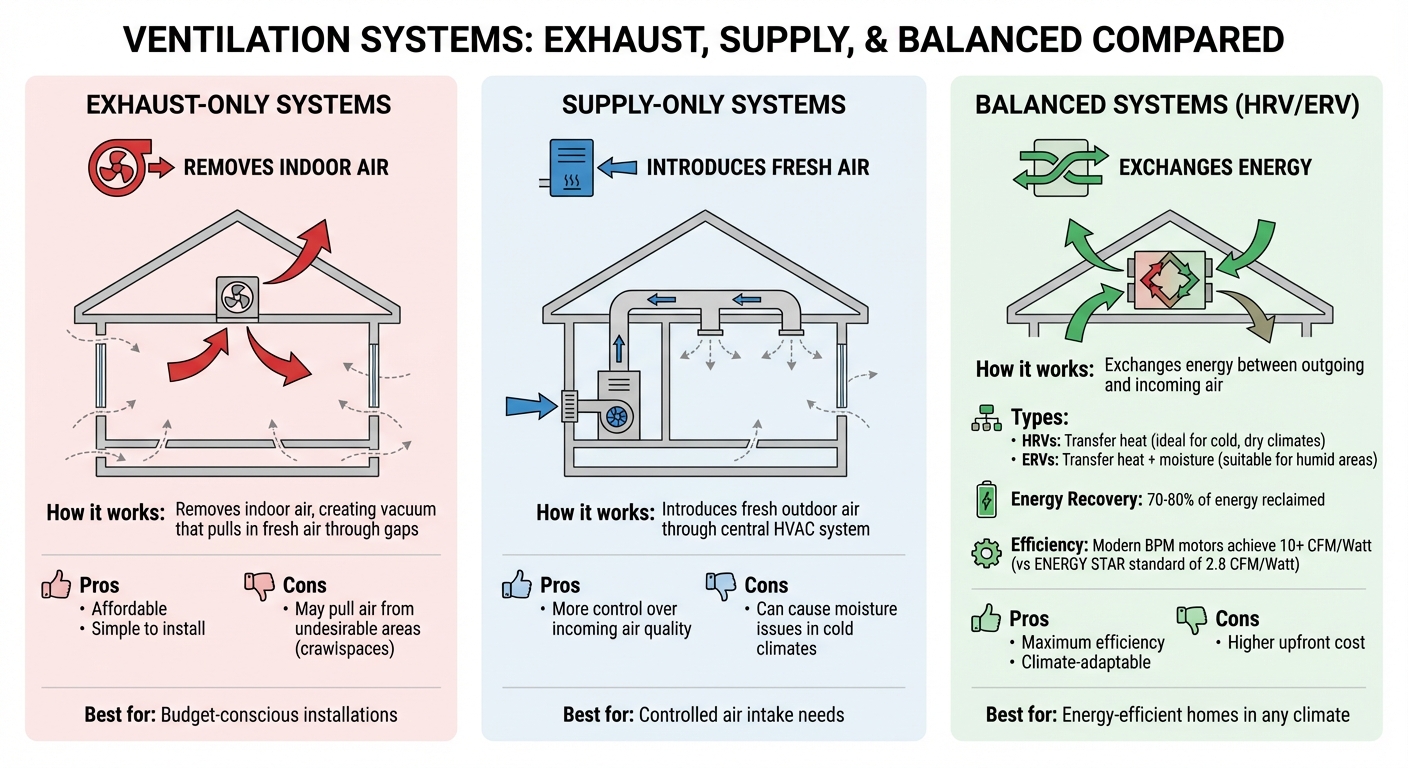
Ventilation System Types Comparison: Exhaust-Only vs Supply-Only vs Balanced Systems
Ventilation systems are designed to bring in fresh air from outside, circulate it, and reduce indoor pollutants either mechanically or naturally. Their performance hinges on two critical factors: maintaining proper airflow and achieving a balanced pressure. These ensure that contaminants don’t build up and are effectively removed. With this foundation in mind, let’s dive into how indoor air quality is monitored and preserved.
Indoor Air Quality (IAQ) Basics
Indoor air quality (IAQ) focuses on controlling pollutants that tend to accumulate in enclosed spaces. Common offenders include carbon dioxide (CO₂), volatile organic compounds (VOCs), particulates, odors, and tobacco smoke. Interestingly, indoor pollutant levels are often higher than those found outdoors, making mechanical ventilation essential. Two key measurements – air changes per hour (ACH) and ventilation rate (CFM) – help gauge air quality. A simple tip to improve IAQ is to set your HVAC fan to "on" instead of "auto." This keeps the air circulating and filtered, even when the heating or cooling system isn’t running – an especially useful practice when hosting visitors. Now, let’s explore the guidelines that shape ventilation practices.
Ventilation Standards and Regulations
Standards set by ASHRAE form the backbone of ventilation requirements for both residential and commercial buildings. ASHRAE Standard 62.2 addresses ventilation in homes, while ASHRAE 62.1 focuses on commercial spaces. Building codes like the IRC and IMC require mechanical ventilation in airtight homes where natural air exchange falls below 0.35 ACH. Specifically, the IMC mandates mechanical systems for homes with air infiltration rates under 5 ACH50, as determined by blower door testing. These rules are especially important for energy-efficient homes, ensuring proper air exchange to prevent the buildup of harmful substances like formaldehyde. While air cleaning and filtration systems can supplement ventilation, they cannot replace the minimum outdoor air requirements dictated by these codes. These regulations are vital for maintaining a healthy indoor environment while meeting legal standards. With this understanding, we can examine the various types of ventilation systems available.
Types of Ventilation Systems
Ventilation systems are generally grouped into three categories based on how they control airflow and pressure.
- Exhaust-only systems remove indoor air, creating a slight vacuum that pulls in fresh air through gaps and openings. These systems are affordable and simple to install but may unintentionally pull in air from undesirable areas, like crawlspaces.
- Supply-only systems work in reverse by introducing fresh outdoor air, often through the central HVAC system. This method allows more control over the quality of incoming air but can lead to moisture issues in colder climates if not carefully managed.
- Balanced systems, such as heat recovery ventilators (HRVs) and energy recovery ventilators (ERVs), excel at exchanging energy between outgoing and incoming air. HRVs transfer heat and are ideal for cold, dry climates, while ERVs handle both heat and moisture, making them suitable for a variety of conditions, including humid areas.
Advancements in fan technology, like brushless permanent-magnet (BPM) motors, have significantly improved energy efficiency. Modern fans can achieve over 10 CFM/Watt, far surpassing the ENERGY STAR benchmark of 2.8 CFM/Watt for fans under 90 CFM.
Residential Ventilation Optimization
Improve your home’s air quality and keep energy costs in check with these practical tips.
Assessing Your Home’s Current Ventilation
Start by inspecting the exhaust fans in your bathrooms and kitchen. Over time, dust buildup can reduce their efficiency. Cleaning the grilles, blades, and housing can restore proper airflow. Also, make sure the exhaust ducts lead outdoors – venting into attics or crawlspaces can cause moisture problems.
To evaluate performance, use a flow hood to measure airflow and confirm the fans meet their design specifications. Look for warning signs like high humidity, condensation on windows, or elevated CO₂ levels. Test powerful exhaust fans, such as range hoods, to ensure they aren’t causing backdrafting issues.
For a thorough evaluation, consider hiring a professional from Eco Temp HVAC. They may perform blower door testing to assess your home’s natural air exchange rate and check the efficiency of your HVAC system. According to ASHRAE Standard 62.2, homes should achieve at least 0.35 air changes per hour or provide 15 cubic feet of air per minute per person.
Once you’ve assessed your current system, you can explore upgrades to improve efficiency and air quality.
Upgrading Ventilation Equipment
If your assessment reveals shortcomings, upgrading your ventilation system can help strike a balance between air quality and energy efficiency. Whole-house systems are a great option – ERVs (Energy Recovery Ventilators) work well in humid climates, while HRVs (Heat Recovery Ventilators) are better suited for cold, dry areas.
When replacing old exhaust fans, consider models with brushless permanent-magnet (BPM) motors. These fans are highly efficient, delivering over 10 CFM per watt. For quiet, continuous operation, choose fans rated at 0.3 sones or less. Replacing an existing fan typically costs $100 to $200, with unit prices ranging from $100 to $250.
In moisture-prone areas, such as bathrooms and kitchens, high-capacity exhaust fans are essential. Aim for at least 50 CFM for bathrooms and 100 CFM for kitchens. Smart controls with humidity or indoor air quality (IAQ) sensors can further improve efficiency by activating ventilation only when necessary, preventing energy waste.
Balancing Comfort, Humidity, and Energy Costs
After upgrading your equipment, fine-tune your system to maximize comfort and minimize energy costs. Tailor your ventilation strategy to your climate. In humid regions, ERVs help manage indoor moisture by transferring it to the outgoing air. In colder, drier climates, HRVs help maintain balanced humidity levels by not transferring moisture. If your new ventilation setup increases indoor humidity, consider adding a dehumidifier.
To prevent energy loss, seal ventilation ducts with mastic rather than duct tape, and insulate any ducts running through unconditioned spaces like attics. Regularly clean outdoor air inlets, as clogged inlets can drastically reduce airflow.
"Any existing ventilation system… should be assessed for effectiveness and any new systems that are installed should be commissioned by a trained HVAC technician or energy rater to verify performance." – PNNL
Eco Temp HVAC’s certified technicians can guide you in selecting the right equipment for your climate and ensure proper installation and commissioning. These steps will set the stage for maintaining long-term air quality and energy efficiency in your home.
sbb-itb-b5c10b1
Commercial Ventilation Optimization
For business owners, managing ventilation in commercial spaces is a balancing act. It’s not just about meeting regulatory standards – it’s also about controlling energy costs and ensuring comfort in larger, more complex environments. In the U.S., commercial HVAC systems make up about 39% of energy use in commercial buildings, so finding ways to improve efficiency is a must.
Design and Retrofitting for Better Ventilation
The starting point for efficient ventilation is proper system sizing. Undersized systems struggle to maintain comfort, while oversized ones waste energy and money. To avoid these pitfalls, rely on the ACCA’s guidelines: Manual J for load calculations, Manual S for equipment selection, and Manual D for duct design.
For existing systems, retro-commissioning can yield noticeable savings. For instance, River Trails Middle School in Mt. Prospect, Illinois, upgraded its HVAC controls and retro-commissioned its systems, cutting annual energy use by 27% and saving $18,900 per year. Similarly, Mt. Washington Elementary School in Kentucky completed a 1.5-year HVAC and lighting renovation, achieving 32% energy savings and $28,000 in annual cost reductions.
When upgrading, consider MERV 13 or higher filters to trap viral particles – just ensure your system can handle the added pressure. For larger buildings, Variable Refrigerant Flow (VRF) systems are a great choice, as they can heat and cool different zones simultaneously, using waste heat efficiently. Also, focus on airflow design, ensuring air moves from clean areas toward exhaust points or HEPA filtration units, especially in spaces where occupant safety is a priority.
Advanced Controls for Better Performance
Advanced controls can take your system’s performance to the next level.
- Demand-controlled ventilation (DCV): Using CO2 or occupancy sensors, DCV adjusts ventilation rates based on real-time occupancy. Proper placement of sensors – away from supply air drafts or open windows – ensures accurate readings and energy savings during low-use periods.
- Building automation systems (BAS): BAS platforms centralize HVAC control, allowing quick responses to external events like wildfire smoke. They also track metrics like pressure drops across filters, so filters can be replaced based on actual need, avoiding both premature changes and clogged filters that waste energy.
- Air economizer controls: These systems monitor outdoor air conditions and bring in outside air for "free cooling" when possible, reducing the need for air conditioning. However, economizer dampers can get stuck open, leading to energy waste – regular maintenance is key.
These technologies not only improve efficiency but also set the foundation for future upgrades.
Energy-Saving Measures for Commercial Systems
When it comes to impactful retrofits, options like air economizers, energy recovery ventilation (ERV), DCV, and BAS deliver excellent results. ERV systems are particularly effective, reclaiming energy from exhaust air and preventing waste from conditioned air leaving the building.
A great example of this is Vista Peak Preparatory in Aurora, Colorado. After a 14-month HVAC recommissioning project, the school achieved a 20% reduction in Energy Use Intensity (EUI) and saved an estimated $54,000 annually.
To further enhance efficiency, seal duct joints with duct mastic and insulate ducts in unconditioned spaces to limit thermal loss. Portable CO2 meters, which cost less than $300, can be used to establish baseline CO2 levels in rooms. Aim for readings below 800 parts per million (ppm), and if future readings exceed 110% of the baseline, it could signal a ventilation issue.
Optimizing commercial ventilation systems doesn’t just meet compliance standards – it boosts overall building performance. Eco Temp HVAC’s certified technicians can evaluate your system, suggest targeted retrofits, and ensure proper commissioning to improve air quality and energy efficiency.
Maintenance for Optimized Ventilation
Even the most advanced systems can lose efficiency without regular maintenance. Surprisingly, less than half of homeowners schedule annual HVAC servicing, which can decrease efficiency by as much as 30%.
Key Maintenance Tasks
Start with filter replacement. Standard homes should have filters changed every 90 days, but if pets are part of your household, aim for every 60 days. For allergy sufferers, replace filters every 30–45 days. A quick test? Hold the filter up to a light source – if no light passes through, it’s time for a change. Glenn Wiseman, Sales Manager at Top Hat Home Comfort Services, emphasizes the importance of clean filters:
"Air filters keep dust and particles from getting into your ductwork and HVAC… If they are covered in dust, the air will filter through your furnace much slower, making your system more inefficient".
Next, inspect your ductwork. Leaky ducts can result in a 30% loss of airflow. Use duct mastic or metal-backed foil tape to seal any leaks. For systems like ERVs (energy recovery ventilators) and HRVs (heat recovery ventilators), clean the heat exchanger surfaces regularly. This prevents bacteria buildup and helps maintain the typical energy recovery rate of 70% to 80%.
Don’t forget your AC condensate drain line – it should be flushed every three months with a bleach-water mixture. Outdoor condenser units also need at least two feet of clearance to operate efficiently. Watch for warning signs, such as a yellow or orange furnace flame instead of a crisp blue one. This could indicate a combustion issue and a potential carbon monoxide hazard.
Performing these tasks consistently not only keeps your system efficient but also helps you identify when professional support might be needed.
Eco Temp HVAC Maintenance Plans

While DIY efforts are helpful, professional maintenance ensures your system stays in top shape. Expert inspections can catch minor issues early, extending the life of your equipment and saving you from costly repairs. A full HVAC inspection typically costs around $300, while repairs can range from $100 to $3,000, depending on the issue.
Eco Temp HVAC offers maintenance plans tailored for Chicagoland homeowners and businesses. Their certified technicians conduct thorough inspections, clean essential components like coils and motors, balance airflow throughout the ductwork, and test safety systems, including carbon monoxide detectors. With service locations in Chicago, St. Charles, Bartlett, Lemont, Downers Grove, and Palatine, they provide fast response times and 24/7 availability.
Conclusion
Optimizing your ventilation system can make a big difference – not just for your health, but also for your wallet. Heating and cooling account for about 40% of the average American homeowner’s annual energy consumption. That means even small upgrades can lead to noticeable savings. By switching to modern, energy-efficient equipment, you could cut energy use by 20% or more, all while enjoying cleaner air and protecting your home from moisture-related damage.
For those in Chicagoland, the climate presents specific challenges, but well-balanced systems or energy recovery ventilators (ERVs) can help. These systems recover 70%–80% of the energy from outgoing air to pre-condition incoming air. However, achieving these results depends on proper installation, accurate sizing, and regular maintenance.
With today’s advanced ventilation technology, professional expertise is crucial. High-efficiency systems require precise installation and ongoing upkeep to perform as designed. Combustion safety testing and preventing backdrafting issues are just a couple of the critical steps involved. Without proper commissioning, even the most advanced systems can fail to deliver their full potential – or worse, create new issues.
Eco Temp HVAC’s certified technicians take a whole-house approach tailored to Chicagoland’s unique climate needs. They provide quick, reliable service and thorough maintenance to ensure your system runs smoothly and efficiently.
FAQs
How can I tell if my home’s ventilation system needs an upgrade?
To figure out if your home’s ventilation system needs an upgrade, start by checking for some telltale signs of trouble. These might include lingering odors, visible mold, condensation, drafts, unusually high energy bills, or household members dealing with headaches, allergies, or fatigue. If your indoor humidity is consistently above 60% or you notice moisture problems, it could point to poor ventilation.
A quick inspection can reveal a lot. Make sure your bathroom and kitchen fans are functioning properly and venting air outside, not just recirculating it. If the airflow feels weak, consider a professional evaluation. Tests like a blower door assessment or a whole-house ventilation check can measure air exchange rates and uncover hidden problems. If these tests reveal low airflow, high indoor CO₂, or too much moisture, upgrading to energy-efficient fans or adding a heat recovery ventilator (HRV) can significantly improve air quality while saving on energy costs.
If you’re in the Chicagoland area, Eco Temp HVAC provides free ventilation assessments. Their services include airflow testing, duct cleaning, and energy-efficient upgrades, all tailored to meet industry standards and boost comfort throughout the year.
What are the benefits of using HRVs and ERVs in different climates?
Heat Recovery Ventilators (HRVs) and Energy Recovery Ventilators (ERVs) are designed to improve indoor air quality while keeping energy consumption in check. They work by exchanging stale indoor air with fresh outdoor air through a heat-exchange core. The main difference between the two lies in how they handle moisture, which makes each more suitable for specific climates.
In colder areas, like the Upper Midwest or New England, HRVs are a great choice. They recover heat from the outgoing air to warm the incoming air, cutting down on heating costs and energy use. On the other hand, in hot and humid regions, such as the Gulf Coast or Southeast, ERVs are better equipped to manage moisture. They transfer some of the humidity from the incoming outdoor air to the exhaust, helping maintain indoor comfort and reducing strain on air conditioning systems.
For regions with mixed climates, both options can offer year-round benefits. HRVs perform well during winter by retaining heat, while ERVs provide some humidity control during the summer months. If you’re in the Chicagoland area, Eco Temp HVAC can assess your specific needs and recommend the most effective solution for your home or business.
Why is regular maintenance important for keeping ventilation systems efficient?
Regular maintenance plays a key role in keeping your ventilation system running smoothly and maintaining good indoor air quality. Over time, filters, ducts, and fans can collect dust, debris, and moisture. This buildup forces the system to work harder, driving up energy costs and causing unnecessary wear and tear on its components.
Simple tasks like cleaning ducts, replacing filters, and inspecting fans can go a long way in preventing expensive repairs and extending the system’s lifespan. Regular upkeep ensures steady airflow, better humidity control, and a healthier indoor environment. Tackling minor issues early can help you avoid bigger problems that might affect your comfort or safety.
If you’re in the Chicagoland area, Eco Temp HVAC provides year-round maintenance plans designed to keep your ventilation system in top shape. Their certified technicians use proven methods to help you cut energy costs and protect your system for the long haul.