
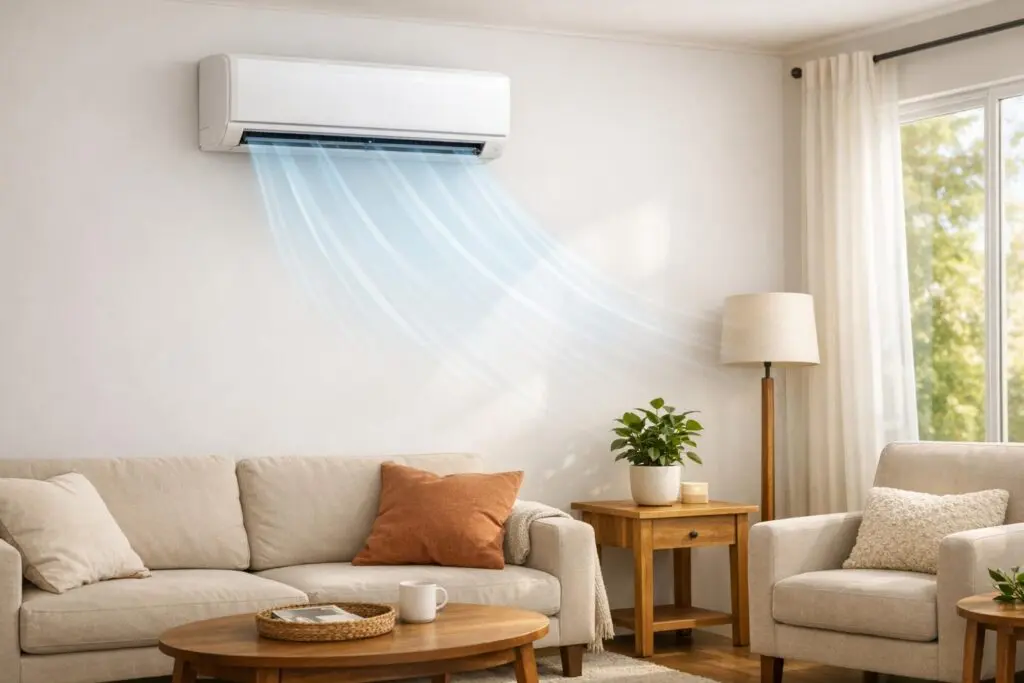
Ductless mini-splits are efficient for heating and cooling, but using them wisely can save even more energy and money. Here’s how you can maximize their performance:
- Run the system continuously: Avoid turning it on and off to reduce energy spikes and wear.
- Set the right temperature: Aim for 75–78°F in summer and 68–72°F in winter for optimal efficiency.
- Adjust airflow direction: Position louvers upward for cooling and downward for heating to improve air circulation.
- Perform regular maintenance: Clean filters, inspect components, and schedule professional servicing twice a year.
- Seal and insulate your home: Prevent air leaks with caulking, weatherstripping, and proper insulation.
- Use a smart controller: Automate temperature settings and reduce energy use with geofencing and scheduling features.
- Protect outdoor units: Shield them from direct sunlight, debris, and snow with covers or awnings.
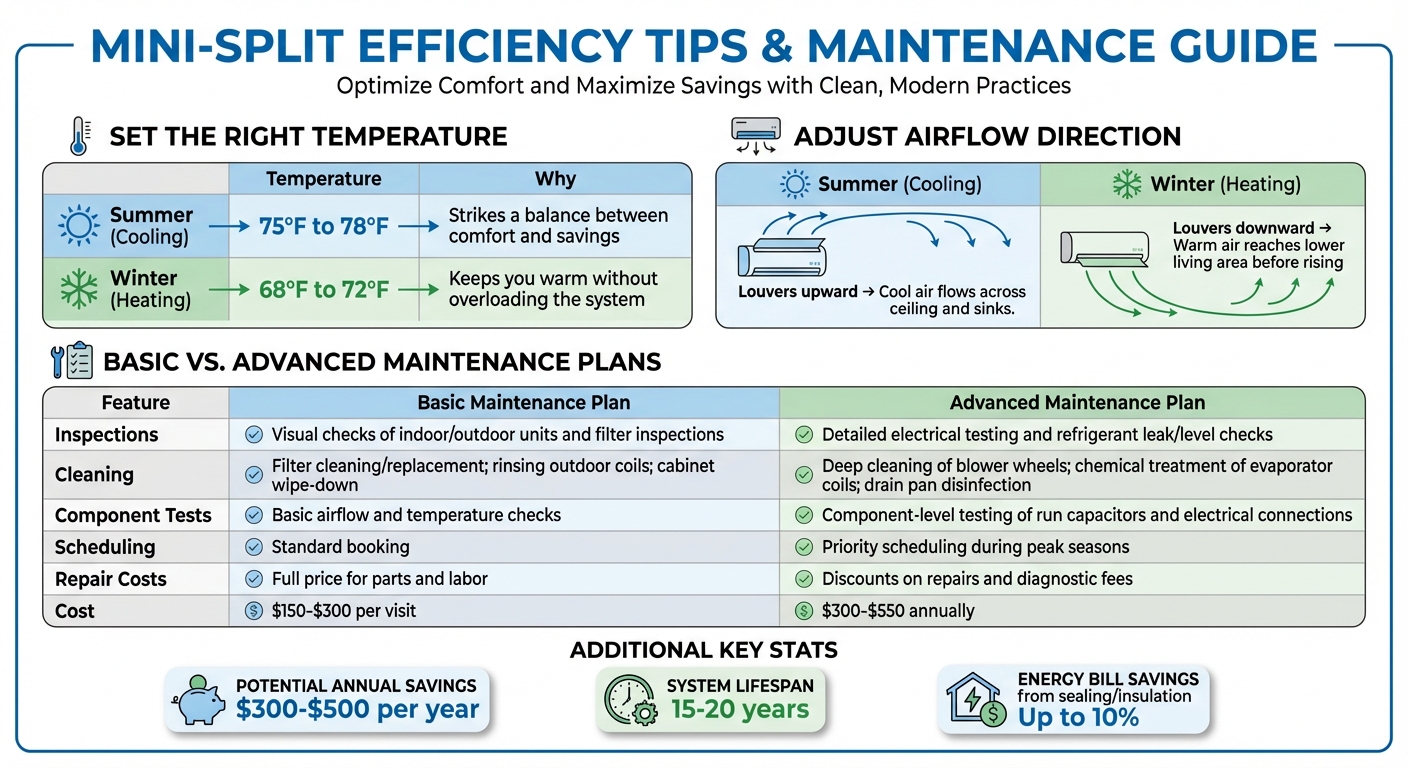
Mini-Split Efficiency Tips: Temperature Settings, Airflow Direction, and Maintenance Plan Comparison
How to Compare Mini Split Efficiency? – Lowest to Highest SEER Rating + Tips on Power Consumption
1. Run Your System Continuously
Mini-splits are designed to perform at their best when they run continuously. Unlike traditional central HVAC systems that turn on and off in cycles every 15 minutes, mini-splits operate more efficiently by maintaining a steady state 24/7.
Here’s why: every time you turn your mini-split on and off, it has to work harder to bring the room back to your desired temperature. This frequent cycling pushes the system to operate at full capacity, leading to energy spikes and added wear on its components. Running the system continuously avoids these energy surges and reduces strain.
"By allowing your mini split to run 24/7, it will use less energy and keep temperatures more consistent." – Pioneer Official Store
Thanks to inverter technology, mini-splits can fine-tune their power usage to maintain your set temperature with minimal energy. This means your room stays comfortable – often within just one degree of your target – while using as little energy as possible.
To maximize efficiency, set your preferred temperature and avoid making frequent adjustments. Small changes of 1–2° are fine, but turning the unit off entirely forces it to work harder to restore comfort, ultimately using more energy. Using the "Auto" mode for both fan and temperature settings can also help, as this allows the system to select the most efficient speed based on current conditions. Even when leaving for work, resist the temptation to turn the unit off – bringing your home back to a comfortable temperature later usually consumes more energy than letting it run steadily.
2. Set the Right Temperature
Your thermostat setting plays a big role in how efficiently your mini-split system operates. Contrary to popular belief, cranking the temperature up or down doesn’t speed up heating or cooling – it just uses more energy. Instead, aim for specific temperature ranges to keep things running smoothly and efficiently.
For summer cooling, set your thermostat between 75°F and 78°F. For winter heating, aim for 68°F to 72°F. These ranges allow the mini-split’s inverter-controlled compressor to work at a steady, lower speed rather than constantly ramping up to full power. This not only saves energy but also reduces wear and tear on the system.
| Season | Recommended Temperature | Why It Works |
|---|---|---|
| Summer (Cooling) | 75°F to 78°F | Strikes a balance between comfort and savings |
| Winter (Heating) | 68°F to 72°F | Keeps you warm without overloading the system |
Keep in mind that indoor units measure temperatures near the ceiling, where the air tends to be warmer. You may need to adjust the thermostat slightly to account for this.
When making changes, avoid sudden, large shifts in temperature. Instead, adjust by just 1–2°F at a time to avoid straining the system. If you’re looking to save energy while you’re away or sleeping, don’t turn the unit off entirely. A small setback of a few degrees is better, as it prevents the compressor from working extra hard to return to your desired temperature when you turn it back on.
3. Adjust Airflow Direction
The direction of airflow plays a key role in how efficiently your mini-split system operates. Since hot air rises and cold air sinks, adjusting the louvers to align with these natural movements can help your system work more effectively.
In the summer, position the louvers upward so the cool air can spread across the ceiling and naturally sink into the room. During winter, direct the louvers downward to push warm air into your living space before it rises.
| Season | Airflow Direction | Why It Works |
|---|---|---|
| Summer (Cooling) | Louvers upward | Cool air flows across the ceiling and sinks |
| Winter (Heating) | Louvers downward | Warm air reaches the lower living area before rising |
These adjustments complement the continuous operation and proper temperature settings mentioned earlier.
Most mini-split systems make this process easy with louvers that can be adjusted using a remote control. Many systems also feature an Auto fan mode, which selects the most efficient fan speed based on the room’s current conditions.
For even better airflow, consider using a ceiling fan in tandem with your mini-split. This helps circulate conditioned air more evenly throughout the space. Also, be mindful of furniture placement – keeping furniture away from the unit ensures that airflow isn’t obstructed.
4. Get Regular Professional Maintenance
Keeping your mini-split system in top shape requires regular professional maintenance. Experts recommend having your system serviced twice a year – once before the heating season and again before the cooling season kicks off. This professional care works hand-in-hand with the operational tips shared earlier.
During these service visits, technicians handle tasks like deep cleaning the blower wheels and coils, checking refrigerant levels at flare connections, inspecting electrical components, and flushing drain lines to prevent mold buildup.
"They’re called mini splits for a reason – everything is micro inside of there."
– Brian Redmond, Owner of Redmond’s Complete Comfort
In addition to professional maintenance, there are simple tasks homeowners can perform to keep their systems efficient. Regularly clean or replace air filters, dust the indoor cabinet monthly, and rinse the outdoor coils using a garden hose. Make sure the outdoor unit has 2 to 3 feet of clearance around it, and during winter, clear away any snow or ice buildup.
The cost of professional tune-ups generally ranges from $150 to $300, while more comprehensive annual maintenance can cost between $300 and $550. It’s a worthwhile investment since a well-maintained mini-split system can last 15 to 20 years. For those in Chicagoland, Eco Temp HVAC offers professional mini-split maintenance services, with certified technicians trained to catch potential problems early.
sbb-itb-b5c10b1
5. Seal and Insulate Your Home
While maintaining your mini-split system is crucial, don’t overlook the importance of your home’s overall structure in achieving energy efficiency. A well-sealed home ensures you get the most out of your mini-split system. Even the most efficient systems can struggle if air leaks through gaps around windows, doors, or other openings.
By sealing air leaks and improving insulation, you could save up to 10% on your energy bills, boosting the efficiency of your mini-split system even further.
Start by identifying trouble spots, such as stained insulation or drafty window frames, which often signal air leaks. Here are a few practical steps to tackle these issues:
- Use caulk for sealing fixed components like window frames.
- Apply weatherstripping to movable parts, such as doors or operable windows.
- Place foam gaskets behind outlet and switch covers on exterior walls.
- Seal gaps around plumbing or electrical penetrations with caulk or foam sealant.
- Close fireplace flues tightly or consider using an inflatable chimney balloon.
- Replace exterior door bottoms and thresholds with models that include pliable sealing gaskets.
- For larger gaps, such as those around baseboards or windows, rely on low-expansion spray foam for effective sealing.
"Reducing the amount of air that leaks in and out of your home is a cost-effective way to cut heating and cooling costs, improve durability, increase comfort, and create a healthier indoor environment." – Energy.gov
The great thing about air sealing measures like caulking and weatherstripping is that they often pay for themselves within a year. These straightforward fixes not only lower your energy costs but also help your mini-split system perform at its peak.
6. Install a Smart Controller
Adding a smart controller to your mini-split system can make a noticeable difference in how efficiently it operates. Why? Because standard mini-splits often measure temperature at the ceiling, where it’s warmer, rather than at the level where people are. A smart controller solves this by sensing the temperature where it matters most, preventing the system from working harder than it needs to. The result? A more efficient and effective performance.
These controllers come with handy features like automated scheduling. You can set specific preferences for when you’re home, away, asleep, or even on vacation. Many also include geofencing, which automatically switches your system to an energy-saving mode when you leave the house. Plus, with remote apps and voice assistants like Amazon Alexa, Google Home, or Apple HomeKit, you can control your system from anywhere. Some advanced models even provide energy insights, such as runtime and humidity levels, to help you better understand your usage.
When choosing a smart controller, make sure it’s compatible with your mini-split brand, as features and remote options can differ. Once installed, use the "Auto" fan setting to let the system adjust the fan speed for optimal performance. If you’re stepping out for a short time, consider setting the temperature back by 4–5°F instead of turning the unit off entirely – this helps maintain efficiency without overburdening the system when you return.
As one user explains:
"Mini split auto mode will allow your system to change fan speed based on the weather and your temperature setting. So, be sure to use auto mode, it’s the best setting for mini split efficiency!" – Mysa
7. Protect Outdoor Units from Weather
Outdoor units are constantly exposed to the elements, which can reduce their efficiency and shorten their lifespan. Just like regular maintenance, shielding your unit from harsh weather is key to keeping it running smoothly. For instance, direct sunlight can make the system work harder than necessary. As Pioneer Official Store points out:
"Direct sunlight and proximity to heat sources will make it turn on more often and waste energy".
Positioning the unit in a shaded area can ease the strain and help it perform more efficiently.
Winter weather brings its own set of challenges. Snow and ice can accumulate on the unit, potentially causing costly mechanical damage and interfering with its operation. A practical solution is installing a wall-mounted awning or sloped canopy, which typically costs between $57 and $111. This setup not only shields the unit from heavy precipitation but also ensures proper airflow, allowing it to function without obstruction.
Keeping the area around the unit clear is equally important. Maintain at least 2 feet of open space and regularly trim shrubs, remove leaves, and clear away grass clippings. According to American Standard:
"Keeping the surrounding area clear of weeds, grass and other obstructions can help maximize performance and slow down wear and tear".
To further protect your unit, consider installing PVC or metal line set covers, which range from $28 to $77. These covers shield refrigerant lines and electrical tubing from UV damage and weather-related wear. In areas with harsh winters, elevating the unit on a raised platform can keep it above snow and debris, preventing blockages and damage.
It’s also important to avoid using full fabric covers while the unit is in operation. Instead, opt for waterproof covers, priced between $14 and $43, for off-season storage. By taking these precautions, you can help your mini-split system reach its expected lifespan of 15 to 20 years.
Maintenance Plan Comparison
Keeping your mini-split system in top shape requires regular maintenance, but not all service plans provide the same level of care. Each plan offers a different approach to maintaining your system’s performance.
Basic maintenance plans cover the essentials. These include visual inspections of both indoor and outdoor units, surface coil cleaning, and checking the condensate drain line for any blockages. While this type of service ensures your system operates at a standard level, it doesn’t dive into the more technical aspects that could affect long-term performance.
Advanced maintenance plans, on the other hand, take a deeper dive into your system’s health. They include detailed inspections of refrigerant levels, air temperatures, and electrical connections. Industry professionals emphasize the importance of these precision checks:
"We encourage homeowners to get a precision inspection where the dealer verifies refrigerant temperatures, air temperatures, voltages, amp draws, and the tightness of wire connections." – Brian Redmond, Owner of Redmond’s Complete Comfort
These plans also go beyond surface cleaning. They include thorough cleaning of components like blower wheels and drain pans, chemical treatments for evaporator coils, and testing of run capacitors to catch early signs of failure. Additionally, advanced plans often come with perks like priority scheduling during busy seasons and discounts on repair costs, which can make the higher upfront cost worthwhile. Standard tune-ups typically range from $150 to $300 per visit, while comprehensive annual maintenance plans cost between $300 and $550. Over the lifespan of 15–20 years, advanced maintenance helps identify and fix small problems early, preventing expensive repairs and maintaining energy efficiency.
Here’s a quick comparison of what each plan offers:
| Feature | Basic Maintenance Plan | Advanced Maintenance Plan |
|---|---|---|
| Inspections | Visual checks of indoor/outdoor units and filter inspections | Detailed electrical testing and refrigerant leak/level checks |
| Cleaning | Filter cleaning/replacement; rinsing outdoor coils; cabinet wipe-down | Deep cleaning of blower wheels; chemical treatment of evaporator coils; drain pan disinfection |
| Component Tests | Basic airflow and temperature checks | Component-level testing of run capacitors and electrical connections |
| Scheduling | Standard booking | Priority scheduling during peak seasons |
| Repair Costs | Full price for parts and labor | Discounts on repairs and diagnostic fees |
Selecting the right maintenance plan can make all the difference in your system’s efficiency and longevity. For a thorough and reliable option, consider Eco Temp HVAC. Their certified technicians are dedicated to keeping your system running at its best throughout the year.
Conclusion
Keeping your mini-split system running efficiently doesn’t have to be complicated. With a few smart habits and regular upkeep, you can cut energy use, lower utility costs, and help your system last up to 15–20 years.
Simple actions like running the system consistently, setting temperatures thoughtfully, and cleaning filters can make a big difference. Pair these with good home insulation and smart airflow management, and you could save $300 to $500 a year on heating and cooling costs. Plus, these steps improve indoor air quality by reducing dust and allergens.
Don’t overlook the importance of professional maintenance. While basic tasks like filter cleaning can be done on your own, having a certified technician perform detailed inspections can prevent expensive repairs. This kind of proactive care ensures your mini-split operates at its best. For homeowners in the Chicagoland area, expert help is just around the corner.
Eco Temp HVAC specializes in keeping mini-split systems in top shape. Their certified technicians handle everything from thorough inspections to component-level maintenance, helping you protect your investment throughout the year.
Start applying these strategies today. With regular care and professional support, your mini-split system will stay efficient, dependable, and budget-friendly for years to come.
FAQs
Why is it better to keep my mini-split running instead of turning it off when I’m not using it?
Keeping your mini-split system running at a low, steady speed is a smart way to maintain its energy efficiency and reduce strain on the compressor. Frequently turning it off and on forces the system to work harder to reach your desired temperature. This not only increases energy consumption but also causes temperature swings and adds unnecessary stress to the unit.
When you let the mini-split operate consistently, it does a better job of regulating both temperature and humidity. This creates a more comfortable indoor environment while helping you save energy over time. Plus, this method can extend the system’s lifespan and cut down on maintenance needs.
How does adjusting the airflow direction help my mini-split work more efficiently?
Adjusting the airflow direction on your mini-split is a quick way to ensure the air circulates evenly throughout your room. When you’re using cooling mode, aim the airflow upward – this takes advantage of cool air’s natural tendency to sink. On the other hand, in heating mode, direct the airflow downward to help warm air rise and spread more evenly.
Making this small change can help your system achieve your preferred temperature more quickly, ease the workload on the compressor, and cut down on energy waste. The result? A more efficient system and a cozier home.
What are the advantages of using a smart controller with a mini-split system?
Using a smart controller with your mini-split system can make your home more comfortable while saving energy. These controllers allow your system to automatically adjust its settings to keep the indoor temperature steady – usually within ±1°F. This precision helps reduce energy use, cuts down your utility bills, and lessens strain on the compressor by avoiding unnecessary heating or cooling cycles.
Smart controllers come packed with features like remote access through your smartphone, so you can manage your system from anywhere. You can set schedules, get maintenance reminders, and even receive alerts for tasks like filter cleaning. These tools not only improve your comfort but also help your mini-split run efficiently, which can extend its lifespan.
If you’re located in the Chicagoland area, Eco Temp HVAC offers installation and programming services for smart controllers. They can fine-tune your system to deliver year-round comfort while helping you save on energy costs.