
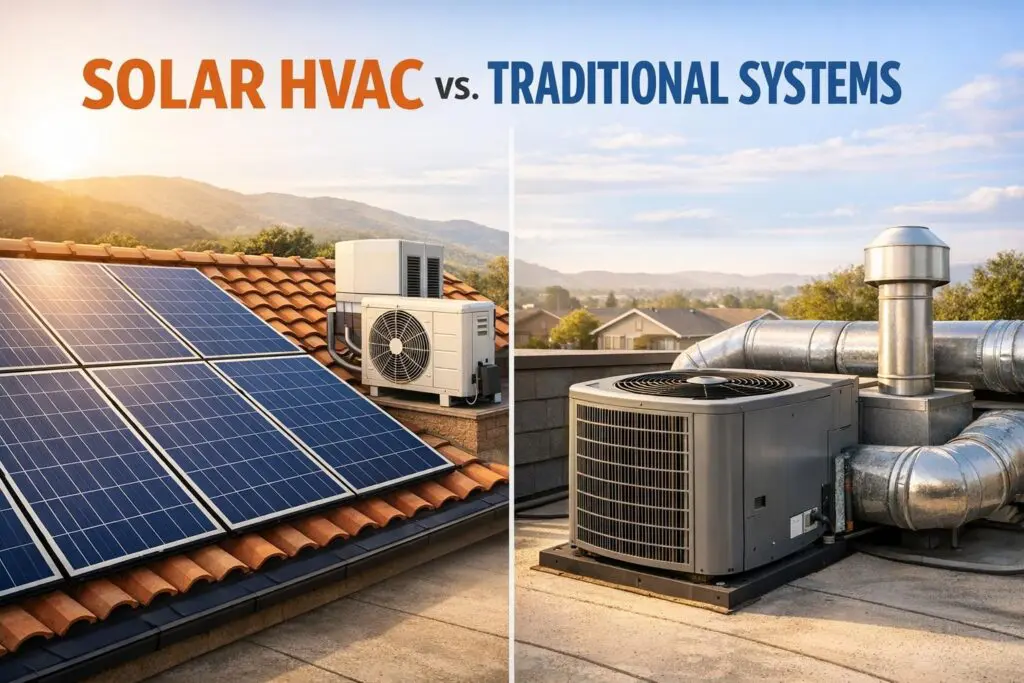
When choosing between solar HVAC and traditional systems, the decision often boils down to cost, efficiency, and environmental impact. Here’s a quick breakdown:
- Solar HVAC Systems: Use solar panels for power, cutting energy bills by 40–50%. They cost more upfront ($15,000–$30,000) but save significantly over time and reduce carbon emissions. They’re ideal for sunny locations but may need grid or battery backup during cloudy weather or at night.
- Traditional HVAC Systems: Depend on grid electricity, costing less initially ($11,590–$14,100) but result in higher long-term energy costs and emissions. They offer consistent performance regardless of weather.
Key Takeaways:
- Upfront Costs: Solar systems are more expensive but qualify for a 30% federal tax credit.
- Energy Costs: Solar systems save up to 80% on energy bills, while traditional systems are subject to rising utility rates.
- Maintenance: Solar systems require less frequent but specialized care; traditional systems need regular filter changes and tune-ups.
- Lifespan: Solar panels last 25+ years, while traditional systems typically last 10–15 years.
- Environmental Impact: Solar systems significantly reduce carbon emissions, unlike traditional options.
Quick Comparison:
| Feature | Solar HVAC | Traditional HVAC |
|---|---|---|
| Upfront Cost | $15,000–$30,000 | $11,590–$14,100 |
| Tax Credit | 30% of cost | Up to $2,000 |
| Energy Savings | 40–80% | None |
| Lifespan | 25+ years (panels) | 10–15 years |
| Carbon Emissions | Reduced by 39–100% | High |
| Weather Dependence | Sunlight-dependent | Consistent performance |
Solar HVAC systems offer long-term savings and cleaner energy but require a higher initial investment. Traditional systems are cheaper upfront but come with higher ongoing costs and environmental concerns. Your choice depends on your budget, location, and energy priorities.
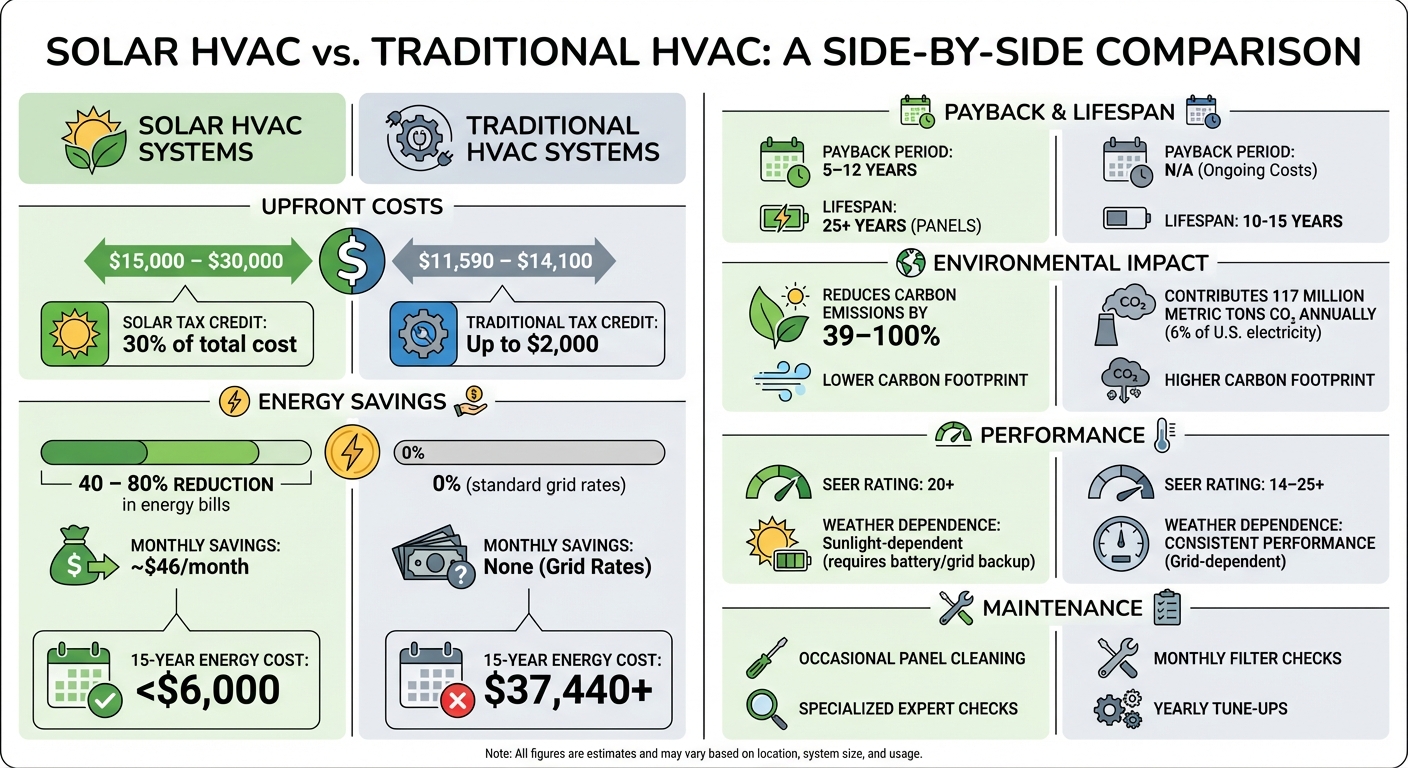
Solar HVAC vs Traditional Systems Cost and Performance Comparison
Costs: Initial Investment and Long-Term Expenses
Installation Costs
Installing a solar HVAC system requires a larger upfront investment compared to traditional systems. For a fully solar-powered heat pump system, including panels, costs typically range from $15,000 to $30,000. On the other hand, replacing a conventional HVAC system (AC and gas furnace) in 2026 is estimated to cost between $11,590 and $14,100. The higher price tag for solar systems covers everything – HVAC units, solar panels, inverters, mounting hardware, and sometimes even battery storage.
To help offset these costs, the Federal Residential Clean Energy Credit offers a 30% tax credit for qualifying solar installations. Meanwhile, traditional heat pumps may qualify for up to $2,000 in federal credits. For a standard 2,000-square-foot home, powering a 3.5-ton central AC unit effectively would require around 11 to 17 solar panels. Labor costs also differ: installing a solar AC system typically costs between $1,500 and $3,500, compared to $500 to $2,500 for traditional systems. While the initial costs are higher, the long-term savings can make solar systems a more economical choice, as outlined below.
Operating and Maintenance Expenses
Over the years, solar HVAC systems can deliver substantial savings. They reduce monthly cooling costs by 40% to 80%, which translates to about $46 in monthly savings for the average U.S. homeowner. In contrast, traditional systems rely entirely on grid electricity, leaving homeowners vulnerable to projected utility rate increases of 40% to 70% over the next 15 years.
Solar HVAC systems typically reach their break-even point within 5 to 12 years. After that, the savings directly reduce operating costs. Maintenance for solar components runs about $30 to $70 per kilowatt annually, while traditional systems require routine filter changes and yearly tune-ups. Over a 15-year period, energy costs for solar systems stay under $6,000, compared to at least $37,440 for grid-dependent systems.
Cost Comparison Table
| Financial Metric | Solar HVAC System | Traditional HVAC System |
|---|---|---|
| Upfront Installation Cost | $15,000–$30,000 | $11,590–$14,100 |
| Federal Tax Credit | 30% of total cost | Up to $2,000 |
| Monthly Energy Savings | 40%–80% reduction | 0% (standard grid rates) |
| Payback Period | 5–12 years | N/A |
| 15-Year Energy Cost | <$6,000 | $37,440+ |
| Expected Lifespan | 20–25+ years | 10–15 years |
Energy Efficiency and Performance
SEER Ratings and Energy Use
Solar HVAC systems often boast SEER ratings of 20 or higher, placing them among the most efficient options available, comparable to top-tier traditional models. For context, standard central air conditioners in the U.S. are required to have a minimum SEER rating of 14, while premium units can achieve ratings of 25 or more. What sets solar systems apart is their ability to utilize renewable energy during peak sunlight hours, potentially offsetting anywhere from 39% to 100% of grid electricity usage, depending on factors like location and system design.
According to HVAC expert Tom Moor, solar air conditioners deliver the same cooling and comfort as traditional systems, but with greater efficiency thanks to features like variable-speed compressors and DC motors that minimize energy waste. Additionally, ductless mini-split systems, which are commonly paired with solar setups, avoid the 30% or more energy losses often seen in traditional ducted systems due to leaks or poor insulation.
While efficiency ratings are essential for evaluating energy use, system performance under different weather conditions is equally important.
Weather-Dependent Performance
Efficiency ratings only tell part of the story – how a system performs under varying weather conditions is just as crucial. Traditional HVAC systems provide consistent performance around the clock, as they rely entirely on grid electricity, unaffected by sunlight or storms. Solar systems, on the other hand, shine brightest during peak sunlight hours, which conveniently align with the highest cooling demands. However, their capacity decreases when sunlight is limited, such as during cloudy weather, nighttime, or storms.
To address this limitation, most residential solar HVAC setups use hybrid configurations that seamlessly switch between solar power, battery storage, and grid electricity. Battery systems, which typically cost between $2,000 and $3,500, provide backup power during low-light conditions or after sunset. For heating and cooling, solar heat pumps achieve a Coefficient of Performance (COP) of 3 to 4, meaning they generate three to four units of heating or cooling for every unit of electricity consumed.
Performance Metrics Table
| Performance Factor | Traditional HVAC | Solar HVAC (Hybrid) |
|---|---|---|
| SEER Rating | 14 to 25+ | Often 20+ |
| Energy Source | 100% Grid Electricity | Solar + Grid/Battery Backup |
| Weather Dependence | None (Consistent) | High (Sunlight-dependent) |
| Nighttime Operation | Full Performance | Requires Battery or Grid |
| COP (Heat Pumps) | Varies by Model | 3.0 to 4.0 |
| Energy Loss | Up to 30% (Ductwork) | Minimized (VRF/DC Tech) |
Is solar air conditioning any good?
Maintenance and System Durability
When it comes to keeping systems running smoothly, maintenance and durability play a huge role in both performance and cost-efficiency. For traditional HVAC systems, regular upkeep is essential. During peak seasons, filters should be checked monthly and replaced quarterly to prevent dust buildup. If neglected, dust can force the system to work harder, increasing energy use and potentially leading to premature failure. On top of that, an annual professional tune-up is recommended to maintain peak efficiency. Much of the routine care for traditional systems revolves around filter and duct maintenance.
Solar HVAC systems, on the other hand, operate a bit differently. Solar panels themselves are highly reliable and only need occasional cleaning to remove debris. However, the overall system is more complex than traditional setups, requiring expert maintenance for components like inverters and batteries. Many solar systems use ductless mini-splits, which eliminates the need for duct-related upkeep entirely.
Expected Lifespan
Sticking to these maintenance routines helps systems reach their maximum lifespan. Traditional furnaces typically last between 15 and 20 years. However, any HVAC equipment older than 10 years should be evaluated by a professional to decide if repair or replacement makes better financial sense. Proper installation is also key – poor setup can reduce efficiency by up to 30% and shorten the equipment’s life.
Solar panels, in contrast, are built for long-term durability. They’re engineered to withstand storms, hail, and UV damage. Solar AC systems often pay for themselves within about 10 years. While the panels are extremely durable, other components like inverters, batteries, and thermal chillers may require specialized attention over time due to the system’s complexity.
Pros and Cons Table
| Aspect | Traditional HVAC | Solar HVAC |
|---|---|---|
| Routine Maintenance | Monthly filter checks and yearly tune-ups | Occasional panel cleaning and expert checks |
| Complexity | Standardized; many tasks can be DIY | Complex; requires skilled technicians |
| Duct Maintenance | Needs periodic sealing and insulation | Often ductless (mini-split) |
| Expected Lifespan | 15–20 years for furnaces | Panels are durable; 10-year payback |
| Weather Resistance | Performs steadily in most conditions | Panels resist UV and hail damage |
| Installation Impact | Poor installation cuts efficiency by 30% | Proper installation is critical |
sbb-itb-b5c10b1
Environmental Impact and Energy Independence
Carbon Emissions
Traditional HVAC systems take a toll on the environment. Air conditioning alone accounts for about 6% of electricity use in the U.S., with power plants emitting around 117 million metric tons of CO₂ annually to meet this demand.
Solar HVAC systems offer a cleaner alternative by cutting back on grid electricity, which is often generated from fossil fuels. Depending on the system’s design and location, solar absorption and electric systems can slash electrical energy use – and the associated CO₂ emissions – by anywhere from 39% to 100%. Additionally, solar thermal systems use eco-conscious refrigerants like water/lithium bromide, which have zero ozone depletion potential. This avoids the environmental hazards posed by traditional refrigerants such as CFCs and HCFCs.
Energy Independence
Solar HVAC systems don’t just reduce emissions – they also give homeowners more control over their energy use. By relying less on the utility grid, these systems empower users to generate their own energy. Off-grid setups, for example, use batteries to store solar energy for use at night or during cloudy weather. Hybrid systems, which switch seamlessly between solar and grid power, can reduce grid reliance by 40%–60% during peak sunlight hours.
This energy independence becomes especially critical during extreme weather. As Tom Moor from HVAC.com explains:
Solar AC owners won’t have to worry when utilities employ rolling blackouts on the hottest days to avoid grid overuse. Their ACs work independently of the power company.
In addition, grid-tied systems with net metering let homeowners send surplus solar energy back to the utility company in exchange for credits. This not only lowers electricity bills but also eases the strain on the grid during heatwaves, helping to prevent outages. Solar HVAC systems, in this way, play a vital role in creating a more resilient and sustainable energy infrastructure.
System Types and Setup Options
Solar HVAC System Types
Solar HVAC systems come in three main configurations. DC-powered systems connect directly to solar panels and operate on direct current without needing an inverter. These systems are ideal for off-grid setups, like cabins or RVs, but require significant battery storage to function at night.
AC-powered systems rely on an inverter to convert the DC electricity from solar panels into alternating current. These are typically grid-tied, allowing homeowners to take advantage of net metering by sending excess power back to the utility company. On the other hand, hybrid AC/DC systems combine the best of both worlds, drawing power from solar panels and the grid simultaneously. They automatically switch between power sources based on availability and don’t require an external inverter.
Hybrid and Ductless Systems
Ductless mini-splits are a popular choice for solar HVAC installations. These systems feature an outdoor compressor paired with one or more indoor units, eliminating the need for ductwork. They also allow for independent temperature control in different zones. With most solar mini-splits consuming around 500–700 watts per zone, they are much easier to power with solar panels compared to traditional central systems.
In contrast, central AC systems demand larger solar arrays, making them less efficient for solar setups compared to ductless mini-splits. Hybrid configurations can also integrate with existing systems. For example, a solar-powered heat pump can handle cooling and light heating needs, while a traditional furnace provides supplemental heat during extremely cold conditions. These setups enhance the overall efficiency and cost-effectiveness of solar HVAC solutions.
| System Type | Power Source | Inverter Needed? | Best Use Case |
|---|---|---|---|
| DC-Powered | Solar Panels / Battery | No | Off-grid cabins, RVs |
| AC-Powered | Grid / Solar (via Inverter) | Yes | Homes with net metering |
| Hybrid AC/DC | Solar & Grid Simultaneously | No | Most residential solar setups |
Conclusion
Solar HVAC systems come with a higher upfront cost compared to traditional options, but they can cut energy bills by over 40% and typically pay for themselves within about 10 years. This initial investment leads to significant long-term savings and reduces dependence on the power grid. While traditional systems contribute heavily to CO₂ emissions, solar-powered systems tap into renewable energy, helping to lower your carbon footprint. During peak sunlight hours, these systems can generate up to 90% of the energy they need, which means less reliance on the grid and protection against rising utility rates.
Maintenance needs differ between the two systems as well. Traditional HVAC systems require regular filter changes and tune-ups, while solar systems include additional components that need less frequent but more specialized care. Fortunately, solar panels are built to last over 25 years with minimal upkeep. On the other hand, traditional systems remain entirely dependent on the grid, leaving homeowners more exposed to power outages and fluctuating electricity costs.
By reducing reliance on the grid and cutting emissions, solar HVAC systems provide a cleaner and more sustainable alternative. To decide if this option is right for you, consider factors like your local climate, home design, and financial goals. Homes in sunny regions often see quicker returns on their solar investments. Additionally, you can take advantage of federal tax credits (currently 30% for energy-efficient systems) and improve your home’s insulation to reduce the size of your solar panel system and overall costs.
If you’re ready to explore sustainable cooling options, reach out to Eco Temp HVAC for expert advice, personalized recommendations, and professional installation services tailored to your needs.
FAQs
How effective are solar HVAC systems in areas with limited sunlight?
Solar HVAC systems rely on sunlight to produce energy, which means their performance can take a hit in areas with fewer sunny days or lower sunlight intensity. In regions with frequent cloudy weather or during the winter months, efficiency might drop by as much as 20–30%. This reduction can make it harder to consistently meet heating and cooling needs.
To overcome this challenge, systems in such locations often include larger solar panels or combine solar power with hybrid setups that use grid electricity as a backup. While this approach does come with higher upfront costs, it ensures consistent comfort and energy efficiency throughout the year. Eco Temp HVAC specializes in evaluating your home’s solar potential and creating a customized system to deliver dependable performance – even on those overcast days.
What maintenance does a solar HVAC system require?
Maintaining a solar HVAC system involves a mix of standard HVAC upkeep and specific care for the solar components. For the solar panels or collectors, keeping them clean and debris-free is key to maintaining energy efficiency. In most parts of the U.S., cleaning every 12–18 months should suffice. However, if you’re in an area prone to heavy dust, pollen, or bird droppings, you might need to clean them twice a year. A quick annual visual inspection of the panels, wiring, and mounting hardware can help spot issues like loose connections or physical damage.
As for the HVAC system itself, the routine is much like that of a traditional unit. Replace air filters every 1–3 months, clean the coils and evaporator fins once a year, and check the condensate drain to ensure it’s clear of blockages. If your system uses solar-powered controllers or batteries, verify they’re functioning within the manufacturer’s recommended settings. It’s also a good idea to schedule a professional service annually to check refrigerant levels, calibrate the thermostat, and assess overall system performance. With consistent care, both the solar and HVAC components can stay efficient and reliable for years.
What is the payback period for solar HVAC systems compared to traditional systems?
The time it takes to recoup your investment in a solar HVAC system depends on several factors, including installation costs, energy savings, and any tax incentives or rebates you qualify for. While solar systems often come with a higher upfront price tag, they can lead to substantial energy bill savings over time, potentially reducing the payback period. On the other hand, traditional HVAC systems might cost less initially but tend to have higher ongoing energy expenses.
If you’re looking for a clearer picture of what makes sense for your situation, it’s a good idea to speak with a professional. For instance, Eco Temp HVAC specializes in helping homeowners in the Chicagoland area assess their needs and find energy-efficient solutions tailored to their circumstances.