
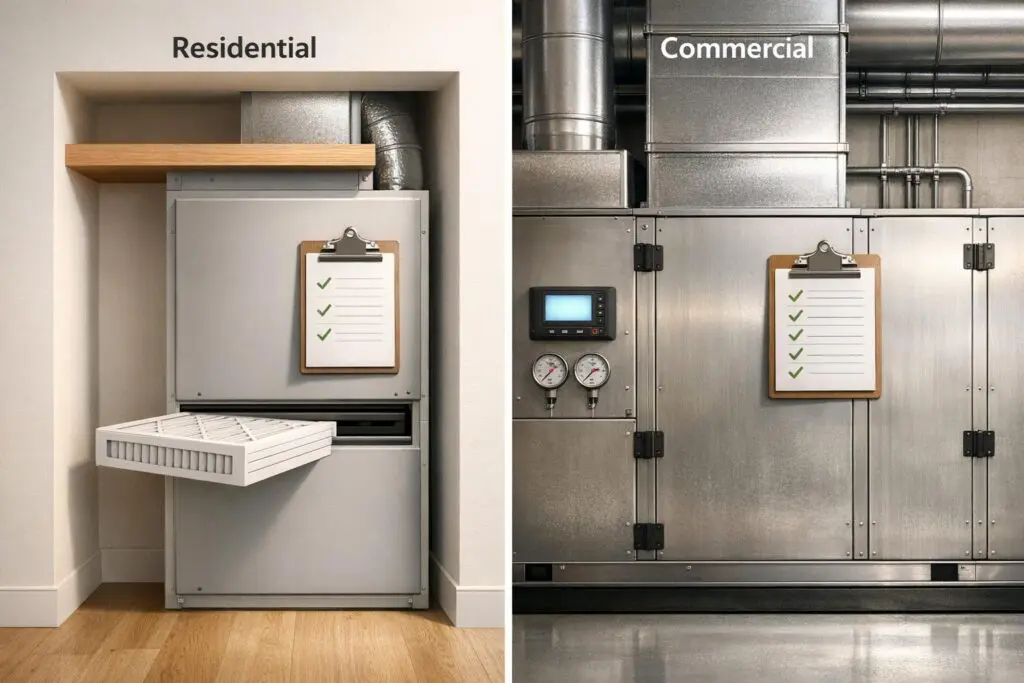
Residential and commercial HVAC systems serve the same purpose – keeping indoor spaces comfortable – but their maintenance needs are vastly different due to size, complexity, and usage.
Key Takeaways:
- Residential Systems: Smaller, simpler systems like split units or furnaces. Require professional air conditioning services twice a year (spring and fall). Homeowners can handle basic tasks like replacing filters every 1–3 months.
- Commercial Systems: Larger, more complex setups (e.g., 20-ton rooftop units, chillers, VRF systems). Need daily, monthly, quarterly, and annual checkups. Maintenance often includes advanced tasks like refrigerant monitoring, coil cleaning, and 3-phase voltage checks.
Why Maintenance Matters:
- Energy Savings: Proper care can reduce energy use by 10–40%.
- Lifespan: A well-maintained commercial unit may last 14–20 years, compared to 9 years with neglect.
- Cost Efficiency: Every $1 spent on preventive care saves $5 in future repairs. For businesses, this can also mean compliance with stricter regulations and avoiding operational downtime.
Quick Comparison:
| Feature | Residential HVAC | Commercial HVAC |
|---|---|---|
| Maintenance Schedule | Twice yearly professional service | Daily, monthly, quarterly, annual |
| System Complexity | <30 components, single-phase power | 100+ components, 3-phase power |
| Filter Changes | Every 1–3 months | Every 3–4 weeks |
| Technician Needs | General HVAC technician | Licensed specialists |
Regular maintenance ensures both system types operate efficiently, prevent breakdowns, and reduce energy costs. Tailored care is essential for meeting the unique needs of residential and commercial setups.
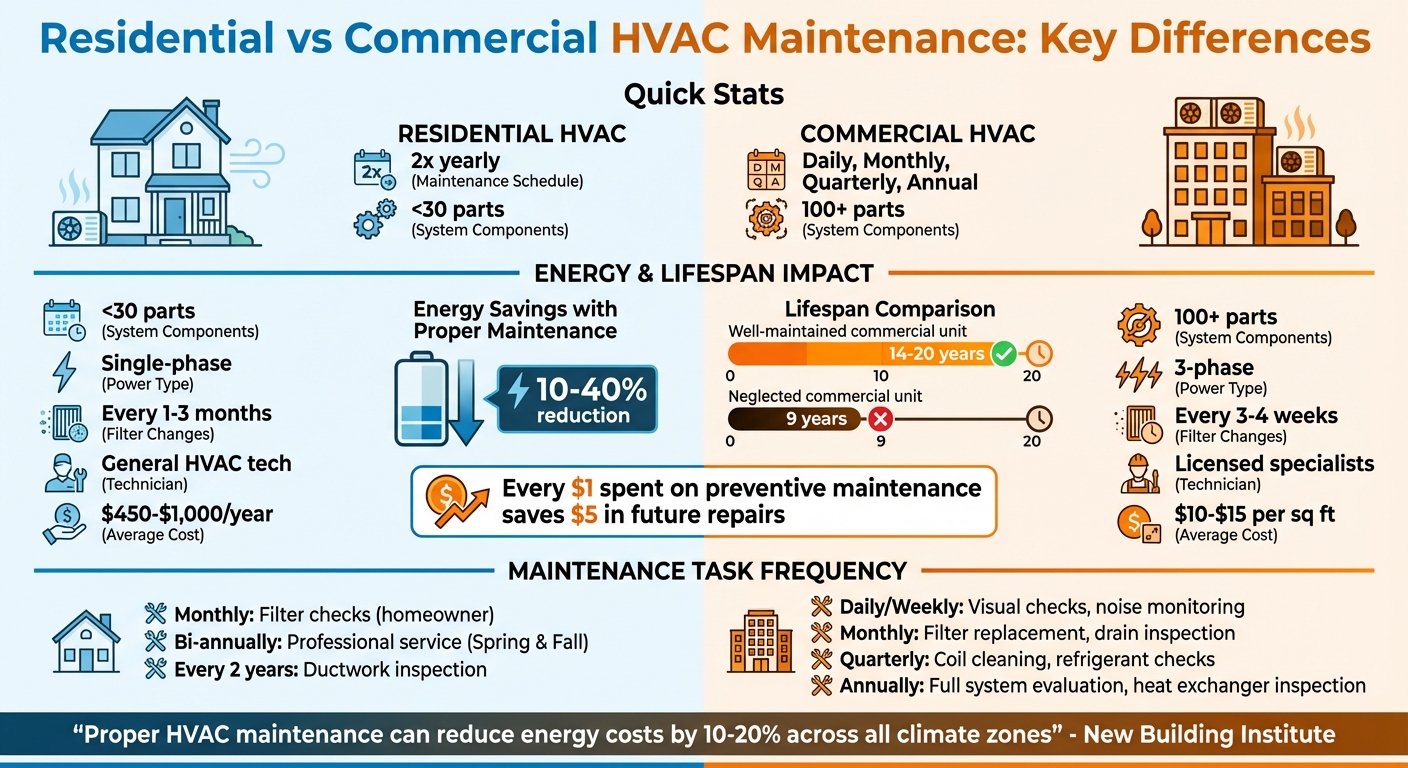
Residential vs Commercial HVAC Maintenance Requirements Comparison
Maintenance Tasks for Both System Types
Common Maintenance Checklist
No matter the HVAC system, certain maintenance tasks are non-negotiable. Replacing air filters is a priority since clogged filters can choke airflow, forcing systems to work harder. This inefficiency can drive energy use up by 30% to 60%. Another critical step is cleaning condenser and evaporator coils during AC repair and maintenance. Skipping annual cleanings can slash energy efficiency by as much as 40%.
Inspecting electrical connections helps identify loose wires or potential fire hazards. Technicians often rely on multimeters to assess voltage and current levels. Checking refrigerant levels is equally important to maintain cooling efficiency. Low refrigerant not only wastes energy but also overworks compressors, shortening their lifespan. Additionally, lubricating moving parts reduces wear on components like bearings and motors, while clearing condensate drains prevents water damage and mold issues.
"Regular HVAC maintenance can reduce energy cost by 10 to 20 percent across all climate zones in the United States." – The New Building Institute
How Execution Differs for Shared Tasks
Although these tasks apply to all systems, the approach varies depending on whether the system is residential or commercial. Residential systems generally require professional servicing twice a year – once in spring for cooling and again in fall for heating. On the other hand, commercial systems, especially those running non-stop in places like hospitals or data centers, demand more frequent servicing, often monthly or quarterly, due to their heavier workload.
| Maintenance Task | Residential Execution | Commercial Execution |
|---|---|---|
| Air Filter Change | Every 1–3 months; often handled by homeowners | Every 3–4 weeks in high-traffic areas; done by facility staff or contractors |
| Coil Cleaning | Annually; involves one outdoor condenser and one evaporator | Semi-annually or quarterly; covers multiple rooftop units or large chillers |
| Electrical Inspection | Basic thermostat and connection checks during annual tune-ups | In-depth testing of 3-phase voltage, VFD fault codes, and BAS systems |
| Lubrication | Minimal; focuses on blower motors and fans | Extensive; includes bearings, pulleys, and heavy-duty motors with specific lubricants |
| Refrigerant Checks | Standard pressure checks during annual visits | Requires superheat and subcooling calculations with strict EPA compliance |
Commercial systems, which often comprise over 100 components, demand specialized tools and more time for thorough maintenance. This complexity is reflected in the cost, with commercial maintenance contracts averaging $10 to $15 per square foot. These distinctions underscore the need for tailored care based on system type and usage.
sbb-itb-b5c10b1
Residential HVAC Maintenance Checklist
Homeowner Maintenance Checklist
Taking care of your home’s HVAC system doesn’t have to be overwhelming. With a few simple steps, homeowners can help prevent energy waste and avoid costly repairs. While some tasks are easy to handle yourself, others require the expertise of a licensed technician.
Air Filters
Check your air filters every month and replace them every 30–90 days during heavy use. A clogged filter not only drives up energy bills but can also damage your system, potentially leading to early failure.
Outdoor Condenser Unit
Keep the area around your outdoor condenser unit clear of debris like leaves and grass clippings. Aim for at least a 2-foot clearance to maintain proper airflow. A quick monthly cleanup goes a long way in ensuring your system runs smoothly.
Thermostat and Condensate Drain Line
Test your thermostat settings every few months and switch out the batteries once a year. For the condensate drain line, pouring a cup of vinegar or bleach down it monthly can prevent algae buildup and water damage. These small actions, paired with professional checkups, can significantly boost your system’s efficiency.
Professional Maintenance Visits
Book professional HVAC maintenance twice a year – spring for cooling systems and fall for heating systems. During these visits, technicians typically:
- Clean evaporator and condenser coils
- Check refrigerant levels
- Lubricate moving parts like motors and bearings
- Inspect electrical connections
- For heating systems, examine the heat exchanger, test burner combustion, and inspect gas or oil connections
These routine inspections can prevent up to 80% of HVAC breakdowns, ensuring your system runs efficiently and reliably.
"Scheduling an HVAC inspection every six months is crucial for ensuring your system operates efficiently and safely, preventing unexpected breakdowns and costly repairs."
– Kaitlyn Pacheco, Content Editor, Angi
Cost and Long-Term Benefits
The average cost for a professional tune-up ranges from $450 to $1,000, depending on the size and condition of your system. However, every $1 spent on maintenance can save $3–$6 in avoided repairs and energy expenses. Plus, regular care can add 5 to 7 years to your system’s life, pushing the average replacement age from 10–15 years to 15–20+ years.
Don’t forget to inspect your ductwork every two years. Dust, mold, or leaks in the ducts can lower efficiency and compromise air quality.
Commercial HVAC Maintenance Checklist
Business Maintenance Checklist
Commercial HVAC systems need consistent and focused maintenance to run efficiently. Simple daily or weekly visual checks – such as listening for odd noises, noticing vibrations or odors, and ensuring thermostat settings match the building’s schedule – can catch potential issues early.
On a monthly basis, tasks like replacing filters, inspecting condensate drains, and checking belts and pulleys are essential. For example, clogged drains in busy buildings can disrupt operations if left unchecked.
Quarterly maintenance steps include cleaning condenser and evaporator coils, checking refrigerant levels and pressures, tightening electrical connections, and lubricating motors and bearings. In facilities with heavy usage or systems operating around the clock, quarterly professional inspections are vital for maintaining air quality and avoiding unexpected breakdowns.
Annual maintenance takes a deeper dive, covering full system performance evaluations, heat exchanger inspections for cracks or corrosion, burner and ignition system tests, ductwork cleaning, and calibration of controls and automation systems. These tasks are especially critical in buildings with high occupancy, where issues like a cracked heat exchanger could lead to serious safety concerns, such as carbon monoxide leaks.
| Frequency | Key Maintenance Tasks |
|---|---|
| Monthly | Replace filters; inspect belts and pulleys |
| Quarterly | Clean coils; check refrigerant levels; tighten connections; lubricate moving parts |
| Bi-Annually | Recalibrate system settings and thermostat |
| Annually | Inspect heat exchangers; test burners; clean ductwork; verify safety controls |
In addition to routine tasks, some components require extra attention to ensure the system operates at peak performance.
Specialized Tasks for Commercial Systems
Commercial HVAC systems often include advanced components that demand specialized care. For instance, chillers require regular water treatment, tube cleaning, and cooling tower maintenance to stay efficient. Rooftop units (RTUs) benefit from quarterly inspections that cover heating and cooling components, as well as cabinet integrity checks. Similarly, variable refrigerant flow (VRF) systems need precise monitoring of refrigerant flow and control systems, which only certified technicians should handle.
Economizers, which bring in outdoor air for "free cooling", must have their temperature sensors, dampers, and actuators inspected regularly to ensure they work correctly. Since many commercial HVAC systems operate on 3-phase power, technicians should also monitor for voltage imbalances, which can cause motors to overheat.
Modern commercial HVAC systems are complex, often comprising over 100 interconnected parts. This complexity highlights the importance of professional expertise. Certified technicians not only ensure proper calibration of building automation systems but also apply antimicrobial treatments to cleaned coils to prevent mold growth. While professional maintenance might seem costly upfront, it’s a smart investment – every US $1 spent on preventive care can save about US $5 in future repairs. Plus, well-maintained systems often last longer, sometimes exceeding their expected service life.
Commercial Split / RTU Maintenance
Residential vs Commercial HVAC Maintenance Comparison
Residential and commercial HVAC maintenance differ significantly in terms of frequency, complexity, and scope. While homeowners typically schedule professional service twice a year, commercial systems demand a far stricter regimen, ranging from daily checks to annual comprehensive inspections. The table below highlights the key distinctions between these two types of systems.
| Feature | Residential HVAC | Commercial HVAC |
|---|---|---|
| Maintenance Schedule | Twice yearly professional service; monthly filter changes | Daily to weekly checks, monthly tasks, quarterly deep services, and an annual comprehensive inspection |
| System Complexity | Fewer than 30 major components; single-phase power | Over 100 interconnected parts; 3-phase power with voltage monitoring |
| Specialized Equipment | Standard split systems, furnaces, and heat pumps | Chillers, cooling towers, VRF systems, economizers, and rooftop units |
| Filter Inspection | Every 1–3 months | Every 3–4 weeks |
| Technician Requirements | General HVAC technician | Licensed specialists for refrigerant work, combustion tuning, and complex controls |
Eco Temp HVAC offers tailored maintenance plans to address these distinct needs, ensuring both residential and commercial systems operate efficiently.
Key Differences in Design and Operation
The differences in maintenance requirements stem largely from the design and operational demands of these systems. Residential HVAC setups are relatively straightforward, with fewer than 30 major components and reliance on single-phase power. On the other hand, commercial systems are far more intricate, featuring over 100 interconnected parts and components like chillers, cooling towers, and variable refrigerant flow (VRF) systems. They also use 3-phase power, which requires technicians to monitor voltage imbalances that could lead to motor overheating.
Why Commercial Systems Demand More Attention
Commercial systems face higher stakes when it comes to maintenance. Neglecting these systems can lead to premature failure, while regular servicing significantly extends their lifespan. Poorly maintained commercial units can also consume 30% to 60% more energy, directly impacting operating costs. According to the U.S. Department of Energy, proper maintenance can save businesses 5% to 20% annually on energy expenses.
"As a general rule, every dollar you spend on preventive HVAC maintenance costs you five dollars in future reactive repairs." – MaintainX Editorial Team
These differences underscore the importance of tailored maintenance plans for residential and commercial systems, ensuring they meet their unique operational demands effectively.
Eco Temp HVAC Maintenance Plans
Eco Temp HVAC offers maintenance programs tailored to the needs of residential and commercial clients throughout the Chicagoland area. Their certified technicians, who undergo strict screening and drug tests, ensure top-notch service. With an A+ rating from the Better Business Bureau – a distinction achieved by only about 2% of HVAC providers – Eco Temp HVAC prioritizes professionalism and reliability. These programs are crafted to improve energy efficiency and are available in Chicago, St. Charles, Bartlett, Lemont, Downers Grove, and Palatine, ensuring quick response times for the region. They also align seamlessly with the detailed maintenance tasks previously mentioned.
"HVAC maintenance is the simplest way to avoid breakdowns, cut energy waste, and extend equipment life." – Eco Temp HVAC
Here’s a closer look at the maintenance plans designed for homes and businesses.
Basic Maintenance Plan for Homes
Eco Home Program: $19.95/month when billed annually ($239.40/year) or $24.95 month-to-month. For additional units, the cost is $9.95/month (annual billing).
This plan is ideal for homeowners seeking consistent and efficient maintenance. It includes two visits per year: one in spring for AC cleaning and another in autumn for heating checks, ensuring compliance with warranty requirements. Each visit features thorough equipment and safety inspections, with filters provided as part of the service. Members also benefit from priority scheduling, automatic reminders, a $50 discount on diagnostic fees, and 10% off repairs, services, and air purification products. By opting for this plan, homeowners can avoid the higher costs of one-time tune-ups, which typically range from $100 to $200 per visit in the Chicago area, while maintaining year-round care for their heating and cooling systems.
Advanced Maintenance Plan for Businesses
For commercial clients, Eco Temp HVAC offers a customized maintenance plan designed to handle the complexities of larger systems.
- Rates: $90 per hour for standard maintenance, $110 per hour for repairs, and $185 per hour for emergency services. An $85 trip charge applies.
This plan caters to businesses with advanced HVAC equipment, including rooftop units, packaged systems, make-up air systems, and commercial boilers. Experienced technicians perform specialized servicing to enhance the reliability, efficiency, and lifespan of these systems.
Commercial clients benefit from scheduled visits tailored to their needs, along with features like appointment reminders, technician previews before arrival, and 24/7 availability. Eco Temp HVAC’s team is skilled in servicing major brands like American Standard, Carrier, Trane, Lennox, Goodman, and Mitsubishi, ensuring businesses receive the expert care their systems require.
These plans are designed to provide peace of mind and optimal performance for both residential and commercial systems.
Conclusion
Residential and commercial HVAC systems have distinct maintenance needs due to their differing sizes, complexities, and usage demands. While residential systems typically require service twice a year, commercial systems often need more frequent checkups to handle round-the-clock operation, larger occupancy levels, and specialized components like chillers, cooling towers, and rooftop units.
These differences significantly impact maintenance results. In commercial settings, the stakes are much higher. For example, a poorly maintained 20-ton unit is more likely to fail prematurely compared to one that receives consistent care. Such failures can lead to production halts, spoiled food, or damaged inventory – issues that rarely arise in residential environments.
Custom maintenance plans tailored to these needs can make a noticeable difference. For businesses, proper upkeep can lower annual energy expenses by 5%–20%. For homeowners, regular maintenance helps prevent the discomfort of unexpected breakdowns during extreme weather, while businesses can avoid expensive disruptions and stay compliant with safety requirements.
Eco Temp HVAC offers services designed to meet these unique demands. Their residential Eco Home Program ensures twice-yearly maintenance, while their commercial plans include 24/7 emergency support for businesses with complex systems. With credentials like Mitsubishi Diamond Elite Contractor status, their team provides everything from routine filter changes to advanced diagnostics.
Whether you’re looking to maintain comfort at home or keep your business running smoothly, professional HVAC maintenance is a smart investment. It helps systems run efficiently, extends their lifespan, and reduces the risk of costly, unexpected repairs. Visit Eco Temp HVAC at https://ecotemphvac.com to schedule your maintenance and keep your system in top shape.
FAQs
What maintenance tasks can I safely do myself?
To keep your HVAC system running smoothly, you can handle simple upkeep tasks like replacing air filters every 30 to 90 days, cleaning air vents and registers, and checking thermostat settings to ensure everything is functioning as it should. These actions help maintain good airflow, reduce dust buildup, and improve energy efficiency.
That said, leave the more technical jobs – like working with electrical connections, lubricating components, or checking refrigerant levels – to trained professionals. This ensures safety and that your system gets the care it needs.
How do I know my HVAC needs service before it breaks?
If your HVAC system starts acting up, there are a few warning signs to watch for. Odd noises, like banging or squealing, can indicate mechanical problems. Strange odors might suggest mold or burnt wiring. If you notice uneven temperatures across rooms or your thermostat readings don’t match the actual room temperature, it’s a clear signal something’s off.
To avoid major issues, routine maintenance is key. This includes tasks like checking electrical connections, lubricating moving parts, inspecting filters, and monitoring refrigerant levels. Catching problems early can save you from costly repairs. It’s also a good idea to schedule inspections before peak seasons – this helps prevent unexpected breakdowns and keeps your system running smoothly when you need it most.
What’s included in a commercial HVAC maintenance contract?
A commercial HVAC maintenance contract generally includes routine inspections and upkeep of essential system components. This typically involves checking and maintaining filters, belts, coils, ductwork, electrical connections, refrigerant levels, and thermostat functionality. Additionally, it covers lubricating moving parts and conducting performance tests to help keep the system running smoothly, reliably, and for as long as possible.