
Most mini-split systems fail to perform at their best due to improper commissioning. Without this crucial step, you risk higher energy bills, uneven cooling, and even early equipment failure. Studies show that 70%–90% of new systems have issues like incorrect refrigerant levels or poor airflow, which can reduce efficiency and void warranties.
Commissioning ensures your system is set up to match your home’s specific needs. It involves precise steps like refrigerant charge verification, vacuum evacuation, and airflow calibration. Skipping these can cost you in energy waste, repairs, and reduced system lifespan. Proper commissioning not only protects your investment but also ensures you get the comfort and savings you paid for.
Key points:
- 70% of systems have installation issues; 74% have incorrect refrigerant charges.
- Skipping commissioning can increase energy bills by up to 20%.
- Proper commissioning includes leak testing, refrigerant checks, and airflow calibration.
- Ensures warranty protection and prevents early equipment failure.
Hiring certified HVAC professionals who follow strict commissioning protocols is essential for getting the most out of your mini-split system.
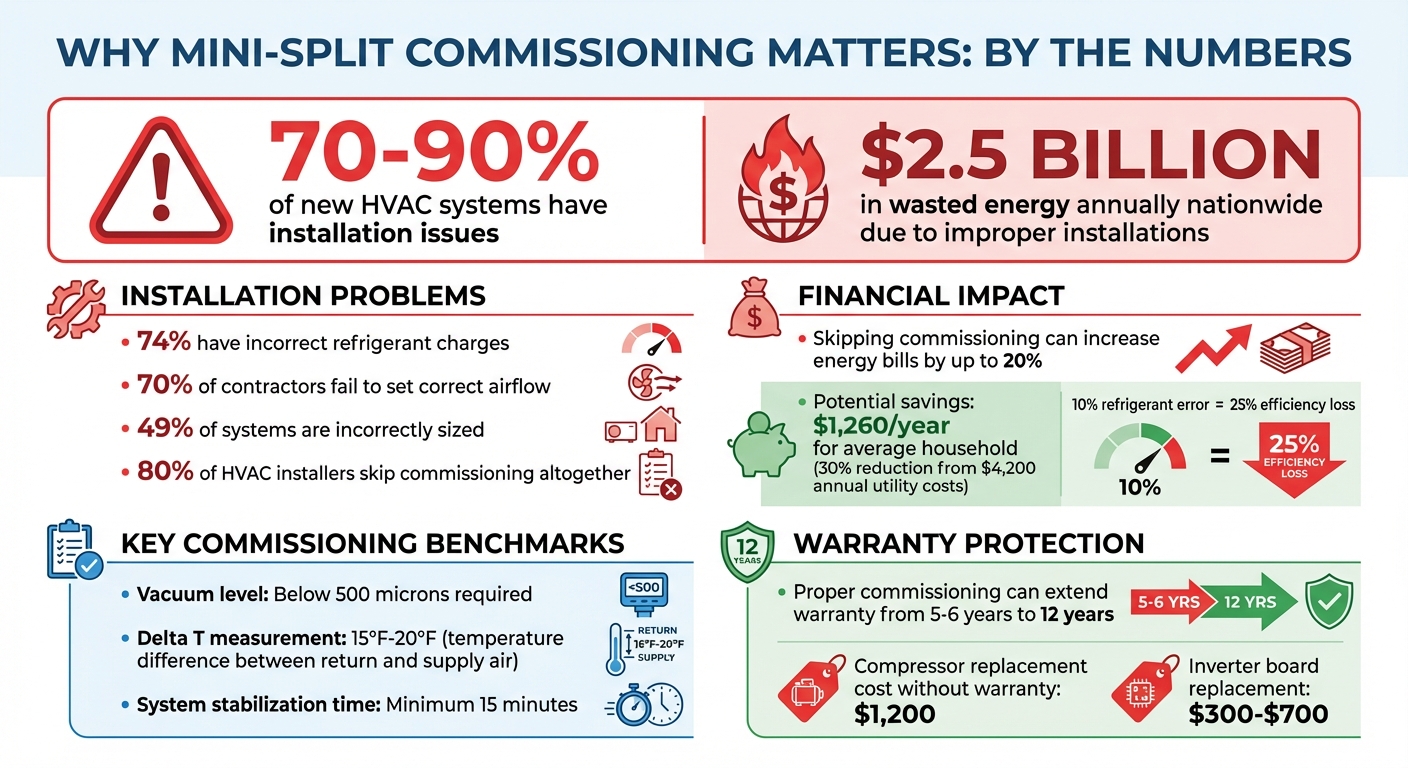
Mini-Split Commissioning Statistics and Impact on Energy Efficiency
Installing and commissioning DAIKIN R32 Ductless Mini Split AIR CONDITIONER

sbb-itb-b5c10b1
What Is Mini-Split Commissioning?
Commissioning is the process that ensures your mini-split system operates as intended. It goes beyond just installing the units – mounting them, connecting electrical components, and running line sets. Commissioning involves verifying, testing, and fine-tuning every aspect of the system to align with the manufacturer’s specifications. Think of it as the step that ensures your system doesn’t just look ready but actually performs at its best.
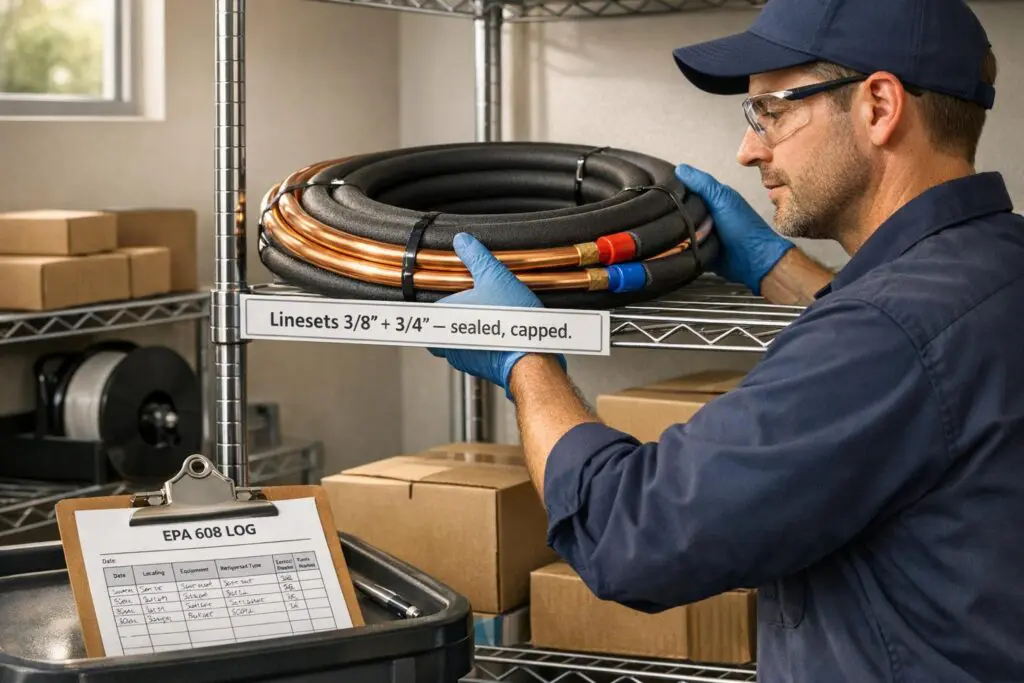
While installation is about assembling the parts, commissioning ensures they work together seamlessly. This is done by running diagnostic tests under real-world conditions. Tools like digital manifold gauges, refrigerant scales, and vacuum pumps are used to measure and compare system performance against precise benchmarks.
"Just as a conductor ensures each section of an orchestra harmonizes, your refrigerant charge ensures your air conditioning system operates efficiently and effectively." – Mike, Efficient Mini Splits
Why does this matter? A properly commissioned system is optimized for peak performance, which not only prevents early compressor failure but also validates your manufacturer’s warranty. Skipping this step might leave you with a system that looks functional but hasn’t been proven to perform correctly.
Key Steps in the Commissioning Process
To protect your investment and ensure top performance, commissioning involves several important steps. Here’s a breakdown:
- Nitrogen Pressure Testing: This step checks for leaks in the refrigerant lines.
- Deep Vacuum Evacuation: Moisture and non-condensables are removed from the system. The vacuum level must drop below 500 microns, measured with a micron gauge.
- Refrigerant Charge Verification: Using a refrigerant scale, technicians confirm the exact charge matches the system’s nameplate specifications.
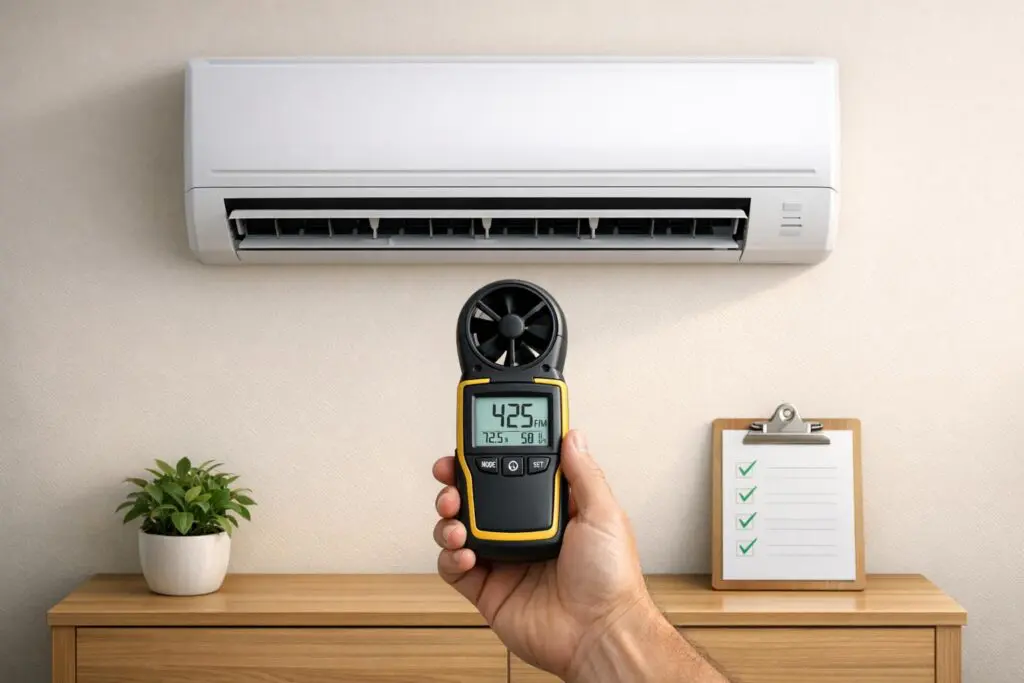
- System Stabilization and Delta T Measurement: After running the system for at least 15 minutes, the temperature difference (Delta T) between return and supply air is measured. It should typically fall between 15°F and 20°F.
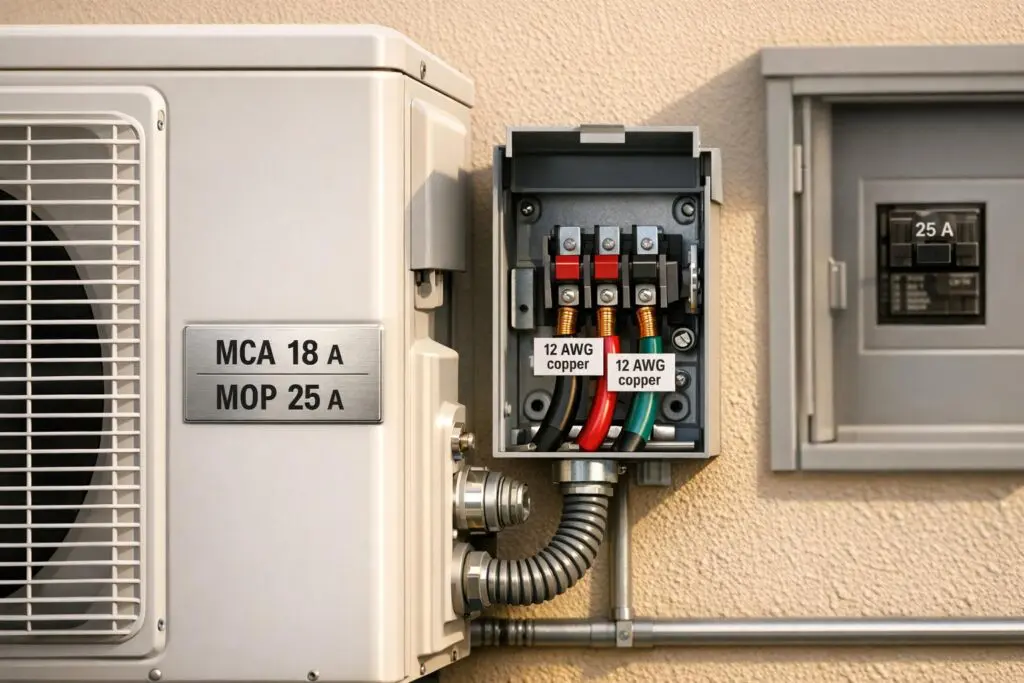
Physical checks are just as important. The outdoor condenser must be perfectly level, as even a slight tilt (like 5°) can disrupt oil return to the compressor, potentially causing mechanical failure. Electrical connections are tightened with a torque wrench to prevent arcing, drainage is tested by pouring water into the drain pan, and technicians ensure proper clearances around the indoor unit.
| Refrigerant Type | Optimal Low Side Pressure (psi) | Optimal High Side Pressure (psi) |
|---|---|---|
| R-410A | 120–140 | 350–450 |
| R-32 | 75–110 | 280–320 |
| R-22 | 60–85 | 250–300 |
Note: These pressures can vary depending on ambient temperature and the manufacturer’s specific guidelines.
"Spending the extra hour on math now, and you will save hundreds of dollars in power and repairs later." – Mark Callahan, The Furnace Outlet
The Consequences of Skipping Commissioning
Skipping commissioning can result in higher energy bills, uneven comfort, and early equipment failure. Improper ductless mini split installation often leads to widespread performance issues, with duct leakage alone sometimes causing nearly 100% of systems to underperform.
Higher Energy Bills
When commissioning is skipped, even small imbalances can snowball into energy inefficiency. An uncommissioned system wastes energy, driving up utility costs. For example, incorrect refrigerant levels force the compressor to work harder, while skipping or rushing the vacuum step traps air inside the system. This increases head pressure and reduces efficiency. Improper HVAC installations are estimated to account for about 9% of all energy consumed by these systems nationwide, adding roughly $2.5 billion to annual utility bills.
Factory settings rarely align with a home’s specific needs. Incorrect refrigerant charges and restricted airflow force the compressor to overwork, wasting energy. A system with just a 20% undercharge or a 15% airflow reduction can experience significant energy loss.
This inefficiency doesn’t just hurt your wallet – it also disrupts comfort.
Comfort and Performance Problems
Uncommissioned systems often fail to maintain consistent indoor temperatures. Some rooms may feel too warm while others remain too cold, or the system might run endlessly without ever meeting the thermostat’s setting. These comfort issues are often due to improper calibration for the specific space. Alarmingly, 70% of contractors fail to set the correct airflow for a home’s equipment size , which is why it is critical to choose the right air conditioning company for the job, and 49% of HVAC systems are incorrectly sized for their intended space.
Even minor errors can have a big impact. For instance, if the outdoor unit isn’t level – just a 5° tilt can cause this – oil might not return properly to the compressor. Similarly, an improperly sloped drainage line can lead to water backups, potentially damaging surrounding materials.
These comfort issues also increase the likelihood of serious equipment damage.
Premature Equipment Failure
The most expensive consequence of skipping commissioning is premature equipment failure. When moisture isn’t fully removed during installation, it can mix with refrigerant and oil to create corrosive acids. These acids can damage compressor windings and bearings from the inside. Trapped non-condensable gases generate excess heat, which accelerates wear and tear.
"The vacuum pump is the ONLY tool that separates a successful, efficient, warranty-backed installation from a guaranteed failure." – South Mini Splits
Most major manufacturers require proof of proper commissioning – such as a deep vacuum reading below 500 microns – to honor warranty claims. Without this documentation, you could be left paying for a full system replacement. Considering that 74% of systems installed by licensed contractors have an incorrect refrigerant charge, nearly three out of every four installations may already face risks of premature failure and warranty denial.
Benefits of Proper Mini-Split Commissioning
Getting your mini-split system commissioned correctly doesn’t just mean smoother operation – it’s also about protecting your investment. A well-commissioned system delivers better efficiency, lasts longer, and can save you money over time.
Better Energy Efficiency
Commissioning fine-tunes your system to eliminate energy waste. It starts with a Manual J load calculation, which ensures your unit is the right size. This prevents short-cycling – when oversized systems constantly turn on and off – wasting energy and wearing out components.
When done right, the variable-speed compressor adjusts precisely to your heating or cooling needs. With proper inverter setup and no duct losses (a common issue in central air systems, where over 30% of energy is wasted), you could see utility bills drop by nearly 30%. For a household spending $4,200 annually on utilities, that’s about $1,260 in yearly savings. Plus, these efficiency improvements help your equipment last longer.
Longer Equipment Lifespan
Proper commissioning doesn’t just save energy – it also protects your system from wear and tear. For example, a nitrogen pressure test (150–300 PSI) and a deep vacuum evacuation to 500 microns remove moisture and air. Without these steps, corrosive acids could form inside the system, damaging components.
Electrical connections are another critical checkpoint. Verifying these connections prevents arcing, which can destroy inverter boards. Replacing an inverter board costs $300 to $700, compared to under $50 for a standard contactor in traditional systems. Refrigerant charging is also key – undercharging can overheat the compressor, while overcharging creates excessive pressure. Even testing condensate drainage is essential, as standing water can lead to mold or structural damage. Together, these steps significantly reduce the risk of failures, helping your system last longer.
Warranty Protection and Fewer Service Calls
Many manufacturers, including Mitsubishi Electric and Fujitsu, require installation by a licensed HVAC professional to keep warranty coverage valid. For instance, Eco Temp HVAC’s Mitsubishi Diamond Elite Contractor certification allows them to offer a 12-year warranty on Mitsubishi products – but only if proper commissioning is documented. Failing to register the system within the required 60–90 days could reduce that coverage to just 5 or 6 years.
"A warranty is your financial safety net, covering pricey parts for a decade or more… but only if you follow the rules." – Mark Callahan
Keeping commissioning records – like operating pressures, superheat, and subcooling readings – can also make filing warranty claims easier. This documentation could save you from paying out-of-pocket for major repairs, like a $1,200 compressor replacement. Plus, a properly commissioned system is less likely to need frequent service calls, saving you time and reducing headaches.
Why Commissioning Is Often Overlooked
Despite being a critical step, nearly 80% of HVAC installers skip the commissioning process altogether. This isn’t always due to negligence – various factors, like outdated training methods and misconceptions about time and cost, play a significant role in why commissioning often gets ignored.
Lack of Awareness or Training
A major issue is that many technicians simply aren’t taught how to commission systems properly. Instead of pursuing formal certifications, they often rely on informal, on-the-job training. Unfortunately, this training often comes from peers who view mini-splits as simple plug-and-play systems rather than intricate setups requiring precise adjustments.
Without proper education, many installers also lack the expertise to use advanced tools like digital manifolds or micron gauges – specialized equipment that can cost between $700 and $800.
"Not all HVAC installers are trained properly or at all. So, the best training that they have typically is… from the word of the guy that’s been doing it longer." – Josh, Fire & Ice
This gap in training leads to widespread installation errors. For example, even a seemingly minor issue – like being off by just 2.3 ounces of refrigerant – can result in short-cycling, which impacts system efficiency and durability. These gaps in knowledge often cause technicians to take shortcuts, skipping essential commissioning steps.
Perceived Time and Cost Barriers
Beyond training deficiencies, many installers face significant time and cost pressures. Commissioning takes between 45 and 90 minutes, which some contractors view as an unnecessary delay. In high-volume environments, speed often takes priority over thoroughness, leading to skipped steps like nitrogen leak testing or triple vacuum pulls.
Homeowners can inadvertently contribute to this problem by opting for lower-cost quotes that omit commissioning. They may not realize that these shortcuts could result in extensive future repairs costing thousands of dollars. This mindset often leads both contractors and customers to treat commissioning as an optional extra rather than a necessary step to ensure system longevity and warranty protection.
The Role of Certified Professionals
Hiring certified technicians makes a world of difference. Professionals trained in recognized standards – like ACCA QI-5 or ENERGY STAR HVAC Commissioning – use advanced tools and follow strict protocols to ensure systems are installed correctly and warranties remain valid.
For instance, Eco Temp HVAC employs certified technicians who adhere to rigorous commissioning practices, allowing them to offer a 12-year warranty on Mitsubishi products. To ensure you’re working with qualified professionals, ask for a documented commissioning checklist, verify the use of digital diagnostic tools, and confirm that protective line hide is part of the quote.
"If your contractor doesn’t talk about commissioning, walk away." – Fire & Ice
Taking these steps ensures homeowners can enjoy the full benefits of a well-installed, efficient, and reliable HVAC system.
Conclusion
Commissioning a mini-split system isn’t just an extra step – it’s what ensures your system delivers on its promises. Without it, you risk higher costs and reduced comfort. In fact, statistics show that 90% of newly installed HVAC systems have issues that impact efficiency or comfort. Even more concerning, installation-related errors lead to about $2.5 billion in wasted energy across the U.S. every year. The good news? These problems can be avoided with proper commissioning.
This process involves critical steps like nitrogen leak testing, pulling multiple vacuums to 500 microns, verifying refrigerant levels, and calibrating airflow. Small mistakes can have big consequences – just a 10% error in refrigerant charge can slash system efficiency by 25%.
By following these guidelines and working with certified professionals, you can protect both your investment and peace of mind. At Eco Temp HVAC, technicians adhere to strict commissioning protocols for every installation, which allows them to confidently offer a 12-year warranty on Mitsubishi products.
To maintain efficiency and safeguard your warranty, it’s essential to choose a contractor who prioritizes transparency. Look for someone who provides a detailed commissioning checklist, including data on static pressure, refrigerant charge, and vacuum decay tests. Also, confirm they use modern tools like digital manifold and micron gauges – avoiding outdated analog equipment or guesswork.
Your mini-split system is a significant investment in both comfort and energy savings. Proper commissioning ensures you get the performance, lower energy costs, and reliability you’re paying for. Don’t settle for less – insist on thorough commissioning.
FAQs
How do I know if my mini-split was properly commissioned?
To make sure your mini-split system was set up correctly, verify that key aspects like controls, refrigerant charge, airflow, and overall system performance were thoroughly tested. This process ensures the system runs efficiently and provides the best possible performance.
Can improper commissioning void my mini-split warranty?
Skipping essential steps during commissioning – such as accurate system registration, routine maintenance, or proper installation – can jeopardize your mini-split warranty. Make sure these tasks are completed thoroughly to safeguard your investment and keep your warranty intact.
Is commissioning still needed if my mini-split seems to work fine?
Even if your mini-split seems to be running smoothly, commissioning is a must. It ensures the system operates at its best, improves energy efficiency, and helps prolong its lifespan. Overlooking this step can mask underlying problems that might hurt reliability and drive up energy bills in the long run.