
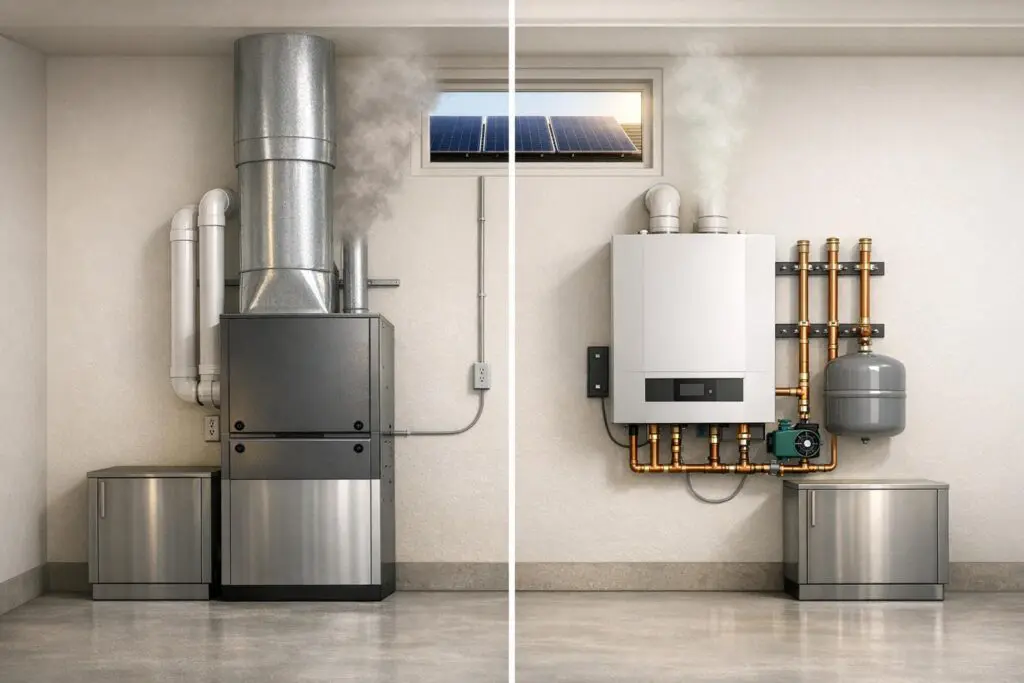
When deciding between a furnace and a boiler for home heating, understanding their carbon footprints is key. Both systems are effective, but they differ in how they work, their efficiency, and their environmental impact. Here’s a quick breakdown:
- Furnaces heat air and distribute it through ducts. Modern models with high AFUE ratings (up to 99%) reduce emissions significantly.
- Boilers heat water or steam for distribution through pipes. They are slightly more efficient than furnaces, with AFUE ratings up to 97%, and often cost less to operate.
- Fuel type matters: Natural gas produces less CO₂ than heating oil, but methane leaks during extraction add to its overall impact.
- Efficiency upgrades: Switching from an 80% to a 96% AFUE system can cut annual CO₂ emissions by over 1,600 pounds, equivalent to planting 275 trees over 15 years.
- Electric systems: While highly efficient, their carbon footprint depends on how the electricity is generated.
Quick Comparison
| Feature | Furnaces | Boilers |
|---|---|---|
| Heating Method | Heats air, uses ducts | Heats water/steam, uses pipes |
| Max AFUE | ~99% | ~97% |
| Distribution | Forced air | Radiators, baseboards, floors |
| Lifespan | 15–25 years | 20–30 years |
| CO₂ Emissions | Varies by fuel and efficiency | Varies by fuel and efficiency |
Choosing the right system depends on your home’s needs, fuel availability, and efficiency goals. High-efficiency models and renewable energy options can further reduce emissions and save on energy costs.
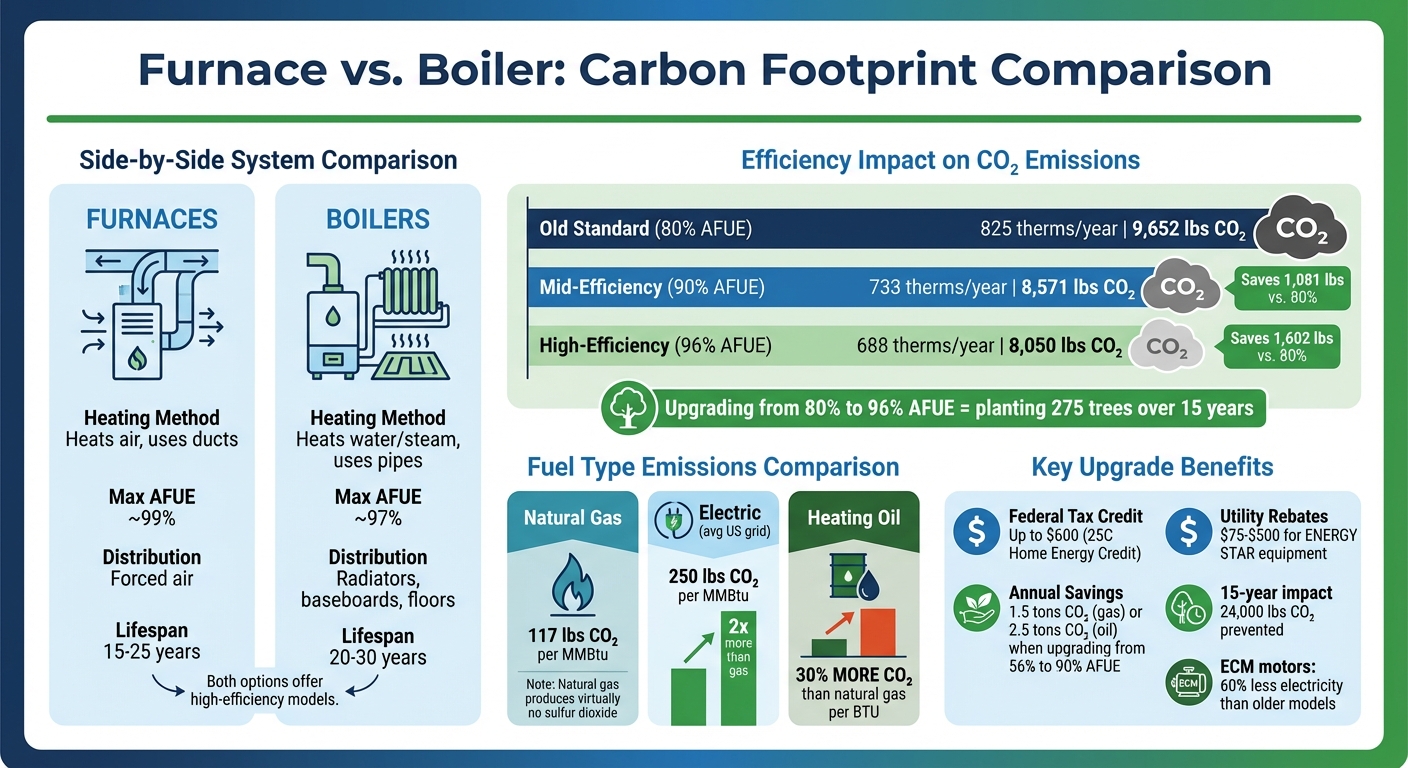
Furnace vs Boiler Carbon Footprint and Efficiency Comparison
Embodied Carbon vs Carbon Footprint in Heating and Hot Water Systems
sbb-itb-b5c10b1
How Furnaces and Boilers Work
Understanding how these systems heat and distribute energy helps in evaluating their carbon footprints.
Furnaces: Forced-Air Heating
Furnaces heat air directly and distribute it through a system of ducts. When the thermostat calls for heat, the furnace burns fuel – usually natural gas, propane, or heating oil – in its combustion chamber. Some models run on electricity, though these are less common in colder areas. A heat exchanger warms the air, while a blower motor pushes it through the ductwork to heat your home.
Burning natural gas produces heat, water vapor, and carbon dioxide. For example, burning one therm of natural gas releases around 11.7 pounds of CO₂. Many modern furnaces feature high-efficiency designs, including sealed combustion chambers that draw air from outside, reducing drafts and improving indoor air quality. Some also use condensing technology, which captures heat from exhaust gases by cooling them from 300–400°F to about 100°F. This process recovers heat that older systems waste, directly impacting carbon emissions.
Additionally, newer furnaces often include variable-speed ECM blowers, which consume about 60% less electricity than older models, further reducing indirect emissions.
Boilers, however, operate quite differently, using water or steam for heat distribution.
Boilers: Water and Steam Heating
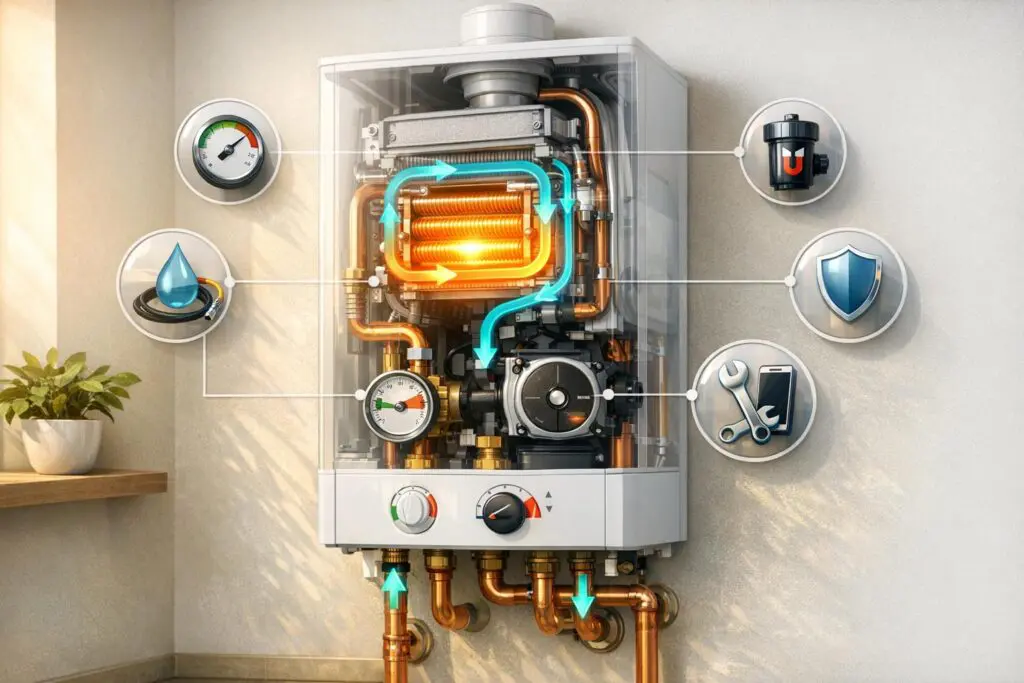
Boilers heat water or create steam and distribute it through sealed pipes to radiators, baseboard heaters, or radiant floor systems. This hydronic heating method takes advantage of water’s excellent ability to transfer heat compared to air. Like furnaces, boilers typically use natural gas, propane, heating oil, or electricity as fuel. Some models, known as combi boilers, also provide domestic hot water – a feature not found in furnaces.
Because water transfers heat more efficiently, boilers often cost less to run. Rene Langer, Senior Comfort Specialist at PICKHVAC, highlights this point:
"In almost all cases, a boiler costs less to operate than a furnace".
High-efficiency condensing boilers use technology similar to advanced furnaces, cooling exhaust gases to recover extra heat. These systems achieve AFUE ratings between 90% and 97% for natural gas models. The efficiency of water-based heat distribution also plays a role in reducing the overall carbon impact.
Boilers offer another advantage: they don’t circulate dust and allergens like forced-air systems, leading to cleaner indoor air. However, they do come with the risk of water damage if pipes or radiators leak. On the plus side, boilers typically last longer, with lifespans of 20 to 30 years compared to 15 to 25 years for furnaces.
Energy Efficiency and Carbon Emissions Comparison
The efficiency of your heating system plays a big role in how much fuel you burn and how much carbon dioxide (CO₂) you release into the air. Simply put, a more efficient system uses less fuel and produces fewer emissions.
AFUE Ratings Explained
AFUE (Annual Fuel Utilization Efficiency) is a standard measure of how effectively a furnace or boiler converts fuel into heat over the course of a year. The U.S. Department of Energy describes it as "the ratio of the furnace’s or boiler’s annual heat output compared to its total annual fossil fuel energy consumed".
For example, an AFUE of 90% means 90% of the fuel is turned into heat for your home, while the remaining 10% escapes through the chimney or flue. The higher the rating, the less waste and fewer carbon emissions. Modern high-efficiency condensing systems achieve AFUE ratings between 90% and 98.5% by using a secondary heat exchanger to capture extra heat from exhaust gases before they exit the system.
Electric furnaces and boilers, on the other hand, can technically achieve 95% to 100% AFUE because they convert electricity to heat with very little loss. However, their carbon emissions depend entirely on how the electricity is generated. In areas where coal is a primary energy source, electric systems can actually produce more emissions than high-efficiency gas systems.
Both furnaces and boilers offer similar efficiency ranges. For natural gas models, furnaces typically have 91.2% to 99% AFUE, while boilers range from 90% to 97%. Heating oil systems generally fall between 85% and 96.7% AFUE for furnaces and 87% to 91% for boilers.
These efficiency ratings directly affect the amount of carbon emissions produced during operation, as shown below.
CO₂ Emissions by Efficiency Level
Burning one therm (100,000 BTUs) of natural gas releases about 11.7 lbs of CO₂. A more efficient heating system uses fewer therms, reducing emissions.
The U.S. Department of Energy highlights the potential savings: "Upgrading your furnace or boiler from 56% to 90% efficiency in an average cold-climate house will save 1.5 tons of carbon dioxide emissions each year if you heat with natural gas, or 2.5 tons if you heat with oil".
Higher AFUE ratings not only cut fuel consumption but also significantly reduce carbon emissions. Here’s a comparison:
| Furnace Type | AFUE Rating | Annual Gas Use (Therms) | Annual CO₂ (lbs) | Carbon Saved vs. 80% AFUE |
|---|---|---|---|---|
| Old Standard | 80% | 825 | 9,652 | – |
| Mid-Efficiency | 90% | 733 | 8,571 | 1,081 lbs |
| High-Efficiency | 96% | 688 | 8,050 | 1,602 lbs |
Natural gas releases about 117 lbs of CO₂ per MMBtu of fuel. At 95% AFUE, this translates to roughly 123 lbs of CO₂ per delivered MMBtu. By contrast, an electric furnace running on the average U.S. grid emits about 250 lbs of CO₂ per delivered MMBtu, which is more than twice the emissions of a high-efficiency gas system.
Fuel Types and Their Impact on Carbon Emissions
When comparing heating systems, the type of fuel used plays a major role in determining carbon emissions. Each fuel type emits a specific amount of CO₂ and carries unique environmental challenges, making it essential to weigh their impacts carefully.
Natural Gas vs. Heating Oil
Natural gas emerges as the cleaner fossil fuel for home heating. Data shows that natural gas combustion generates about 117 lbs of CO₂ per MMBtu of fuel.
"Natural gas produces roughly 30% less carbon dioxide per BTU than heating oil and virtually no sulfur dioxide." – Samantha Reyes, The Furnace Outlet
Natural gas not only produces less carbon dioxide but also burns cleaner overall. It emits minimal sulfur dioxide, fewer nitrogen oxides, and fewer particulates compared to heating oil. In contrast, heating oil systems pose additional environmental concerns, such as the risk of soil contamination from tank leaks or spills.
That said, natural gas isn’t entirely without issues. Methane leakage during its extraction and transportation significantly adds to its carbon footprint. Methane is a greenhouse gas over 80 times more potent than CO₂ over a 20-year period. These indirect emissions are not reflected in the combustion data alone.
From a cost perspective, natural gas is also more affordable. It averages around $1.40 per therm, while heating oil costs approximately $4.10 per gallon. For homes with access to natural gas, switching from an oil boiler to a gas system can lead to lower operating costs and reduced emissions.
These considerations highlight why many are now looking toward renewable energy options for even greater emission reductions.
Renewable Energy Options
Renewable energy opens up further opportunities to minimize emissions. Options like biogas integration and hydrogen-ready burners are paving the way for blending renewable fuels with natural gas.
Solar-assisted systems are another practical solution. Solar water pre-heaters, for example, can reduce the amount of heating oil or gas needed by using solar energy to warm water before it enters the boiler. For homes without natural gas access, upgrading to a high-efficiency condensing oil boiler – such as the Weil-McLain GV90+ series – can still improve efficiency significantly compared to older models.
Hybrid or dual-fuel systems are gaining traction as well. These systems combine a high-efficiency furnace or boiler with an electric heat pumps. During milder weather, the heat pump uses cleaner electricity, while combustion heating kicks in only during extreme cold. This setup reduces overall fossil fuel use while ensuring reliable heating in harsh winters.
Benefits of Upgrading to High-Efficiency Systems
upgrading to high-efficiency furnaces or boilers isn’t just about cutting carbon emissions – it also brings real financial perks. According to the U.S. Department of Energy, energy upgrades can slash both fuel bills and carbon emissions by half.
Modern systems use advanced features like condensing technology, sealed combustion, and variable-speed ECM motors, which consume 60% less electricity compared to older PSC motors. These improvements not only reduce emissions but also translate into noticeable savings on energy costs.
Emissions Reductions from System Upgrades
The environmental impact of upgrading depends on your current system’s efficiency and fuel type. For example, replacing a 56% AFUE system with a 90% AFUE system can save an average cold-climate home 1.5 tons of CO₂ annually for gas systems and 2.5 tons for oil systems. Even a smaller upgrade, like moving from an 80% AFUE furnace to a 96% AFUE model, cuts CO₂ emissions by around 1,602 lbs per year.
Over a 15-year lifespan, these savings add up. A high-efficiency system can prevent 24,000 lbs of CO₂ emissions, which is roughly the same as planting 275 trees. Additionally, high-efficiency burners can lower nitrogen oxide (NOx) emissions by up to 70%, making them friendlier to the environment.
The bottom line? Lower emissions mean reduced energy use – and lower heating bills.
Cost Savings and Financial Incentives
The financial benefits of upgrading go beyond just cheaper energy bills. High-efficiency systems can save you money upfront and over time through various incentives and rebates.
For instance, the Federal 25C Home Energy Credit offers up to $600 for eligible high-efficiency heating systems. Local utilities often chip in too, with rebates ranging from $75 to $500 for ENERGY STAR® certified equipment. In colder climates, the energy savings typically offset the higher initial cost within 4–7 years.
Before committing to a new system, consider improving your home’s insulation and sealing ductwork. These upgrades can allow for a smaller, more efficient unit – cutting both upfront costs and long-term emissions.
Conclusion
Furnaces and boilers can significantly reduce carbon emissions when paired with high-efficiency systems and clean energy sources. Modern condensing systems, with efficiency ratings of 95–98% AFUE, outperform older 80% units by a wide margin. Meanwhile, heat pumps stand out for their minimal carbon impact, as they transfer heat rather than burn fuel. Considering that residential heating contributes roughly 15% of all U.S. energy-related emissions, choosing the right system is a meaningful step toward sustainability.
To maximize these benefits, consider upgrading outdated equipment to advanced high-efficiency models, pairing them with renewable energy options like solar panels, and scheduling regular maintenance to ensure peak performance. In areas where the electricity grid is becoming cleaner – such as the U.S., where coal usage has dropped from 45% in 2010 to under 20% by 2025 – electric heat pumps become an even more attractive option for reducing emissions.
As Eco Temp HVAC explains:
"In most Chicago homes, switching to a cold-climate ductless heat pump can cut your heating costs by 20–40% while reducing your carbon footprint."
Getting professional advice is crucial. Companies like Eco Temp HVAC provide expert services, from precise load calculations to recommending the most efficient system for your home. They also help navigate federal tax credits and local rebates. As a Mitsubishi Diamond Elite Contractor and Navien Service Specialist, Eco Temp HVAC specializes in installing and maintaining cutting-edge, low-carbon heating solutions across the Chicagoland area.
Whether you opt for a furnace, boiler, or heat pump, focusing on high efficiency is the key to reducing emissions. By choosing a condensing boiler, a high-efficiency furnace, or a heat pump, you can enjoy lower energy bills, a smaller carbon footprint, and greater comfort – all with the right system and skilled installation.
FAQs
Which has a lower carbon footprint in my home: a furnace or a boiler?
Electric heating systems often produce fewer emissions compared to gas furnaces, especially in regions where electricity is generated from renewable energy sources. Unlike gas furnaces, which emit carbon dioxide during combustion, electric systems operate without releasing emissions directly. Similarly, electric boilers can be a greener option when powered by clean energy. If you’re looking to lower your carbon footprint, focus on the efficiency of the system you choose and the energy sources available in your area.
Is switching to electric heat cleaner than gas in my area?
Switching to electric heating can help lower emissions, but the actual impact depends heavily on the energy sources powering your local grid. In regions where electricity comes from renewable or low-carbon sources, electric systems like heat pumps tend to be a cleaner option. On the other hand, if your grid relies heavily on fossil fuels, gas heating might result in fewer emissions overall. The environmental benefits of making the switch will vary based on your area’s electricity mix and how efficient the electric system you choose is.
What upgrades cut heating CO₂ the most without replacing everything?
To cut down heating-related CO₂ emissions without overhauling your entire system, focus on making it more efficient. Start by considering a high-efficiency furnace with an AFUE rating of 96% or higher, or upgrade to a variable-speed blower motor for better energy use.
Other practical steps include:
- Sealing air leaks to prevent heat loss.
- Using programmable thermostats to maintain precise temperature control.
- Replacing filters regularly to keep your system running smoothly.
These upgrades not only enhance your system’s performance and reduce fuel usage but also help lower carbon emissions – all without needing a complete system replacement.