
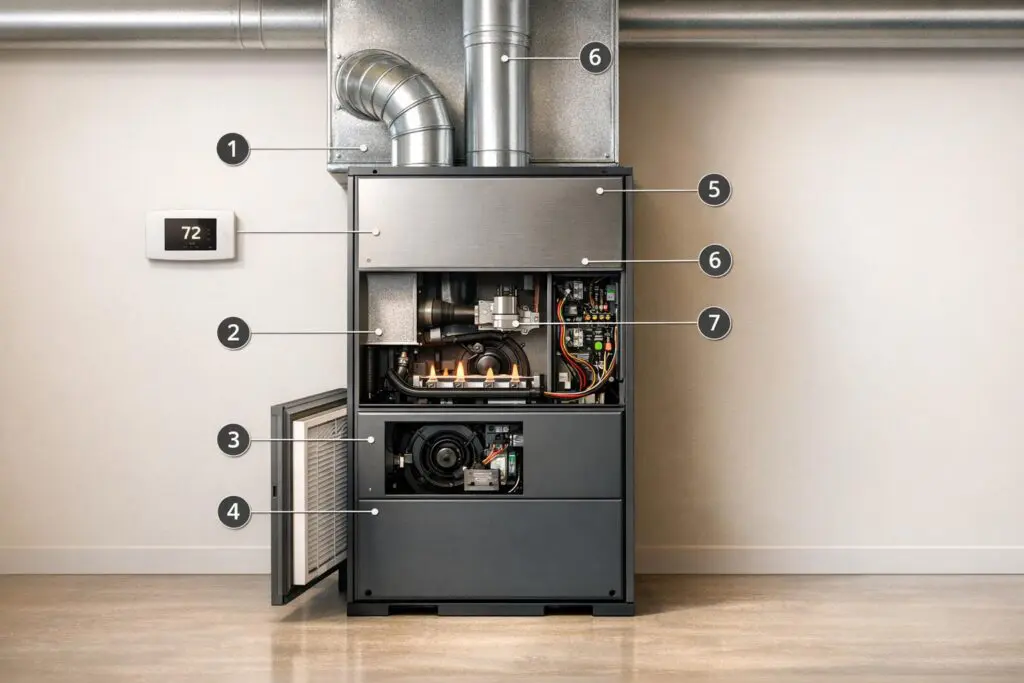
When your furnace stops working, it’s usually due to one of these seven common issues. Some can be fixed easily, while others require professional help. Here’s a quick breakdown:
- Furnace Won’t Turn On: Check thermostat settings, power switches, circuit breakers, and air filters. If unresolved, call a technician.
- Not Enough Heat: Likely caused by dirty filters, thermostat settings, or leaky ductwork. Replace filters or adjust settings.
- Short-Cycling (Turns On/Off Too Often): Caused by clogged filters, thermostat placement, or mechanical issues. Replace the filter or call a professional.
- Unusual Noises: Sounds like banging, squealing, or clicking often signal mechanical or electrical problems. Some fixes are DIY; others need expert attention.
- Dirty Air Filters: Replace filters every 1–3 months to prevent airflow issues and overheating.
- Thermostat Malfunctions: Dead batteries, poor placement, or wiring issues can disrupt function. Replace batteries or clean the device.
- Blower Fan Problems: Weak airflow or endless running may point to filter clogs or electrical faults. Check settings and filters.
Key Tip: Always replace air filters regularly and schedule annual maintenance to avoid costly repairs. For complex issues, a professional technician is your safest bet.
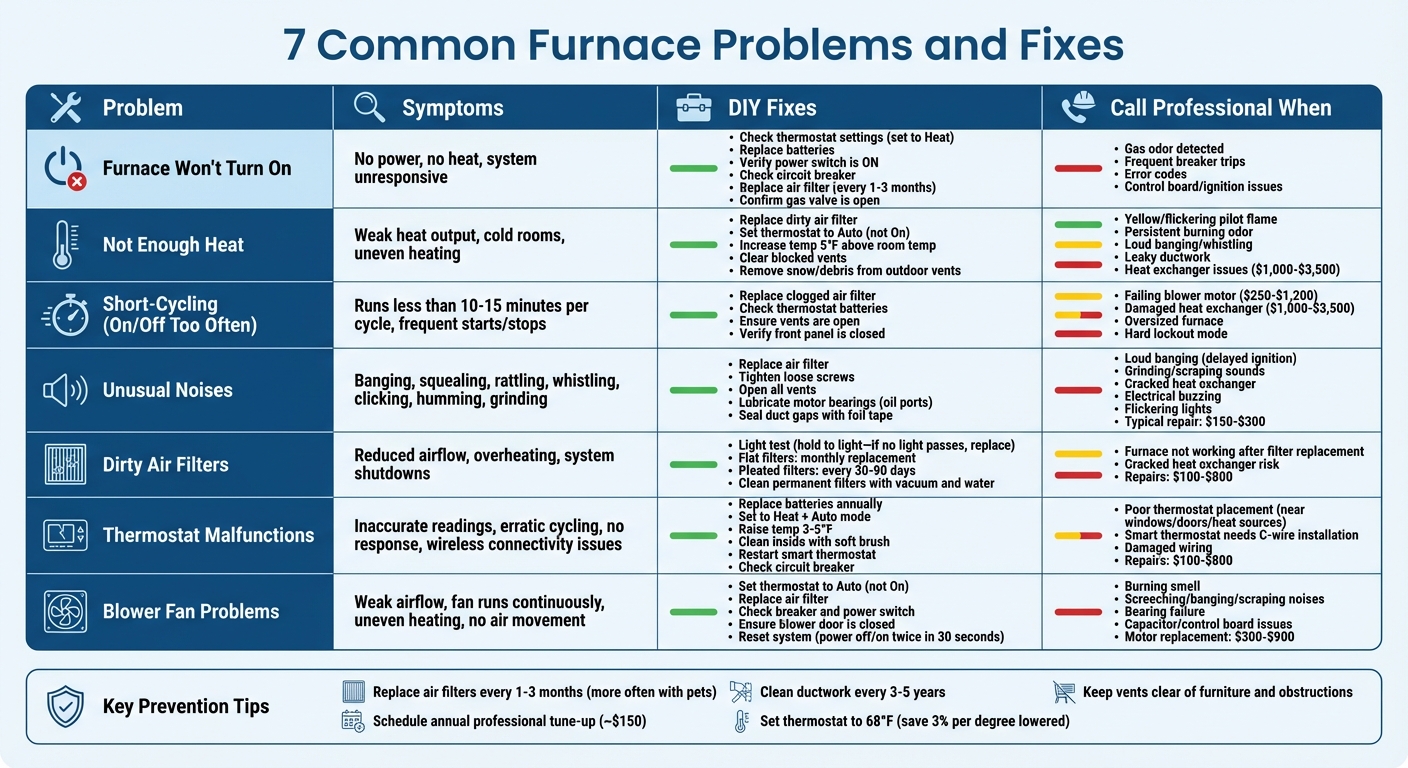
7 Common Furnace Problems: Symptoms, DIY Fixes, and When to Call a Pro
1. Furnace Won’t Turn On
Common Causes of the Problem
When your furnace refuses to start, it’s often due to simple issues. For instance, the thermostat might be set to "Cool" or "Off", or its batteries could be dead. It’s also possible the thermostat is programmed below the current room temperature, which prevents the furnace from kicking in. Power interruptions, such as a flipped power switch near the furnace or a tripped circuit breaker, can also cut power to the system.
Another common culprit is a clogged air filter or blocked vents. These can cause the heat exchanger to overheat, triggering the safety limit switch to shut the system down. For gas-powered furnaces, problems like a closed gas valve, an empty propane tank, or a clogged fuel line could prevent the burners from igniting.
DIY Troubleshooting Steps
Start by checking the thermostat. Make sure it’s set to Heat and the temperature is higher than the current room temperature. Next, confirm that the furnace’s power switch is turned on and that no circuit breakers have tripped.
Inspect the air filter. A dirty or clogged filter can disrupt airflow and lead to shutdowns, so replace it if needed. Ideally, filters should be swapped out every 1 to 3 months. For gas furnaces, verify that the gas valve handle is in the open position (parallel to the pipe). Also, check that the front panel door is securely clicked into place, as this engages the safety interlock.
If these steps don’t resolve the issue, it’s time to call in the pros.
When to Call a Professional
If your furnace still won’t turn on after basic troubleshooting, it’s best to contact a professional. And if you notice a gas odor – often described as a rotten-egg smell – leave your home immediately and call 911 or your utility provider.
Certain problems, such as those involving control boards, heat exchangers, or ignition systems, require specialized tools and expertise. Frequent circuit breaker trips or error codes on modern units are also signs of deeper issues that go beyond DIY fixes.
Attempting complex repairs yourself can void warranties and create serious safety hazards. For those in the Chicagoland area, Eco Temp HVAC offers 24/7 service with certified technicians who can safely handle even the most complicated electrical and mechanical problems.
2. Not Enough Heat
Common Causes of the Problem
A furnace that doesn’t produce enough heat can often be traced back to a few key issues. Dirty air filters are a frequent culprit. When filters are clogged, they restrict airflow, causing the furnace to overheat and deliver less heat overall. Another common problem is thermostat missettings. For instance, if your thermostat’s fan mode is set to On instead of Auto, the blower may continuously circulate unheated air between cycles, leaving rooms feeling colder than they should.
Leaky ductwork can also lead to heat loss. Cracks or gaps in the ducts allow warm air to escape before it reaches your living spaces. This is particularly noticeable in upper floors or rooms farthest from the furnace. According to the National Air Duct Cleaners Association, ductwork should be cleaned every 3 to 5 years to maintain optimal airflow. Additionally, blocked supply registers – whether from furniture, closed vents, or shut air duct dampers – can restrict heat delivery to specific areas.
Mechanical issues are another possibility. Components like faulty flame sensors, broken igniters, or a damaged heat exchanger can all reduce your furnace’s efficiency. A cracked heat exchanger is especially serious and costly to fix, with replacement costs reaching up to $3,500. For gas furnaces, ensure the gas valve is open, and if you have an older model, check that the pilot light is lit.
DIY Troubleshooting Steps
Before calling for help, there are a few things you can check yourself. Start with the thermostat. Make sure it’s set to Heat and increase the temperature by 5°F above the current room temperature to see if the furnace kicks on. Also, switch the fan mode to Auto to prevent cold air from circulating unnecessarily.
Inspect the air filter. Hold it up to a light source – if light doesn’t pass through, it’s time to replace it. Standard one-inch filters typically need replacement every 30 days, while thicker four-inch filters can last up to a year.
Next, ensure all supply registers are open and free from obstructions like furniture or rugs. Don’t forget to check the outdoor intake and exhaust vents, clearing away any snow, ice, or debris that might block airflow.
"When a furnace is not operating, we tell the homeowner to make sure their air filter is clean, confirm the gas supply is on, and verify the power switch to the furnace is turned on." – Kevin Dickson, President of Energy Services Air Conditioning, Heating and Electrical
If these steps don’t resolve the issue, it’s time to call in a professional.
When to Call a Professional
If basic troubleshooting doesn’t restore sufficient heat, a professional technician should step in. More complex issues – like problems with the circuit control board, blower motor, heat exchanger, or gas valves – require specialized tools and expertise.
Certain warning signs demand immediate attention. A yellow or flickering pilot flame, for example, could signal carbon monoxide issues. Other red flags include excessive rust on the flue, persistent burning odors, or loud banging and whistling noises.
Leaky ductwork hidden behind walls often requires professional pressure testing to locate and repair. Minor duct repairs typically cost between $100 and $800, but major fixes, such as replacing a heat exchanger, can cost thousands.
For those in the Chicagoland area, Eco Temp HVAC offers 24/7 service with certified technicians ready to handle everything from simple thermostat adjustments to intricate mechanical repairs.
3. Furnace Turns On and Off Too Often
Common Causes of the Problem
Ideally, a furnace should run for about 10–15 minutes per cycle. If your furnace turns on and off frequently, this is known as short-cycling, and it can lead to excessive wear on your system while driving up energy costs.
One of the most frequent causes is a dirty air filter. When filters are clogged with dust and debris, airflow becomes restricted. This can cause the heat exchanger to overheat, triggering a safety shut-off. Another common issue stems from thermostat placement. A thermostat near a heat source like a lamp, window, or kitchen may misread the room’s temperature and shut the furnace off prematurely. Faulty wiring or low batteries can also disrupt proper functioning.
A dirty flame sensor is another potential culprit. If soot builds up on the sensor, it may fail to detect the burner flame, leading to a safety shutdown. Additionally, an oversized furnace, one that’s too powerful for your home, can heat the space so quickly that it shuts off before completing a full cycle. Mechanical problems like a faulty limit switch, a clogged flue, or even a cracked heat exchanger can also cause short-cycling or push the system into "lockout" mode.
DIY Troubleshooting Steps
If your furnace is short-cycling, there are a few things you can check on your own before calling a professional.
Start with the air filter. Hold it up to a light source – if little to no light passes through, it’s time for a replacement. Next, check your thermostat. If the display looks dim, replace the batteries. Ensure all vents are open and unobstructed to allow proper airflow. Lastly, double-check that the furnace’s front panel is securely closed, as an open panel can trigger the safety switch.
If these steps don’t solve the problem, it’s a sign that professional service may be required.
When to Call a Professional
If replacing the filter and checking the thermostat doesn’t stop the short-cycling, it’s time to bring in a technician. More complex issues like a failing blower motor (repair costs range from $250–$1,200), a damaged heat exchanger ($1,000–$3,500), or an oversized furnace will need expert attention.
However, certain situations call for immediate action. If you detect a gas smell, hear loud banging or screeching noises, or if your carbon monoxide alarm goes off, shut down the furnace and seek help immediately. Similarly, if the furnace enters "hard lockout" mode – refusing to ignite after multiple failures – do not attempt to reset it yourself. Eco Temp HVAC offers 24/7 service across the Chicagoland area to quickly diagnose and fix short-cycling problems, ensuring your system stays safe and functional.
Preventive Maintenance Tips
Regular maintenance is key to avoiding short-cycling and keeping your furnace running efficiently. Replace air filters every 1–3 months, schedule a professional tune-up annually, and have your ductwork cleaned every 3–5 years for optimal performance.
4. Unusual Noises
Common Causes of the Problem
A furnace should run quietly, so any loud or strange noises are usually a sign of trouble. Interestingly, about 6.6% of homeowners report odd noises as a major issue with their gas furnace.
- Banging or booming: This often happens when gas builds up in the combustion chamber and ignites all at once, a condition known as delayed ignition. It can also be caused by metal ductwork expanding and contracting as temperatures shift.
- Squealing or screeching: These sounds might indicate a worn or slipping blower belt or motor bearings that need lubrication.
- Rattling or clanking: Loose panels, screws, or blower wheels are common culprits. If the rattling happens right at startup, it could be a cracked heat exchanger, which is a serious safety concern.
- Whistling: This typically comes from restricted airflow, often due to a clogged filter, blocked vents, or leaks in the ductwork.
- Clicking: If clicking continues without the furnace lighting, the ignition system may have a problem, such as a faulty ignitor or dirty flame sensor.
- Humming or buzzing: These sounds often suggest electrical issues like a failing transformer or capacitor.
- Grinding or scraping: These noises usually mean worn-out ball bearings, and the unit should be turned off immediately to avoid further damage.
Catching these noises early can save you from bigger problems down the road, just like keeping an eye on your furnace’s heat output and cycling patterns.
DIY Troubleshooting Steps
Once you’ve identified the type of noise, try these steps to address it:
- Check the air filter for dirt or clogging, as this often causes whistling and puts a strain on the system.
- Tighten any loose screws on the furnace cabinet or access panels with a screwdriver to stop rattling.
- Ensure all vents and registers are open and free from obstructions like furniture or rugs.
- If your furnace motor has oil ports, apply lightweight machine oil to the bearings after turning off the power.
- Seal gaps in ductwork causing whistling with foil tape or mastic sealant – avoid using standard duct tape, as it won’t hold up.
If the noise persists despite these efforts, it’s time to bring in a professional.
When to Call a Professional
Some noises require immediate expert attention. For example:
- Loud banging (delayed ignition) or persistent clicking (ignition failure) should prompt a call to a technician right away.
- Grinding or scraping means you need to shut off the furnace immediately and seek professional help.
- A cracked heat exchanger, often indicated by rattling along with soot, a chemical smell, or a yellow/orange flame instead of blue, is an emergency. This can lead to dangerous carbon monoxide leaks.
- Electrical buzzing could signal a failing transformer or loose wiring, which are potential fire hazards. If your lights flicker when the furnace cycles on, it’s likely a serious electrical issue.
Fixing noise-related furnace problems usually costs between $150 and $300. Eco Temp HVAC offers 24/7 service across Chicagoland to diagnose and fix these issues safely.
Preventive Maintenance Tips
To avoid noise problems and keep your furnace running efficiently, schedule a fall tune-up, replace filters every 1–3 months, and lubricate motor bearings once a year.
5. Dirty Air Filters
Common Causes of the Problem
HVAC experts agree that clogged filters are one of the leading causes of furnace issues. As your furnace pulls in air from your home, it also collects dust, pet hair, and other debris on the filter. Factors like having multiple pets, a large household, the size of your home, and even where you live can speed up how quickly your filter gets clogged. Dust can also build up during the months your furnace isn’t in use, leading to potential issues when you turn it on for the first time in the season. The type of filter you use and any allergies in your household can also determine how often the filter needs attention.
DIY Troubleshooting Steps
A simple way to check your filter is by using the light test: hold the filter up to a light source – if no light shines through, it’s time for a replacement. Before inspecting or replacing the filter, make sure to turn off both the thermostat and furnace power for safety. Flat filters should be replaced monthly, while pleated filters should be checked monthly and replaced every 30–90 days, depending on their condition. If you have pets, you might need to check the filters every few weeks since pet hair and dander can clog them faster.
When installing a new filter, pay attention to the arrow on the frame – it should point toward the furnace to ensure proper airflow. If you’re using a permanent filter, clean it by vacuuming with a shop vac, rinsing it with water, and letting it fully air dry before reinstalling. Never run your furnace without a filter, as it can harm the system and worsen your home’s air quality. If replacing the filter doesn’t solve the problem, it’s time to call in a professional.
When to Call a Professional
If your furnace still isn’t working or isn’t heating properly after you’ve replaced the filter, get in touch with a professional like Eco Temp HVAC (https://ecotemphvac.com). Ignoring filter issues for too long can lead to a cracked heat exchanger, a dangerous problem that could release carbon monoxide into your home. Repair costs vary – standard furnace repairs typically range from $300 to $800, while minor fixes, such as replacing a sensor, might be as low as $100.
Preventive Maintenance Tips
To keep your furnace running smoothly, replace filters every 30–90 days. Homes with pets, kids, or high levels of dust may need more frequent changes.
sbb-itb-b5c10b1
6. Thermostat Malfunctions
Common Causes of the Problem
Thermostat issues are a common culprit when your furnace isn’t working as it should. Since the thermostat controls the furnace, even small malfunctions can cause big problems. These can include dead batteries, incorrect settings, poor placement, wireless connectivity issues, dust buildup, loose connections, or improper installation.
For example, if your thermostat is near exterior doors, windows, or heat sources, it can give inaccurate temperature readings, causing the furnace to cycle on and off unpredictably. Smart thermostats add another layer of complexity, as they can suffer from wireless glitches, software bugs, or insufficient power if a common "C" wire isn’t present. Dust, damaged wires, or an uneven installation can also throw the thermostat off balance, further affecting performance.
DIY Troubleshooting Steps
Start with simple fixes. Replace the batteries, and ensure the thermostat is set to "Heat" with a target temperature 3–5°F higher than the current room temperature. Switch the fan setting to "Auto." If you have a programmable thermostat, use the "Hold" function to manually set a temperature, bypassing any potentially faulty programming.
Open the thermostat housing and gently clean inside with a soft brush to remove dust or debris that could interfere with the sensors. For smart thermostats, try restarting the device to resolve wireless or software hiccups. Inspect the wiring for any signs of damage, and double-check that the furnace’s circuit breaker is on. If these steps don’t fix the issue, it’s time to call in the pros.
When to Call a Professional
If your thermostat still isn’t working or the furnace won’t turn on despite troubleshooting, it’s best to contact a professional, like Eco Temp HVAC (https://ecotemphvac.com).
A technician can check for deeper issues, such as poor thermostat placement near windows, doors, or heat sources. For smart thermostats that frequently lose connection or quickly drain batteries, a professional might recommend installing a common "C" wire to ensure a steady power supply. Keep in mind that HVAC repair costs can vary widely – from $300 to $800 for most repairs, while minor fixes like sensor adjustments might cost as little as $100.
Preventive Maintenance Tips
To keep thermostat problems at bay, replace the batteries once a year and make sure the area around the thermostat is free of furniture, curtains, or decorations that could block airflow or affect temperature readings. Clean the inside of the thermostat annually using a soft brush or vacuum to remove dust from the sensors. For energy savings, consider setting your thermostat to 68°F while you’re awake and lowering it when you’re asleep or out of the house. You can save about 3% on heating costs for every degree you lower the temperature.
7. Blower Fan Problems
Common Causes of the Problem
The blower fan plays a key role in your heating system by pushing warm air through the ductwork and into your home. When it malfunctions, you might notice weak airflow, uneven heating, or a fan that runs endlessly. Common culprits include clogged filters, which overwork the blower motor, and incorrect thermostat settings. For example, if the fan is set to "On" instead of "Auto", it will keep running even when the furnace isn’t heating. Electrical issues, like tripped breakers, blown fuses, or faulty capacitors, can also stop the motor from functioning. In older systems, worn bearings, damaged fan belts, or misaligned blower wheels can cause noisy operation and reduced performance. Additionally, safety switches – such as the interlock switch on the blower door – will shut the fan off if the access panel isn’t securely closed.
DIY Troubleshooting Steps
You can often tackle blower fan issues with a few straightforward checks. First, make sure the thermostat is set to "Heat" and the fan is on "Auto." Inspect the air filter for dirt or blockages and replace it if needed. Check the electrical panel for tripped breakers and confirm the furnace power switch (usually near the unit and resembling a light switch) is turned on. Also, ensure the blower access door is securely closed to engage the safety switch. For newer furnaces, resetting the system may resolve lockout issues – simply turn the power off and back on twice within 30 seconds.
"When a furnace is not operating, we tell the homeowner to make sure their air filter is clean, confirm the gas supply is on, and verify the power switch to the furnace is turned on." – Kevin Dickson, President, Energy Services Air Conditioning, Heating and Electrical
When to Call a Professional
If the problem persists, it might point to more serious issues within the system. Warning signs like a burning smell or unusual noises – such as screeching, banging, or scraping – should prompt an immediate call to a professional. These could indicate bearing failure or electrical problems, both of which can pose fire hazards. Complex fixes, such as replacing a capacitor, control board, or blower motor, require specialized tools and expertise. Companies like Eco Temp HVAC offer 24/7 emergency service in the Chicagoland area for blower fan issues. Minor repairs, such as replacing a worn belt or tightening connections, typically cost between $150 and $450. Replacing a blower motor, however, can range from $300 to $900. If your furnace is over 15 years old and the motor fails, a technician can help you weigh the costs of repair versus replacement.
Preventive Maintenance Tips
Routine care can go a long way in keeping your blower fan running smoothly. Replace air filters every 30 to 90 days to avoid straining the motor and maintain proper airflow. Regular cleaning and inspection, as mentioned in previous sections, also apply to the blower fan. Scheduling an annual professional tune-up is another smart move – this service often includes cleaning the blower assembly and lubricating the motor. Additionally, keep return air vents and registers free from obstructions like furniture or heavy curtains to ensure proper airflow. These simple steps can help extend the life of your blower fan and improve your furnace’s overall efficiency.
Top 5 Furnace Problems and How to Fix Them
When to Call Eco Temp HVAC
Sometimes, even the best DIY efforts can’t solve furnace problems, and that’s when it’s time to bring in the pros. While basic troubleshooting can handle minor issues, more complex problems – like a faulty blower motor, a damaged heat exchanger, or a malfunctioning ignition system – require the right tools and expertise to fix safely. If your furnace still isn’t working after trying simple fixes, it’s best to call in certified technicians who can properly diagnose and repair the issue.
Safety hazards demand immediate professional help. If you smell gas (often described as a rotten egg odor), spot rust around the flue (a sign of potential carbon monoxide danger), or notice the furnace flame is yellow or orange instead of blue, evacuate your home right away. Call emergency services or a qualified HVAC technician immediately. Similarly, a persistent burning smell is another red flag. In such cases, avoid using any electrical switches and contact a professional without delay.
Eco Temp HVAC is available 24/7 for emergency services throughout Chicagoland. Their certified technicians hold top industry credentials, including Mitsubishi Diamond Elite Contractor, Navien Service Specialist, and American Standard Customer Care Dealer certifications. Whether you need a quick repair or are considering replacing a furnace that’s over 15 years old or constantly breaking down, their team can provide expert advice and fast solutions.
Conclusion
Furnace problems can throw a wrench into your winter comfort, but the good news is that many issues are easy to address. Start by checking your thermostat settings, replacing air filters, resetting breakers, and ensuring vents are clear. Knowing when to handle repairs yourself and when to call in a professional can save you time, money, and potential safety risks.
Routine maintenance is your strongest ally against unexpected furnace troubles. Simple habits like replacing air filters every 30–90 days and scheduling an annual tune-up (typically around $150) can help you avoid costly repairs, which often range from $300 to $800. With proper care, your furnace could last more than 15 years, while neglect could lead to early breakdowns and higher energy bills.
Regular upkeep doesn’t just prevent breakdowns – it also boosts efficiency and lowers energy costs. Restricted airflow or dirty components force your system to work harder, driving up utility bills. As Mike Fisher, General Manager of Energy Services at HomeServe USA, explains:
The cost of a gas boiler or furnace tune-up averages $150, while having to have an actual repair completed comes in at a much higher average of $450.
If basic fixes don’t solve the problem or if safety concerns arise, it’s time to call in the experts. Eco Temp HVAC offers 24/7 service across Chicagoland, including Chicago, St. Charles, Bartlett, Lemont, Downers Grove, and Palatine. Their certified technicians, backed by credentials like Mitsubishi Diamond Elite Contractor and American Standard Customer Care Dealer, provide accurate diagnostics and dependable repairs to keep your home warm and safe all winter long.
FAQs
What should I do if my furnace smells like gas?
If you smell gas coming from your furnace, it’s crucial to act right away. That odor could mean there’s a leak or another problem that requires expert attention.
Start by turning off the furnace. Avoid using any electrical devices, lighting matches, or creating open flames. Then, leave the area immediately. Once you’re in a safe spot, call a licensed HVAC technician or your gas company to investigate and fix the issue. When it comes to potential gas leaks, safety must always be your top priority.
How often should I change my furnace air filter?
You should replace your furnace air filter every 1 to 3 months, though this can vary based on a few factors, such as the filter type, how often your furnace is in use, and the air quality in your home. If you have pets, suffer from allergies, or live in a dusty area, you might need to swap it out more often.
Changing your air filter regularly keeps airflow steady, boosts energy efficiency, and helps maintain cleaner air in your home. Make it a habit to check the filter each month – if it looks dirty, it’s time for a replacement to keep your furnace operating efficiently.
When should I call a professional for furnace problems?
You should reach out to a professional for furnace issues that are too complicated or risky to tackle on your own. While straightforward tasks like adjusting the thermostat or swapping out batteries are manageable, some problems demand expert care.
For instance, if your furnace starts making odd noises, gives off strange smells, or has mechanical troubles like a faulty blower motor or leaks, it’s a clear sign to call a licensed HVAC technician. Other red flags include the furnace refusing to turn on, short cycling, tripping circuit breakers, or experiencing electrical problems like blown fuses. These issues can affect both safety and performance, making professional inspection and repair a must.
For dependable service, you can turn to Eco Temp HVAC, where certified technicians are ready to handle your furnace concerns with care and expertise.