
Installing an air conditioner requires the right tools to ensure safety, efficiency, and long-term performance. Using improper tools or skipping key steps can lead to costly mistakes, such as refrigerant leaks, electrical hazards, or system failures. Here’s what you need to know:
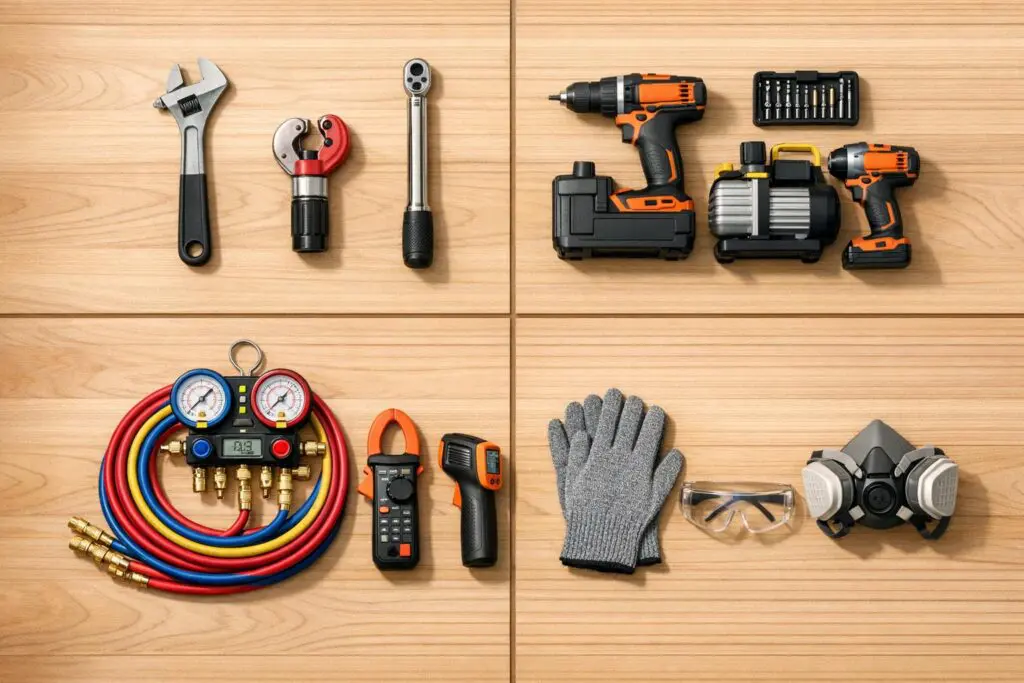
- Basic Tools: Screwdrivers, pliers, adjustable wrenches, and tape measures are essential for securing components, measuring spaces, and making precise adjustments. Insulated tools are critical for electrical safety.
- Power Tools: Cordless drills and angle grinders help with heavy-duty tasks like drilling and cutting metal. Choose models with high torque and ergonomic designs.
- Specialized Equipment: Manifold gauges, vacuum pumps, and tube flaring tools ensure proper refrigerant handling, moisture removal, and leak-proof connections.
- Diagnostic Tools: Multimeters and digital manifold gauges provide precise readings for electrical and refrigerant system checks, preventing errors.
- Safety Gear: Safety glasses, gloves, and respirators protect against injuries, while fire extinguishers and fall protection equipment enhance safety during complex installations.
Investing in high-quality tools from trusted brands like Fluke, Yellow Jacket, and Fieldpiece ensures better results, fewer errors, and longer-lasting systems. Certified professionals, like those at Eco Temp HVAC, use these tools to deliver precise installations that comply with warranties and building codes.
HVAC Basic Tools of the Trade – Don’t Break the Bank!
Basic Hand Tools for AC Installation
Every AC installation relies on a dependable set of hand tools. These tools handle everything from opening panels and securing components to measuring spaces and setting up electrical connections. Screwdrivers and nut drivers are the most frequently used tools in HVAC work, involved in 95% of service tasks. When technicians use the right tools, they not only work faster – completing service calls 23% quicker – but also maintain higher safety standards.
Screwdrivers, Pliers, and Adjustable Wrenches
In HVAC work, Phillips screwdrivers are a go-to tool. The #2 size handles about 80% of tasks, while the smaller #1 size is perfect for thermostat installations and control boards. Flat-head screwdrivers, especially in 1/4-inch size, are essential for terminal blocks and specialty fasteners. For hex-head screws, nut drivers are indispensable, with 1/4-inch and 5/16-inch sizes being the most commonly used. Multi-bit drivers, like the Klein 11-in-1 (priced between $30 and $45), combine multiple tool sizes for convenience.
Pliers are another key player, especially insulated ones that protect against electrical shocks – vital in modern HVAC systems, which are about 50% electrical. Needle-nose pliers are perfect for tight spaces, lineman’s pliers handle heavy electrical work, and channel-lock pliers are excellent for gripping pipes and fittings.
Adjustable wrenches are crucial for tasks like tightening flare nuts on refrigerant lines or securing gas and water connections. A 6-inch or 8-inch wrench is ideal for confined spaces, while larger 10-inch or 12-inch versions provide the leverage needed for tougher fittings. Often, two wrenches are used together – one to stabilize the pipe and the other to tighten the fitting.
Precise measurements and clean cuts are equally important.
Tape Measures and Duct Knives
Accurate measurements ensure that AC systems fit seamlessly into existing spaces and function as intended. A tape measure between 25 and 50 feet is typically sufficient for residential installations, whether you’re measuring ductwork, equipment clearances, or refrigerant line lengths. Models with clear markings and magnetic tips make solo measurements much easier, especially for long distances or elevated equipment.
For cutting tasks, duct knives and utility knives are indispensable. These tools handle insulation, open boxes, and modify ductwork during installation. Their design ensures clean cuts, which are critical for maintaining airtight duct joints. Poor cuts can lead to air leaks, reducing system efficiency and driving up energy costs.
Tin snips are another must-have, available in left-cut, right-cut, and straight-cut versions. They’re perfect for shaping sheet metal ductwork and making precise adjustments. Aviation shears offer similar functionality but with ergonomic handles to reduce hand fatigue during extended use. Both tools are essential for customizing ductwork.
Finally, reliable electrical connections and secure assembly depend on the right wire stripping and hammering tools.
Wire Strippers and Hammers
Proper electrical connections and sturdy assembly are key to keeping an AC system running smoothly. Wire strippers are used to prepare connections for thermostats, control circuits, and power wiring. HVAC professionals typically use strippers that cover wire gauges between 10 and 22 AWG. The Klein Tools 11063W Wire Stripper, priced between $25 and $40, is a popular choice for its durability and versatility.
Insulated wire strippers are critical for safety, preventing electrical shocks and avoiding damage to equipment. High-quality models cleanly remove insulation without nicking or crushing wire strands, ensuring dependable connections.
Hammers are used for mounting brackets, positioning components, and working with sheet metal. While a standard claw hammer is fine for basic tasks, dead blow hammers are preferred for sheet metal work. These hammers distribute force evenly, avoiding dents or damage that could disrupt airflow – especially important when working with thin-gauge ductwork or delicate equipment housings. Mastering these tools lays the groundwork for a reliable and efficient AC installation.
Power and Cutting Tools for Precision Work
After covering the must-have hand tools, let’s dive into power and cutting tools that elevate efficiency and accuracy. These tools tackle the heavy-duty tasks that hand tools simply can’t handle – like drilling through tough walls, cutting through metal, or ensuring precise connections for refrigerant lines.
Power Drills and Angle Grinders
Cordless drills are indispensable for HVAC installation. They’re used for everything from drilling pilot holes to creating 3-inch wall openings for line sets and securing mounting brackets for condensers and air handlers. For demanding jobs, opt for 18V or 20V models. Lower-powered 12V drills often lack the torque needed for tougher materials like masonry or thick metal. A standout option is the Milwaukee 2804-20 M18 FUEL Drill, known for its brushless motor that extends tool life by up to 50% compared to traditional brushed motors. Expect professional-grade cordless drill kits to cost between $100 and $200.
Angle grinders are another powerhouse tool, perfect for grinding rough metal edges, cutting bolts, and customizing ductwork fittings. These tools prevent issues like air leaks by smoothing sharp edges that could damage insulation or create gaps in ductwork. Prices for angle grinders typically range from $40 to $150. When choosing one, focus on models with high RPM ratings and ergonomic grips for comfort during long projects.
Next up, tools that ensure airtight connections and secure ductwork.
Tube Flaring Tools and Staple Guns
Tube flaring tools are critical for creating leak-proof connections in refrigerant systems. They shape the ends of copper lines into 45-degree flares, a necessity for modern refrigerants like R-32 and R-410A. Manual models are budget-friendly, costing between $15 and $50. However, upgrading to a tool with a built-in clutch can help avoid over-flaring, a common issue that leads to refrigerant leaks in high-pressure systems. As HVAC pro Mark Callahan aptly states:
"Charging refrigerant by ‘feel’ is like measuring flour with your hands – don’t do it".
Precision here is non-negotiable for reliable, leak-free connections.
Staple guns, while less glamorous, play a vital role in securing ductwork and insulation during installation. Models with jam-resistance features save time – especially when working in tight spaces or overhead. Look for heavy-duty staple guns with strong drive mechanisms that can penetrate multiple layers of insulation backing without constant reloading. Their reliability ensures a smoother workflow and a more secure finish.
Diagnostic and Specialty Tools for HVAC Systems
Once an HVAC system is installed, diagnostic tools play a key role in confirming its performance. These tools help identify potential issues early, avoiding expensive repairs or failures down the line. Given the heavy reliance on electrical components in HVAC systems, diagnostic equipment is just as essential as hand tools.
Multimeters and Manifold Gauge Sets
After completing the physical installation, accurate diagnostics ensure the system operates efficiently. Multimeters are indispensable for electrical diagnostics, measuring voltage, current, resistance, and capacitance to test components like control boards, motors, and capacitors. When selecting a multimeter, opt for True RMS models, as standard meters can misread variable-speed motors and inverter systems, leading to incorrect diagnoses. As HVAC Reaper aptly put it:
"A mindset is only as good as the data it receives. If your meter reads 24V when there’s actually a ghost voltage… you aren’t diagnosing – you’re guessing."
Professional-grade multimeters, such as the Fluke 116, typically cost between $150 and $300, while mid-range options range from $80 to $120. Always test your multimeter on a known live voltage source before troubleshooting a "no power" issue to confirm the tool’s accuracy.
Manifold gauge sets are another must-have, used to measure refrigerant pressures on the high (discharge) and low (suction) sides. These readings are crucial for calculating superheat and subcooling, ensuring the system has the correct refrigerant charge. Analog sets usually cost between $80 and $150, while digital models with features like Bluetooth connectivity and automated calculations range from $250 to $400. Digital gauges reduce the chance of manual errors by providing real-time data and logging capabilities, though they require batteries and careful handling.
Vacuum Pumps and Caulking Guns
Beyond electrical checks, maintaining refrigerant integrity and sealing ducts are equally critical. Vacuum pumps remove air and moisture from refrigerant lines, preventing issues like corrosion, ice formation, and compressor failure. As Tom’s Mechanical emphasizes:
"Moisture in refrigerant lines can cause freezing, corrosion and system damage. Removing this moisture is necessary for maintaining an HVAC system’s efficiency and preventing future issues."
A 2-stage vacuum pump is generally preferred over single-stage models because it achieves lower micron levels – typically 500 microns or less – ensuring thorough removal of moisture and non-condensable gases. Professional-grade pumps cost between $200 and $400, while budget-friendly models are available for $100 to $150. Pair your vacuum pump with a micron gauge to confirm the system has reached the desired vacuum level and to perform a decay test to ensure there are no leaks.
Caulking guns are essential for sealing gaps in ductwork and cabinet openings, preventing energy loss and maintaining proper airflow. Look for models with smooth trigger mechanisms that allow for precise application, especially in tight spaces around air handlers and duct connections.
sbb-itb-b5c10b1
Safety Gear and How to Select Quality Tools
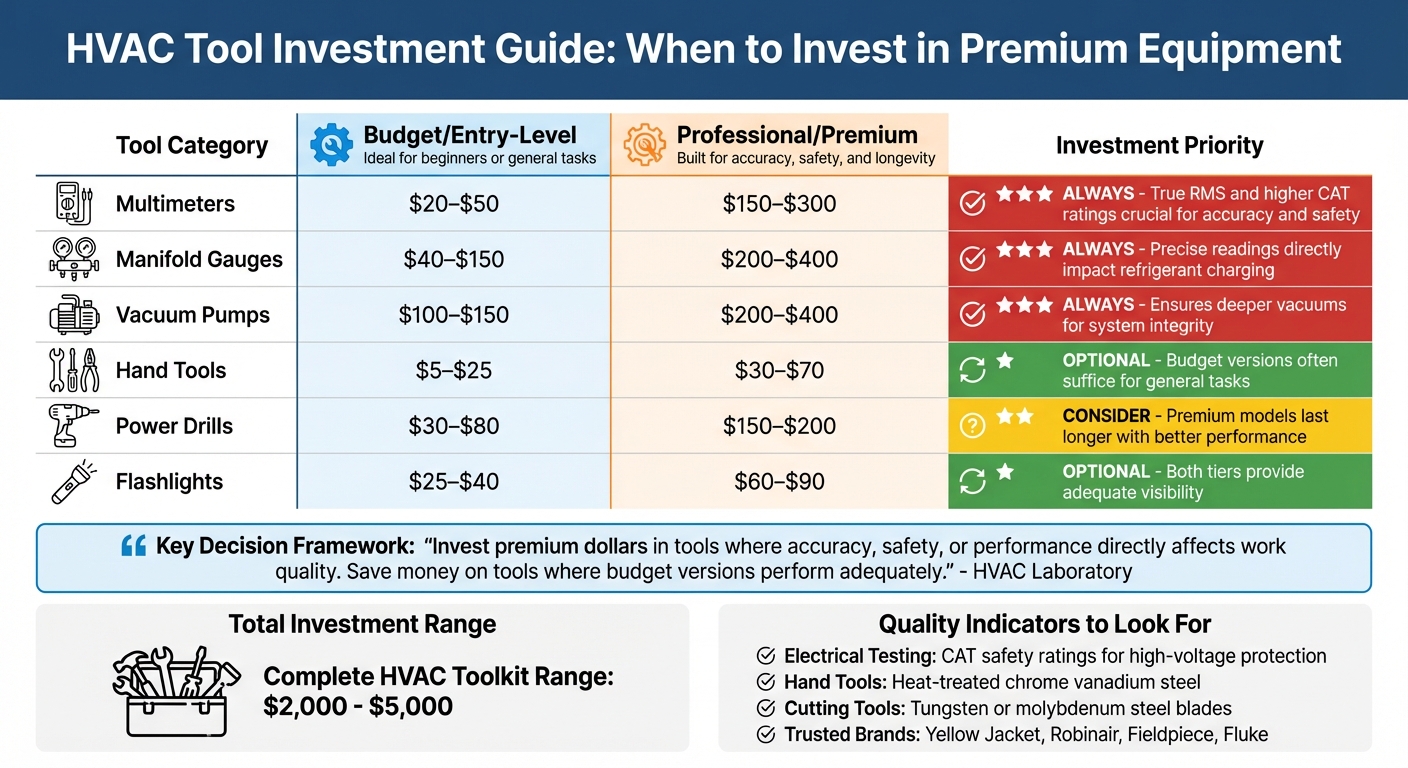
HVAC Tool Investment Guide: Budget vs Premium Equipment Comparison
Safety Glasses, Gloves, and Flashlights
Wearing the right protective gear is essential for staying safe during installations. Safety glasses or goggles shield your eyes from flying debris, refrigerant splashes, and sparks during brazing. For your hands, use two types of gloves: cut-resistant gloves for handling sharp sheet metal and insulated gloves for electrical tasks. Heavy-duty steel-toe work boots are another must-have, offering both traction on ladders and protection from falling tools or equipment.
A headlamp with 300–500 lumens is great for working hands-free in dark spaces, while a backup flashlight (with extra batteries) ensures you’re never left in the dark. Professional handheld lights typically range from $60 to $90, but budget options priced between $25 and $40 work well for occasional use.
Respirators are necessary when dealing with insulation or fumes, and ear protection is a smart choice when using loud power tools. If you’re working on rooftops, fall protection harnesses and tie-offs are non-negotiable. And don’t forget to keep a fire extinguisher nearby during brazing operations – better safe than sorry.
Once you’re fully equipped with safety gear, the next step is choosing tools that meet high-quality standards for performance and durability.
Criteria for Evaluating Tools
Selecting the right tools is just as vital as wearing proper safety gear. The key is to know where to spend and where to save. As HVAC Laboratory puts it:
"The rule: Invest premium dollars in tools where accuracy, safety, or performance directly affects work quality. Save money on tools where budget versions perform adequately."
Think long-term when evaluating tools. Spending more on premium tools can often mean fewer errors and reduced callbacks. A simple way to assess value is dividing the tool’s cost by its expected lifespan. For example, premium electrical testing equipment is a wise investment, especially when it meets CAT safety ratings to guard against high-voltage surges and arc flashes. For hand tools, look for ones made from heat-treated chrome vanadium steel, and for cutting tools, prioritize tungsten or molybdenum steel blades for better durability.
Here’s a breakdown of tool categories, costs, and when it makes sense to invest in premium options:
| Tool Category | Budget/Entry-Level ($) | Professional/Premium ($) | When to Invest Premium |
|---|---|---|---|
| Multimeters | $20–$50 | $150–$300 | Always – True RMS and higher CAT ratings are crucial for accuracy and safety |
| Manifold Gauges | $40–$150 | $200–$400 | Always – precise readings directly impact refrigerant charging |
| Vacuum Pumps | $100–$150 | $200–$400 | Always – ensures deeper vacuums for system integrity |
| Hand Tools | $5–$25 | $30–$70 | Optional – budget versions often suffice for general tasks |
| Power Drills | $30–$80 | $150–$200 | Consider – premium models last longer and may offer better performance |
| Flashlights | $25–$40 | $60–$90 | Optional – both tiers provide adequate visibility for most tasks |
When choosing tools, brand reputation matters. Established HVAC brands like Yellow Jacket, Robinair, Fieldpiece, and Fluke are built for daily professional use and often come with strong warranties. Regular maintenance, such as annual calibration for diagnostic tools and periodic replacement of test leads, can also help extend their lifespan. Investing in trusted brands and taking care of your tools ensures you’re always prepared for the job.
Professional AC Installation Services with Certified Technicians
Eco Temp HVAC‘s Certifications and Expertise
When it comes to HVAC systems, having the right tools is only part of the equation – expertise is what truly makes the difference. At Eco Temp HVAC, their certifications set them apart in the Chicagoland area. As a Mitsubishi Diamond Elite Contractor, they provide an impressive 12-year warranty on Mitsubishi products, far surpassing standard manufacturer coverage. Their credentials don’t stop there; they are also Navien Service Specialists for tankless water heaters and American Standard Customer Care Dealers, showcasing their dedication to quality across a variety of equipment brands.
These certifications go beyond just titles – they reflect proven skill with advanced diagnostic tools like manifold gauges and vacuum pumps, ensuring refrigerant systems are precisely charged and free from moisture contamination. This level of precision is vital, especially since HVAC systems rely heavily on electrical components. Using professional-grade multimeters, Eco Temp HVAC technicians expertly diagnose issues with control boards, motors, and sensors. These qualifications not only validate their technical abilities but also contribute to longer-lasting, better-performing systems.
Benefits of Professional HVAC Services
Certified technicians don’t just install systems – they protect your investment. Many HVAC manufacturers stipulate that equipment must be installed by licensed professionals to maintain warranties, meaning uncertified or DIY work could leave you without coverage. Beyond warranties, professional installation ensures compliance with local building codes, a critical requirement for passing inspections in cities like Chicago, St. Charles, Bartlett, Lemont, Downers Grove, Palatine, and nearby areas.
Proper installation by skilled technicians also significantly impacts energy efficiency and the lifespan of your system. For example, they use nitrogen regulators during brazing to prevent internal oxidation, vacuum pumps to eliminate moisture that could harm compressors, and digital refrigerant scales to achieve exact system charges. By pairing these techniques with Manual J load calculations to size units correctly, certified installers ensure your AC system operates efficiently. This precision prevents problems like short-cycling or overexertion, which can lead to higher energy bills and premature wear.
Eco Temp HVAC’s expertise is especially valuable in the Chicagoland area, where extreme seasonal changes demand reliable HVAC performance. With 24/7 availability, their certified technicians deliver the precision and dependability needed to keep your home comfortable year-round.
Conclusion
The right tools play a crucial role in improving AC performance, boosting energy efficiency, and extending the system’s lifespan. For example, high-quality vacuum pumps effectively remove moisture, preventing internal corrosion and premature compressor failure. Precise manifold gauges and digital scales ensure refrigerant levels are spot-on, which is essential for optimal performance. Additionally, professional-grade multimeters help maintain electrical integrity – critical since modern HVAC systems are roughly 50% electrical. While these tools require an upfront investment, they deliver long-term savings through better efficiency and fewer repairs.
A complete HVAC toolkit can range between $2,000 and $5,000, but it enables professionals to complete installations in about 90 minutes, far faster than working with basic equipment. Mark Callahan, an HVAC Tech at The Furnace Outlet, highlights the importance of proper tools:
"Moisture = system killer. You will void your warranty without [a vacuum pump]".
Safety should always come first. Handling high-voltage electrical components and pressurized refrigerants requires insulated tools, proper personal protective equipment – like safety glasses and steel-toed boots – and the expertise to avoid costly errors. Certified technicians, such as those at Eco Temp HVAC, combine specialized tools with their skills to deliver systems that are both efficient and long-lasting. This combination of safety and performance underscores why professional services are worth the investment.
FAQs
Which AC installation tools are worth buying premium?
Premium tools for AC installation are worth considering if you’re aiming for precision, reliability, and long-lasting results. Some essential tools to have on hand include digital multimeters, refrigerant gauge sets, vacuum pumps, and durable wrenches and snips. These tools play a critical role in ensuring accurate diagnostics, safe refrigerant management, and secure fittings – key factors for a smooth and effective installation. Choosing high-quality versions of these tools can boost efficiency, improve safety, and extend the life of your equipment.
Do I need a vacuum pump and micron gauge for installs?
Absolutely. A vacuum pump and micron gauge are must-have tools for proper AC installations, particularly when it comes to evacuating refrigerant lines. These tools work together to eliminate moisture, air, and non-condensable gases from the system. Why is this important? Because any leftover contaminants can compromise the system’s efficiency and longevity.
A vacuum pump is designed to pull the system down to a deep vacuum – typically around 300 microns, which is the level many manufacturers recommend. Achieving this ensures the system is thoroughly degassed and dehydrated, creating the ideal conditions for refrigerant charging and peak performance. Skipping this step could lead to poor cooling, higher energy consumption, or even damage to the system over time.
What safety gear is essential for AC installation?
For a safe AC installation, make sure to wear insulated gloves and safety goggles to guard against electrical shocks and flying debris. A flashlight or headlamp can be a lifesaver when working in dimly lit areas. Always stick to safety guidelines and use the right protective gear when dealing with electrical parts or sharp metal edges.