
Energy-efficient boilers can save businesses money over time despite their higher upfront costs. These systems operate at efficiencies of 92–94%, compared to older boilers at around 60–80%. Here’s what you need to know:
- Cost: Installation ranges from $25,000 to $80,000, with possible additional expenses for rigging, asbestos removal, or fuel conversion.
- Savings: Upgrading can reduce fuel bills by 15–20%, saving $1,440+ annually for smaller spaces and up to $50,000 for larger buildings.
- Incentives: Federal tax credits and utility rebates cover up to 30% of costs can add $1,000–$10,000 in savings.
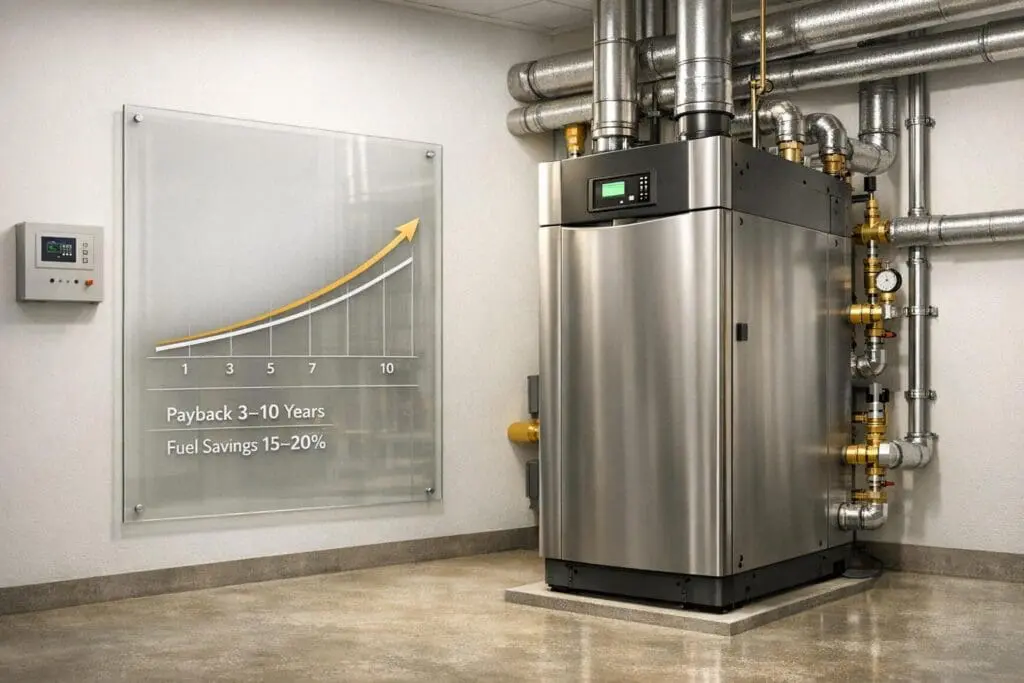
- Payback Period: Most businesses recover costs within 5–10 years, shorter for larger properties.
- Maintenance: Modern boilers reduce maintenance expenses by 30% due to advanced diagnostics and fewer breakdowns.
While older systems have lower initial costs, they waste more energy and incur higher long-term expenses. Energy-efficient boilers are a better choice for businesses aiming to lower operational costs and improve heating efficiency.
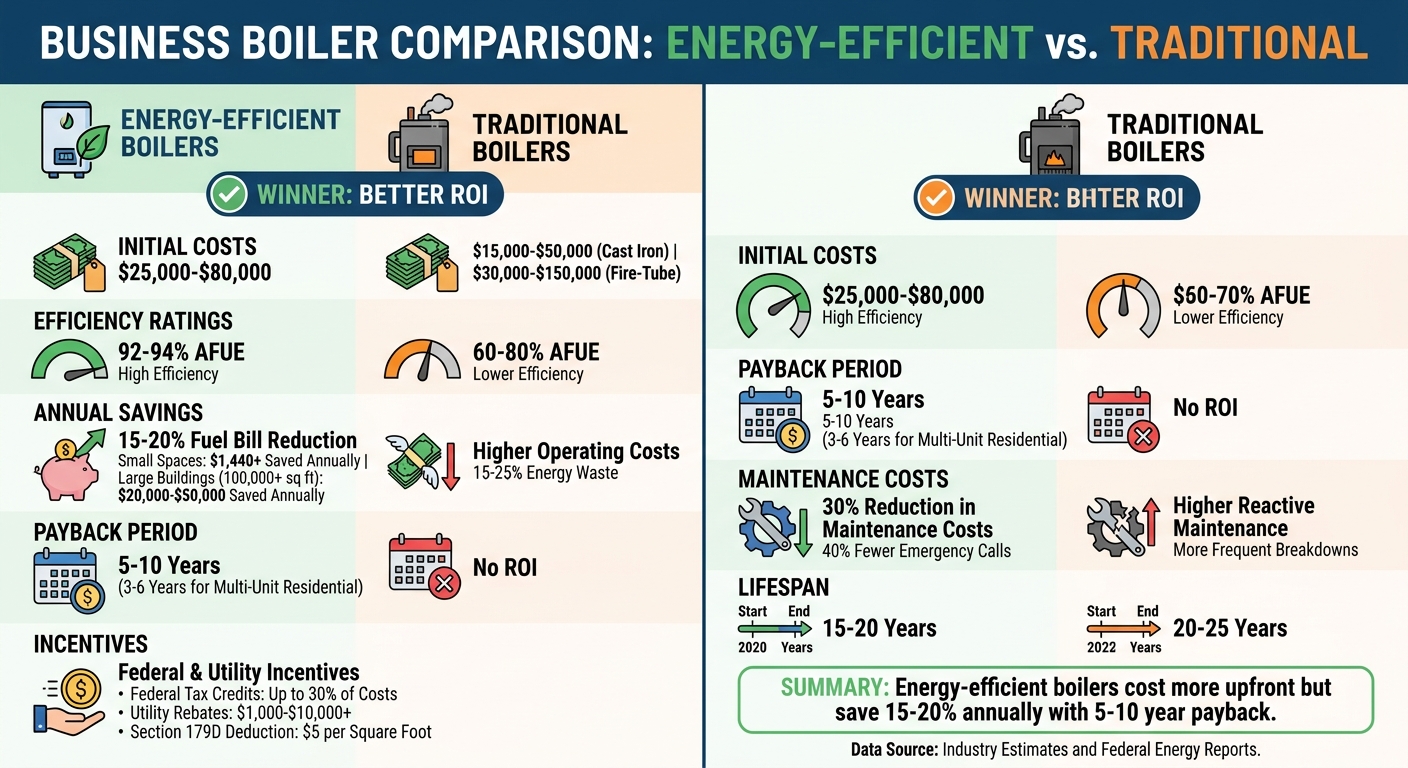
Energy-Efficient vs Traditional Boilers: Cost and ROI Comparison
1. Energy-Efficient Boilers
Initial Costs
Switching to energy-efficient condensing boilers involves a higher upfront investment compared to traditional systems, but understanding the cost breakdown can help with planning. The boiler equipment itself makes up 40%–60% of the total cost, with the rest going toward labor, infrastructure updates, and permitting.
The cost to install a condensing boiler generally falls between $25,000 and $80,000, depending on the building’s needs and the boiler’s capacity. However, certain factors can push costs higher. For example, if the boiler is too large to fit through standard doorways, specialized rigging may add $10,000–$30,000. In older buildings, asbestos removal might be necessary, costing $5,000–$30,000. Additionally, converting fuel types – like switching from oil to natural gas – typically runs between $5,000 and $20,000.
Fortunately, federal tax credits can cover up to 30% of installation costs, while utility rebates often provide $1,000–$10,000 or more in savings. The Section 179D tax deduction also offers $5 per square foot for eligible commercial HVAC energy-efficient upgrades.
These upfront expenses, while substantial, are balanced by long-term savings on energy costs.
Energy Savings
Energy-efficient boilers can significantly reduce fuel consumption. For instance, upgrading from an 80% AFUE boiler to a 95% AFUE condensing model can lower fuel bills by 15%–20%. ENERGY STAR certified commercial boilers, which are 14% more efficient than standard models, save businesses an average of over $1,440 annually on energy costs. For larger spaces, such as buildings over 100,000 square feet, annual savings can range from $20,000 to $50,000 on natural gas.
These savings are achieved through advanced controls that adjust heating based on real-time demand, occupancy, and outdoor conditions. Instead of running on fixed schedules, these systems adapt to actual needs, delivering the same heat output with much less gas consumption. Mid-sized apartment buildings often see heating cost reductions of 15%–25% after upgrading.
Such energy savings directly contribute to a shorter payback period.
Payback Period
Most businesses recover their investment in energy-efficient boilers within 5–10 years. For multi-unit residential properties, the payback period is often quicker, ranging from 3–6 years. The timeline varies based on factors like the efficiency of the current system, local fuel costs, building size, and available incentives.
"Smart boilers offer a strategic investment in energy efficiency, comfort, and long-term savings." – Simon Soloff, President and co-founder of EnTech
Beyond energy savings, these systems can also improve employee productivity. A Cornell University study found that cooler workplace temperatures can increase hourly labor costs by 10% due to reduced efficiency and motivation. Consistent, comfortable heating not only eliminates this hidden cost but also boosts workplace morale and reduces absenteeism.
Maintenance and Long-Term Costs
Energy-efficient boilers are less expensive to maintain and repair than traditional systems. Many building managers report up to a 30% reduction in maintenance costs within the first year of installing high-efficiency boilers. This is largely due to predictive diagnostics that catch potential issues early and reduced wear thanks to fewer heating cycles.
To maintain these savings, it’s crucial to schedule annual tune-ups. Deferred maintenance is the leading cause of premature replacements and high repair bills. Modern boilers equipped with IoT connectivity make it easier to monitor performance in real time, helping to address minor problems before they escalate.
When assessing long-term costs, consider the Life Cycle Cost (LCC), which includes Purchase Price, Installation, Fuel, Maintenance, Repairs, Downtime, and Disposal. Over their 15–25-year lifespan, energy-efficient boilers consistently outperform traditional systems in terms of overall value.
sbb-itb-b5c10b1
2. Traditional Boilers
Initial Costs
Traditional boilers may have appealing lower upfront costs, but they come with trade-offs that impact long-term value. It’s essential to weigh both the initial investment and the total costs over the system’s lifespan when comparing them to energy-efficient models.
For low-rise buildings, cast iron sectional boilers cost between $15,000 and $50,000 installed, offering capacities of 400,000 to 4,000,000 BTU/hr. Larger applications often use steel fire-tube boilers, which range from $30,000 to $150,000 installed and handle 1,000,000 to over 20,000,000 BTU/hr. Meanwhile, water-tube boilers, commonly found in hospitals or campus plants, cost anywhere from $100,000 to $500,000 or more. Beyond equipment costs, additional expenses include permits ($500–$3,000), engineering drawings ($2,000–$5,000), and potential extras like rigging, asbestos removal, electrical upgrades, or temporary boiler rentals. These additional factors can significantly increase the total installation price. Lead times also vary depending on the model: cast iron units typically take 4–8 weeks, while larger fire-tube boilers may require 10–16 weeks to arrive.
Energy Savings
Traditional boilers generally achieve 75%–85% efficiency, meaning they waste 15%–25% of the energy they consume. Older models, particularly those built before 2000, often operate closer to 78–82% efficiency. These inefficiencies stem from several factors:
- Fixed operating schedules that heat spaces even when unoccupied.
- Single-stage operation that runs at full capacity regardless of actual heating needs.
- Heat loss through uninsulated pipes and exhaust systems.
"Traditional boilers operate on preset cycles, often heating empty units or running longer than necessary." – Simon Soloff, President and Co-founder, EnTech
Oversized units that "short-cycle" (frequently turning on and off) waste even more energy, while issues like soot buildup and aging components force the system to work harder to produce the same output.
Maintenance and Long-Term Costs
Traditional boilers often rely on reactive maintenance, which leads to higher repair costs and longer downtimes. Skipping routine tune-ups can cause efficiency to drop below 75%, further increasing fuel waste. Older systems are also more prone to failures, such as malfunctioning pressure relief valves, which can pose safety risks. Without features like remote monitoring or diagnostic sensors, small problems can escalate into costly emergencies.
In one example, a 75-unit building that switched from a conventional boiler system to a smart alternative saw emergency maintenance calls drop by 40%. Over a lifespan of 15–25 years, the total cost of ownership for traditional boilers includes not just the initial purchase and installation but also fuel, maintenance, repairs, downtime, and eventual disposal. While these systems may seem cost-effective at first, their inefficiencies and maintenance demands often lead to significantly higher expenses over time. This creates an opportunity to compare their long-term return on investment with energy-efficient systems.
SMI Webinar Series: Comparing Boiler Replacements for Efficiency Improvement
Advantages and Disadvantages
Let’s break down the trade-offs between energy-efficient boilers and traditional boilers by comparing their costs, efficiency, and maintenance needs.
Energy-efficient boilers are designed with advanced technology, boasting AFUE ratings between 90–98%. This high efficiency translates to fuel savings of around 15–20% annually. They also come equipped with IoT sensors for predictive maintenance, reducing emergency service calls by up to 40%. For instance, a 75-unit building reported an 18% drop in energy expenses, alongside fewer maintenance issues, after upgrading to an energy-efficient boiler. However, these systems come with a higher upfront cost, require PVC venting for proper installation, and demand regular professional upkeep.
On the other hand, traditional boilers cater to businesses operating on tighter budgets. Their simpler, single-stage burner design makes them easier to maintain, and they can often use existing chimney vents, which helps lower installation costs. However, traditional boilers operate on fixed schedules, which can lead to energy waste. Additionally, deferred maintenance often turns minor issues into expensive repairs or even necessitates premature system replacement.
Here’s a side-by-side comparison to highlight the differences:
| Feature | Traditional Boilers | Energy-Efficient Boilers |
|---|---|---|
| Efficiency (AFUE) | 80–89% | 90–98% |
| Upfront Cost | Lower initial investment | Higher initial investment |
| Annual Fuel Bills | Higher operating costs | 15–20% lower costs |
| Maintenance | Simpler, reactive approach | Complex; requires predictive care |
| Venting | Uses existing chimney | Requires PVC ventilation |
| Monitoring | Manual/on-site only | Remote IoT dashboards |
| Typical Payback | N/A | 3–6 years |
When deciding between these systems, it’s essential to consider your building’s goals and budget. If your facility has a long-term asset strategy, the efficiency and technology of energy-efficient boilers could offer substantial savings over time. Meanwhile, businesses with immediate capital constraints might opt for traditional boilers, even though they come with higher ongoing energy costs.
Conclusion
Energy-efficient boilers offer impressive long-term returns for most commercial properties. While their upfront cost can be as much as 60% higher, it’s important to note that fuel expenses account for 75% to 80% of a boiler’s total lifecycle costs. Over time, these savings often outweigh the initial investment.
On average, energy-efficient boilers pay for themselves within 2 to 8 years. According to ENERGY STAR, these units are about 14% more efficient, translating into annual energy savings of over $1,440. Beyond cost savings, better climate control reduces productivity losses, which can boost a property’s overall value. Still, it’s essential to balance these long-term benefits against the upfront financial commitment.
Standard boilers, however, can make sense in specific circumstances. If you’re planning to sell your property within 2 to 3 years or need to prioritize lower initial costs, a standard unit might be the better fit. These models typically have a longer lifespan of 20 to 25 years, compared to the 15 to 20 years seen with high-efficiency options.
For businesses in the Chicagoland area evaluating these choices, proper installation and regular maintenance are key to optimizing your boiler’s performance and return on investment. Eco Temp HVAC offers 24/7 professional boiler services by certified technicians to ensure your system operates at its best from day one. Additionally, utility rebates and federal tax credits can help offset 10% to 30% of your initial investment.
FAQs
How do I know if my building is a good fit for a condensing boiler?
To figure out if a condensing boiler is right for your building, start by evaluating its size and purpose. These boilers are popular in commercial properties because they help lower energy use and reduce operating costs. If energy efficiency and maximizing return on investment are key goals for your building, a condensing boiler could be a strong option. For a more thorough evaluation, reach out to an HVAC professional who has experience with condensing boilers in commercial environments.
What incentives can I combine to lower the installed cost?
You can pair utility rebates – like those offered by Nicor Gas and ComEd – with federal tax incentives, including the Section 179D deduction and the Energy-Efficient Commercial Building Deduction. These programs can help lower the initial costs of installing energy-efficient boilers, making them a budget-friendly choice for your business.
What maintenance is required to keep efficiency and ROI on track?
Regular maintenance plays a crucial role in keeping energy-efficient boilers running smoothly while delivering a solid return on investment (ROI). This involves tasks like routine inspections, cleaning burners, checking heat exchangers, verifying controls and safety devices, and ensuring proper combustion.
Essential steps include replacing or cleaning filters and treating water to prevent scaling and corrosion. By staying on top of these tasks, you can lower operating costs, extend the lifespan of the equipment, and maintain energy efficiency over the long term.