
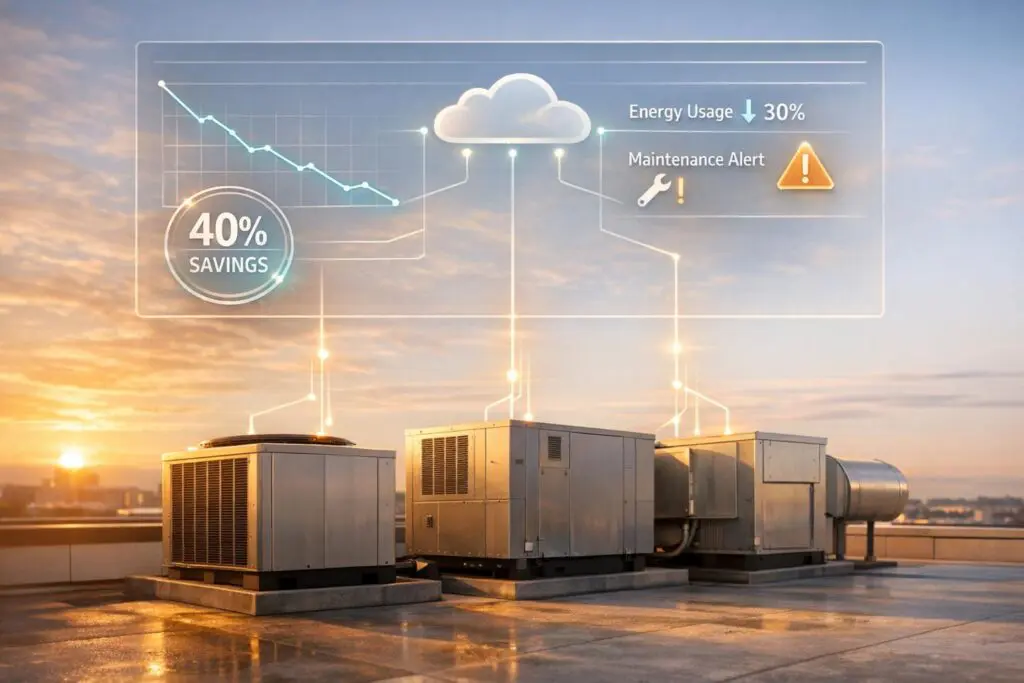
Cloud-based HVAC systems with energy analytics are revolutionizing how buildings manage heating and cooling. These systems use real-time IoT sensor data, AI-driven insights, and automated adjustments to reduce energy use by 30–40%, cut failures by 72%, and lower costs. Unlike older systems that react to temperature changes, these solutions predict needs, optimize performance, and extend equipment life.
Key Takeaways:
- Energy Savings: Up to 40% reduction in HVAC energy use.
- Predictive Maintenance: Cuts unplanned failures by 72%.
- Remote Access: Manage systems across multiple locations via apps.
- Quick ROI: Payback within 18–24 months through savings.
This article explores how IoT sensors, AI, and cloud platforms work together to deliver these benefits, along with practical steps for implementation and insights from industry leaders like Eco Temp HVAC.
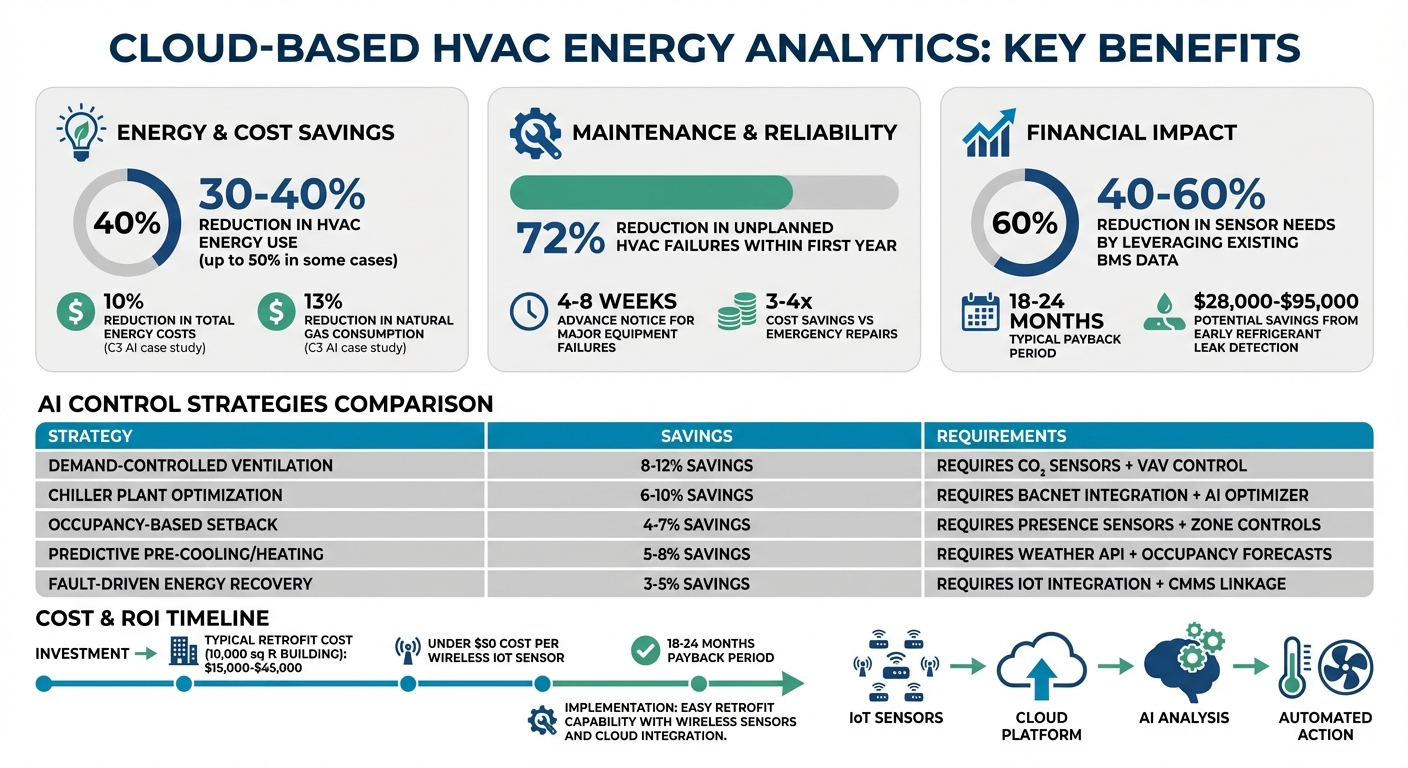
Cloud-Based HVAC Energy Analytics Benefits and ROI Statistics
Daikin HERO Pro Edge | Advanced Cloud-Based Control for VRV, Mini-Split & Rooftop Units
sbb-itb-b5c10b1
How Cloud-Based HVAC Energy Analytics Work
Cloud-based energy analytics for HVAC systems follow a clear path: data collection, intelligent analysis, and actionable insights. Each stage builds upon the last, enabling systems to operate more efficiently and adapt over time.
IoT Sensors and Cloud Platforms
IoT sensors are installed on HVAC components like chillers, air handling units, and pumps to monitor factors such as motor current, pressure, airflow, and temperature. Common sensors include current transducers, pressure transmitters, and flow meters. These wireless sensors can be retrofitted to existing systems quickly, without requiring extensive cabling.
Once installed, these sensors send their data to a local gateway for initial processing. From there, the data is transmitted to cloud platforms via REST APIs for deeper analysis. Connectivity options include LoRaWAN, Zigbee, Wi-Fi 6, BACnet/IP, and Modbus RTU. This hybrid setup – where local nodes manage immediate adjustments and the cloud handles broader optimizations – ensures both quick responses and long-term efficiency.
Before adding new hardware, it’s wise to review your existing Building Management System (BMS). Many buildings already collect useful data, which can cut the need for additional sensors by 40% to 60%. Plus, with wireless IoT sensors costing under $50 each, retrofitting a 10,000-square-foot commercial building typically costs between $15,000 and $45,000.
Filtered sensor data is then used for advanced analytics, paving the way for smarter energy management.
AI and Machine Learning for Energy Optimization
AI algorithms bring a new level of precision to HVAC energy management. Instead of relying on single data points, they analyze patterns across multiple sensors to detect issues that traditional systems might miss. For instance, AI can combine data on suction pressure, motor current, and superheat readings to identify a refrigerant leak weeks before it becomes critical.
Machine learning models take this further by predicting future conditions – like room temperature or thermal load – based on current data and weather forecasts. These predictions allow the system to adjust HVAC settings in real-time, balancing energy efficiency with occupant comfort. Techniques like predictive pre-cooling and pre-heating, which use weather and occupancy data, can condition spaces during off-peak hours, cutting down on expensive peak demand charges.
A standout example comes from February 2025, when C3 AI implemented an optimization model for a North American facility. By predicting temperature and humidity and fine-tuning steam boiler and chiller operations, the facility reduced total energy costs by 10% and natural gas consumption by 13%, all while maintaining strict climate controls.
| AI Control Strategy | Typical Energy Savings | Primary Requirement |
|---|---|---|
| Demand-Controlled Ventilation | 8–12% | CO₂ sensors + VAV control |
| Chiller Plant Optimization | 6–10% | BACnet integration + AI optimizer |
| Occupancy-Based Setback | 4–7% | Presence sensors + zone controls |
| Predictive Pre-Cooling/Heating | 5–8% | Weather API + occupancy forecasts |
| Fault-Driven Energy Recovery | 3–5% | IoT integration + CMMS linkage |
Insights from these systems are then displayed on user-friendly dashboards for real-time decision-making.
Dashboards and Reporting Tools
Cloud platforms turn raw data into dynamic dashboards that show real-time energy usage, equipment performance, and system status across one or multiple buildings. These centralized platforms standardize data, allowing facility managers to oversee multiple locations efficiently.
Modern reporting tools don’t just issue alerts – they identify patterns and correlations that hint at emerging problems. For example, subtle shifts in compressor current, suction pressure, and temperature might collectively indicate a future issue. These tools can provide 4 to 8 weeks of advance notice for major failures, such as chiller breakdowns or bearing wear in air handling units.
The best dashboards integrate directly with Computerized Maintenance Management Systems (CMMS). When inefficiencies or faults are flagged, the system creates work orders for technicians automatically. This ensures that detected issues lead to action, rather than just sitting in a dashboard.
"Sensor data that sits in a monitoring dashboard without triggering maintenance action captures the detection benefit but not the intervention benefit." – Mark Strong, Oxmaint
For security, it’s essential to isolate HVAC IoT devices on separate VLANs and use TLS 1.2+ encryption with certificate-based authentication.
Benefits of Cloud-Based HVAC Energy Analytics
Cloud-based HVAC systems bring a range of benefits, from cutting energy costs to extending equipment life. Here’s a closer look at how these systems make a measurable difference.
Lower Energy Costs and Improved Efficiency
One of the standout advantages of cloud-based energy analytics is the significant reduction in energy consumption. On average, these systems cut HVAC energy use by 30%–40%, with some setups achieving savings as high as 50%. This is made possible by dynamically adjusting settings based on factors like occupancy, weather, and even energy pricing.
At Penn Medicine, Energy Manager Kathleen Morlang shared a compelling example:
"When we shut the system off, energy use spikes. Restarting it immediately cuts consumption and verifies our investment’s rapid payback".
Beyond optimizing energy use, these systems can pinpoint inefficiencies such as fouled coils or low refrigerant levels. Addressing these issues can prevent additional operating expenses, which might otherwise range from 8% to 25%. Not only does this save money, but it also ensures your HVAC system runs at peak efficiency.
Longer System Life Through Predictive Maintenance
Predictive maintenance is a game-changer for HVAC systems. Instead of sticking to a rigid service schedule, cloud-based analytics use sensor data to flag potential issues before they become major problems. This approach has been shown to lower unplanned HVAC failures by 72% within the first year.
Early fault detection can make a huge difference. For instance, spotting a refrigerant leak early allows for a quick, affordable repair. If left unchecked, however, the issue could escalate and damage the compressor, leading to repair costs between $28,000 and $95,000. By catching problems early, technicians can plan repairs, order parts, and avoid costly emergency callouts, which are often three to four times more expensive than scheduled maintenance. This proactive care also reduces mechanical strain, ensuring components last longer and operate more reliably.
Remote Monitoring and Real-Time Alerts
Cloud platforms provide round-the-clock visibility into HVAC performance and deliver instant alerts for any irregularities. This eliminates the need to wait for periodic inspections or tenant complaints to identify problems.
These real-time alerts are smarter than simple threshold notifications. For example, while individual sensor readings on a chiller might appear normal, AI-powered analytics can detect patterns that suggest condenser fouling weeks before a failure occurs – often 3 to 6 weeks in advance.
For facilities managing multiple locations, centralized dashboards offer an efficient way to oversee operations. Managers can track energy usage, compare performance metrics, and prioritize maintenance tasks with ease. When paired with a Computerized Maintenance Management System (CMMS), the system can even generate work orders automatically based on detected faults. This ensures timely action is taken for every alert, complementing the system’s energy-saving benefits and keeping operations running smoothly.
How to Implement Cloud-Based HVAC Systems
Switching to cloud-based HVAC technology doesn’t mean overhauling your entire setup. In fact, most systems in 2026 are upgraded through retrofitting, using wireless sensors that can be installed in just a few hours instead of days. The process involves three main steps: adding sensors, connecting to the cloud, and setting up automation.
Installing IoT Sensors on HVAC Equipment
The first step is retrofitting your existing HVAC equipment with IoT sensors. Start by reviewing your current Building Management System (BMS) to see which data points are already being monitored. This can reduce the need for additional sensors by 40–60%.
Modern wireless IoT sensors are affordable, often costing under $50 each. When deciding where to place them, focus on equipment that’s more likely to fail rather than just aiming for broad coverage. Key types of sensors include vibration accelerometers for fan motors, current transducers for pumps, and CO₂ sensors for monitoring occupied spaces. To streamline data collection, install a gateway that consolidates information from both your BMS and the new wireless sensors.
Connecting to Cloud Platforms and AI Tools
After gathering sensor data, the next step is to set up a secure connection to the cloud. The gateway links to a cloud platform using standard communication protocols, allowing real-time data processing. Typically, the system operates across four layers:
- Sensing: IoT sensors collect data.
- Edge Processing: Local gateways handle immediate alerts.
- Cloud Analytics: AI tools analyze patterns in the data.
- Action/Automation: Adjustments are made to BMS setpoints based on insights.
For security, ensure HVAC IoT devices are on isolated VLANs and use certificate-based authentication along with TLS 1.2 encryption.
Configuring Automation and Monitoring
Automation turns raw data into actionable maintenance tasks. By setting up multivariate pattern recognition, AI can detect related sensor changes – like shifts in suction pressure and motor current – and automatically generate work orders through your Computerized Maintenance Management System (CMMS). This predictive approach can identify potential issues 4–8 weeks before they lead to failure.
Integrating cloud analytics with your CMMS ensures that flagged problems trigger immediate maintenance actions instead of just sitting on a dashboard. For example, CO₂ sensors can enable demand-controlled ventilation, adjusting fresh air supply based on actual occupancy. This typically cuts ventilation energy use by 8–12%. Most smart HVAC systems recover their costs through energy savings and reduced repair expenses within 18–24 months.
Working with Certified HVAC Providers
To unlock the full energy-saving capabilities of cloud-based vs. traditional HVAC systems, expert integration is essential. Without certified professionals handling the setup, buildings risk energy inefficiencies, expensive repairs, and missed opportunities for optimization. Certified providers play a crucial role in ensuring that these advanced systems are installed and configured for seamless operation and dependable performance.
Eco Temp HVAC: Energy-Efficient HVAC Solutions
Eco Temp HVAC stands out as a trusted name for advanced HVAC solutions in the Chicagoland area, backed by impressive certifications. As a Mitsubishi Diamond Elite Contractor, they offer an extended 12-year warranty on Mitsubishi products. Their additional credentials, such as Navien Service Specialist and American Standard Customer Care Dealer, highlight expertise across various equipment types. With service locations in Chicago, St. Charles, Bartlett, Lemont, Downers Grove, and Palatine, they ensure quick response times for both residential and commercial needs. Their certified technicians are skilled in integrating smart thermostats, ductless mini-splits, and other connected devices into cloud-based energy systems, ensuring every layer of your HVAC solution works in harmony.
Professional System Integration
Certified professionals are essential for ensuring that all four layers of HVAC technology – sensing, edge processing, cloud analytics, and automated action – operate as a cohesive system. They perform critical tasks like BMS data audits to optimize sensor placement and implement robust cybersecurity measures, including network segmentation with isolated VLANs and certificate-based device authentication, to safeguard corporate networks from IoT vulnerabilities. Furthermore, they link sensor data directly to a Computerized Maintenance Management System (CMMS), enabling automatic work order generation for detected issues – eliminating the risk of problems being overlooked on dashboards.
Local Support and 24/7 Service
Real-time alerts and predictive maintenance only deliver value when they are acted on promptly, which is why local expert support is indispensable. Eco Temp HVAC offers 24/7 availability, ensuring technicians can respond quickly when cloud analytics flag issues, such as a refrigerant charge loss in a chiller – a problem that could cost between $28,000 and $95,000 if not addressed in time. This proactive maintenance approach avoids the steep costs of emergency repairs, which are typically 3–4 times higher. Additionally, their local teams provide vital support for facility managers who may not have the expertise to interpret IoT and AI data, helping in-house teams maintain system reliability and regain energy savings without delay.
Conclusion
Using Data to Improve HVAC Efficiency
Cloud-based HVAC analytics are changing the game for energy management by addressing problems before they grow costly. These systems keep an eye on key metrics like temperature, pressure, vibration, and current, helping to reduce HVAC energy consumption by 30–40%. On top of that, they can catch issues like refrigerant charge loss early, preventing repair costs that could range from $28,000 to $95,000. When paired with a Computerized Maintenance Management System (CMMS), the data from these sensors can automatically generate work orders, ensuring that insights lead to prompt action. This level of precision in data handling lays the groundwork for expert-driven solutions.
Partnering with Certified Experts Like Eco Temp HVAC
To make the most out of these advanced analytics, professional integration is key. Certified providers like Eco Temp HVAC offer the expertise needed to seamlessly combine the four layers of smart HVAC architecture: sensing, edge processing, cloud analytics, and automated action. Their certifications guarantee the proper installation of IoT sensors, secure cloud platforms, and essential cybersecurity measures like network segmentation. With round-the-clock availability in areas like Chicago, St. Charles, Bartlett, Lemont, Downers Grove, and Palatine, their local teams can quickly address flagged issues, ensuring the full potential of predictive maintenance is realized. Considering the 18–24 month payback period typical for smart HVAC systems, working with experts like Eco Temp HVAC makes this upgrade both energy-efficient and financially practical.
FAQs
Will this work with my existing HVAC system?
Yes, cloud-based energy analytics systems can integrate with your current HVAC system, provided it supports the required sensors, control interfaces, and data integration methods. The key is ensuring your HVAC system is equipped to connect with the technology these platforms use.
What data do the sensors collect, and how is it used?
Cloud-based HVAC systems rely on sensors to gather information such as temperature, equipment performance, and energy usage. This data is then processed through AI to uncover patterns, detect faults, and pinpoint inefficiencies.
Some key advantages include better energy management, increased system reliability, and the ability to perform predictive maintenance. For instance, these systems can spot potential problems early, enabling timely repairs and adjustments. This proactive approach not only boosts efficiency but also helps cut down on energy expenses.
How do I keep cloud-connected HVAC systems secure?
To keep cloud-connected HVAC systems safe, it’s crucial to stick to some core cloud security practices. Start by understanding the shared responsibility model, which clarifies what security aspects you handle versus what your cloud provider manages. Next, adopt zero-trust principles – only grant access to users and devices that absolutely need it. Strengthening your network security is another must.
Make sure to schedule regular audits and implement continuous monitoring to catch vulnerabilities early. Using cloud-native firewalls to block unnecessary traffic adds another layer of protection. These steps not only safeguard energy analytics and other cloud-based features but also ensure your HVAC system stays efficient and secure.