
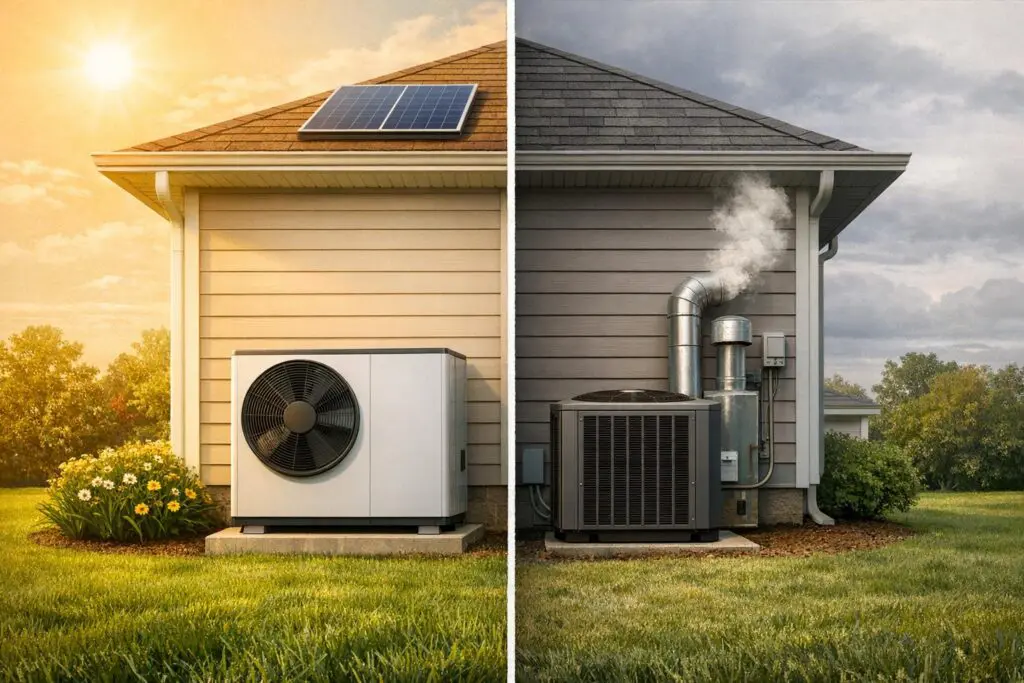
Choosing between heat pumps and HVAC systems? Here’s what you need to know:
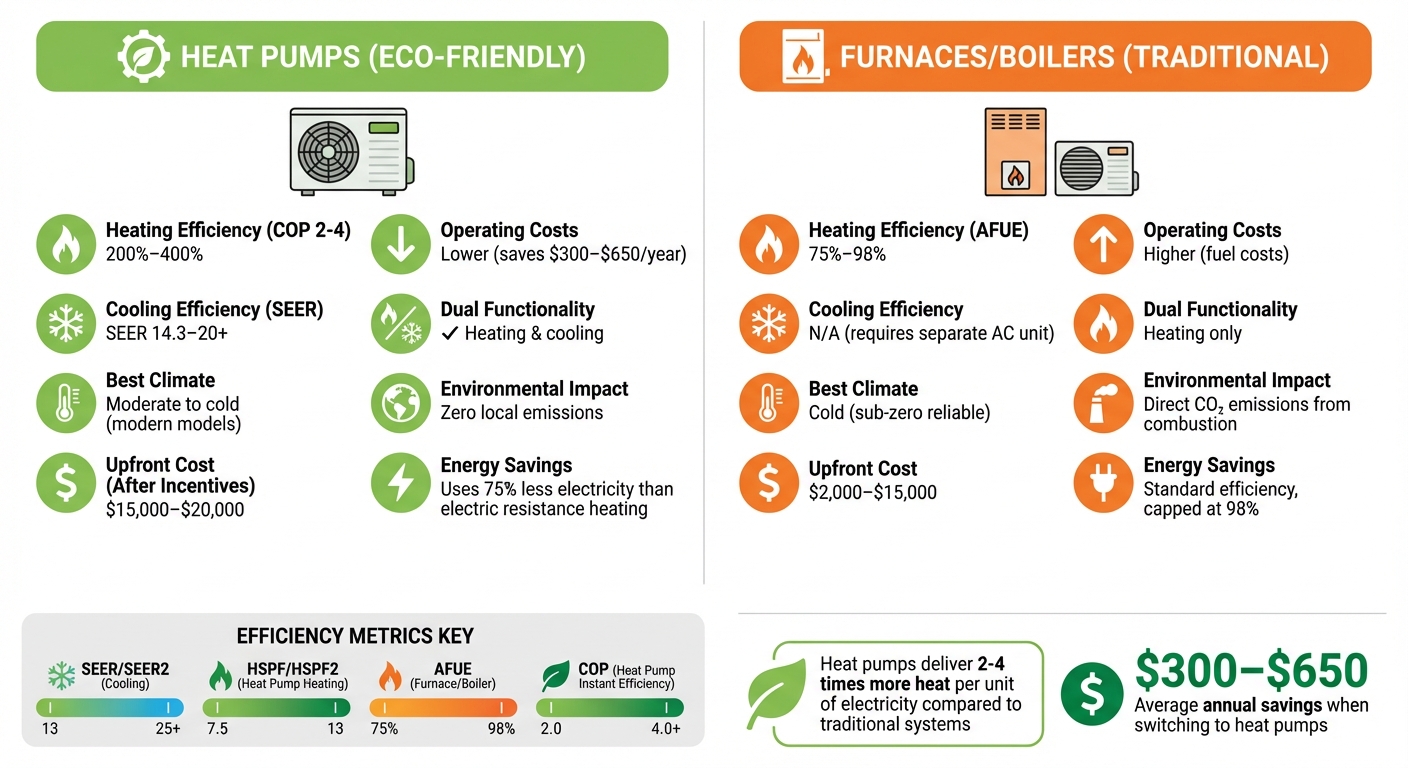
- Heat Pumps: Use electricity to transfer heat, offering 200%-400% efficiency. They handle both heating and cooling, making them a single-system solution. Best for moderate climates but modern models work well in colder areas too.
- Furnaces & Boilers: Burn fuel (gas, oil, or propane) for heat, with efficiency capped at 98%. Reliable in extreme cold but require separate cooling systems.
- Efficiency Metrics:
- Heat pumps excel with HSPF (heating) and SEER (cooling) ratings.
- Furnaces rely on AFUE for heating efficiency.
- Heat pumps outperform in energy savings, especially compared to electric resistance or older systems.
Quick Comparison
| Feature | Heat Pumps | Furnaces/Boilers |
|---|---|---|
| Heating Efficiency | 200%-400% (COP 2-4) | 75%-98% (AFUE) |
| Cooling Efficiency | SEER 14.3–20+ | N/A (requires AC unit) |
| Best Climate | Moderate to cold (with modern models) | Cold (sub-zero reliable) |
| Upfront Cost | $15,000–$20,000 (after incentives) | $2,000–$15,000 |
| Operating Costs | Lower (saves $300–$650/year) | Higher (fuel costs) |
| Dual Functionality | Heating & cooling | Heating only |
Heat pumps save energy and reduce bills in most cases but may need backup heating in harsh winters. Furnaces perform consistently in freezing temperatures but come with higher fuel costs and limited efficiency. Your choice depends on climate, budget, and long-term energy goals.
Heat Pumps vs Traditional HVAC Systems: Efficiency and Cost Comparison
Is a Heat Pump cheaper to operate? TRUTH REVEALED🔥
How to Measure HVAC Efficiency
When assessing HVAC systems, pay close attention to the efficiency ratings displayed on the EnergyGuide label. These ratings play a major role in determining your energy bills and long-term savings. Each metric provides insight into a specific aspect of the system’s performance, helping you make informed comparisons.
SEER and HSPF Ratings
SEER (Seasonal Energy Efficiency Ratio) evaluates how efficiently a system cools your home throughout a cooling season. It’s calculated by comparing the amount of heat removed (in BTUs) to the electricity used (in watt-hours). SEER ratings for cooling systems generally range from 13 to 25+. Starting in January 2023, the industry shifted to SEER2, which better reflects real-world performance by considering airflow resistance in ductwork. For reference, a unit previously rated at 15 SEER now translates to about 14.3 SEER2.
HSPF (Heating Seasonal Performance Factor) measures the heating efficiency of heat pumps over a typical heating season. It’s the ratio of heat output (in BTUs) to electricity consumption (in watt-hours). In 2023, the Department of Energy raised the minimum HSPF standard to 8.8, though high-efficiency models can achieve ratings of 13 or more. This metric also transitioned to HSPF2 in 2023, with an 8.8 HSPF unit being roughly equivalent to 7.5 HSPF2. If you live in a warm climate, prioritize SEER for cooling, while colder regions like Chicagoland should focus on maximizing HSPF ratings for heating.
AFUE for Traditional Systems
For traditional furnaces and boilers, efficiency is measured using AFUE (Annual Fuel Utilization Efficiency). This metric indicates the percentage of fuel that gets converted into usable heat, with the remainder lost through the exhaust.
For example, a furnace with an 80% AFUE rating loses 20% of its energy through the chimney, while a 90% AFUE model uses a secondary heat exchanger to reclaim more heat before it escapes. Non-condensing furnaces typically have AFUE ratings between 80% and 83%, while condensing models can achieve efficiencies of 95% to 98%. Since AFUE measures combustion efficiency, it is capped at 100%.
COP: A Measure of Heat Pump Efficiency
COP (Coefficient of Performance) measures a heat pump’s efficiency at any given moment by comparing the heat it delivers to the energy it consumes. For instance, a COP of 3 means the system operates at 300% efficiency. This is why heat pumps are often described as being up to three times more efficient than traditional heating systems.
Unlike SEER and HSPF, which average performance over a season, COP provides an instantaneous efficiency snapshot. To estimate a heat pump’s COP from its HSPF rating, multiply the HSPF by 0.293. In real-world conditions, heat pumps typically achieve a seasonal COP of around 2.5 (or 250% efficiency), compared to 100% for electric resistance heating and 80% for basic gas furnaces.
| Metric | System Type | What It Measures | Efficiency Range |
|---|---|---|---|
| SEER / SEER2 | Heat Pump / AC | Seasonal cooling efficiency | 13 to 25+ |
| HSPF / HSPF2 | Heat Pump | Seasonal heating efficiency | 7.5 to 13 |
| AFUE | Furnace / Boiler | Fuel-to-heat conversion percentage | 75% to 98% |
| COP | Heat Pump | Instantaneous energy multiplier | 2.0 to 4.0+ |
These metrics provide a clear framework for comparing the efficiency of heat pumps and traditional HVAC systems, ensuring you can make the best choice for your needs.
Heat Pumps vs Traditional HVAC: Efficiency Comparison
Efficiency Metrics Comparison Table
Heat pumps work by transferring existing heat with electricity, while traditional furnaces generate heat by burning fuel or using electric resistance. This basic difference plays a big role in how efficient each system can be.
| Metric | Heat Pump | Traditional HVAC (AC/Furnace) | Practical Impact |
|---|---|---|---|
| SEER/SEER2 | 14.3 – 20+ | 13 – 20+ (Central AC) | Higher ratings mean lower cooling costs in summer |
| HSPF/HSPF2 | 7.5 – 10+ | N/A | Higher ratings lower heating costs in winter |
| COP | 2.0 – 4.0 (200–400% efficiency) | 1.0 (Electric Resistance) | Heat pumps deliver 2–4 times more heat per watt of electricity |
| AFUE | N/A | 75% – 98% (Gas/Oil Furnaces) | Shows how efficiently fuel converts to heat, always under 100% |
For perspective, a heat pump with a 10.3 HSPF rating produces 10,300 BTUs of heat per kWh of electricity, compared to just 3,400 BTUs per kWh from electric resistance heating. That means heat pumps can use up to 75% less electricity for heating compared to traditional electric resistance systems like baseboard heaters. Even the most efficient gas furnaces, with AFUE ratings between 90% and 98.5%, can’t match the 200% to 400% efficiency range of heat pumps.
But ratings only tell part of the story – real-world factors also shape how efficiently these systems perform.
Factors That Affect Efficiency
While efficiency ratings give a theoretical benchmark, actual performance depends on several practical factors. One of the most critical is installation quality. For example, poorly sealed ducts can cut system efficiency by as much as 30%. To maintain optimal performance, technicians must ensure proper airflow – around 400 cubic feet per minute (cfm) per ton of cooling capacity – and correct refrigerant levels.
Climate is another key factor. In warmer areas, cooling efficiency (SEER) matters most, while in colder regions like Chicagoland, heating efficiency (HSPF) takes priority. Modern cold-climate heat pumps are designed to operate effectively even at temperatures as low as 5°F or lower, though their efficiency naturally decreases as outdoor temperatures drop. Each home also has a "balance point", the outdoor temperature where the heat pump’s output matches the heating demand. Below this point, auxiliary heating kicks in, which lowers overall efficiency.
Home insulation and weatherproofing also have a big impact. Poorly insulated homes can use five to ten times more electricity than well-insulated ones in the same climate. Proper insulation helps heat pumps stay above their balance point for longer periods, maximizing efficiency during the heating season.
For Chicagoland homeowners, professional installation and regular maintenance – like the services offered by Eco Temp HVAC – are essential for getting the most out of these efficiency advantages.
How Climate Affects Performance
Heat Pumps in Mild and Cold Climates
Heat pumps excel in moderate climates, efficiently transferring heat with minimal energy use. In areas with mild winters, they can achieve efficiencies ranging from 300% to 400%. However, Chicagoland winters, with their frequent sub-freezing temperatures and occasional polar vortex events, present a tougher challenge.
Traditional air-source heat pumps have historically struggled when temperatures dip below 30°F, with their heating capacity dropping significantly just when it’s needed most. Enter modern cold-climate heat pumps (CCHPs). These advanced systems use features like variable-speed compressors, enhanced vapor injection, and electronic expansion valves to maintain full heating capacity even at 0°F and continue operating reliably down to -23°F. Certified CCHPs are required to deliver a Coefficient of Performance (COP) of at least 1.75 at 5°F, meaning they remain 175% efficient even in such cold conditions.
"Where traditional heat pumps no longer produce heat below 20°- 30°F, cold climate heat pumps can produce heat from outdoor temperatures down to 0°F or colder." – EnergySense, University of Illinois
For homeowners in Chicagoland, choosing a heat pump with the "ENERGY STAR Cold Climate" label is crucial. These systems are designed to perform effectively at 5°F and below. Beyond selecting the right unit, proper home insulation and weatherization are essential to keep the heat pump running efficiently during the harshest winter months, reducing reliance on backup heating systems. Professional installation by certified technicians, like those at Eco Temp HVAC, ensures the system is properly sized and configured to handle Chicago’s unique climate challenges. While heat pumps offer impressive efficiency, traditional heating systems remain a strong contender for consistent performance in extreme cold.
Traditional HVAC in Cold Weather
Unlike heat pumps, which transfer heat, gas furnaces and boilers generate heat through combustion, allowing them to maintain steady performance regardless of how low the outdoor temperature drops. This reliability makes them a popular choice for Chicago’s coldest days.
Furnaces, in particular, are known for their ability to quickly recover and produce strong heat output during extreme cold snaps. High-efficiency furnaces with Annual Fuel Utilization Efficiency (AFUE) ratings of 95% to 98% deliver dependable warmth even during deep freezes. Many Chicagoland residents opt for dual-fuel systems, where a heat pump handles milder days (typically above 30°F to 40°F), and a furnace takes over during severe cold. While furnaces provide consistent heating, they can’t match the 200% to 400% efficiency of heat pumps in moderate conditions. Ultimately, homeowners must weigh the upfront costs of these systems against the potential long-term energy savings, especially given Chicagoland’s unpredictable winter weather. This balance is critical when deciding on the most cost-effective and efficient heating solution.
sbb-itb-b5c10b1
Long-Term Energy Costs and Savings
Energy Bill Comparisons
Switching to a heat pump can significantly lower monthly energy bills compared to traditional HVAC systems, though savings depend on factors like climate and current heating fuel. Studies show that between 62% and 95% of U.S. households would see reduced energy costs by making the switch to a heat pump. Homes using electricity, fuel oil, or propane for heating tend to benefit the most, with median annual savings ranging from $300 to $650.
A practical example highlights these savings: a homeowner replaced inefficient gas fireplaces and electric heaters with a ductless mini-split heat pump. The result? Their winter natural gas bill dropped from over $100 to about $25, while the electric bill remained around $100 – saving approximately $75 each month.
However, operating costs can vary based on location and electricity rates. For instance, in Atlanta, a typical heat pump uses about 5,981 kWh annually, costing around $845.71. In Minneapolis, the figure rises to 8,786 kWh, costing $1,358.32. On average, heat pumps reduce home energy use by 31% to 47% nationwide.
"Heat pumps, by contrast, are in the range of 200-300 percent efficient. This means that a heat pump will add or remove heat (thermal energy) from your home at a higher rate than it uses energy from the electrical grid."
- Charlotte Shuff, Oregon CUB
Maximizing your home’s insulation before installing a heat pump can further amplify savings. Enhanced weatherization can increase the likelihood of energy bill reductions from 82% to 97%.
Maintenance and Lifespan Costs
In addition to energy savings, heat pumps offer long-term cost advantages. While heat pumps typically last around 15 years (slightly less than the 15–20 years of traditional furnaces), they provide both heating and cooling year-round, unlike furnaces that primarily operate during colder months.
Heat pumps require professional servicing twice a year – once before the heating season and once before cooling begins. In contrast, traditional systems often need service only once per season. Repair costs for heat pumps range from $160 to $640, while central AC repairs can exceed $2,000. On average, annual maintenance for a heat pump costs about $200, compared to $300 for a furnace and AC system combined.
When looking at 10-year total costs, heat pumps often come out ahead in moderate climates. One analysis estimated a 10-year total cost of $19,700 for a heat pump, compared to $21,370 for a gas furnace paired with central AC. These figures include installation, federal tax credits, and maintenance. While the upfront investment for a heat pump – typically $15,000 to $20,000 after state and local incentives – may seem steep, lower monthly energy bills and the dual functionality of heating and cooling help offset the initial expense.
For homeowners in the Chicagoland area, working with certified local technicians like those at Eco Temp HVAC ensures proper system sizing and configuration, which is key to maximizing efficiency and extending the system’s lifespan. Pairing a heat pump with solar panels can further reduce costs by shielding you from utility price hikes. Additionally, regular filter maintenance – such as cleaning or replacing filters – keeps the system running smoothly and helps avoid expensive repairs.
When you weigh the lower energy bills, reduced maintenance expenses, and integrated heating and cooling capabilities, heat pumps clearly stand out as a smart long-term investment. Over time, they deliver both economic and practical benefits that traditional HVAC systems struggle to match.
Environmental Impact and Carbon Footprint
When choosing a heating system, it’s not just about energy costs and efficiency; the environmental impact is a critical factor too. Examining how heat pumps and traditional HVAC systems influence carbon emissions can help you balance comfort with sustainability goals.
Heat Pumps and Lower Emissions
Heat pumps stand out for their eco-friendly operation. Instead of burning fuel, they transfer heat, resulting in zero local CO₂ emissions. With efficiency rates of 200%–300%, heat pumps deliver two to three units of heat for every unit of electricity used. Geothermal models, in particular, use 61% less energy compared to standard systems.
As the electrical grid continues to adopt renewable energy sources, combining a heat pump with solar panels can bring emissions close to zero.
"The only eco-friendly heating system is an electric heat pump system." – Panama Bartholomy, Executive Director, Building Decarbonization Coalition
This efficiency and adaptability highlight the environmental advantages of heat pumps over combustion-based systems.
Traditional HVAC and Fossil Fuel Reliance
In contrast, traditional heating systems come with higher environmental costs. Furnaces and boilers rely on burning fossil fuels, which directly release greenhouse gases into the atmosphere. Many older systems are particularly inefficient, operating at just 56% efficiency and wasting nearly half of the fuel’s energy.
These systems also require on-site storage of flammable fuels and carry risks of carbon monoxide leaks – issues that electric heat pumps completely avoid. With space heating being one of the largest contributors to household energy use and carbon emissions, switching to a heat pump can make a substantial difference.
"Switching to a heat pump provides a more efficient and less carbon-intensive heat source in the winter." – Rory Isbell, Board Member, Oregon CUB
Which System Is Right for You?
Deciding between a heat pump and a traditional HVAC system depends on several factors, including your local climate, current heating setup, and long-term energy priorities.
When to Choose Heat Pumps
Heat pumps are a great option if you’re replacing electric resistance, fuel oil, or propane heating systems. They work well with existing ductwork or, in the case of ductless mini-splits, are perfect for homes without ducts or those using radiators. Switching to a heat pump can lead to annual savings ranging from $300 to $650. For homes currently relying on electric baseboard heaters or experiencing high propane costs, a heat pump can cut electricity use for heating by up to 75%.
Heat pumps perform particularly well in moderate to warm climates, such as southern and coastal areas.
"Experts agree that heat pumps are a smart choice for reducing electricity consumption."
If you’re considering or already using solar panels, heat pumps become even more appealing. They allow you to potentially power your heating and cooling system with your own renewable energy. Plus, federal tax credits and state rebates can help offset installation costs.
For colder regions, modern cold-climate heat pumps are designed to function efficiently even in temperatures as low as 5°F. In areas with occasional extreme cold, a dual-fuel or hybrid system – combining a heat pump with a gas furnace – can be a practical solution. The heat pump handles the majority of the heating season, while the furnace steps in during severe freezes. This setup provides flexibility, unlike traditional systems that are best suited for consistently frigid conditions.
When to Choose Traditional HVAC
Traditional furnaces might be a better fit in areas with prolonged sub-zero temperatures. High-efficiency gas furnaces are reliable during extended cold spells and typically cost between $2,000 and $15,000 to install. If your home already has natural gas lines, the lower upfront costs of a furnace could make it an attractive option.
However, keep in mind that furnaces only provide heating. You’ll need a separate air conditioning system for cooling. Meanwhile, heat pumps handle both heating and cooling, which can offset their higher initial cost with reduced operating expenses and the convenience of a single system. This dual functionality often makes heat pumps a smart choice for long-term savings, even if the upfront investment is higher.
Conclusion
Efficiency Metrics Summary
Heat pumps stand out by delivering 2–4 times more heat per unit of energy compared to traditional systems, with a coefficient of performance (COP) ranging from 2.0 to 3.0 – translating to 200% to 300% efficiency. In contrast, even the most efficient gas furnaces top out at 90% to 98.5% annual fuel utilization efficiency (AFUE). This efficiency edge comes from how heat pumps work: instead of generating heat through combustion, they transfer it, making them far more energy-efficient.
When selecting a heat pump, aim for models with a SEER2 rating of 20 or higher for cooling and an HSPF2 rating of 10.5 or more for heating. While traditional furnaces are rated by AFUE, even a 98% efficient furnace can’t compete with a heat pump operating at around 250% efficiency. This performance difference translates into meaningful energy savings and environmental benefits over time.
Cost and Environmental Benefits
Switching to a high-efficiency heat pump can cut electricity use for heating by up to 75% when compared to electric resistance systems. For homeowners currently using propane or oil, this switch could save anywhere from $300 to $1,500 annually, depending on local climate conditions. Federal tax credits sweeten the deal, covering 30% of installation costs – up to $2,000 per year – which makes the financial case even stronger.
Heat pumps also significantly lower your carbon footprint by eliminating fuel combustion. As Sara Baldwin, Director of Electrification Policy at Energy Innovation, advises:
"If you’re in the market for an air conditioner, don’t buy a standalone. Instead, buy a heat pump version that can provide cooling and heat".
This dual-purpose functionality, combined with the option to integrate with solar panels, positions heat pumps as a smart choice for energy efficiency and environmental responsibility. By choosing a heat pump, you can enjoy reduced energy costs, long-term savings, and a smaller environmental impact – benefits that align with both financial and sustainability objectives.
For expert guidance and certified installation, reach out to Eco Temp HVAC and make the most of these advantages in your Chicagoland home.
FAQs
Why are heat pumps more energy-efficient than traditional HVAC systems?
Heat pumps stand out for their energy efficiency because they transfer heat instead of creating it by burning fuel. Using a refrigeration cycle, they draw heat from outdoor air – even in freezing conditions – and move it indoors. This process allows heat pumps to deliver 2 to 4 units of heat for every unit of electricity consumed, translating to efficiency levels of 200–400%. Compare that to traditional furnaces, which typically operate at only 80–95% efficiency, and the difference is clear.
Another advantage is their electricity consumption. Heat pumps use about 50% less energy than standard electric heating systems, making them a cost-effective choice for homeowners. Plus, they serve a dual purpose: during warmer months, they function as air conditioners, eliminating the need for a separate cooling system and reducing energy use even further. For those living in the Chicagoland area, Eco Temp HVAC offers professional installation and maintenance services to help homeowners maximize their energy savings throughout the year.
What should I consider when deciding between a heat pump and a traditional furnace?
When weighing a heat pump against a traditional furnace, the initial cost for a heat pump – particularly advanced types like geothermal systems – tends to be higher. However, one major advantage is that heat pumps can handle both heating and cooling, potentially eliminating the need for a separate air conditioner. Over time, this dual-purpose functionality can make the investment more economical.
Heat pumps are incredibly energy-efficient. Instead of generating heat, they use electricity to transfer it, which can result in significantly lower utility bills. Their efficiency often exceeds 97% and, in some cases, can reach as high as 300%. Maintenance costs are also typically lower because heat pumps lack many of the combustion components found in furnaces. On top of that, many homeowners may qualify for federal or state rebates and tax credits for installing clean-energy systems, which can further reduce overall expenses.
For homeowners in the Chicagoland area, Eco Temp HVAC offers expert advice on installation costs, maintenance requirements, and available incentives. They can help you choose the best option for your home and budget.
How does the climate affect the efficiency of heat pumps?
The performance of heat pumps is heavily influenced by outdoor temperatures. In areas with moderate climates, they operate impressively, often achieving efficiency levels 2–3 times higher than electric resistance heating. However, when temperatures fall below freezing, the heat available in the air diminishes, forcing the system to work harder, which lowers its efficiency. Standard heat pump models typically start losing capacity around 32°F and may cease functioning altogether when temperatures approach 0°F.
For regions with harsher winters, like Chicago, where temperatures can drop to 5°F or even lower, cold-climate heat pumps are engineered to deliver consistent performance even in extreme cold. Selecting the right model and ensuring it’s installed correctly is essential, as improper installation can reduce efficiency by as much as 30%.
Eco Temp HVAC specializes in evaluating your home’s specific needs, recommending the most suitable cold-climate heat pump for Chicago winters, and providing professional installation and maintenance to guarantee reliable efficiency and comfort throughout the year.