
Tankless water heaters are gaining popularity for good reason. They provide hot water on demand, save energy, and take up less space than traditional tank models. Here’s what you need to know:
- Efficiency: They heat water only when needed, cutting energy use by 24%-34% for households using 41 gallons or less daily.
- Cost Savings: While upfront costs are higher, long-term savings on utility bills can offset the investment.
- Compact Design: Wall-mounted units save up to 80% of space compared to bulky storage tanks.
- Durability: With a lifespan of over 20 years, they outlast traditional tanks by nearly a decade.
- Custom Options: Choose between gas (higher flow rates) and electric (higher efficiency) models to suit your home.
Tankless systems are ideal for homes with limited space, smaller water demands, or those looking to lower energy bills. However, water heater replacement may require upgrades to gas lines or electrical systems, so consulting a professional is essential.
Expert Plumber Compares Gas vs Electric TANKLESS Water Heaters
How Tankless Water Heaters Work
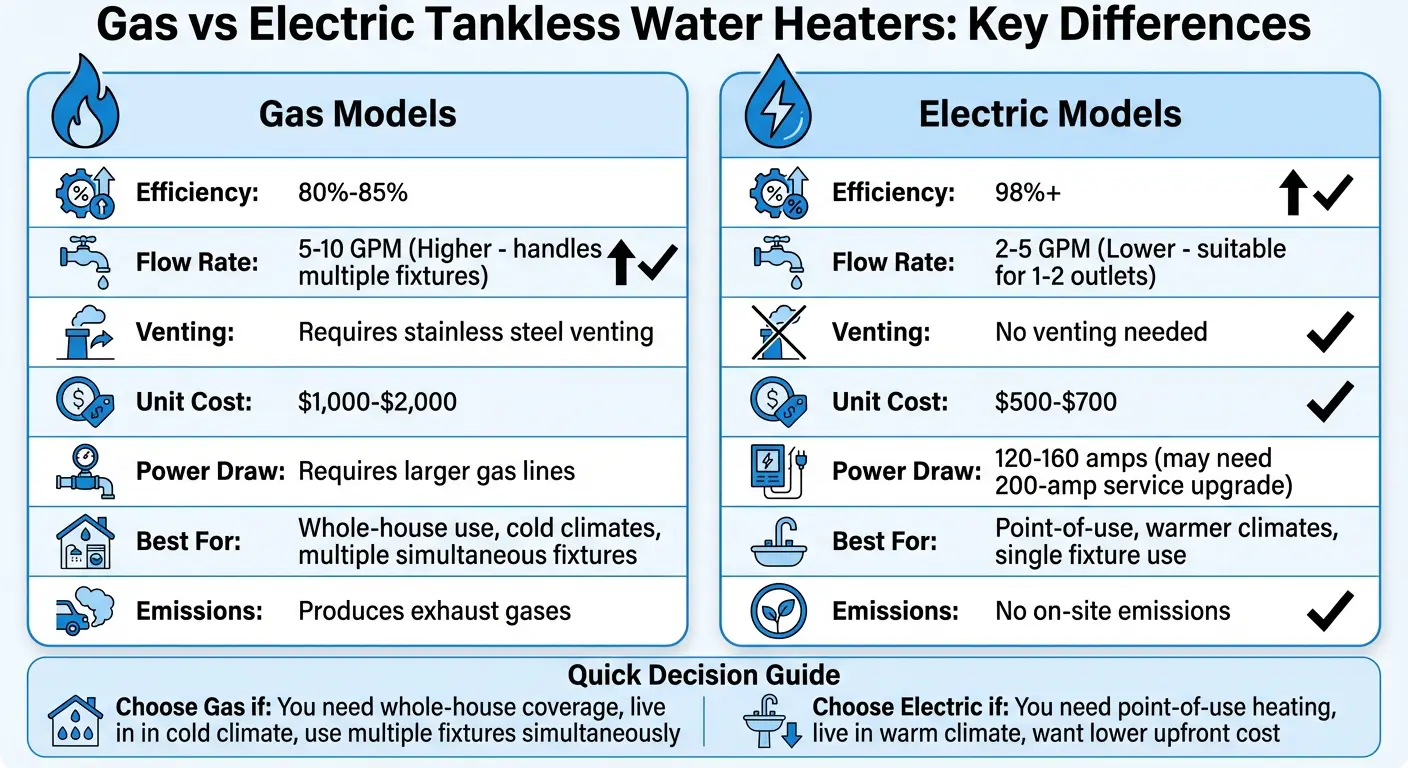
Gas vs Electric Tankless Water Heaters Comparison Chart
On-Demand Hot Water Production
When you turn on a hot water tap, a tankless water heater springs into action. A flow sensor detects the movement of cold water and signals the control panel to activate the heat exchanger. This exchanger – typically made of copper – heats the water using either a gas burner or an electric element.
"Its design activates heating only when water flows." – Integrity Home Solutions
As the water moves through the heat exchanger, a temperature sensor monitors its heat level. The system’s control panel adjusts the gas valve or electric current in real-time to maintain the preset temperature. Since the water is heated as it flows, you get a steady supply without needing to wait for a tank to refill. This design eliminates the need to keep stored water hot, saving energy. However, most units need a minimum flow rate of at least 0.5 gallons per minute (GPM) to activate. These operational features highlight the differences between gas and electric tankless water heaters in terms of performance and installation.
Gas vs. Electric Models
Tankless water heaters come in two main types – gas and electric – each with its own strengths.
Gas tankless water heaters rely on natural gas or propane burners to heat water. They can deliver higher flow rates, making them well-suited for whole-house use, especially when multiple fixtures are running at the same time. These systems typically operate at 80% to 85% efficiency and often include an intermittent ignition device instead of a standing pilot light for better energy use. However, they require stainless steel venting to expel exhaust gases and might need larger gas lines during installation.
On the other hand, electric tankless models use high-voltage heating elements and achieve 98%+ efficiency. They’re generally more budget-friendly, with prices ranging from $500 to $700 for whole-house models compared to $1,000 to $2,000 for gas units. Electric models don’t require venting and produce no on-site emissions, making them a cleaner option at the point of use. However, they tend to have lower flow rates, which might be an issue in colder climates where groundwater temperatures drop below 58°F. Additionally, they draw significant power – 120 to 160 amps – and may necessitate a 200-amp service upgrade.
| Feature | Gas Models | Electric Models |
|---|---|---|
| Efficiency | 80%–85% | 98%+ |
| Flow Rate | Higher (handles multiple fixtures) | Lower (suitable for 1–2 outlets) |
| Venting | Requires stainless steel venting | No venting needed |
| Unit Cost | $1,000–$2,000 | $500–$700 |
| Best For | Whole-house use, cold climates | Point-of-use, warmer climates |
Energy Efficiency and Cost Savings
Higher Energy Efficiency
Tankless water heaters are designed to heat water only when it’s needed, eliminating the standby heat loss associated with traditional storage tanks. This on-demand heating approach makes them inherently more efficient overall.
The actual efficiency improvements depend on how much hot water your household uses daily. For homes that use 41 gallons or less per day, tankless systems can be 24% to 34% more efficient than conventional tank models. Even in households with higher water demands – around 86 gallons per day – efficiency gains of 8% to 14% are achievable. Electric tankless models often reach efficiency ratings of 98% to 99%, while gas models typically range between 80% and 95%.
Many modern tankless systems include self-modulating technology, which adjusts the power output in real time based on the amount of hot water being used. This feature further fine-tunes energy consumption. ENERGY STAR-certified models take it a step further by incorporating secondary heat exchangers to capture and reuse heat. For gas-powered units, choosing a model with an intermittent ignition device instead of a standing pilot light can help minimize unnecessary gas usage.
These efficiency features don’t just save energy – they translate into noticeable reductions in utility costs.
Lower Utility Bills and Long-Term Savings
With improved energy efficiency, operating costs naturally decrease. Water heating accounts for about 14%–18% of a typical U.S. household’s utility bill, or roughly $400–$600 annually. Switching to a tankless water heater can significantly cut these expenses. For instance, an ENERGY STAR-certified gas tankless unit can save a family of four around $95 annually on gas bills, adding up to approximately $1,800 over its 20-year lifespan.
The monthly cost comparison highlights the savings even further. Electric tankless water heaters generally consume between 20 and 50 kWh per month, compared to the 300 to 600 kWh used by standard electric tank models. At an estimated electricity rate of $0.18 per kWh in 2025, operating a standard electric tank could cost between $65 and $98 per month, while an electric tankless system would cost only about $16 to $49. Similarly, gas tankless units have annual operating costs of about $195, compared to $245 for gas storage tanks.
"By heating water only when you need it, ENERGY STAR certified tankless water heaters save a family of four $95 per year, or $1,800 over its lifetime, on gas bills compared to a standard gas storage model." – ENERGY STAR
While the upfront costs of tankless systems are higher – ranging from $525 to $1,150 for the unit itself, plus $800 to $1,500 for installation – their extended lifespan of around 20 years (nearly double that of traditional tanks) helps balance out the initial investment. On average, the payback period through energy savings is about 12 to 20 years for electric models and 22.5 to 27.5 years for gas models. Additionally, setting your water heater to 120°F instead of the factory default of 140°F can save you an extra $36 to $61 annually.
Continuous Hot Water Supply and Performance
Unlimited Hot Water Availability
Tankless water heaters provide an uninterrupted supply of hot water by heating it on demand. Unlike traditional systems with 20- to 80-gallon storage tanks that need time to refill and reheat, these systems kick into action the moment you turn on a hot water tap. Sensors detect the water flow and activate the heating element, quickly warming the water to your desired temperature in seconds. This on-demand approach means you won’t run out of hot water, even when multiple taps are in use.
Some advanced models come equipped with internal buffer tanks and recirculation pumps, which address the "cold-water sandwich effect" – the brief bursts of cold water that can occur during rapid cycling. These features help maintain a steady water temperature, enhancing your overall experience. To make the most of this continuous supply, it’s essential to choose a unit that’s properly sized for your household’s needs.
Flow Rate and Sizing
Getting the right flow rate and size is critical for ensuring optimal performance from a tankless water heater. While these systems can provide endless hot water, their capacity is determined by their flow rate, measured in gallons per minute (GPM). Gas-powered units typically deliver between 5 and 10 GPM, whereas electric models generally range from 2 to 5 GPM. A standard tankless system can usually handle 2 to 3 people showering at the same time, as long as the unit is sized to meet your home’s peak demand.
To determine the right size for your system, calculate your peak demand by adding up the GPM requirements of all fixtures you might use simultaneously. For example, a standard showerhead uses 2.0 to 3.0 GPM, a kitchen faucet consumes 1.0 to 2.0 GPM, and a dishwasher requires 1.0 to 3.0 GPM.
Temperature rise – how much the incoming water needs to be heated to reach your desired temperature – also plays a significant role in flow rate. In colder areas, where groundwater temperatures might be around 47°F, a unit will deliver fewer GPM compared to warmer regions like Florida, where groundwater is closer to 72°F. For instance, a unit providing 5 GPM in Florida may only manage 3 GPM in a colder climate. A family of five in northern regions might need a 10 GPM unit, while the same family in the south could get by with a 7 GPM system.
| Household Size | Recommended Flow Rate (GPM) | Simultaneous Usage |
|---|---|---|
| 1–2 People | 3.5–6 GPM | 1–2 fixtures |
| 2–4 People | 7–9 GPM | 2–3 fixtures |
| 4+ People | 10+ GPM | 3–5 fixtures |
Space-Saving Design and Installation Options
Compact Wall-Mounted Design
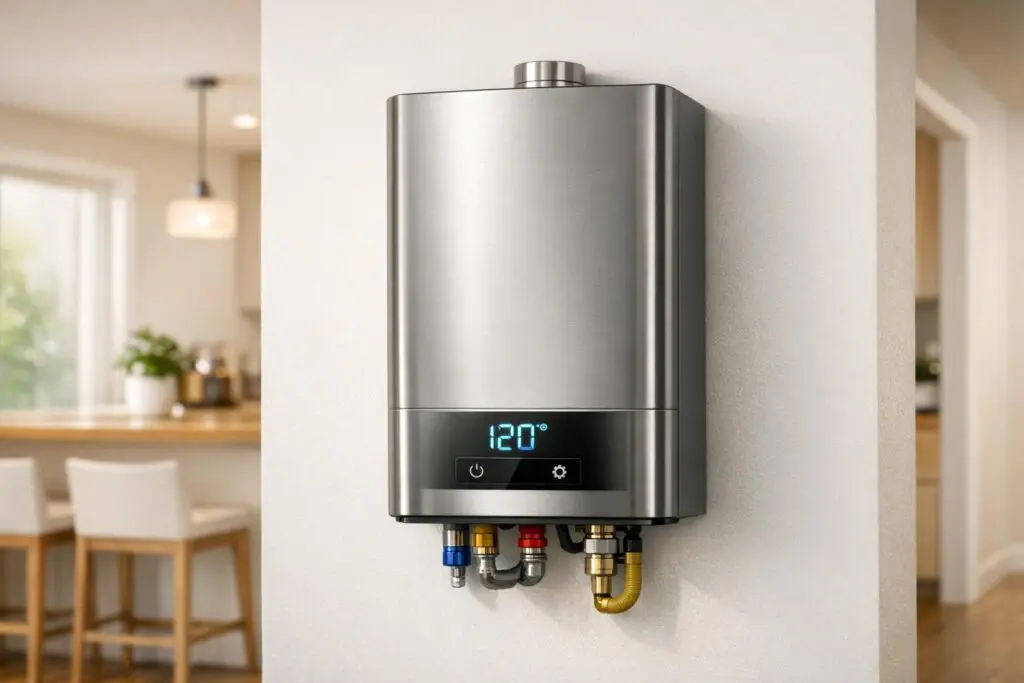
One of the standout benefits of tankless water heaters is how little space they take up. Traditional storage tank water heaters typically consume about 16 square feet of floor space – roughly the size of a small closet – and are often 5 feet or taller and at least 2 feet wide. Compare that to tankless units, which require around 80% less space. A typical tankless model is about 28 inches tall, 20 inches wide, and 10 inches deep – basically, the size of a carry-on suitcase.
"What if we told you that you could get the same amount of hot water (or more) from a water heater the size of a carry-on suitcase?" – Consumer Reports
This compact, rectangular design allows these systems to be mounted directly to walls, freeing up floor space for other uses like storage or laundry appliances. They can be installed in tight utility closets, laundry rooms, under cabinets, or even on exterior walls. Electric models, which are particularly lightweight – some weighing just 8.5 to 11 pounds – are even easier to position in small spaces. For gas models, outdoor installations are an option, which can simplify venting and eliminate indoor space concerns.
This streamlined design isn’t just about saving space – it also impacts how and where these units can be installed.
Installation Requirements
Installing a tankless water heater is more involved than simply swapping out a traditional tank. Professional installation costs typically range from $800 to $1,500, largely because of the upgrades and adjustments required.
For gas models, installation often involves upgrading to a larger gas line to ensure sufficient fuel supply for on-demand heating. Additionally, specialized venting systems are needed. While condensing units can use PVC venting, non-condensing models require more conventional exhaust setups.
Electric models come with their own set of challenges. These units can draw between 120 and 160 amps, which may necessitate upgrading your home’s electrical service to 200 amps or more. Older homes, in particular, often lack the infrastructure to handle this kind of power demand, requiring heavy-duty circuits and possibly multiple 40–60 amp breakers.
"When you make a change like that, the house operates a little differently." – Geno Caccia, Plumber, Caccia Plumbing
To ensure a smooth installation, it’s important to work with a qualified contractor who can confirm your home’s electrical capacity or gas venting setup meets the unit’s requirements. Adding isolation valves during installation is also a smart move, as these make future maintenance and descaling much easier, especially in tight spaces.
Durability and Maintenance
Longer Lifespan
Tankless water heaters can last over 20 years, far exceeding the 8–15 years typical of traditional storage tanks. This extended lifespan means fewer replacements over time, delivering better long-term value for homeowners.
The secret to their longevity lies in their design. Unlike storage tanks that constantly hold 30 to 80 gallons of water – creating an environment where sediment settles and causes corrosion – tankless systems bypass this issue entirely. In fact, within a decade, a standard tank can accumulate up to a foot of scale inside.
"Because they have no storage tank, there’s no sediment or corrosion to affect their longevity." – A.O. Smith
Another plus? Tankless water heaters are built with replaceable components. If a sensor or heating element wears out, you can swap it out without replacing the entire unit. This design not only extends their lifespan but also makes repairs more manageable and cost-effective.
Lower Maintenance Needs
Tankless water heaters not only last longer but also require less intensive maintenance. Their upkeep mainly involves periodic descaling of the heat exchanger to remove mineral buildup. This process typically takes about 45 minutes and should be done annually – or more frequently if you live in an area with hard water. Geno Caccia, a plumber at Caccia Plumbing, emphasizes:
"If you live in a poor-water area, we suggest maintenance once a year." – Geno Caccia, Plumber, Caccia Plumbing
In addition to descaling, cleaning the sediment filter occasionally helps maintain steady water flow. Professional maintenance services usually range between $150 and $350, but for DIY enthusiasts, descaling kits are available for $40 to $100.
Perhaps the biggest maintenance perk is peace of mind. Unlike traditional tanks, tankless systems eliminate the risk of catastrophic flooding from a tank rupture. While minor plumbing leaks could occur, the absence of a large water tank significantly reduces the likelihood of major water damage.
Environmental Impact
Reduced Carbon Footprint
Switching to a tankless water heater can significantly cut greenhouse gas emissions by eliminating standby heat losses. Unlike traditional storage tanks, which continuously heat and reheat water – even when you’re not using it – tankless systems only heat water on demand.
For households using 41 gallons or less of hot water daily, tankless water heaters are between 24% and 34% more energy-efficient than conventional storage tanks. This improved efficiency means less energy consumption, which directly reduces emissions from power plants and natural gas use. To put it into perspective, if every residential gas tankless water heater sold in the U.S. were ENERGY STAR certified, the country could avoid nearly 1.8 billion pounds of greenhouse gas emissions annually. That’s equivalent to taking 160,000 cars off the road.
"If all residential gas tankless water heaters sold in the United States were ENERGY STAR certified… nearly 1.8 billion pounds of annual greenhouse gas emissions would be prevented, equivalent to the emissions from 160 thousand vehicles." – ENERGY STAR
Some advanced models take efficiency even further. High-efficiency condensing units use a secondary heat exchanger to capture and reuse waste heat, preheating the incoming water. This process allows these systems to utilize up to 96% of a fuel’s heat, ensuring minimal energy waste. Beyond reducing emissions, these systems also cut down on physical waste, making them an environmentally friendly choice.
Less Waste Through Longer Lifespan
Tankless water heaters also shine when it comes to longevity. They last much longer than traditional storage tanks, meaning fewer replacements over time. Over a 40-year span, you might replace a single tankless unit compared to three or four traditional tanks.
Their compact, wall-mounted design reduces the amount of material waste when they eventually reach the end of their lifecycle. Traditional tanks, which hold anywhere from 20 to 80 gallons of steel and insulation, contribute significantly to landfills. Tankless models, on the other hand, require fewer raw materials to produce and leave a much smaller footprint when discarded.
Additionally, their modular construction – highlighted in the durability section – allows for individual components to be replaced instead of discarding the entire unit if something breaks. This design further reduces waste and makes them a smarter choice for the planet.
"Because they have a longer lifespan, fewer tankless water heaters end up in landfills, making them a more sustainable option overall." – North Country PHC
Is a Tankless Water Heater Right for You?
Key Factors to Consider
Deciding whether a tankless water heater is a good fit for your home depends on several factors. For households that use 41 gallons or less of hot water daily, these systems can deliver energy savings of 24%–34%. If your household uses closer to 86 gallons per day, the savings drop to about 8%–14%.
Another important consideration is how much hot water you use at the same time. A tankless unit must handle your peak simultaneous demand. For instance, a shower typically requires about 2.5 gallons per minute (GPM), a dishwasher around 1.3 GPM, and a clothes washer roughly 3.3 GPM. If the combined demand exceeds the unit’s capacity, you might experience inconsistent water temperatures or even run out of hot water. Gas-powered models generally support higher flow rates than electric ones, making them a better choice for homes with overlapping hot water needs.
Your local climate and groundwater temperature also play a role. In colder areas, incoming water takes longer to heat, which can reduce the unit’s effective flow rate. As plumber Geno Caccia explains:
"The colder the water coming in, the longer it takes to heat".
Additionally, your home’s existing infrastructure may require upgrades. Electric tankless units often need a 200-amp electrical panel, while gas models typically require larger gas lines and proper venting. These adjustments can increase installation costs.
Hard water is another factor to keep in mind. It leads to mineral buildup, which means you’ll need to descale the unit annually – a maintenance task that can cost $300 or more. Without regular upkeep, the system may not reach its expected 20+ year lifespan.
Installation costs for tankless water heaters range between $1,400 and $4,000. While ENERGY STAR-certified models can save a family of four about $95 annually on gas bills, the payback period usually falls between 5 and 7 years. If your current tank water heater is still under warranty and working well, replacing it immediately may not make financial sense.
After reviewing these factors, it’s wise to consult a professional to ensure your home is compatible with a tankless system.
Professional Assessment
Beyond energy savings and installation considerations, a professional evaluation is key to determining if a tankless water heater suits your home. A certified technician can assess your gas lines, electrical setup, and plumbing to confirm they meet the requirements for a tankless system without needing costly upgrades. They’ll also calculate your household’s peak hot water demand and recommend the right unit size.
Professional installation is essential to keep manufacturer warranties intact, as DIY attempts can void coverage and lead to expensive repairs. Companies like Eco Temp HVAC specialize in evaluating your specific needs, identifying potential utility upgrades, and ensuring compliance with local building codes during installation.
Conclusion
Tankless water heaters provide hot water on demand with impressive efficiency, boasting rates between 80% and 99% – nearly double that of traditional water tanks. Thanks to their compact, wall-mounted design, they free up valuable space, roughly the size of an extra closet. Plus, their durability is hard to beat, with a lifespan exceeding 20 years compared to the 10–15 years you typically get with conventional tanks. For a family of four, choosing an ENERGY STAR-certified gas tankless model can trim about $95 off annual gas bills, adding up to around $1,800 in savings over the unit’s lifetime.
These systems don’t just save money; they’re also better for the environment. By lowering greenhouse gas emissions and reducing your carbon footprint, every use makes a difference.
That said, proper installation and sizing are crucial to enjoy these benefits. Gas models might require upgraded gas lines, while electric units could need a 200-amp electrical panel. Professional installation is key to avoiding safety risks and ensuring warranties remain valid.
Eco Temp HVAC has the expertise to evaluate your specific hot water needs, ensure compliance with local codes, and install systems for optimal efficiency and performance. From calculating peak demand to securing permits and helping you find rebates, their certified technicians handle it all.
Interested in endless hot water and slashing energy costs? Reach out to Eco Temp HVAC for a professional consultation today.
FAQs
What’s the difference between gas and electric tankless water heaters?
Gas and electric tankless water heaters differ in how they work, their installation needs, and what they cost to run. Gas models heat water using natural gas or propane, which means they require a gas line and proper venting to safely release combustion gases. Electric models, however, use high-powered heating elements connected to your home’s electrical system. While they don’t need venting, they might require an upgraded electrical circuit – typically 240 volts and 40–80 amps – to handle the demand.
Gas units are known for delivering higher flow rates, usually between 3 and 5 gallons per minute. They also tend to perform better in colder climates, making them a good choice for larger households or homes where multiple people need hot water at the same time. Electric units are more compact and easier to install but offer lower flow rates, typically 2 to 4 gallons per minute. They may also struggle to heat water quickly in colder environments.
When it comes to cost, gas heaters are often cheaper to operate in areas where natural gas is affordable, and they can last up to 20 years. Electric models might have a steeper upfront price but can cut energy use by as much as 34% for smaller households, which could translate to lower electricity bills over time. If you need higher capacity and better cold-weather performance, gas is a solid option. If you prefer a simpler, vent-free setup, electric might be the way to go.
How can I choose the right size tankless water heater for my home?
To choose the right tankless water heater for your home, start by estimating how much hot water you’ll need at one time. Make a list of the fixtures you might use simultaneously – like showers, dishwashers, or washing machines – and note their flow rates in gallons per minute (GPM). For reference, a shower typically uses about 2–3 GPM, while a washing machine might require 3–5 GPM. Add these numbers together to determine the total GPM your water heater needs to handle.
Next, figure out the temperature rise (ΔT) required. To do this, subtract your area’s average groundwater temperature from your desired hot water temperature. In the U.S., groundwater temperatures average around 57°F, though it’s colder in northern states and warmer in southern regions. If you want hot water at 115°F and your groundwater is 57°F, you’ll need a temperature rise of 58°F.
With your total GPM and temperature rise calculated, compare these numbers to the specifications of tankless water heaters. Look for a model that meets or slightly exceeds your requirements to ensure reliable performance, even during colder months when groundwater temperatures are lower.
What challenges might arise when installing a tankless water heater?
Installing a tankless water heater isn’t as straightforward as swapping out a traditional tank model. It often involves upgrading plumbing and fuel supply systems. For electric units, you might need to increase your home’s electrical capacity, which could mean updating your breaker panel to handle higher amperage. Gas models, on the other hand, require a connection to a natural gas or propane line, along with proper venting to direct combustion gases safely outside. This could involve additional construction work.
Venting for gas units can be particularly challenging. Many systems require new vent pipes or adjustments to your existing exhaust setup to ensure safe operation. Plus, the installation must adhere to local building, plumbing, and electrical codes, adding another layer of complexity.
Given the technical demands and safety considerations, hiring a licensed plumber or HVAC technician is highly recommended. A professional ensures everything is installed correctly, meets code requirements, and saves you the hassle of navigating potential complications.