
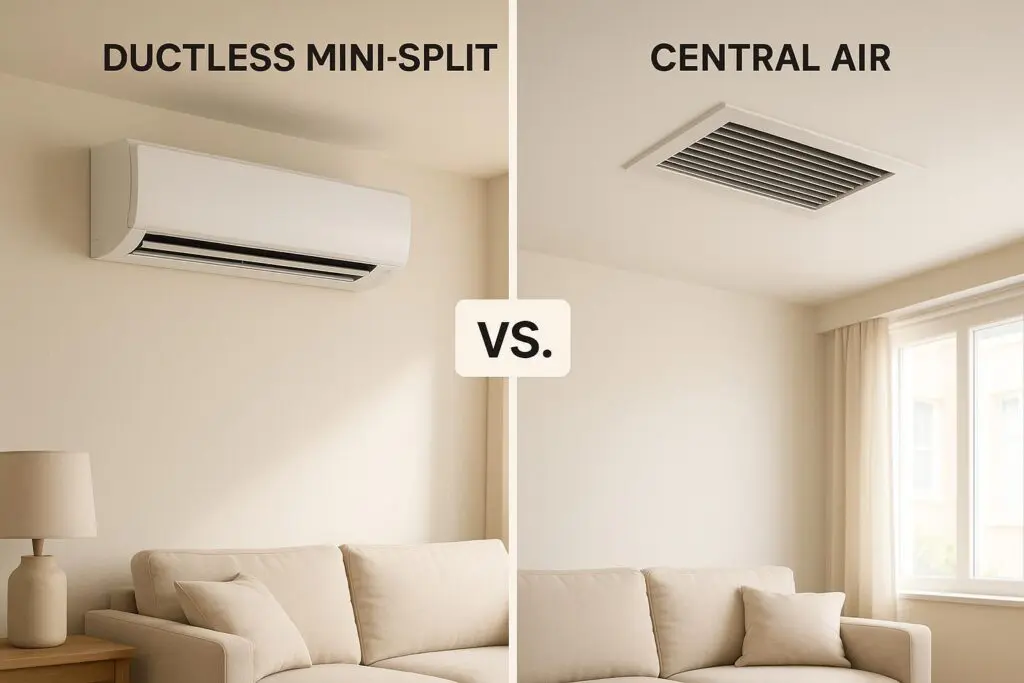
When deciding between a ductless mini-split and central air, costs vary significantly depending on your home’s setup. Here’s the breakdown:
- Installation Costs:
- Ductless mini-splits range from $2,500 to $15,000+, depending on the number of zones.
- Central air costs $3,000 to $7,000 with existing ductwork, but without ducts, it can climb to $8,000 to $22,000+.
- Energy Efficiency:
- Mini-splits use 30% less energy and avoid duct-related air loss (20–30%).
- Central air systems are less efficient due to duct leaks and fixed-speed operation.
- Maintenance:
- Mini-splits require less upkeep, with semi-annual professional servicing costing $150–$300 per visit.
- Central air has higher maintenance needs, including duct cleaning and servicing multiple components.
Quick Comparison
| Factor | Ductless Mini-Split | Central Air |
|---|---|---|
| Installation Cost | $2,500–$15,000+ | $3,000–$22,000+ (with/without ducts) |
| Energy Efficiency | 30% less energy use; no duct losses | Duct losses (20–30%); fixed speeds |
| Maintenance | Lower; no ducts, simple design | Higher; ducts and complex components |
| Best For | Homes without ducts, zoning needs | Homes with good existing ductwork |
If your home lacks ducts or needs zoned cooling, mini-splits are likely the better choice. For homes with well-maintained ducts, central air may be more cost-effective upfront but could cost more over time.
Mini Split vs. Central Air: Why I Chose Both for My Seal Beach Home | HVAC Expert Explains
Installation Costs: Upfront Investment Comparison
When comparing installation costs, the upfront expenses for ductless mini-split systems and central air systems can vary significantly depending on your home’s current setup. If your home already has ductwork in good condition, central air might initially seem like the less expensive option. However, for homes without ductwork or those requiring extensive duct repairs, ductless mini-splits often become the more economical choice.
Ductless Mini-Split Installation Costs
The biggest factor driving the cost of installing a ductless mini-split system is the number of indoor units needed. Each additional indoor unit requires its own refrigerant lines, electrical connections, and labor, which can quickly increase the overall cost.
- Single-zone systems (one outdoor compressor and one indoor air handler) are the most affordable option, typically costing $2,500 to $6,000. These are ideal for cooling a single room, a home addition, or a converted space like a garage. Labor for these installations usually ranges from $1,200 to $3,500, making up about 30–50% of the total cost.
- Dual-zone systems (two indoor units) range from $4,500 to $8,000, while a three-zone setup costs $6,500 to $11,000.
- For larger homes, a four-zone system costs $8,000 to $12,000, and a five-zone system for whole-home coverage can reach $10,000 to $15,000 or more.
The type of indoor unit also plays a role in pricing:
- Wall-mounted units: $2,500 to $5,000 (single-zone).
- Floor-mounted units: $3,000 to $5,000.
- Ceiling cassette units: $3,500 to $6,000.
- Concealed duct units: $4,000 to $7,500.
Additional costs include permits ($250–$400), electrical panel upgrades ($500–$1,500), modifications to walls or ceilings ($200–$600), and removing old systems ($80–$150). Installation complexity, such as running refrigerant lines through finished walls or working in tight spaces, can further increase labor costs, which range from $2,500 to $6,000+ for multi-zone setups.
Central Air Installation Costs
The presence of ductwork in your home is a significant factor in determining the cost of central air installation. Homes with existing ductwork in good condition benefit from a relatively straightforward installation process, while homes without ducts face much higher expenses.
- With existing ductwork: Installation costs range from $3,000 to $7,000. This includes the outdoor condenser, indoor air handler or furnace coil, thermostat, and labor. These estimates assume the ducts are properly sized, sealed, and in good condition.
- Without ductwork: Installing ducts throughout the home adds $5,000 to $15,000 to the total cost, bringing the full installation to $8,000 to $22,000 or more. This process involves cutting into walls and ceilings, running ducts to every room, and sealing them to minimize air leakage.
- With duct repairs or replacement: If existing ducts are outdated or damaged, repairs can cost $1,000 to $3,000, while replacing sections may run $1,500 to $5,000.
The size of the system also influences costs. Central air systems typically range from 2 to 5 tons of cooling capacity (24,000 to 60,000 BTU). Larger homes require bigger systems, which increase the upfront cost. Like mini-splits, central air installations also require permits ($100–$500) and may necessitate electrical upgrades ($500–$1,500).
Installation Cost Comparison Table
| System Type | Scenario | Installation Cost Range |
|---|---|---|
| Ductless Mini-Split | Single-zone (1 room) | $2,500 – $6,000 |
| Ductless Mini-Split | Dual-zone (2 rooms) | $4,500 – $8,000 |
| Ductless Mini-Split | Three-zone (3 rooms) | $6,500 – $11,000 |
| Ductless Mini-Split | Four-zone (4 rooms) | $8,000 – $12,000 |
| Ductless Mini-Split | Five-zone (whole home) | $10,000 – $15,000+ |
| Central Air | With existing ductwork | $3,000 – $7,000 |
| Central Air | Without ductwork (new install) | $8,000 – $22,000+ |
| Central Air | With duct repairs/replacement | $5,000 – $12,000 |
For retrofitting older homes without ductwork, such as historic properties or homes with radiant heating, ductless mini-splits eliminate the need for cutting into walls and ceilings, which can save $5,000 to $15,000. On the other hand, new construction or major renovations may justify the expense of installing ductwork.
Labor also plays a significant role in cost differences. Ductless mini-split installations involve mounting indoor units, running refrigerant lines, and making precise electrical connections. Central air installations, by contrast, focus on placing the outdoor unit, connecting it to ductwork, and ensuring proper airflow. When new ductwork is required, the process becomes more invasive and labor-intensive, often requiring multiple contractors and several days of work.
In 2025, the average cost of a ductless mini-split system was $19,556 after state and local incentives, averaging $4,944 per ton for a 3.7-ton system. Meanwhile, a ducted heat pump system averaged $15,326 after incentives – though this assumes existing ductwork. Adding new ducts can push the cost to rival or exceed that of a ductless system.
With upfront costs outlined, the next consideration is how each system impacts your monthly energy bills.
Energy Operating Costs: Monthly and Annual Differences
Energy costs can take a big bite out of your budget, so knowing how different HVAC systems affect your utility bills is crucial. By comparing the energy consumption of ductless mini-split systems and central air systems, you can better estimate the long-term financial impact of each option.
Ductless Mini-Split Energy Efficiency and Costs
Ductless mini-split systems often stand out for their energy efficiency. Equipped with variable-speed compressors, these systems can adjust their output to match the exact cooling or heating needs of your home, which reduces energy waste. Plus, since they don’t rely on ductwork, they avoid the energy losses that often occur in ducts, particularly when those ducts pass through unconditioned spaces like attics or garages.
Many mini-splits also double as heat pumps, meaning they can handle both cooling in the summer and heating in the winter. This dual functionality eliminates the need for separate systems, potentially lowering your overall energy costs. While actual operating expenses will vary based on your home and climate, the efficiency of mini-splits usually translates to smaller monthly utility bills.
Central Air Energy Consumption and Costs
Central air systems, on the other hand, can face efficiency hurdles – largely due to ductwork. Even in well-installed systems, ducts can leak or lose conditioned air, especially when they run through unconditioned areas like crawl spaces or attics. This inefficiency can drive up energy usage.
Another challenge is that many central air units operate at fixed speeds, meaning they often run at full capacity regardless of the actual cooling needs. This can lead to energy spikes and less precise temperature control. Additionally, central air systems typically lack true zoning capabilities. Even if you close vents in unused rooms, the system will still condition the entire house, wasting energy. To top it off, central air systems are usually designed for cooling only, requiring a separate heating system for colder months, which can further increase your energy consumption.
Energy Efficiency and Cost Implications
The way these systems operate has a direct impact on your energy bills. While factors like your local climate, home insulation, and electricity rates will influence costs, ductless mini-split systems generally offer lower operating expenses over time due to their efficiency. When looking at the total cost of ownership over a 10-year period, these differences become even more significant. Understanding these energy efficiency contrasts is an important step in making a smart, informed investment in your HVAC system.
sbb-itb-b5c10b1
Maintenance and Repair Expenses: Long-Term Considerations
When evaluating the total cost of owning an HVAC system, it’s essential to think beyond installation and energy costs. Regular maintenance and potential repair expenses play a significant role in the long-term budget, and knowing what each system requires can help you plan accordingly.
Ductless Mini-Split Maintenance Costs
Maintaining a ductless mini-split system is relatively straightforward. The most frequent task is cleaning the filters every two weeks, especially if the system is used year-round, or if you have pets or live in a dusty environment. Additionally, you’ll need to keep the outdoor unit free from debris and check for ice buildup during colder months to ensure the system runs efficiently and maintains good air quality.
Professional maintenance is recommended twice a year, costing between $150 and $300 per visit. During these tune-ups, a technician will clean the coils, check refrigerant levels and drains, inspect electrical connections, and lubricate any moving parts. Thanks to their simpler design, ductless systems generally require less maintenance over time compared to other HVAC options.
Central Air Maintenance Costs
Central air systems, on the other hand, require more comprehensive care. Beyond routine filter cleaning, ductwork must be cleaned periodically to maintain proper airflow and system efficiency. This added layer of maintenance stems from the complexity of central air systems, which combine multiple components and ductwork that need attention. The broader scope of upkeep makes central air systems more demanding – and often more expensive – in the long run.
Maintenance and Repair Cost Comparison Overview
| Maintenance Aspect | Ductless Mini-Split | Central Air |
|---|---|---|
| DIY Filter Cleaning | Clean filters every two weeks | Regular filter care is recommended |
| Professional Service | Semi-annual tune-ups ($150–$300 per visit) | More extensive servicing for system and ductwork |
| Ductwork | Not required | Requires periodic cleaning to ensure airflow |
| Overall Maintenance | Lower due to simpler design | Higher because of ductwork and complex components |
Ductless mini-split systems generally have lower maintenance demands, with fewer components to service and no ductwork to worry about. In contrast, central air systems involve more extensive upkeep, including duct cleaning and servicing multiple components, which adds to their long-term costs.
Total Cost of Ownership Over 10 Years
After looking at installation, energy, and maintenance costs, it’s essential to step back and consider the bigger picture: the financial impact over a full decade. While upfront costs are a major factor, ongoing energy use and maintenance play a significant role in determining which system is more cost-effective in the long run.
Cost Analysis: Homes With and Without Ductwork
Whether a home has existing ductwork can significantly affect the overall cost of each cooling system. For homes with well-maintained ducts already in place, central air installation is generally more budget-friendly, as there’s no need to install new ductwork. On the other hand, homes without ducts face much higher costs when opting for central air due to the added expense of installing a duct system.
This is where ductless mini-splits shine. For homes without ducts, these systems typically cost less to install and operate. In homes with existing ducts, the upfront cost of central air narrows the price gap, but it’s important to note that central air systems often come with higher energy and maintenance costs over time compared to ductless mini-splits.
The size of your home also impacts costs. Smaller homes may only need a single mini-split unit, while larger homes often require multiple zones, which can increase the expense. These variables are key when comparing the total cost over 10 years.
10-Year Total Cost Comparison Overview
Looking at the long-term financial picture, a few general trends emerge:
- Ductless mini-split systems often result in lower total costs, especially for homes without existing ductwork. Their combination of lower installation, energy, and maintenance expenses makes them a compelling option.
- Central air systems can be more appealing for homes with existing ductwork due to lower upfront costs. However, their higher energy usage and maintenance needs typically lead to greater expenses over time.
Of course, your actual costs will depend on factors like local energy rates, your home’s climate, and the specific equipment you choose. For instance, homes in areas with extreme heat or cold may notice bigger differences in energy consumption between the two systems, which could significantly influence the 10-year cost comparison.
Choosing the Right System for Your Needs
Deciding between a ductless mini-split and a central air system depends on your home’s setup, your budget, and how you use your space. Neither option is inherently better – it all comes down to what fits your specific circumstances.
When to Choose Ductless Mini-Splits
If your home doesn’t have existing ductwork, ductless mini-splits are often the most practical choice. Installing new ductwork can cost upwards of $18,000, making mini-splits a more budget-friendly option for homes without ducts.
They’re particularly well-suited for older homes, home additions, converted garages, or finished basements – spaces where ducts might not exist or where installing them would be both expensive and disruptive. A mini-split system only requires a small wall opening to connect the indoor and outdoor units, keeping construction to a minimum.
Another advantage of mini-splits is their ability to provide zoned temperature control. For example, if your upstairs bedrooms are always warmer than the main floor or you only need to cool your home office during the day, a multi-zone mini-split can target specific areas. This tailored cooling can cut air conditioning costs by as much as $1,000 annually in hot climates where AC is heavily used.
If your home has aging or leaky ductwork, mini-splits are also a smart alternative. They eliminate the energy losses that occur with duct leaks. However, if your existing ductwork is in good shape, central air might be a better choice.
When to Choose Central Air Systems
Central air systems are ideal for homes that already have well-maintained ductwork. If your home was built with ducts and they’re in good condition, sticking with a central AC system is often more cost-effective. Installation costs are lower since you’re utilizing the existing infrastructure.
Central air is also a great option for larger homes where you want consistent temperatures throughout. If you don’t need to adjust the cooling for specific rooms, a central system simplifies things by cooling the entire house uniformly.
For homes that rely on a furnace for heating, central air offers the convenience of an integrated HVAC system. You can manage both heating and cooling through the same ductwork, avoiding the need for separate systems.
However, if you’re replacing an old central AC unit and your ductwork needs repairs or upgrades, the total cost could range from $8,000 to $12,000. At that price, it’s worth comparing the long-term savings of a ductless mini-split system, which may offer better efficiency and lower maintenance costs over time.
Final Recommendations
Start by evaluating your ductwork. If your home lacks ducts or they’re in poor condition, a ductless mini-split system is likely the better choice. On the other hand, if you have well-maintained ducts, central air remains a solid option.
Consider how you use your living space. Do you need to cool specific rooms at different times, or do you prefer a consistent temperature throughout the house? Mini-splits offer flexibility for zoned cooling, while central air provides simplicity and uniformity.
While budget is a factor, remember to account for long-term costs. A system that’s cheaper to install might end up costing more to operate over the years. Think about your local energy rates, your climate, and how often you’ll use the system. In areas with high AC usage, the efficiency of mini-splits can make up for their higher initial cost.
Lastly, think about your home’s layout and any future plans. If you’re considering renovations or additions, ductless systems are easier to expand. If you prefer a seamless look without visible indoor units, central air’s hidden ductwork might be more appealing.
FAQs
How do ductless mini-split systems save energy compared to central air systems?
Ductless mini-split systems are a smart way to save energy because they provide zoned temperature control. This means you can heat or cool only the rooms you’re actively using, unlike central air systems that condition the entire house – even the spaces you’re not in. By focusing energy where it’s needed, mini-splits help cut down on waste.
Another big advantage is that mini-splits don’t rely on ductwork, which can lose up to 30% of energy in traditional central air systems. On top of that, they use heat pump technology, a highly efficient method for both heating and cooling. This combination not only reduces energy consumption but also helps lower your utility bills.
What should I consider when choosing between a ductless mini-split and a central air system for a home without existing ductwork?
When deciding between a ductless mini-split and a central air system for a home without existing ductwork, there are several important points to consider:
- Installation Costs: Installing a ductless mini-split is generally less expensive for homes without ducts. This is because you can skip the costly process of adding or modifying ductwork.
- Energy Efficiency: Mini-splits are often more efficient since they avoid the energy losses that occur in ductwork, which is a common issue with central air systems.
- Zoning and Flexibility: With mini-splits, you can set different temperatures for different rooms. This makes them a great choice for homes with unique layouts or varying comfort needs.
Choosing the right system depends on factors like your budget, home size, and your focus on energy efficiency and comfort. For homes without existing ductwork, ductless mini-splits are often the more practical and budget-friendly solution.
What are the differences in maintenance between ductless mini-split and central air systems, and how do they affect long-term costs?
Ductless mini-split systems generally need less upkeep compared to traditional central air systems. For mini-splits, maintenance typically involves simple tasks like cleaning or replacing filters and scheduling occasional professional check-ups to keep everything running smoothly.
In contrast, central air systems demand more attention. Regular duct cleaning, checking for leaks, and maintaining both indoor and outdoor units are all part of the routine. These extra steps often translate to higher maintenance costs over time.
Opting for a system with fewer maintenance requirements, such as a ductless mini-split, can help you save money in the long run while also cutting down on the time and effort needed to keep your HVAC system in top shape.